Aiso Review 2026
Aiso helps brands find the questions customers ask AI, track mentions and citations, uncover fan-out queries, and improve visibility across ChatGPT, Gemini, Perplexity, and other engines.

Key takeaways
- Aiso's differentiator is real conversation data. It sources anonymized, multi-turn ChatGPT chats, so you see the follow-up questions buyers actually ask, and its published research (a median 59% of multi-turn conversation content comes after the first prompt) is some of the more useful primary research in the GEO space.
- Monitoring is the whole product. No content generation, no CMS publishing, no AI crawler logs, no visitor analytics or traffic attribution, no Reddit/YouTube tracking, no ChatGPT Shopping data. Promptwatch covers all of that, and its agents actually fix visibility gaps rather than just reporting them.
- Entry pricing is unusually low ($19/mo), but the jump to Pro ($215/mo) is steep, and every self-serve tier caps you at 3 AI models. Enterprise unlocks the rest.
- Very early company: a two-person team, a beta API that tracks only ChatGPT and Gemini despite marketing that names five engines, and a product page that admits several workflows are still "shipping next."
- Best fit is a solo marketer or small DTC brand that wants cheap, conversation-grounded prompt research. Agencies and enterprises that need execution, attribution, and multi-model coverage should look elsewhere.
What Aiso is
Aiso is an AI search visibility platform from a small Tel Aviv startup, founded by Ben Tannenbaum after he noticed leads arriving from ChatGPT at his previous company in late 2024. Where most tools in this category ask you to type in the prompts you want tracked, Aiso starts from the other end: a dataset of real, anonymized ChatGPT conversations collected at scale.
That's the whole thesis. Their research found a median 59% of what people say in multi-turn AI conversations comes after the first prompt, and 50% of unique terms appear after turn one. If you're only tracking seed prompts like "best CRM for startups," you're blind to most of the conversation where preferences actually form. It's a good argument, and the Conversation Explorer backs it up: you can browse real prompts filtered by intent, geography, and engine, with turn counts and conversation type (recommendation, comparison, and so on).
The rest of the platform is what you'd expect from an AI visibility tool, executed reasonably well.
The core workflows
Brand Visibility gives you a visibility score with a mentioned/recommended/absent split, sentiment, and average rank when you appear. One methodological detail worth crediting: every prompt runs 10 times to capture answer variance. LLM answers are non-deterministic, and tools that run a prompt once and report the result are mostly reporting noise.
Fan-out tracking maps the sub-queries an AI generates from a seed prompt and shows your status on each one. Promptwatch does query fan-outs too, so the concept isn't unique to Aiso, but grounding them in observed conversation data gives Aiso's version more credibility than purely synthetic expansion.
Competitor Analysis compares visibility, sentiment, and rank against the brands you're up against. Mention Tracker surfaces brand mentions and cited third-party sources, priority-ranked. Their citation analysis found one third-party page cited 41 times across eight tracked prompts, which tells you something important: AI visibility often concentrates in a surprisingly small number of external sources, so knowing which ones matter is half the job.
Newer additions include a Crawlability Audit and a Third-Party Source Mapper. Small inconsistency on the product page: the meta description says five workflows are live, the body text says three. Either way, the roadmap admits that audits, content, schema, and reporting workflows are still "shipping next."
The data sourcing model, honestly
This deserves its own section because it's both Aiso's moat and its biggest question mark. Aiso collects anonymized, aggregated ChatGPT conversations partly by giving users access to paid OpenAI models or free features in exchange for analyzing their chats. It's clever distribution, and it's why their prompt data reflects real behavior instead of guessed keywords. It's also the kind of arrangement that raises questions about consent mechanics and platform terms, and it depends on conditions the company doesn't control. If OpenAI tightens its terms, the data pipeline is exposed. I'd read the fine print before pointing a regulated client at this.
To their credit, the team publishes its research rather than just claiming it: three arXiv papers, a founder who writes for Search Engine Land, and a controlled schema markup experiment showing JSON-LD made identical content roughly 30% easier for ChatGPT and Perplexity to retrieve across paired sites. That experiment is more rigorous than most vendor "studies" I see in this category.
Pricing
Starter is $19/mo for 50 tracked prompts, 3 AI models, 1 project, unlimited users, daily tracking, and hosted MCP access. Pro is $215/mo for 150 prompts, 2 projects, and multi-country tracking (3 countries per project). Advanced is $445/mo for 350 prompts, 5 projects, Looker Studio integration, and branded PDF reports. Enterprise is custom, with unlimited prompts, all AI models, API access, SSO, and a dedicated success manager. There's a 7-day free trial, yearly billing saves 15%, and a referral program pays 20% of a referral's first year.
Two observations. First, the gap between $19 and $215 is enormous. There is no middle tier for a growing brand; you go from hobby pricing to agency budget overnight. Second, compare the value at Pro money. Promptwatch's Professional plan is $245/mo for 150 prompts plus 25M crawler logs, automated content generation, shopping insights, and state/city tracking across all models. Aiso's Pro gives you 150 prompts on 3 models and, well, monitoring.
There's also a proof-of-value pilot for selected brands: a lower upfront fee plus a success fee on qualified AI-attributed leads over 60 to 90 days. For a company this size, pricing part of the deal on outcomes is a confident move, and I respect it.
One nice touch: they publish a machine-readable pricing endpoint specifically for AI agents. Of course they do. It's on brand.
Strengths and limitations
Strengths:
- Real multi-turn conversation data, which almost nobody else has. The follow-up question insights are genuinely different from synthetic prompt lists.
- Methodological care: 10 runs per prompt, week-over-week tracking, published experiments with actual controls.
- Cheap entry, unlimited users on Starter, hosted MCP on all plans, and an open-source AI traffic attribution framework on GitHub.
- Responsive founders, per multiple reviews. The G2 write-ups (4.0 and 4.5) praise the competitor analysis panel and the redesigned UI, and Product Hunt sits at 5.0.
Limitations, and this is where the comparison with Promptwatch gets blunt:
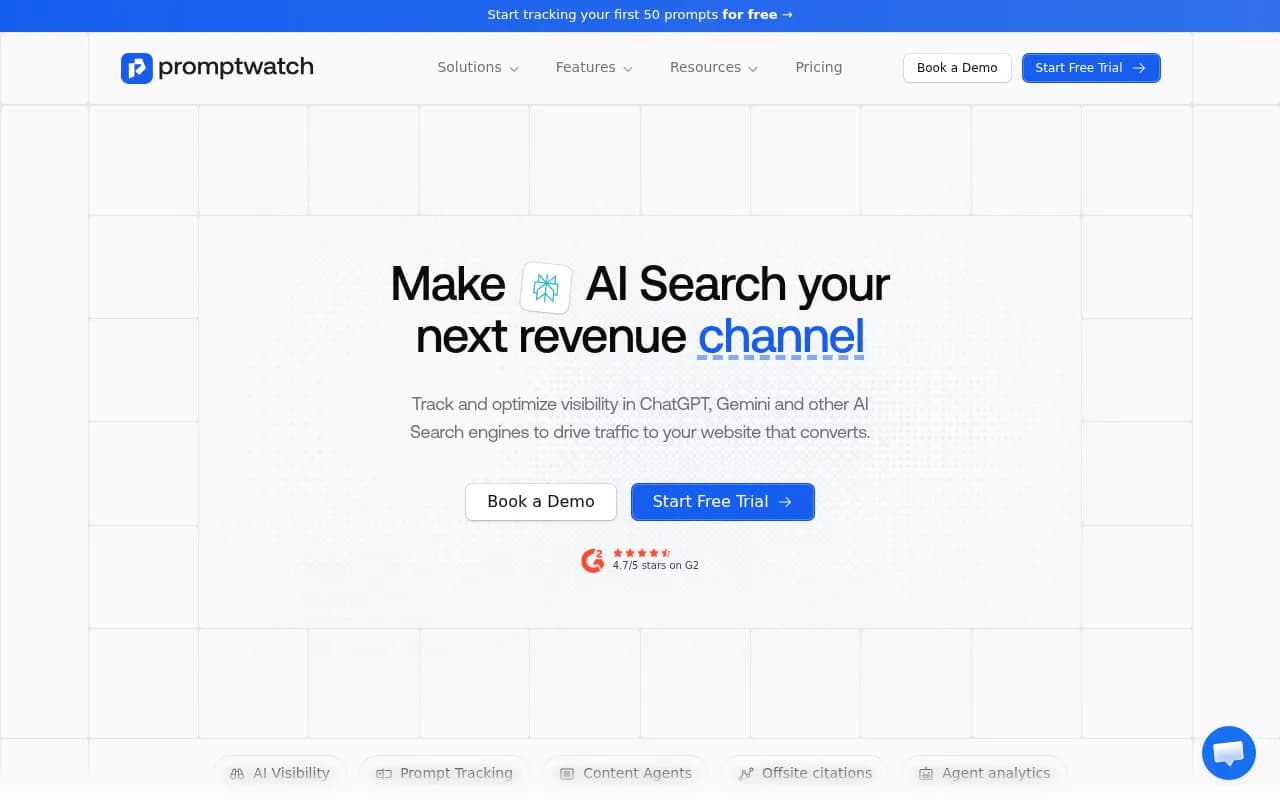
- No content generation or CMS publishing. Promptwatch's Content Agents plan, write, and publish GEO-optimized content to Webflow, Framer, and WordPress. Aiso hands you a diagnosis and wishes you luck with the treatment.
- No AI crawler logs. Promptwatch logs ChatGPTBot, ClaudeBot, PerplexityBot, and 400+ other crawlers in real time, with crawl-to-citation paths per page. Aiso's crawlability audit is a static check, not live crawler analytics.
- No visitor analytics or in-product traffic attribution. You cannot see whether your AI visibility drives visits or conversions. Promptwatch tracks actual traffic and conversions from AI platforms, which is the difference between measuring mentions and measuring revenue.
- No Reddit or YouTube citation tracking, no ChatGPT Shopping or Ads Radar, no prompt volume or difficulty scoring, no page-level citation trends.
- Model coverage is thinner than the marketing suggests. Paid tiers cap at 3 models, and the beta API tracks only ChatGPT and Gemini despite the site naming Claude, Perplexity, and Copilot. Promptwatch monitors 10+ engines including Grok, DeepSeek, Mistral, Meta Llama, Google AI Overviews, and AI Mode.
- Trust signals are thin. One Trustpilot review (3.5 average), a couple of G2 reviews, a two-person team. Promptwatch has 1,840+ customers, a 4.7/5 G2 rating, and named clients like Duolingo, Yelp, and Rabobank. The customer logos on Aiso's homepage (H&M, Uber, Wise, dentsu, IHG) sit under "selected clients and Aiso users," which is doing some work in that sentence.
Who it's for
A solo marketer or small DTC brand that wants to understand how buyers actually talk to ChatGPT in their category, cheaply. Particle, their men's grooming case study, claims a 5x visibility lift, and the workflow behind it (prompt research, editorial calendar, schema work) is plausible for a small team.
A content strategist who wants conversation-level insight for editorial planning. The follow-up question data is legitimately good input for a content roadmap.
Not for agencies that need white-label client portals, execution at scale, or proof that AI visibility drives pipeline. Not for enterprises that need crawler diagnostics, attribution, and SSO before procurement will even look at a tool.
Bottom line
Aiso is a research-forward monitoring tool built on a genuinely interesting data asset, and I'd trust its published numbers more than most vendors' marketing. If you want to understand real buyer conversations in your category, the $19 Starter month is a low-risk way to find out.
But it stops at monitoring, and the category has moved past that. If you want a platform that shows why you're invisible and then helps fix it, with content gap analysis, automated content generation, CMS publishing, prioritized actions, crawler logs, and real traffic attribution to prove the result, Promptwatch is the stronger choice at a comparable price.
Frequently asked questions
What is Aiso?
How much does Aiso cost?
What AI platforms does Aiso track?
How is Aiso different from traditional SEO tools?
Does Aiso generate or publish content?
Is Aiso good for agencies?
Where does Aiso's conversation data come from?
Is there a free trial for Aiso?
Similar and alternative tools to Aiso