Key takeaways
- MCP (Model Context Protocol) lets Claude pull live data from an AI visibility tool instead of you switching to a dashboard, and setup for Claude Code is often a single terminal command.
- Two separate connection paths exist: Claude.ai custom connectors (Pro, Max, Team, Enterprise) and Claude Code's local MCP config. Adding a server to one does not add it to the other.
- MCP has no push notifications. It only answers when you ask, so "alert me if my citations drop" isn't something an MCP server can do on its own yet.
- Security matters more than people admit: independent audits found a meaningful share of MCP servers skip proper authentication, so favor vendors that require OAuth over ones that ask you to paste a static API key into a URL.
- Once connected, useful questions include which pages get cited, what content types are winning in your category, and whether AI crawlers are actually reaching your site.
Why you'd bother connecting Claude to a visibility tool at all
Here's the pattern that's emerged over the last year or so: brands got serious about tracking how ChatGPT, Gemini, Perplexity and Google's AI surfaces talk about them, but the data lived in yet another dashboard. You'd log in, filter by date, export a CSV, then go explain it to someone in Slack. MCP kills a chunk of that friction. Instead of opening a tab, you ask your AI assistant directly: "how did my brand's AI visibility change this month?" and it fetches the answer from the tool's live data.
Anthropic built MCP as a standard way for models like Claude to call external tools without every vendor writing a custom plugin. It's genuinely useful for this specific job because AI visibility questions are naturally conversational ("which pages are getting cited," "who's beating us in Perplexity") and Claude is decent at turning messy tool output into a readable answer.
That said, I'd temper the excitement a bit. MCP is a request-response protocol, not a monitoring system. It answers when asked. It can't tap you on the shoulder when something changes. If you want alerts, you're still relying on the vendor's own notification system, not the MCP layer.
The two Claude connection paths, and why people mix them up
This trips up a lot of people, so it's worth being precise.
Claude.ai custom connectors live inside the chat app (Pro, Max, Team and Enterprise plans). You go to Settings, then Connectors, then Add Custom Connector, and paste in an HTTPS remote MCP server URL, plus an OAuth Client ID and Secret if the vendor requires one. This is the path most non-technical marketing people will use.
Claude Code is a separate system entirely, with its own local configuration. For a remote HTTP server, the whole setup is one line in a terminal:
claude mcp add --transport http knowatoa https://knowatoa.com/mcp
Run claude mcp list to confirm it connected, and inside a session, /mcp shows which servers are active and walks you through any OAuth flow. Adding a server here does nothing for your Claude.ai chat window, and vice versa. If you set up a visibility tool's MCP server in Claude Code and then can't find it in the regular Claude app, that's not a bug, that's just how the two systems work.
One more wrinkle worth flagging: as of an August 2026 update from Anthropic's Claude Code team, any connector you've already set up in Claude.ai (Gmail, Slack, Calendar) becomes automatically available inside Claude Code too. Some developers pushed back on this, and I get why. Claude Code can run shell commands, so it inheriting read access to whatever you've connected in chat widens the attack surface if something goes wrong. Anthropic says Claude Code's execution mode is resistant to prompt injection. I'd treat that as a claim to verify with your own testing, not something to take on faith.
Which AI visibility tools actually ship MCP servers
A handful of AI visibility platforms have shipped native MCP support. Here's roughly where things stand.
| Tool | MCP setup | Starting price | Notable detail |
|---|---|---|---|
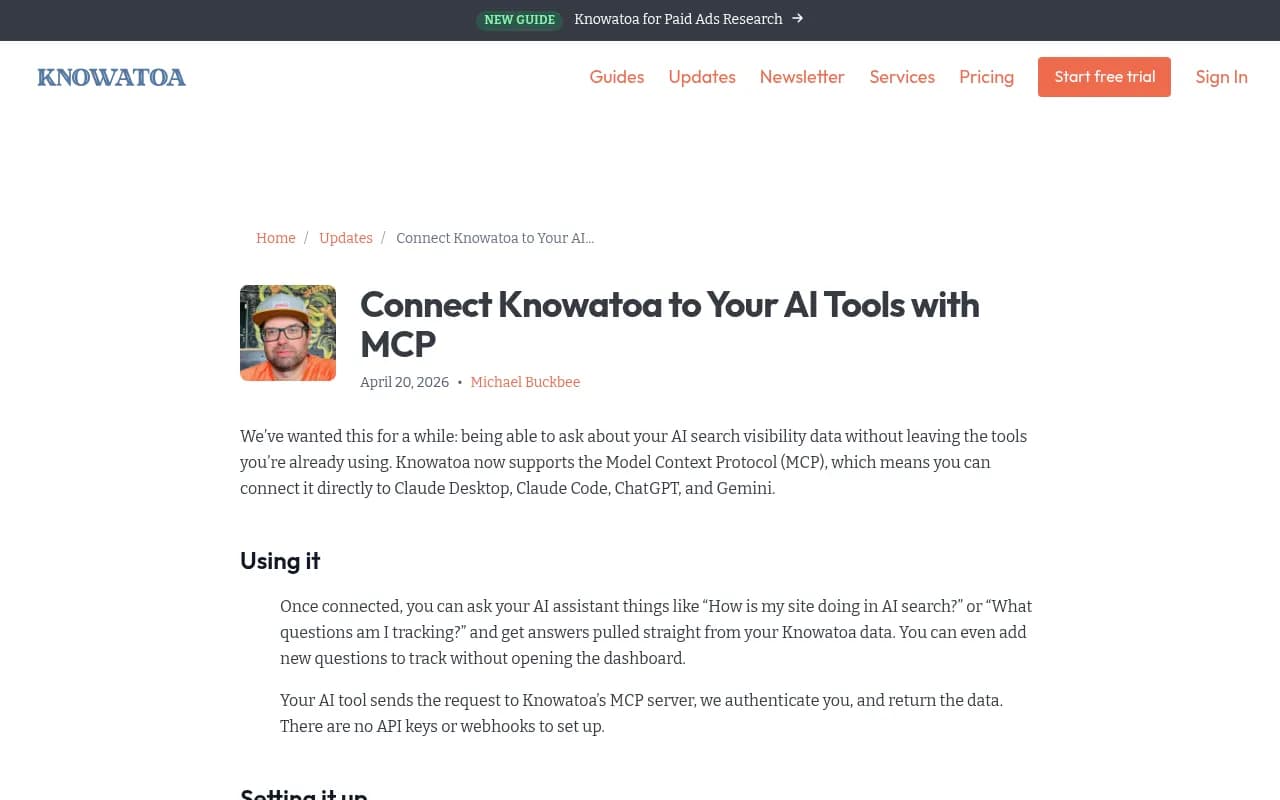
| Knowatoa | One command in Claude Code, or config file in Claude Desktop | $59/mo Starter (only 3 of 7 engines), $199/mo Growth (MCP requires Growth or higher) | No API keys or webhooks; authentication happens inside the MCP flow |
| Otterly.AI | Streamable HTTP transport, OAuth login | $25-29/mo Lite, jumps to ~$189/mo for 100 prompts | MCP exposes citations, GEO audits, and crawlability checks, not just prompt data |
| Searchable | Connects to Cursor, Claude, ChatGPT, n8n, Slack, Notion and more | $125/mo Pro (100 prompts) | Framed for agency reporting workflows as much as brand-side use |
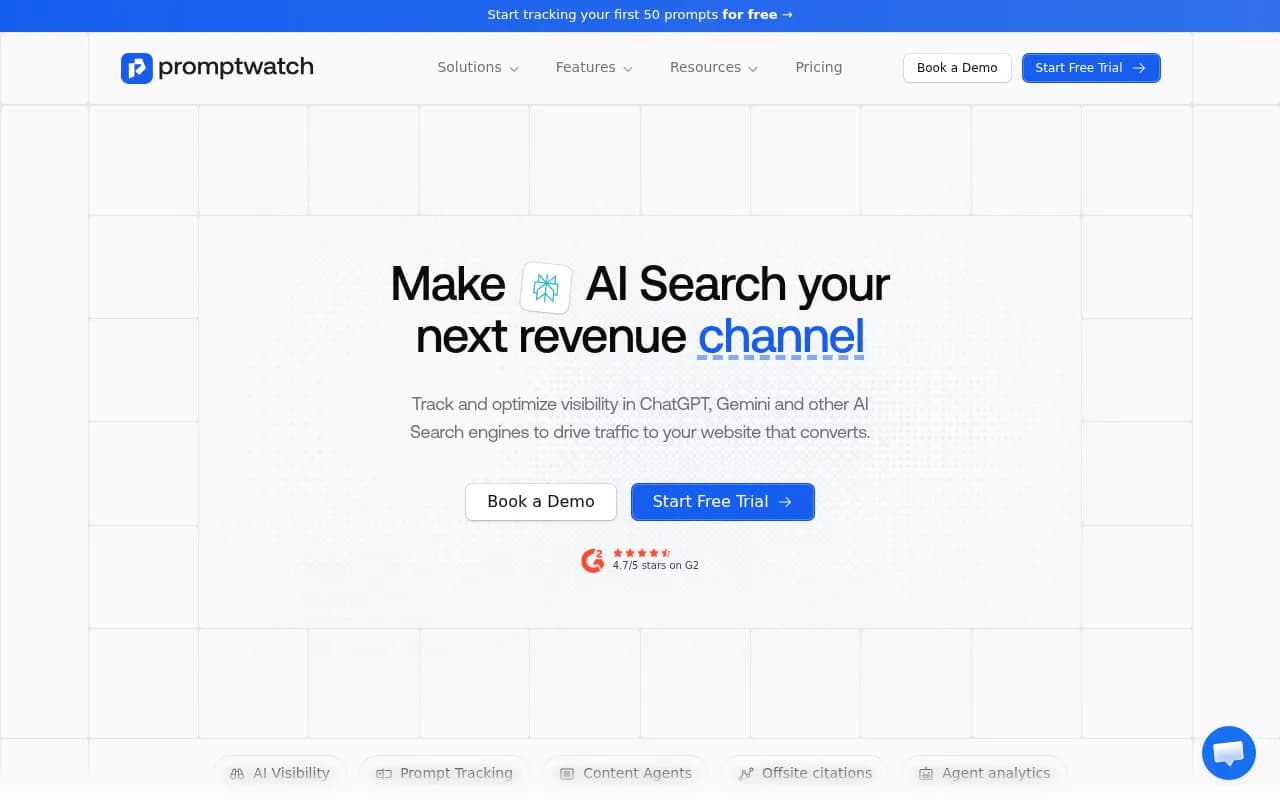
| Promptwatch | MCP server plus official ChatGPT plugin and Claude Connector | Essential $95/mo | Also gives crawler logs, content gap analysis, and CMS publishing, not just monitoring |
Worth noting: not every tool with an API has an MCP server yet, and not every MCP server exposes the same depth of data. Some only let Claude read prompt rankings. Others, like Otterly's, also expose GEO audits and crawlability checks, which is a bigger surface area to ask questions against.
Promptwatch is worth calling out separately here because the MCP connection isn't just a read pipe into prompt rankings, it sits on top of the same data used for content gap analysis, crawler logs, and Unified Actions (a prioritized to-do list Promptwatch generates from your visibility data). Asking Claude "what should I fix first" through Promptwatch's MCP server draws on that action layer, not just a citation count.
Setting it up, step by step
The exact screen changes depend on the vendor, but the general flow looks like this:
- Find the tool's MCP server URL. Vendors usually publish this on a dedicated integrations or docs page, formatted like
https://vendor.com/mcp. - Decide which Claude surface you actually use day to day. If you live in the chat app, use a custom connector. If you work from the terminal or an IDE, use Claude Code.
- For Claude Code, run something like
claude mcp add --transport http <name> <url>and complete OAuth if prompted. Add--scope userif you want it available across every project on your machine, not just the current one. - For Claude.ai, go to Settings then Connectors then Add Custom Connector, paste the URL, and enter OAuth credentials if the vendor requires them.
- Confirm the connection worked by asking a simple question first, something like "what tools do you have access to right now."
If you hit a "couldn't reach the MCP server" error in the Claude.ai web or desktop app even though the server responds fine to a direct curl request, that's a known client-side connection bug that's been reported on Anthropic's GitHub, not necessarily something wrong on your end. Worth trying the Claude Code path instead if the chat connector keeps failing.
What to actually ask once it's connected
This is the part people skip past, but it's the whole point. A few prompts that get genuinely useful answers out of a connected visibility tool:
- "How is my site doing in AI search this month compared to last month?"
- "Which of my pages are getting cited most in ChatGPT and AI Overviews?"
- "What content types is AI citing most in my category right now?" (Promptwatch's own data shows product pages led ChatGPT citations at roughly a third of the total in July 2026, with listicles the fastest-growing format, so a category-specific answer here is genuinely worth comparing against the aggregate. See Promptwatch's ChatGPT citation types data.)
- "Are Anthropic's crawlers able to reach my site, or are they blocked somewhere?" This one matters more than it used to. Promptwatch's data shows Claude's citation crawler grew from a rounding error to over a thousand visits a day between December 2025 and April 2026, a genuine 100x jump even though it's still under 2% of total AI crawler traffic. See the Claude citation crawler growth data. If you blocked something broadly in your robots.txt six months ago, it might be quietly excluding a channel that's growing fast.
- "Add a new prompt to track: [whatever a customer might actually type into ChatGPT]."
- "What should I fix first based on this month's data?" (this one only works well with tools that generate action recommendations, not just raw counts)
What I'd avoid asking: anything that implies the tool will notify you later. "Let me know if my ranking drops" sounds natural but MCP doesn't work that way yet. Anthropic's own working group on triggers and scheduled events was still at the "ideating" stage as of August 2026, well past whatever internal target date they'd set. If you want alerts, set them up inside the vendor's dashboard directly and treat the MCP connection purely as an on-demand query tool.
The security question nobody wants to think about
I'll be blunt: connecting an AI assistant to a tool that holds your brand's visibility data isn't risk-free, and it's worth ten minutes of caution before you paste a URL into Claude's settings.
Independent research cited in NimbleBrain's 2026 security review found only about 8.5% of MCP servers in the wild use proper OAuth; the majority lean on long-lived static secrets, and some skip authentication entirely. Separately, security audits found meaningful percentages of tested MCP servers were vulnerable to command injection, path traversal, or server-side request forgery. None of this is specific to AI visibility tools, it's a broader MCP ecosystem problem, but it means the vendor you pick matters.
A couple of practical filters:
- Prefer a vendor whose MCP setup requires OAuth login rather than one that just wants you to embed an API key in a URL string.
- If your Claude account also has write-capable connectors attached, like Gmail or Slack, remember that Claude Code inherits those by default now. Adding a read-only visibility tool alongside them is low risk on its own, but it's worth knowing the boundaries aren't as clean as they used to be.
- Treat any content an MCP tool returns to Claude as untrusted input, the same way you'd treat a webpage. Prompt injection through tool results is rated a critical risk category by security researchers at WorkOS, because the model can't always tell the difference between data and instructions.
None of this means don't do it. It means don't treat the setup step as a five-minute chore you can forget about.
Where this fits with the rest of your GEO stack
Asking Claude about your visibility data is a workflow improvement, not a replacement for actually doing the optimization work. The MCP connection surfaces what a tool already tracks, it doesn't generate new citations on its own. If you're evaluating which platform to connect in the first place, it's worth comparing based on what happens after the question gets answered, not just how it answers it. A tool that hands you a citation count and stops is a different product from one that turns that gap into a content brief and publishes it to your CMS.
For a broader look at the category, the GEO software directory at bestgeosoftware.com is a reasonable starting point if you want to compare more than the handful of tools mentioned here, and agenticseotools.com covers the agentic-workflow side of things specifically, which is increasingly where MCP connections are heading anyway.
If your team is trying to figure out whether any of this actually moves the needle on organic and AI-driven traffic, and you'd rather not run the experiment solo, 1001 SEO Media works with brands on exactly this kind of AI search and technical SEO strategy, including how to structure content so it gets picked up by the crawlers you're now able to check on through tools like these.