Key takeaways
- An agent skill is a reusable instruction set that tells an AI assistant how to do one job well. For GEO, the three most useful jobs are the weekly briefing, the competitor gap analysis, and newsjacking.
- Skills are the analyst. Your visibility platform or SEO tool is the data source. A skill with no live data just writes plausible filler.
- A weekly briefing cadence fits the data: Promptwatch Data shows news pages lose half their ChatGPT citations within 36 days, while landing pages and docs last far longer.
- Newsjacking buys short bursts of visibility. Pair every newsjacking piece with a durable page (comparison, docs, landing page) that keeps earning citations after the news fades.
- Verify skill output. Generated schema, stats and claims need a human check before publishing.
What an agent skill actually is
A skill is a packaged set of instructions, sometimes with scripts and reference files, that an AI agent loads when a task matches. Think of it as a standing operating procedure. Instead of re-explaining how you want a competitor analysis structured every Monday, you write it once and the agent follows it every time.
The directories tracking these have grown quickly. Top Agent Skills ranks SEO and content skills by install count, provenance and whether they teach modern GEO patterns like definition-first sentences, FAQ schema and citable atomic claims.
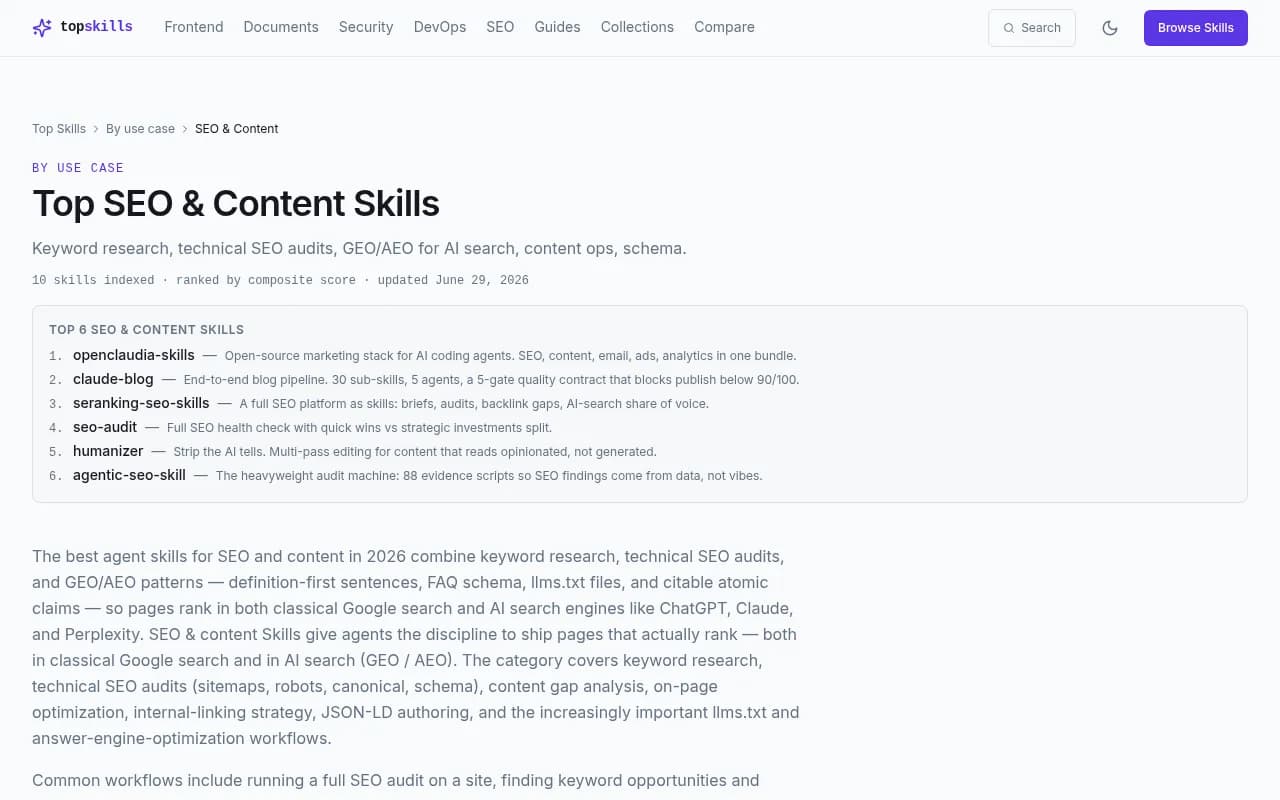
Two things from that directory are worth repeating. First, these skills do not replace Ahrefs or Semrush. They consume that data through MCP servers and apply it. Second, quality varies wildly: the lower-ranked schema skills produce JSON-LD that looks fine and gets rejected by Search Console. Check the verification badge, and run the output through a validator anyway.
The same logic applies to GEO. The skill is the analyst. The data has to come from somewhere real.
Why GEO needs skills more than classic SEO did
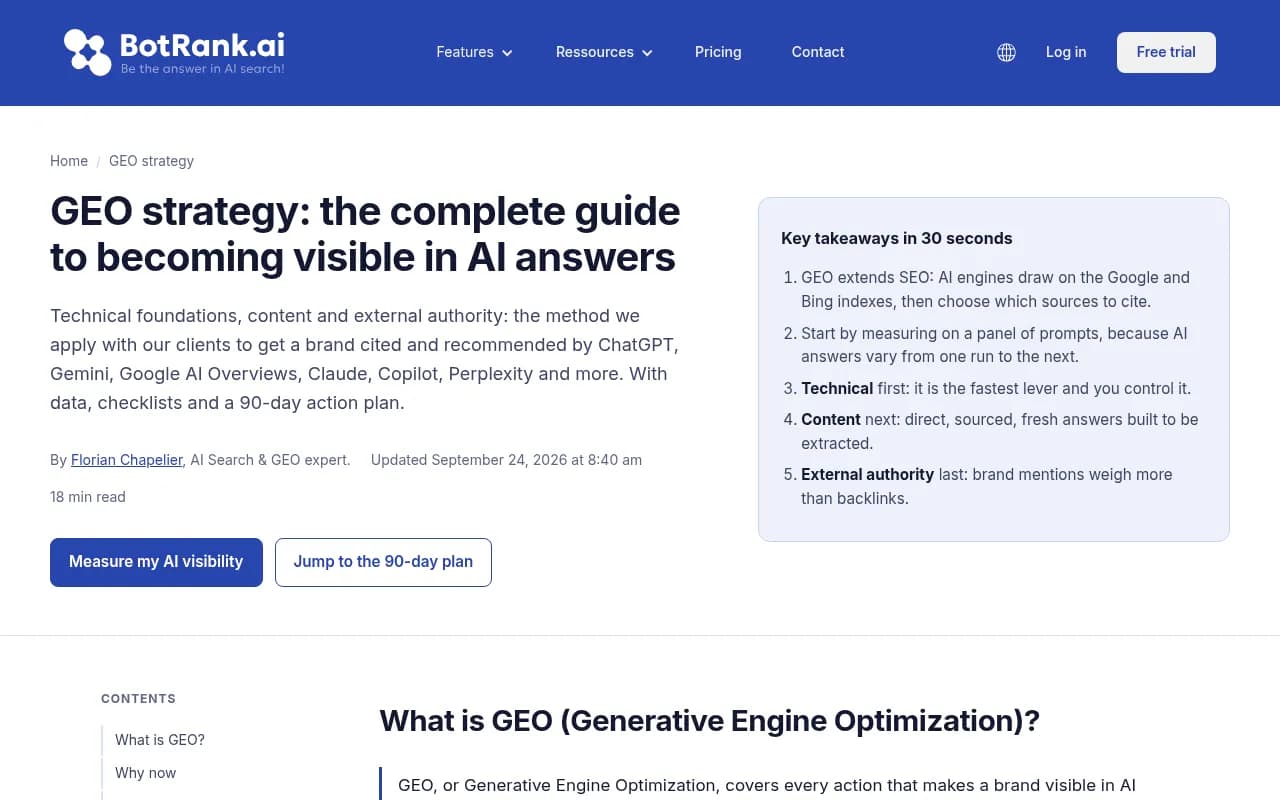
Classic SEO measurement is fairly stable from one day to the next. GEO is probabilistic. The same prompt can produce different answers, different brands and different sources on consecutive runs. BotRank's GEO strategy guide makes the point bluntly: judging on a single answer is the first mistake, and only repeated measurement means anything.
That creates a workload problem. Somebody has to look at fresh data every week, compare it to last week, spot what moved, and decide what to do. It is repetitive, pattern-heavy analysis, which is exactly what agents are decent at.
It also helps to remember how engines pick sources: a prompt gets split into sub-searches (the fan-out), the engine retrieves passages, selects the clear, reliable and fresh ones, then writes the answer. Technical work gets you readable. Content work gets your passage selected. Authority, meaning what others say about you, tips the selection. Each skill below maps to part of that chain.
Skill 1: the 7-day GEO briefing
What it does
The briefing skill reads the last seven days of your AI visibility data and writes a short report: what changed, why it probably changed, and what to do about it. It is the skill you will use most, because it is the one that runs on a schedule.
What a good one covers
- Visibility and share of voice movement by model, country and topic, compared to the previous week
- Prompts where you gained or lost a mention, with the sources that were cited
- Competitors that appeared or climbed
- Crawler errors or site issues that could explain a drop
- Three to five prioritized actions, each with evidence attached
The last bullet is the one people skip. A briefing that ends with "monitor closely" is useless. Make the skill output actions with an owner, a page URL and a reason.
Why seven days
Promptwatch Data's content half-life report tracked every page ChatGPT cited on July 6, 2026 through October 4, 2026. News pages lost half their citations within 36 days, and almost a quarter were never cited again after day 0. Product pages, reviews and how-tos had half-lives of roughly 74 to 77 days. Landing pages and docs stayed cited longest, with 78% and 76% still cited after 30 days.
The half-life figures are an inference target, not a rule, but they suggest a sensible rhythm. News-driven visibility moves in weeks, so a weekly look catches it while you can still react. Evergreen pages can be reviewed on a 60 to 75 day refresh cycle. Put both into the skill: weekly scan, plus a flag for any page approaching its refresh window.
Writing the skill instructions
Keep the file short and specific. Something like this works as a starting point:
Name: weekly-geo-briefing
When: Monday, or when asked for a GEO briefing
Inputs: last 7 days and prior 7 days of prompt results, citations, crawler logs
Steps:
1. Compare visibility, position and share of voice week over week.
2. List the 5 biggest prompt-level movers, with cited sources.
3. Flag new competitors or sources appearing.
4. Check crawler errors and audit changes.
5. Output max 5 actions: page URL, evidence, expected effect.
Rules: never invent numbers. If data is missing, say so.
That last rule matters. Without it, agents fill gaps with confident guesses.
Where the data comes from
The briefing is only as good as its inputs. Promptwatch ships a ready-made 7-day GEO briefing skill inside Agent Chat, which runs over your live prompt, citation, crawler and traffic data and can be scheduled to land in-app or in Slack. If you would rather wire your own skill to a tracker, Promptwatch also exposes an MCP server and REST API, so Claude or ChatGPT can pull the same data.

Other trackers with exports or APIs can feed a custom skill too, such as Peec AI, Otterly.AI or Profound.



Skill 2: competitor gap analysis
The question it answers
Where do competitors get cited or recommended that you do not? The Presspage GEO content guide frames it as three steps: know your current citation share, work out why competitors are getting cited instead, then turn each gap into a concrete piece of work. A skill can run all three.
Three kinds of gap
Tell the skill to separate them, because the fixes differ.
- Prompt gaps: prompts where a competitor is mentioned and you are absent. The fix is usually a page that answers that exact question or comparison.
- Source gaps: third-party pages that AI cites (review sites, listicles, forums, YouTube videos) where competitors appear and you do not. The fix is outreach, reviews or PR, not your own site.
- Format gaps: competitors win with a docs page or comparison table while you have a blog post. The fix is changing the format.
The fan-out matters here too. Promptwatch's ChatGPT query fanout report notes a single prompt can trigger multiple searches, though its measured averages were lower: 2.15 web searches per response in early December, about 1.84 by early March. The practical advice from that report still holds. Cover the sub-questions a fan-out splits into (comparisons, pricing, alternatives, how-tos), build clusters of focused pages instead of one mega-page, and write headings that read like search queries. Have the gap skill list which sub-questions you have no page for.
What to feed it
| Input | Why the skill needs it |
|---|---|
| Prompt-level results for you and 3 to 5 competitors | Shows who gets mentioned where |
| Cited URLs and source types | Separates prompt, source and format gaps |
| Your page inventory | Lets the skill say "you already have a page, it is weak" instead of "write a new one" |
| Search Console data | Shows pages that rank but never get cited |
| Fan-out queries | Reveals the sub-questions to cover |
Tool options for the data layer
| Tool | Competitor gap angle | Good fit |
|---|---|---|
| Promptwatch | Content gap analysis mapping your pages to prompts AI answers, plus an Agent Chat competitor gap skill and an Action Board for the fixes | Teams that want gaps turned into published content and tracked |
| Profound | Enterprise monitoring and competitive analytics | Large brands with monitoring budgets |
| Findable | Cross-LLM visibility with citation-gap analysis | Teams that mainly want the gap view |
| Semrush AI Visibility Toolkit | AI tracking inside an existing SEO suite | Teams already living in Semrush |
| Ahrefs Brand Radar | Brand tracking across AI engines | Ahrefs users adding a layer |

Most of these stop at showing you the gap. The step that matters is what happens next. Promptwatch's Content Agent can draft and publish against those gaps to Webflow, Framer or WordPress and then track whether the new pages get crawled and cited, which closes the loop a monitoring-only tool leaves open.
Agency angle
Gap analysis is also the best sales asset an agency has. LLM Pulse's GEO agency guide recommends running the client's prompts live on the discovery call: if the client does not appear, that is your pitch, and if they do, show where competitors appear more prominently. A gap skill that produces a one-page version of that for each prospect saves hours. The open-source GEO SEO Skills kit on AgenticSkills even bundles a prospecting CRM and proposal generator for this, though I could not find pricing or detailed documentation, so test before relying on it.
Skill 3: newsjacking
What it is in a GEO context
Newsjacking means publishing fast, relevant content about something that just happened. In SEO that gets you a traffic spike. In GEO, AI engines with live search pull fresh pages for current-event prompts, so being early and clear can get you cited.
Be honest about the shelf life
News content decays fast in AI citations. Promptwatch's half-life data again: half of cited news pages were gone after 36 days, and 41% were still cited at day 60. That is a short window. Treat newsjacking as a burst, not a foundation.
The practical rule I would build into the skill: every newsjacking draft must link to, or be paired with, a durable page. If the news is "a platform changed how it cites sources," the evergreen partner is a docs-style explainer or comparison that stays accurate. The news piece catches attention, the durable page keeps the citation.
What the skill should do
- Watch for events tied to your topics (product launches, algorithm changes, reports, regulation)
- Check whether AI answers on related prompts already cite fresh sources, and which ones
- Draft a short, fact-dense piece with a definition-first opening and one original data point or first-hand observation
- Suggest the durable page to update or create alongside it
- Stop and ask for human review before anything publishes
On point 3: the GEO Claude skill write-up from AI Profit Boardroom argues the first instruction in any GEO skill should be that every fact comes from real experience, with no invented statistics or paraphrased documentation. I agree. Fast content is where agents make things up, because there is little source material and a deadline. Put the ban on invented figures at the top of the file.
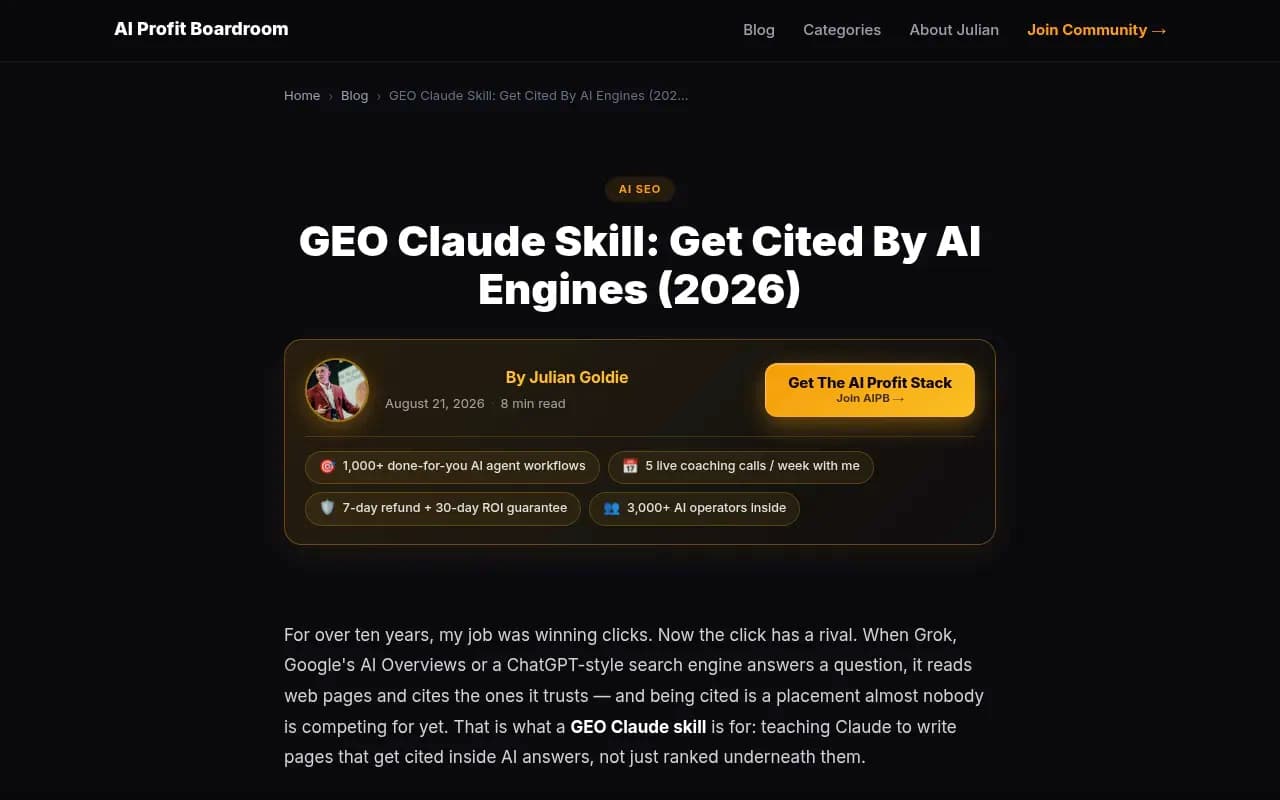
To be fair, that article is a vendor community post and its traffic claims are the author's own, so read it for the skill-writing ideas rather than the results.
Tools that help
Promptwatch's Agent Chat includes a newsjacking skill, and ChatGPT news citations are tracked as their own report, which helps you see whether news pages are actually getting picked up on your prompts. For monitoring the news side, scraping and monitoring tools such as Browse AI or Firecrawl can feed an agent fresh source pages.


Comparing the three skills
| Skill | Cadence | Main input | Output | Main risk |
|---|---|---|---|---|
| 7-day briefing | Weekly, scheduled | Visibility, citations, crawler logs, traffic | Ranked action list | Vague actions with no evidence |
| Competitor gap analysis | Monthly, plus before any content sprint | Prompt results, cited sources, page inventory | Gaps by type with suggested fixes | Recommending new pages when old ones need a refresh |
| Newsjacking | Event-driven | News signals, fresh AI citations | Draft plus durable partner page | Invented facts, short-lived payoff |
How to build your own skill set
Start with the data connection
Before writing any skill, decide where live data comes from. Options are an MCP server from your visibility platform, a CSV export dropped into the conversation, or an API. Without this, you have a prompt template, not a skill.
Write narrow skills
One job per skill. The Claude Blog skill bundle on the Top Agent Skills list has 30 sub-skills and a quality gate that blocks publishing below 90/100, and that structure is a good model: small pieces, with an explicit check at the end. A skill that tries to brief, audit, write and publish will do all four badly.
Add verification steps
Good skills include a checklist the agent must complete before answering: did every number come from the data? Did every recommendation cite a page or prompt? Are there claims with no source? Make it say "I could not find this" when it cannot.
Measure with repeated runs
Because results vary by run, do not judge a recommendation by one answer. Check the trend over several weeks of tracked prompts before deciding something worked. Also keep in mind that GA4 can undercount AI traffic since some visits arrive without a referrer, so use a tracker or crawler data that attributes AI visits directly.
Do the unglamorous basics first
BotRank lists starting with llms.txt before opening the site to search crawlers as a common mistake. A briefing skill will happily tell you to polish content while your robots rules block the crawlers that matter. Run a crawl-access and site audit pass before anything else. Promptwatch's IP-verified crawler logs and weekly audits cover this, and its free Agentic Readiness Check gives a quick first look.
A weekly rhythm that works
| Day | Task |
|---|---|
| Monday | Briefing skill runs, actions land on a board |
| Tuesday | Review actions, pick two or three, assign owners |
| Wednesday to Thursday | Ship content fixes and refreshes; run newsjacking only if a real event warrants it |
| Friday | Check crawl and citation status of what shipped |
| Monthly | Gap analysis; refresh pages near the 60 to 75 day mark |
The board matters more than the briefing. If actions do not have an owner, the briefing becomes a newsletter nobody reads.
If you would rather hire it out
Some teams want the outcome without building the skill stack. An agency that does GEO and technical SEO together, like 1001 SEO Media, can run this cadence for you, and it uses Promptwatch as its AI visibility platform.
To compare more platforms before choosing a data layer, the GEO software directory at bestgeosoftware.com and the AI rank tracker listings at ai-rank-tools.com are good starting points.
Final thoughts
The three skills are not magic. They are routines: look at fresh data every week, find where competitors beat you, and react to news without pretending a news post will last. What separates a useful setup from a gimmick is the data underneath it and the discipline to verify the output. Start with the briefing, give it real inputs, and add the other two once the first one is producing actions your team actually completes.