Key takeaways
- On August 8, 2026, site: operator fan-outs jumped from 0.37% to 16.8% of all ChatGPT fan-out queries, about a 46x increase in one day, according to Promptwatch Data.
- Average fan-outs per response rose from roughly 1.08 to 1.83 on the same day. The site: searches are added on top of generic searches, not swapped in for them.
- Ahrefs' study of 15 million fan-outs found 76% of site: searches among the most-searched sites target brand sites, with the share dropping to 68.3% for comparison questions.
- Your own domain is now a retrieval surface. Indexation, crawlable HTML, and thorough topic coverage decide whether ChatGPT finds your answer.
- Keyword and prompt mappings built before August 8 are stale. Re-run your fan-out analysis and monitor continuously.
What actually changed on August 8
ChatGPT changed how it searches the web overnight. For weeks, site:-scoped searches were a rounding error, about 1 in 280 fan-out queries (0.3% to 0.5%). Then the share dipped to 0.15% on August 3 to 5, which looks like a staged rollout or a pre-launch experiment, and jumped to 16-17% on August 8. It has held there since.
So roughly 1 in 6 fan-outs now reads something like site:yourbrand.com pricing. ChatGPT is no longer only searching the open web and seeing what comes back. It is deliberately walking into specific domains.
The timing matters. Because it happened in a single day, platform-wide, it points to a model or system-prompt change on OpenAI's side. Nothing individual sites did caused it. That is worth saying out loud before anyone rewrites their content strategy in a panic: this is a ChatGPT rollout, not a ranking signal you triggered.
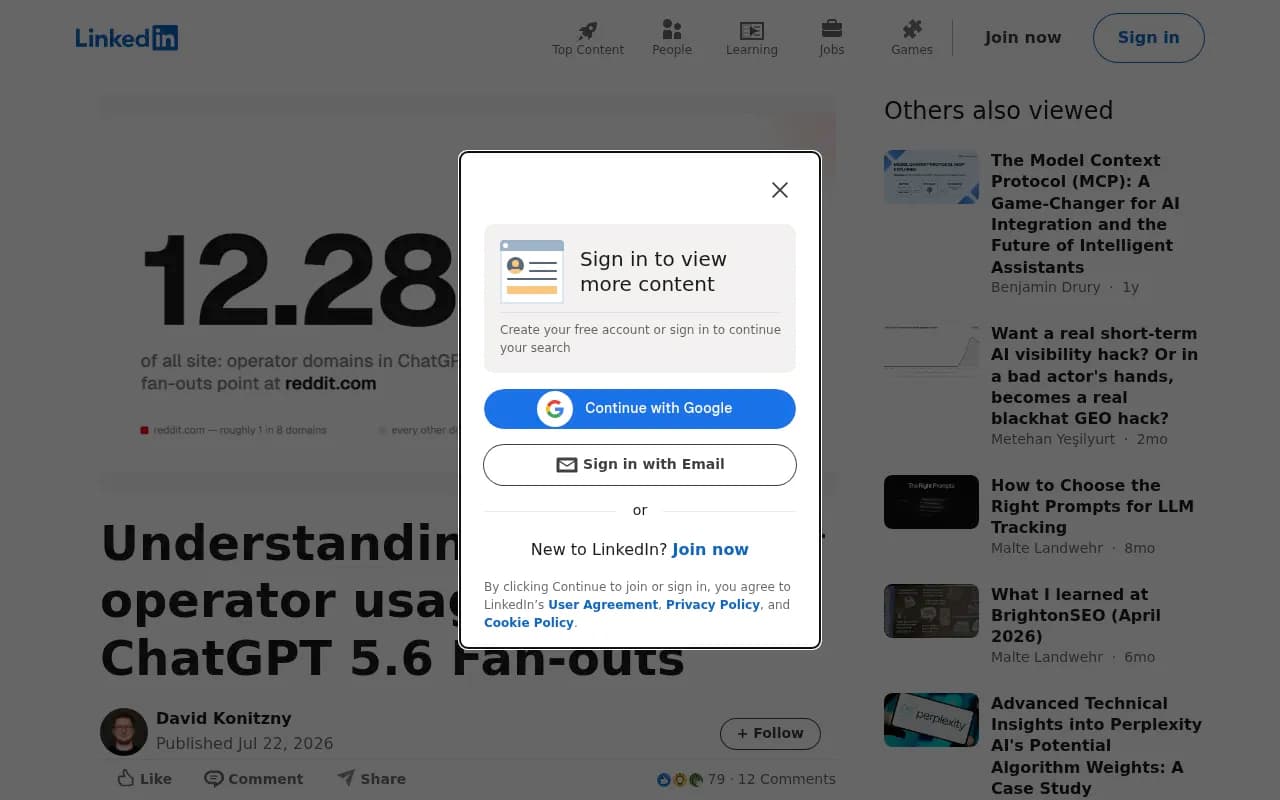
Peec AI's David Konitzny saw a related pattern when ChatGPT 5.6 became the default. By his numbers, prompts with only one fan-out query fell from 94.0% to 43.5%, average retrieved sources roughly doubled from about 12 to 24, and site: appeared in about 23% of fan-outs, up from roughly 0.3%. His measurement is a bit higher than Promptwatch's 16.8%, which is normal when different tools sample different prompt sets. The direction is identical.
Additive, not substitutive
Here is the detail I find most useful. The average number of fan-outs per response went from about 1.08 to 1.83 on August 8, in lockstep with the site: surge. If ChatGPT had replaced generic queries with site: queries, the average would have stayed flat. It didn't.
That means two things for you:
- Generic web search still matters. You still need to rank and get retrieved the normal way.
- You now get a second chance. A site: query is a separate retrieval event that your domain can win or lose independently.
The first is old news. The second is the actual change.
Why ChatGPT is doing this
Nobody outside OpenAI knows for sure. Lily Ray's theory, published August 17, 2026, is that site: is a way to reduce spammy outputs: ChatGPT scopes searches to sites it already trusts, and the habit of adding words like "official" or pointing at a specific subreddit tells you what kind of source it believes will answer the question. She compares it to what Google has tested with E-E-A-T, "but ChatGPT style." She also notes the behavior was already visible in the 5.4 Thinking model, which ran many fan-outs with site: operators aimed at trusted domains.
I think that theory is plausible, and it fits the data. But treat it as a theory. What is observable is the behavior, and the behavior is enough to act on.
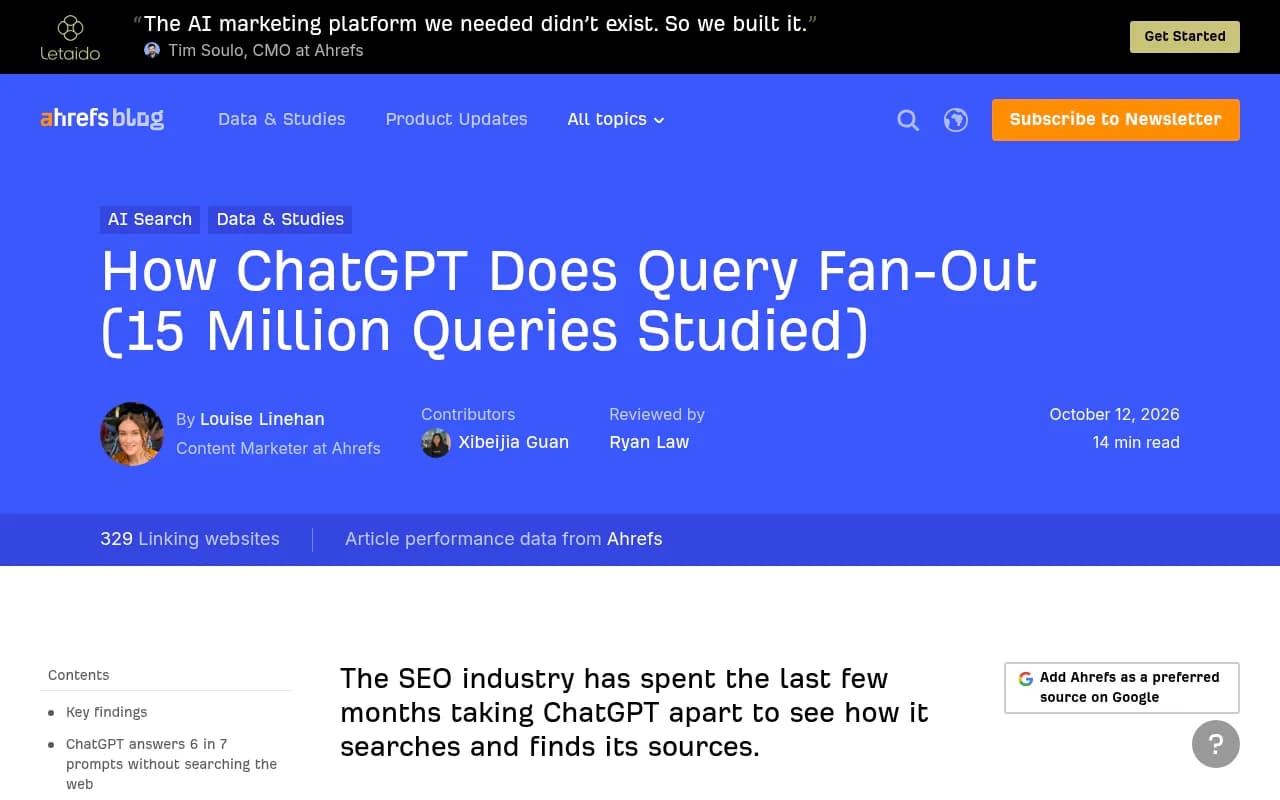
The Ahrefs study adds texture. Of 15 million fan-outs, 6.8% used site: to search a single website, spread across about 116,000 domains. Among the roughly 160 most-searched sites, three in four of those searches targeted a brand site. If you want a price or a spec, the brand site is the obvious place to check. For comparison questions like "A vs B" or "which is cheaper," the brand-site share fell to 68.3%, because ChatGPT leans on other sites when it has to weigh one option against another.
In short: facts come from you, judgments come from everyone else. Plan your content around that split.
What the site: query can and cannot do
A site: query is run against a search engine. It can only return what that engine has indexed from your domain. That has a few consequences that are easy to miss.
- Unindexed pages are invisible to it, however good they are.
- Thin category pages and weak internal linking give the search engine little to return for a topical lookup.
- Facts locked in images or client-side rendered JavaScript may never reach the index in readable form.
- The root-domain form (
site:yourbrand.com topic) is a flexible way for the model to pull from a trusted source for broader informational needs, as Konitzny notes in his analysis of site: usage in 5.6 fan-outs.
A practical adaptation plan
1. Audit what a site: query would return for you
This is the cheapest test there is. Open Google and Bing and run site:yourdomain.com plus your core topics: pricing, features, alternatives, integrations, support, returns, whatever customers ask about. Look at what comes back, in what order, and with what titles and snippets.
If the right page doesn't appear, or a thin tag page outranks your real answer, you have found a gap ChatGPT can also find. Fix the page, the internal links, or the indexation, in that order.
2. Put key facts in plain, crawlable HTML
Pricing, specs, model numbers, support details, policies. If ChatGPT is running a site: search for them, they need to exist as text it can read, not inside an image or in JavaScript-rendered content that only appears after load. Lily Ray makes this the centerpiece of her recommendations, and I agree with her. It is boring advice and it is the highest-return item on this list.
A quick check: view the page source or fetch it without JavaScript. If the fact is not there, assume the retrieval layer will not see it either.
3. Check indexation and crawl access
Confirm your important pages are indexed in both Google and Bing. ChatGPT's retrieval depends on search indexes, so a page missing from them is missing from this path. Also check robots.txt and your CDN rules for the AI crawlers you actually want, such as OAI-SearchBot and ChatGPT-User. Blocking those while hoping for citations is a common self-own.
If you want to see which bots hit which pages and where they fail, you need server or CDN logs. Tools like Promptwatch include IP-verified AI crawler logs that show this directly, filtering out spoofed bots.

4. Cover more angles per topic
Each fan-out is a separate lookup, and now a domain-scoped one is likely in the mix. Comparisons, pricing, alternatives, integrations, and troubleshooting are each a chance to be found. A single product page does not cover "X vs Y," "X pricing," and "X alternatives" well. Three focused pages usually do.
Grow and Convert's study of known fan-out queries makes a related point: the more comprehensively your domain covers a topic area, the more likely ChatGPT is to recognize you as relevant, whichever specific fan-out it runs. Topical depth is the durable version of this advice.
5. Write the first-party answer, then earn the third-party one
Based on the Ahrefs split, own the factual queries and invest in presence elsewhere for the comparative ones. For comparison prompts ChatGPT looks beyond official sources, so reviews, listicles, and community discussion carry more weight. Be aware that Promptwatch Data shows ChatGPT has nearly stopped citing social media (0.46% of citations from Sep 28 to Oct 4, 2026) and that reddit.com's share of ChatGPT citations fell from about 4% to 0.5% in mid-August, so do not assume the old Reddit playbook still pays off in ChatGPT. See the Reddit citation data and the social media citations report for the details. Google AI Overviews, by contrast, got 12.2% of its citations from social platforms in the same week.
6. Match page type to the job
Promptwatch Data on content types (Sep 28 to Oct 4, 2026) puts product pages at 22.4% of ChatGPT citations, ahead of landing pages and listicles. See the content type report. And on persistence, landing pages and docs stayed cited longest, while news lost half its pages within 36 days, per the content half-life study. If a brand-site lookup is what ChatGPT is doing, durable pages on your own domain are what it will find. Keep them current and well structured.
7. Re-run your fan-out analysis
Any keyword-to-prompt mapping built before August 8 predates this behavior. Pull fresh fan-outs for your tracked prompts and look for site: patterns pointing at your domain or at competitors. Then see which pages those queries would resolve to. For a free look at what ChatGPT is doing on a single prompt, Promptwatch's GEO Inspector Chrome extension shows fan-outs and fetched versus cited sources locally. Lily Ray also mentions the Resoneo plugin and FanoutFox for inspecting fan-outs.
What to measure
| Question | Signal to watch | Where to get it |
|---|---|---|
| Is ChatGPT searching my domain? | Share of fan-outs containing site:yourdomain | Fan-out tracking in an AI visibility tool |
| Can it read my pages? | AI crawler hits, errors, status codes | CDN or server logs, crawler log tools |
| Are my pages indexed? | Coverage in Google and Bing | Search Console, Bing Webmaster Tools |
| Do I get cited after lookups? | Citations per page, citation rate | Citation analytics |
| Does it drive traffic? | Referrals from chatgpt.com | Analytics, AI visitor tracking |
Monitor continuously. This shift happened in a day, and the next one can too. One-off audits go out of date quickly.
Tools that help with this
No tool fixes a thin page for you, but several help you see the problem.
| Tool | Useful for | Notes |
|---|---|---|
| Promptwatch | Fan-outs, crawler logs, citations, content gap analysis, Content Agent | Covers the monitoring plus the fix loop |
| Peec AI | Prompt tracking with fan-out research | David Konitzny's data comes from here |
| Profound | Enterprise visibility analytics | Higher price point |
| Aiso | Prompt and fan-out tracking | Smaller, focused |
| Ahrefs Brand Radar | Brand tracking inside an SEO suite | Fixed prompt sets |



Most tools in this space stop at showing you the numbers. Promptwatch goes further by connecting fan-out data to a content gap analysis and a Content Agent that can draft and publish pages for the gaps, then tracks whether those pages get crawled and cited. That loop matters here, because the work is not noticing site: queries, it is having something good for them to find. If you want to compare more options, the GEO software directory lists a wide range.
Mistakes to avoid
- Chasing the operator itself. You cannot make ChatGPT run site: on you. You can only be a good result when it does.
- Treating this as a permanent fixture. It has held since August 8, but ChatGPT's search behavior has changed repeatedly, including a drop in citations per response around the GPT-5.3 rollout on March 4, 2026 (report).
- Over-trusting one dataset. Promptwatch measured 16.8%, Peec saw about 23% on 5.6, and Ahrefs saw 6.8% across a broader, earlier sample. Different samples, different dates, same direction.
- Hiding facts in PDFs, images, or JavaScript widgets.
- Ignoring Bing. If your site is only healthy in Google, you have a hole.
A short checklist
- Run site: searches for your top 20 customer questions in Google and Bing.
- Fix pages that don't appear, or that appear with poor titles or snippets.
- Move key facts into plain HTML text.
- Confirm AI crawlers are allowed and not erroring.
- Add pages for comparison, pricing, and alternatives angles you lack.
- Re-run fan-outs for your tracked prompts and update your mapping.
- Set up ongoing monitoring and review weekly.
The broader dataset behind these reports lives at Promptwatch Data, and the August 8 report itself is at ChatGPT Search now uses the site: operator at scale.
Bottom line
Since August 8, about 1 in 6 ChatGPT fan-outs is aimed at a specific domain, and those searches come on top of the generic ones. If you are a trusted source on your topic, that is an opening: ChatGPT goes to the brand site for facts. If your site is thinly covered, poorly indexed, or hides its facts behind JavaScript, it is a quiet loss. Start with the site: audit this week. It takes an hour and tells you most of what you need to know.