Key takeaways
- Peec AI is a clean, fast-to-set-up AI visibility monitoring tool that tracks brand citations across ChatGPT, Perplexity, Claude, and Google AI Overviews
- It's best suited for established brands with existing SEO traffic -- not new or early-stage sites
- The platform is a monitoring-only tool: it shows you where you're invisible but doesn't help you fix it
- Pricing starts at $100/month, which is reasonable for what you get, but the value depends heavily on what you plan to do with the data
- If you need to act on the data (create content, close citation gaps, track crawlers), you'll need to pair Peec AI with other tools or switch to a more complete platform
Thirty days. That's how long we ran Peec AI across two live projects -- one B2B SaaS brand with solid organic traffic, one newer site still building its SEO foundation. The results were telling, and not always in the way we expected.
Here's the honest breakdown.
What Peec AI actually does
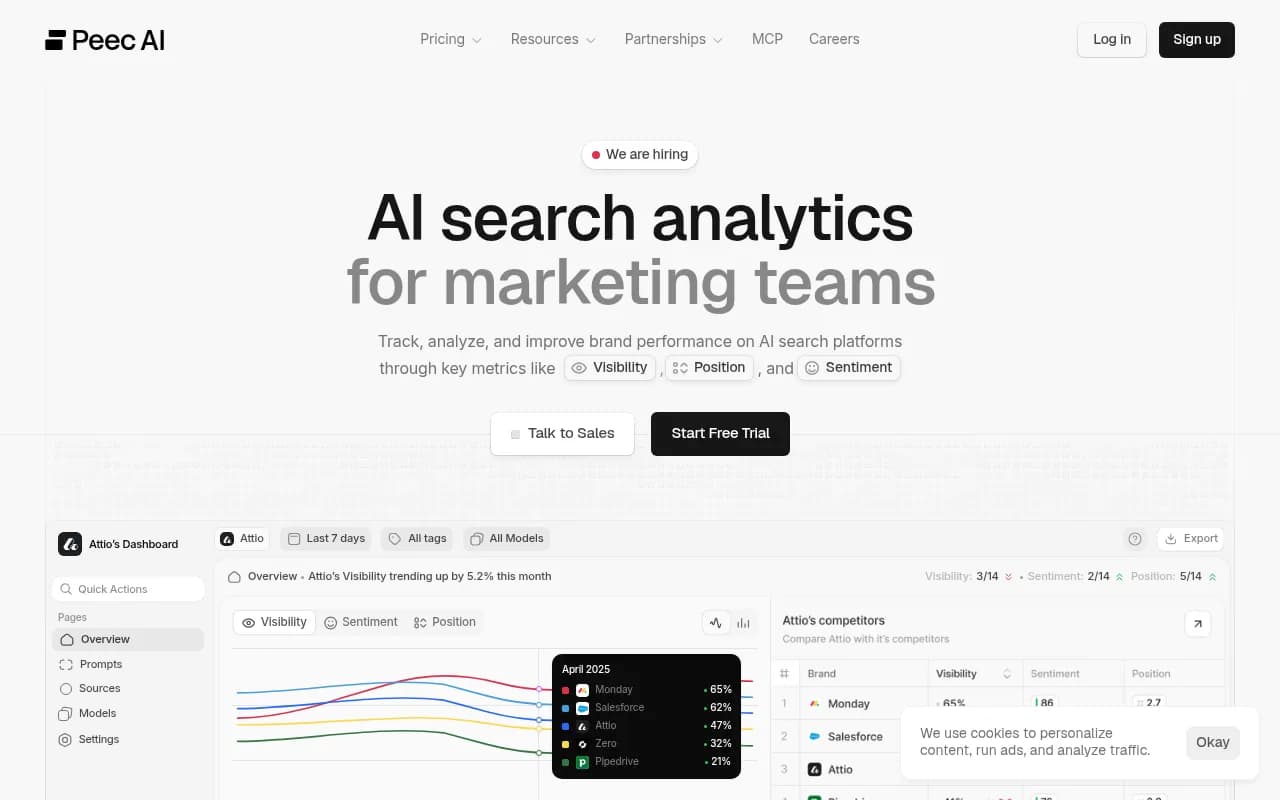
Peec AI tracks how often your brand gets mentioned when people ask AI systems questions in your category. It uses UI scraping (not just API calls) to simulate real user interactions across ChatGPT, Perplexity, Claude, and Google AI Overviews -- which matters, because the answers users actually see can differ from what the API returns.
You set up your brand, add competitor names, define a set of prompts relevant to your space, and the platform starts pulling data. Within a few days you can see:
- Your citation rate (how often you appear vs. competitors)
- Which sources AI models are citing when they mention you
- Share of voice across different LLMs
- Sentiment signals around your brand mentions
Setup genuinely takes about three minutes. There's no complex onboarding, no long configuration wizard. You enter your brand name, describe your business, and you're in.
What 30 days of testing actually looked like
Week one: setup and first impressions
The interface is clean. Refreshingly so. A lot of AI visibility tools try to cram every metric onto one screen -- Peec AI doesn't do that. You get a clear dashboard showing citation frequency, share of voice, and which AI models are mentioning you.
The first thing we noticed: the established B2B SaaS brand showed up in AI responses fairly quickly. Peec AI surfaced citation data within the first few days, and we could see exactly which competitor pages were being cited in responses where we weren't mentioned. That's useful.
The newer site? Almost nothing. Which brings us to the first real limitation.
Week two: the traffic dependency problem
Peec AI's value is tied to how much existing brand recognition and SEO presence you have. If AI models aren't already citing you in any context, the dashboard mostly shows you a lot of zeros. That's accurate data -- but it's not actionable without a plan to create the content that would change those numbers.
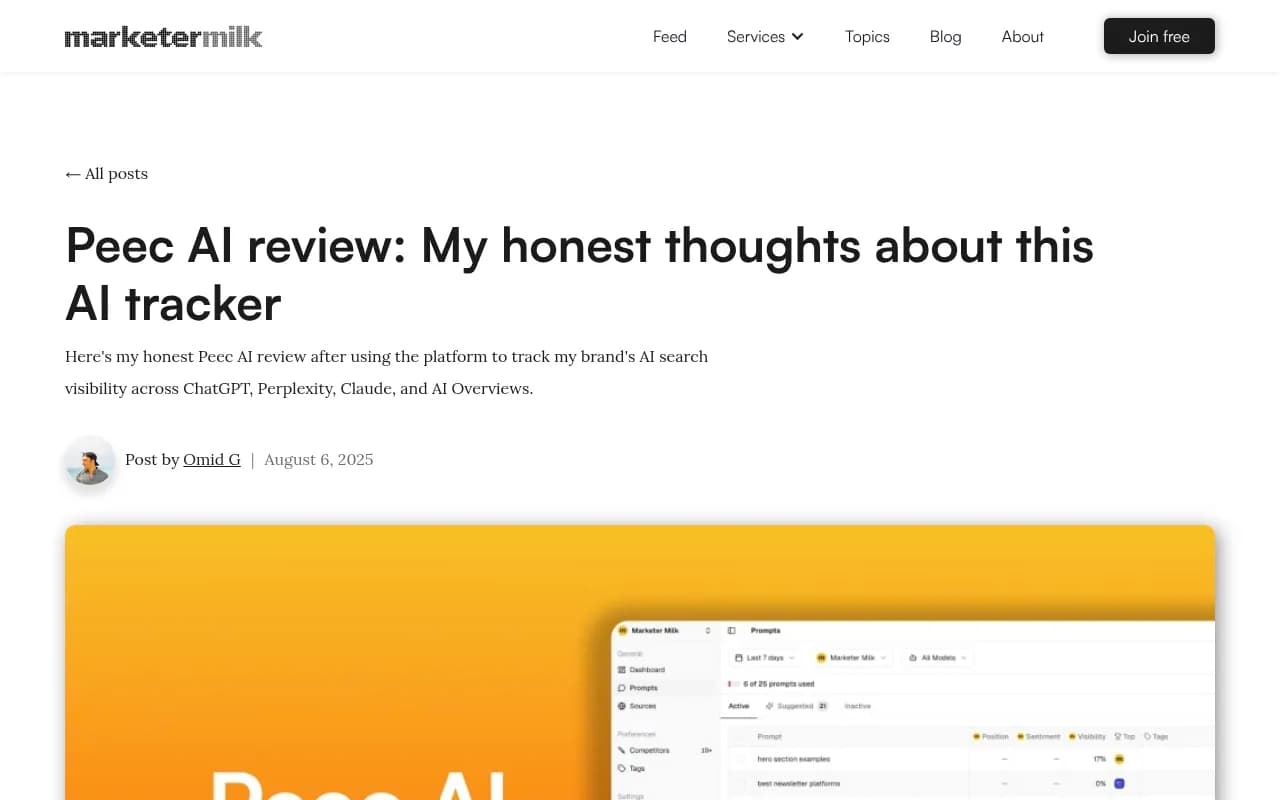
One reviewer at Marketer Milk put it plainly: Peec AI is best for established sites that already get decent SEO traffic and solid branded searches. For new startups, the tool has limited value because there's simply not enough signal to work with yet.
This isn't a knock on Peec AI specifically. It's a structural reality of AI visibility monitoring in general. But it's worth knowing before you sign up.
Week three: digging into citation sources
This is where Peec AI earns its keep. The source URL data -- seeing exactly which pages, Reddit threads, or third-party sites AI models are citing in your category -- is genuinely useful for competitive research. We could see which competitor blog posts were being pulled into ChatGPT responses, which gave us a clear picture of the content gaps we needed to close.
The competitive share of voice view was also solid. Seeing your citation rate vs. three or four competitors on a single chart makes it easy to have a conversation with a marketing team about where you stand.
Week four: the "now what?" problem
By week four, we had a clear picture of our AI visibility. We knew which prompts we weren't appearing for. We knew which competitor pages were winning citations. We had sentiment data.
And then we hit a wall.
Peec AI shows you the gap. It doesn't help you close it. There's no content generation, no brief creation, no crawler log analysis, no suggestions for which pages to update or create. The platform's job ends at diagnosis.
For teams that have a content operation already running, that's fine -- you take the data and hand it to your writers. But for teams that need a full workflow from "we're invisible" to "we're getting cited," Peec AI is only the first step.
What Peec AI does well
- Fast setup with no credit card required for the 7-day trial
- Clean, focused interface that doesn't overwhelm you
- Unlimited seats on paid plans (good for agencies or larger teams)
- UI scraping approach means you're seeing what real users see, not just API outputs
- Citation source tracking is genuinely useful for competitive research
- Reasonable pricing compared to enterprise alternatives
Where it falls short
- No content generation or optimization tools
- No AI crawler logs (you can't see when ChatGPT or Perplexity is crawling your site)
- No traffic attribution (can't connect AI citations to actual revenue or visits)
- No Reddit or YouTube tracking (both are major citation sources for AI models)
- Limited value for new or low-traffic sites
- Recommendations exist but are described as limited -- a few suggestions per week rather than a systematic content gap workflow
Peec AI pricing in 2026
Pricing starts at $100/month, which puts it in the accessible range for most marketing teams. There's a 7-day free trial with no credit card required, which is a good sign -- it means the product is confident enough to let you evaluate it properly.
Compared to enterprise tools like Profound (which can run significantly higher), Peec AI is the budget-conscious choice. Whether that's the right trade-off depends on what you need from the platform.
How Peec AI compares to the main alternatives
| Tool | Monitoring | Content generation | Crawler logs | Traffic attribution | Reddit/YouTube tracking | Starting price |
|---|---|---|---|---|---|---|
| Peec AI | Yes | No | No | No | No | ~$100/mo |
| Otterly.AI | Yes | No | No | No | No | Lower tier |
| Profound | Yes | Limited | No | No | No | Higher tier |
| AthenaHQ | Yes | No | No | No | No | Mid-range |
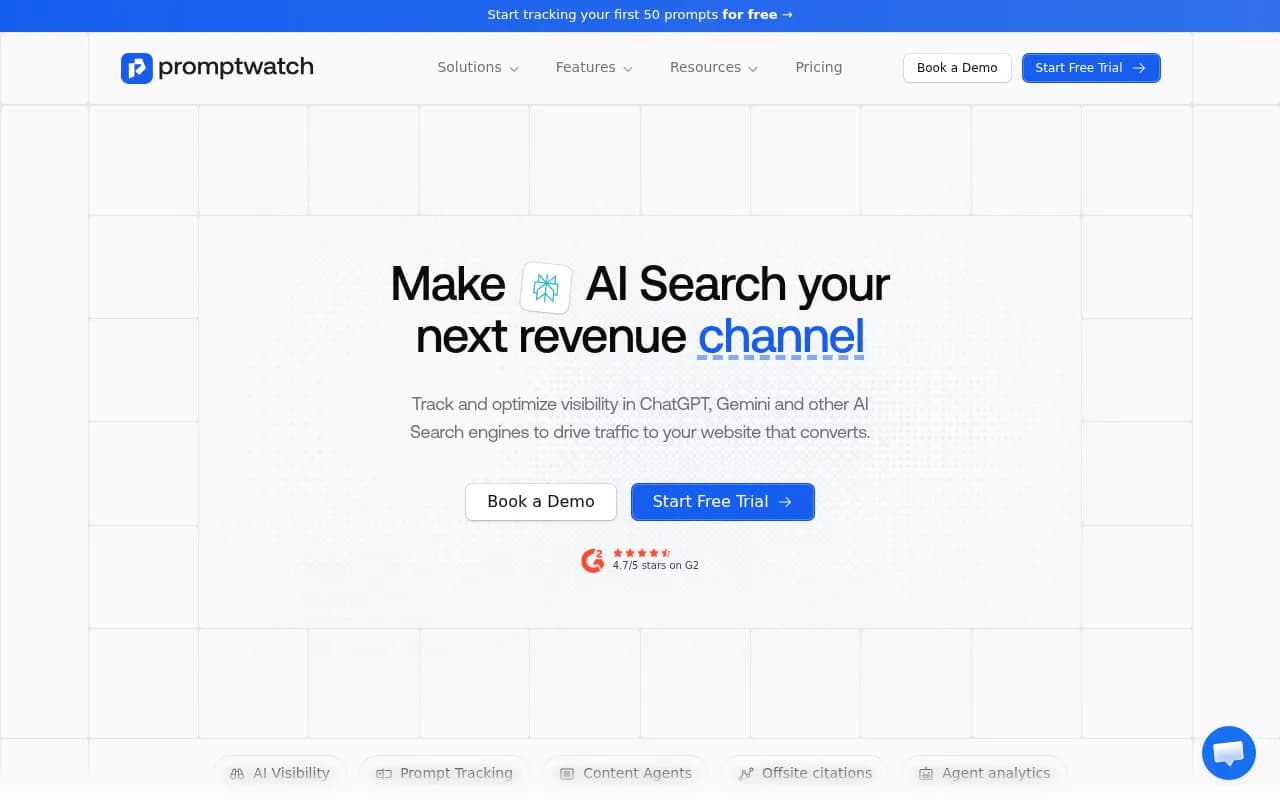
| Promptwatch | Yes | Yes | Yes | Yes | Yes | $99/mo |
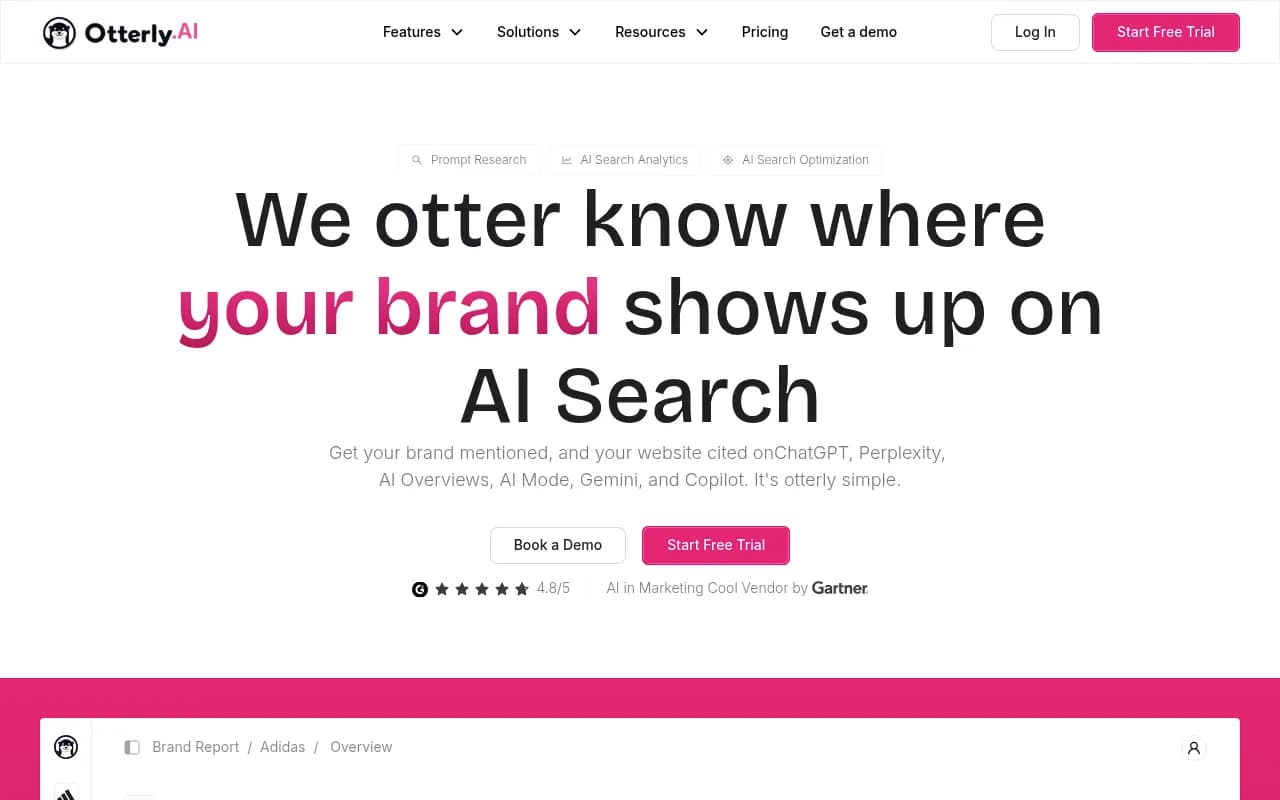

The pattern here is pretty clear. Most AI visibility tools -- Peec AI included -- are monitoring dashboards. They tell you what's happening. Promptwatch is the outlier in this comparison: it's built around the full loop of find gaps, create content, track results. If you're at the stage where you need to act on the data rather than just observe it, that distinction matters.
Promptwatch also starts at $99/month, which makes the comparison even more direct. For roughly the same price, you get monitoring plus content generation, crawler logs, and traffic attribution.
Who should actually use Peec AI
Peec AI makes sense if:
- You're an established brand with existing SEO traffic and you want a clean, affordable way to track AI citation performance
- You already have a content team that can act on the data independently
- You want competitive share of voice data to report to stakeholders
- You're evaluating your AI visibility for the first time and want a low-friction entry point
It's probably not the right fit if:
- You're a new or early-stage brand with limited organic presence
- You need to not just track visibility but actually improve it
- You want to understand how AI crawlers are interacting with your site
- You need to connect AI citations to traffic and revenue
Alternatives worth considering
If Peec AI's monitoring-only approach isn't enough, here are a few tools worth looking at depending on your needs:
For more complete monitoring with agency features:
For enterprise-level AI search intelligence:
For a more affordable entry point with similar monitoring:
For tracking AI visibility alongside traditional SEO:
For the full optimization workflow (monitoring + content + attribution):
The honest verdict
Peec AI is a solid, well-designed monitoring tool. The interface is clean, setup is fast, the citation source data is useful, and the pricing is fair. For an established brand that wants a simple way to track AI visibility and has a content team ready to act on the findings, it does the job.
But "does the job" has limits. After 30 days, the clearest thing we can say is this: Peec AI tells you where you stand. It doesn't move you forward. For teams that need both diagnosis and treatment -- the data and the tools to act on it -- the monitoring-only model will feel incomplete pretty quickly.
Whether that's a dealbreaker depends entirely on what you're trying to accomplish. If you just need the data, Peec AI is worth the $100/month. If you need the full workflow, look at what else is out there before committing.