Key takeaways
- Profound is the most data-rich platform but costs $499+/month and is built for enterprise teams with dedicated analysts.
- Otterly.AI is the cheapest entry point at $29/month, but it's monitoring-only with no path to fixing what you find.
- Peec AI sits in the middle: solid analytics, fast-growing, but still primarily a dashboard without content or optimization tools.
- Promptwatch is the only platform of the four that closes the loop — it shows you where you're invisible, then helps you create content to fix it, then tracks whether that content gets cited.
The AI visibility tools market has gotten crowded fast. Between summer 2025 and spring 2026, the category raised over $300M in funding. Every week there's a new platform claiming to be the definitive way to track your brand across ChatGPT, Perplexity, Claude, and Google AI Overviews.
So I ran a test. Same 50 prompts. Same four platforms. Here's what actually happened.
The prompts covered a mix of informational queries ("what's the best project management software for remote teams"), comparison queries ("Notion vs Asana for small businesses"), and purchase-intent queries ("which CRM should a B2B SaaS company use"). A realistic spread of what real users are actually typing into AI search engines.
The four platforms at a glance
Before getting into results, here's where each platform sits in the market:
| Platform | Starting price | Best for | Content generation | Crawler logs |
|---|---|---|---|---|
| Otterly.AI | $29/month | Budget monitoring | No | No |
| Peec AI | $95/month | Mid-market analytics | No | No |
| Profound | $499/month | Enterprise reporting | No | No |
| Promptwatch | $99/month | Full-cycle optimization | Yes | Yes |
That table already tells a story. Three of the four platforms are monitoring tools. They show you data. Promptwatch is the only one that also helps you act on it.
Let's go deeper on each.
Otterly.AI: the entry point that does what it says
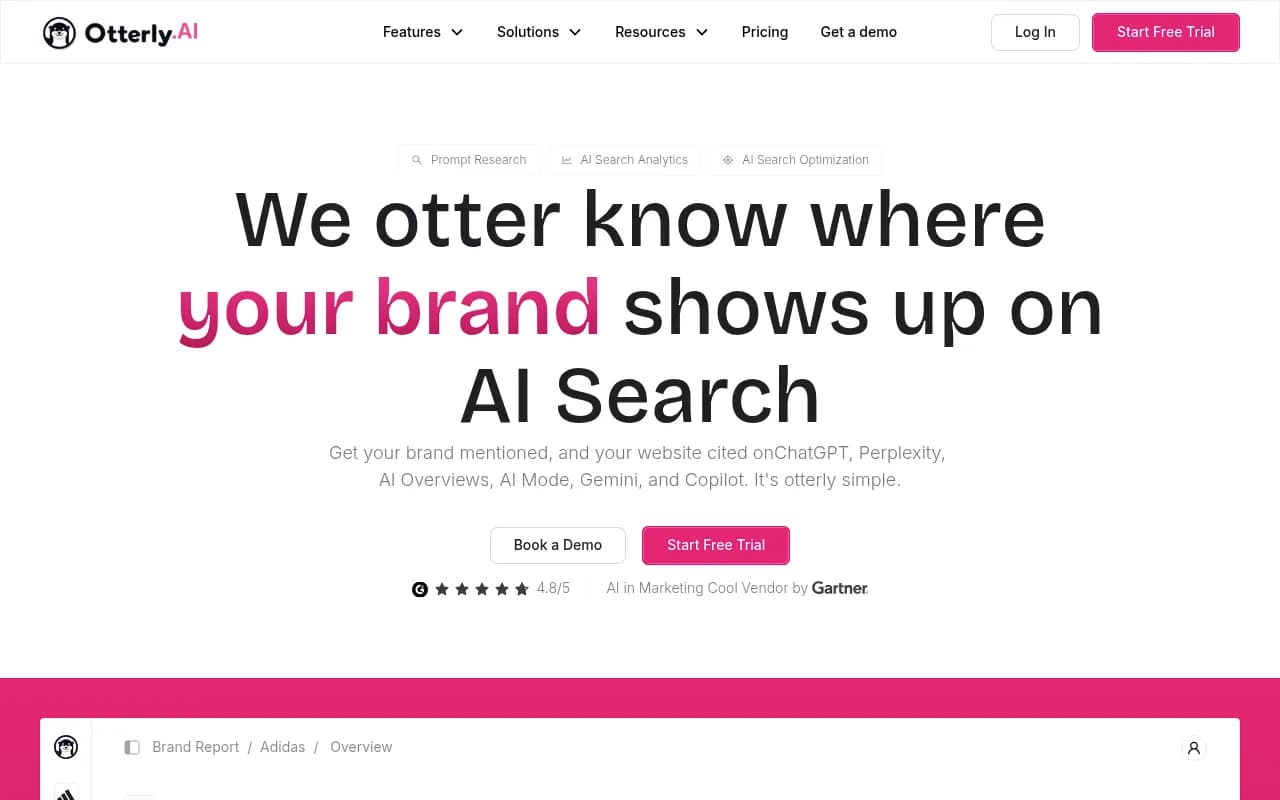
Otterly.AI is genuinely the most accessible tool in this category. At $29/month for the Lite plan, it's priced for marketers who are just starting to pay attention to AI search and want to see whether their brand shows up at all.
For the 50-prompt test, Otterly tracked mentions across a handful of AI models and returned a clean dashboard showing brand mention rates. The interface is simple enough that you don't need onboarding. You can be set up in under 20 minutes.
The problem is what happens next. Otterly shows you a number. Your brand appeared in 14 of 50 responses. Okay. Now what?
There's no answer gap analysis. No content recommendations. No crawler data telling you which pages the AI models are actually reading. No way to understand why you're appearing in some responses and not others.
For a team that has never measured AI visibility before, Otterly is a reasonable first step. But it's a step, not a strategy. Once you've confirmed that yes, your brand has an AI visibility problem, you'll need a different tool to actually solve it.
Pricing goes up to $99/month for the Growth plan and $199/month for the Agency plan, which adds white-labeling and more tracked prompts. Even at the top tier, the feature set stays monitoring-only.
Peec AI: faster analytics, same ceiling
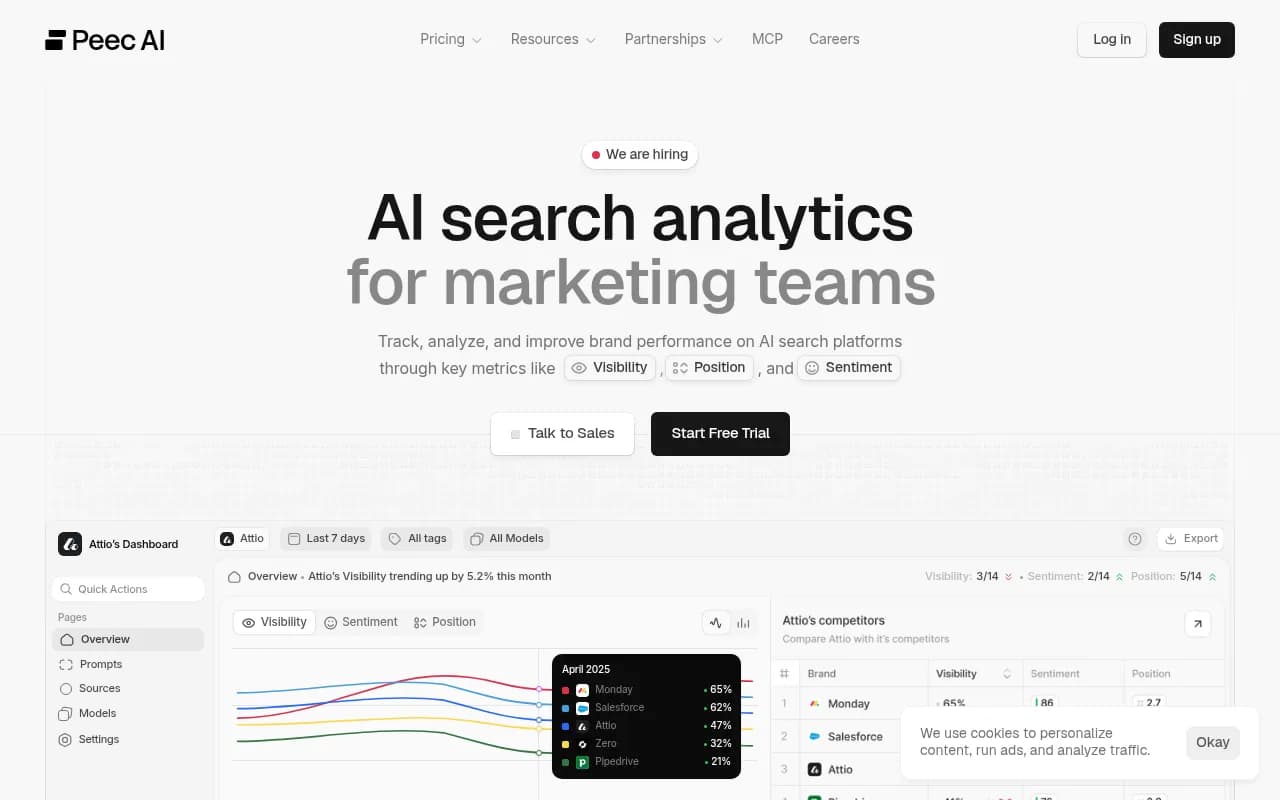
Peec AI raised $29M and hit $4M+ ARR in ten months, which tells you something about the demand for mid-market AI visibility tools. The platform is genuinely well-built. The analytics are faster and more detailed than Otterly, the UI is cleaner than most competitors, and the multi-country tracking on the Advanced plan ($495/month) is useful for brands operating across markets.
For the 50-prompt test, Peec returned more granular data than Otterly. You can see which AI models cited you, how often, and in what context. The prompt-level breakdown is good. You can filter by model, by date range, and by prompt category.
What Peec does well: it gives you a clear picture of your current AI visibility. The dashboards are presentation-ready, which matters if you're reporting to a CMO or a client.
What Peec doesn't do: tell you what to do about it. There's no content gap analysis, no content generation, no crawler logs showing which pages AI models are reading, and no traffic attribution connecting AI citations to actual revenue.
The Starter plan at $95/month covers 50 prompts across 3 AI models. The Pro plan at $245/month adds 150 prompts and 2 projects. Advanced at $495/month adds multi-country tracking and Google Search Console integration. Enterprise is custom.
For a growing marketing team that wants solid analytics and clean reporting, Peec is a reasonable choice. Just know you're buying a dashboard, not an optimization system.
Profound: enterprise depth, enterprise price
Profound raised $155M, hit a $1B valuation, and counts Fortune 500 companies among its clients. It's the category leader by most measures, and the depth of its reporting shows why.
For the 50-prompt test, Profound returned the most detailed output of the four platforms. You get granular citation analysis, competitive benchmarking, and reporting that's clearly designed for teams with dedicated analysts who can interpret it. The platform covers 10+ AI engines and goes deep on each one.
The honest limitation: Profound is built for enterprise. The pricing starts around $499/month and scales significantly from there. The platform assumes you have people whose job is to read these reports and figure out what to do with them. It's not designed to help you create content or fix gaps directly.
That's not a criticism of Profound specifically. It's a product decision. They're selling intelligence to large organizations that have content teams, SEO teams, and analysts who can act on that intelligence separately. If that's your situation, Profound is probably the most thorough monitoring tool available.
If you're a mid-market company or an agency that needs the monitoring and the optimization in one place, the price and the scope don't quite fit.
Promptwatch: the one that closes the loop
Promptwatch is the platform I'd recommend to most teams reading this, and I'll explain exactly why rather than just asserting it.

For the 50-prompt test, Promptwatch returned visibility data comparable to Peec in terms of granularity. You see which AI models cited you, which pages they cited, how often, and for which prompts. The prompt-level tracking is solid.
But then something different happens.
Promptwatch's Answer Gap Analysis shows you the specific prompts where competitors are appearing and you're not. Not just "you appeared in 14 of 50 responses" but "here are the 36 prompts where [Competitor X] is being cited and you aren't, and here's what content they have that you don't." That's actionable in a way that a mention rate isn't.
From there, Content Agents generate articles, comparisons, and briefs grounded in that gap data. The content isn't generic — it's built around the specific prompts and topics where AI models are already looking for answers that your site isn't providing. You can feed in brand guidelines, competitor analysis, and your own knowledge base files.
Then the crawler logs show you when AI crawlers (ChatGPT, Claude, Perplexity, etc.) actually visit your new pages, which errors they hit, how often they return, and when a crawled page starts generating citations. Most platforms have no visibility into this at all.
The result is a cycle: find gaps, create content, watch it get cited, track the traffic it drives. That's different from a dashboard that shows you a number.
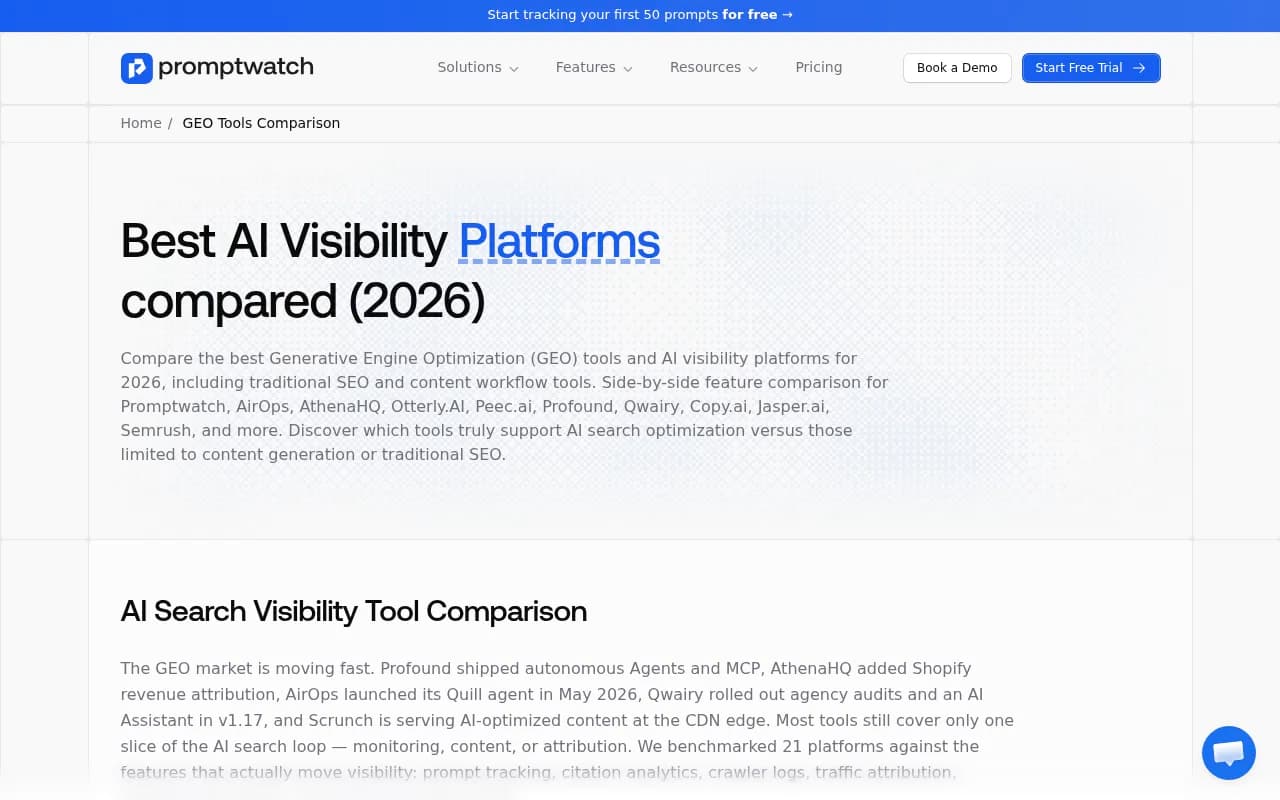
Pricing: $99/month for Essential (1 site, 50 prompts, 5 articles), $249/month for Professional (2 sites, 150 prompts, 15 articles, crawler logs), $579/month for Business (5 sites, 350 prompts, 30 articles). There's a free trial.
For the features you get, the Professional plan at $249/month competes favorably with Peec's Advanced plan at $495/month, and it includes content generation that Peec doesn't have at any price.
What the 50-prompt test actually revealed
Running the same prompts through all four platforms surfaced some patterns worth knowing:
Coverage varies more than you'd expect. The same prompt returned different citation data across platforms, partly because of when they last refreshed their data and partly because of how each platform queries AI models. Promptwatch and Profound had the most consistent coverage. Otterly occasionally missed citations that the others caught.
The "monitoring-only" ceiling is real. After running the test, I had four dashboards showing me visibility scores. Three of them left me with the same question: okay, so what do I do now? Only one platform had an answer built into the product.
Crawler data changes how you think about the problem. Seeing which pages AI models actually visit (and which ones they ignore or hit errors on) reframes AI visibility from a content marketing problem into a technical and content problem. You can't get that from a monitoring dashboard.
Price doesn't correlate with usefulness for most teams. Profound is the most expensive and the most data-rich, but that data is only useful if you have the team to act on it. For a 5-person marketing team, Profound's reports would sit unread. Promptwatch's content generation loop would actually get used.
Head-to-head feature comparison
| Feature | Otterly.AI | Peec AI | Profound | Promptwatch |
|---|---|---|---|---|
| AI model coverage | 4-5 models | 3-10 models | 10+ models | 10 models |
| Prompt tracking | Yes | Yes | Yes | Yes |
| Citation analytics | Basic | Good | Excellent | Good |
| Answer gap analysis | No | No | No | Yes |
| Content generation | No | No | No | Yes |
| AI crawler logs | No | No | No | Yes |
| Traffic attribution | No | No | No | Yes |
| Reddit/YouTube insights | No | No | No | Yes |
| ChatGPT Shopping tracking | No | No | No | Yes |
| Multi-country | No | Advanced plan | Yes | Yes |
| Starting price | $29/mo | $95/mo | ~$499/mo | $99/mo |
Who should use which platform
Use Otterly.AI if you're just starting out, have a tight budget, and want to confirm whether AI search is worth paying attention to for your brand. It's the lowest-friction way to get a first look.
Use Peec AI if you're a mid-market brand that needs clean, presentation-ready analytics and you have a separate content team that can act on the data. The reporting is solid and the interface is fast.
Use Profound if you're an enterprise with a dedicated analytics function, Fortune 500-level budget, and you need the deepest possible reporting across the most AI engines. The depth is real.
Use Promptwatch if you want to actually improve your AI visibility, not just measure it. The monitoring is comparable to Peec, the price is lower than Profound, and the content generation and crawler logs mean you can move from data to action without switching tools. It's the right choice for most marketing teams and agencies.
The bigger picture
The AI visibility tools market is going through the same maturation arc that SEO tools went through a decade ago. First came the rank trackers. Then came the platforms that helped you do something about your rankings.
Most AI visibility tools right now are still rank trackers. They show you a number. The category is moving toward optimization, but slowly.
Promptwatch is the furthest along that path of the four platforms tested here. That's not a permanent advantage — Peec and Profound will likely add content and optimization features over time. But in mid-2026, if you need to actually move the needle on AI search visibility, not just measure it, Promptwatch is the only platform in this group that gives you the full toolkit.
The monitoring-only tools have their place. Otterly at $29/month is a fine way to start. But if you're serious about AI search as a channel, you'll outgrow a dashboard quickly.