Key takeaways
- Otterly.AI is a solid entry-level monitoring tool, but it lacks crawler log visibility, content optimization, and actionable gap analysis -- the things you actually need to improve AI citations.
- Crawler log monitoring (seeing which AI bots visit your site, which pages they read, and when those pages get cited) is a rare feature in this category. Most tools don't have it at all.
- The market has split into two camps: cheap monitoring dashboards that show you data, and more expensive action-oriented platforms that help you do something about it.
- If crawler logs are your primary need, Promptwatch is currently the only platform in this list that combines real-time AI crawler monitoring with content gap analysis and content generation in one workflow.
- Picking the right tool depends heavily on whether you need to watch your AI visibility or improve it.
There's a frustrating pattern with AI visibility tools right now. You sign up, connect your brand, set up some prompts, and then... you watch. You watch ChatGPT mention your competitors. You watch your citation rate hover at 30%. You watch the dashboard refresh every week with slightly different numbers and no clear explanation of why.
Otterly.AI is a good example of this. It's genuinely useful for getting a quick read on where your brand appears across AI search engines. But the moment you ask "what do I do about this?" -- the tool goes quiet.
The bigger gap, though, is crawler log monitoring. Most AI visibility tools have no idea what's happening between an AI bot visiting your website and that bot eventually citing you (or not). They measure outputs -- citations, mentions, brand coverage -- without any visibility into the process that produces those outputs.
This guide covers nine alternatives, with a specific focus on which ones actually show you what AI crawlers are doing on your site.
What crawler log monitoring actually means (and why it matters)
When ChatGPT, Perplexity, or Claude builds a response that cites a webpage, there's a process behind it. A crawler visits the page. It reads the content. It indexes it. Eventually, the model uses it. Or doesn't.
Crawler log monitoring means you can see that process. You get logs showing which AI bots (GPTBot, PerplexityBot, ClaudeBot, etc.) visited your site, which specific URLs they crawled, how often they return, what HTTP errors they encountered, and -- critically -- how long it takes from first crawl to first citation.
Why does this matter? Because if your pages aren't being crawled, no amount of content optimization will help. If a bot is hitting your site and getting 404 errors or slow load times, you need to know. And if you publish a new article targeting an AI search gap, you want to know when the bots find it -- not just hope it eventually shows up in your citation data.
Most tools in this category skip this entirely. They measure the end result (citations) without any visibility into the pipeline that produces them.
The 9 alternatives, ranked by how much they actually help
1. Promptwatch -- the only tool with full crawler log monitoring plus content optimization
Promptwatch is the most complete option here, and the crawler log feature is what separates it from everything else on this list.
The AI Crawler Logs give you real-time visibility into which AI agents (ChatGPT's GPTBot, Perplexity's bot, Claude's crawler, and others) are hitting your website. You can see which pages they read, any errors they encounter, how frequently they return, and the timeline from crawl to citation. That last part -- the crawl-to-citation timeline -- is genuinely useful for understanding how quickly your new content gets picked up.
But crawler logs are just one piece. The reason Promptwatch sits at the top of this list is the full workflow it supports:
- Answer Gap Analysis shows which prompts competitors rank for that you don't, with specific content recommendations for closing those gaps
- Content Agents generate articles, comparisons, and briefs grounded in actual prompt data and citation patterns -- not generic SEO templates
- Page-level tracking shows exactly which of your pages are being cited, by which AI models, and how often
- Prompt Intelligence gives you volume estimates and difficulty scores so you can prioritize which gaps to close first
The pricing starts at $99/month for the Essential plan (1 site, 50 prompts, 5 articles), with the Professional plan at $249/month adding crawler logs, visitor analytics, and state/city tracking. If crawler log monitoring is a hard requirement, you need at least the Professional tier.
It monitors 10 AI models: ChatGPT, Perplexity, Google AI Overviews, Google AI Mode, Claude, Gemini, Meta/Llama, DeepSeek, Grok, and Copilot.
The honest caveat: it's not the cheapest option here. If you genuinely only need basic brand monitoring and have no interest in optimization, there are cheaper tools below.
2. Profound -- enterprise analytics with strong citation tracking
Profound is aimed squarely at enterprise marketing teams. It has solid AI search visibility analytics, good competitor comparison features, and reasonably detailed citation tracking. The data quality is generally high, and the reporting is polished enough for executive presentations.
What it doesn't have: crawler log monitoring. Profound can tell you that your citation rate dropped this week, but it can't tell you whether GPTBot stopped crawling your blog or started hitting 503 errors on your product pages. It's a measurement tool, not a diagnostic one.
Pricing starts around $199/month, which puts it in a similar bracket to Promptwatch's Professional plan. For pure analytics depth at enterprise scale, it's a strong option. For teams that need to understand the why behind their citation data, it falls short.
3. Scrunch AI -- good for agencies, limited on optimization
Scrunch AI has built a reasonably capable monitoring platform with decent competitor analysis and multi-brand support that works well for agencies managing multiple clients. The interface is clean and the reporting is presentable.
The limitation is the same one that affects most tools in this category: it's a monitoring dashboard. You can see what's happening with your AI citations, but the path from "I see a problem" to "I've fixed it" requires you to leave the tool and figure things out yourself.
Starts at $300/month, which is on the higher end for what you get. No crawler log monitoring.
4. Peec AI -- affordable entry point for smaller teams
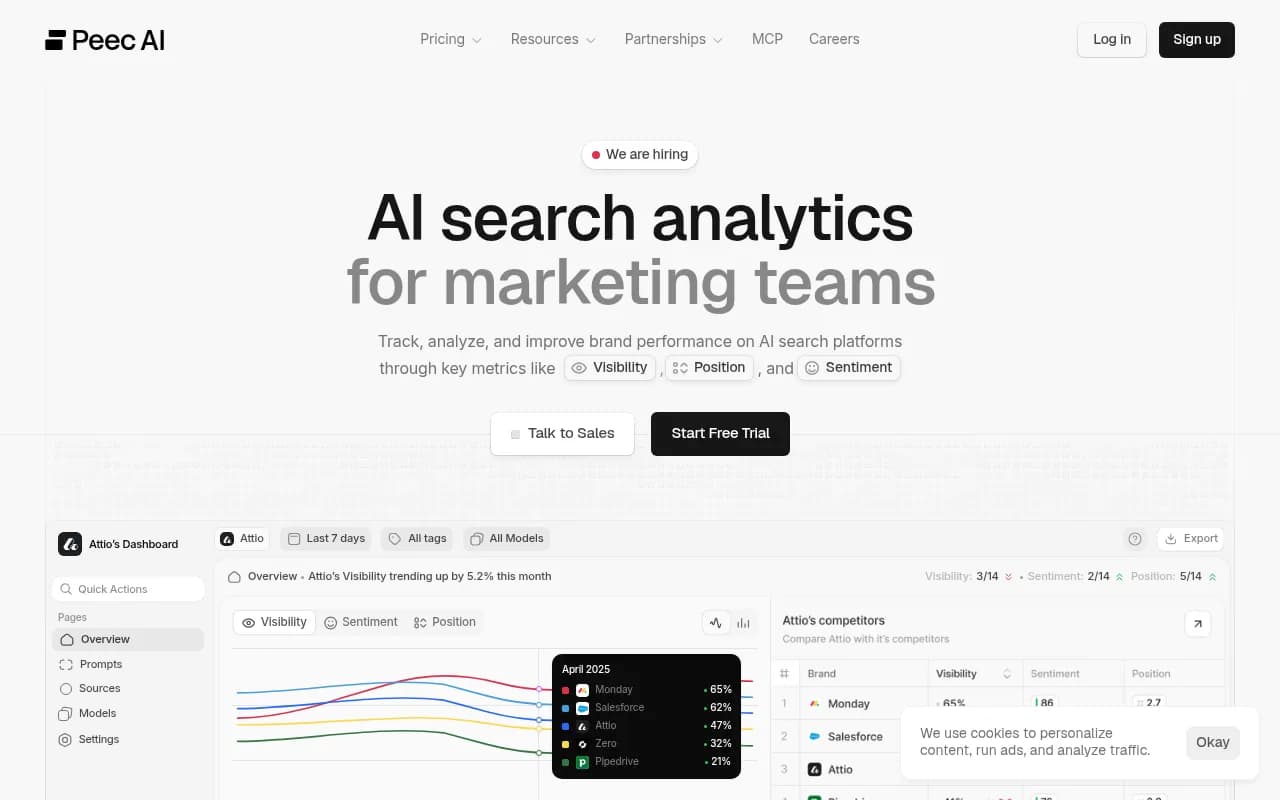
Peec AI is one of the more affordable options in this space, starting at $79/month. It covers the basics -- brand mention tracking across major AI platforms, some competitor visibility data, and a reasonably clean interface.
For small teams or solo marketers who just want to know whether they're appearing in AI responses, it does the job. The "smart suggestions" feature gives some directional guidance, though it's fairly surface-level compared to a full gap analysis.
No crawler logs. No content generation. But at $79/month, you're not paying for those things either.
5. Ahrefs Brand Radar -- familiar tool, limited AI depth
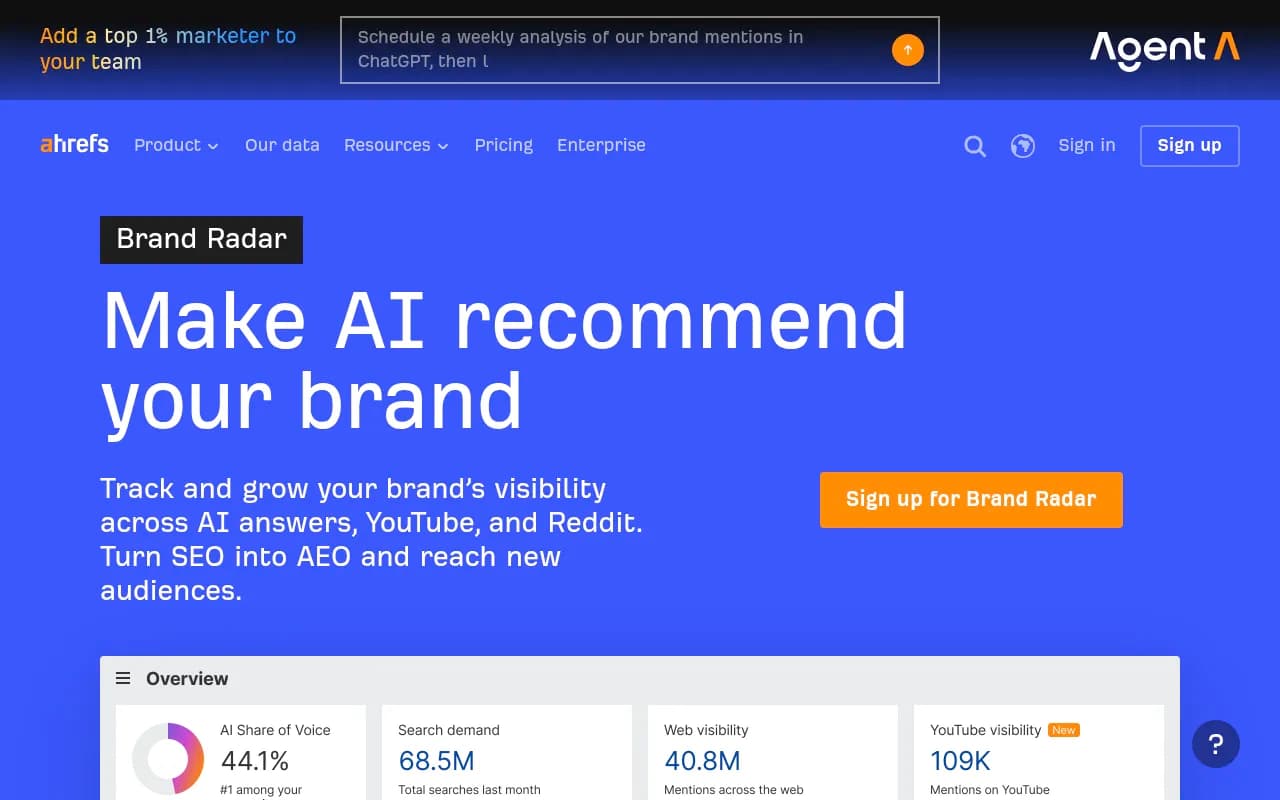
If your team is already deep in the Ahrefs ecosystem, Brand Radar is a natural addition. It tracks brand mentions across AI search engines and integrates with the broader Ahrefs data set, which is genuinely useful for connecting AI visibility to traditional SEO metrics.
The downsides are real, though. Brand Radar uses fixed prompts rather than letting you define your own, which means you're tracking what Ahrefs thinks is relevant rather than what actually matters to your business. There's no AI traffic attribution, no crawler logs, and no content optimization workflow.
It's included with Ahrefs plans starting at $129/month. Worth using if you're already paying for Ahrefs. Not worth switching to Ahrefs for.
6. Semrush AI Visibility Toolkit -- broad platform, shallow AI monitoring
Semrush has added AI visibility features to its platform, and for teams already using Semrush for traditional SEO, the integration is convenient. You get brand monitoring across AI platforms alongside keyword research, backlink data, and all the other Semrush features.
The AI-specific depth is limited, though. Like Ahrefs, Semrush uses fixed prompts rather than custom ones. The AI monitoring feels like an add-on to an SEO platform rather than a purpose-built GEO tool. No crawler logs, no content gap analysis specific to AI search.
Starting at $139.95/month for the base plan. Good if you need a broad SEO platform that includes some AI monitoring. Not the right choice if AI visibility is your primary focus.
7. Nightwatch -- rank tracking with AI visibility added on
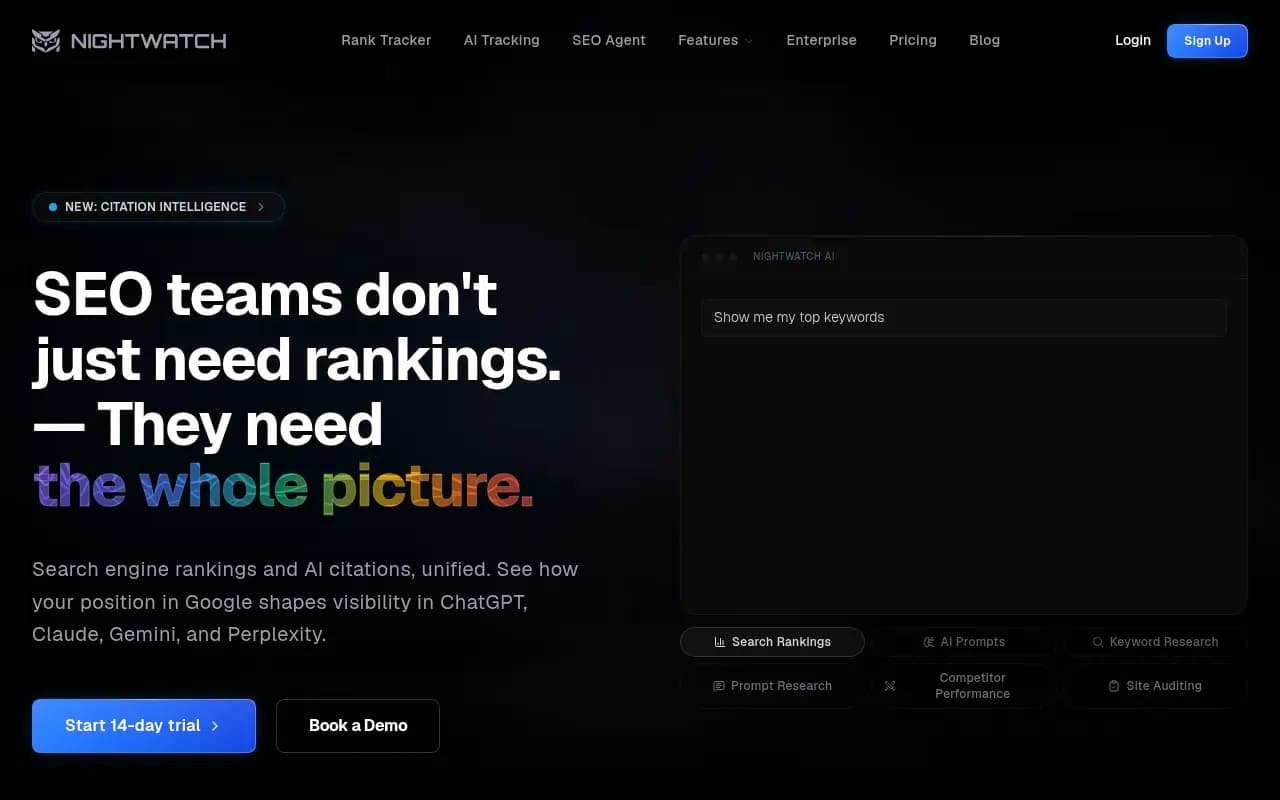
Nightwatch built its reputation on traditional rank tracking and has expanded into AI visibility monitoring. The platform is reliable and the interface is well-designed. If you're already using Nightwatch for rank tracking, the AI visibility features are a reasonable extension.
The AI monitoring capabilities are more limited than dedicated GEO tools. It covers the major AI platforms but lacks the depth of prompt intelligence, gap analysis, or crawler monitoring that you'd get from a purpose-built platform. Think of it as rank tracking with AI visibility as a secondary feature rather than the core product.
8. SE Ranking Visible -- solid mid-tier option
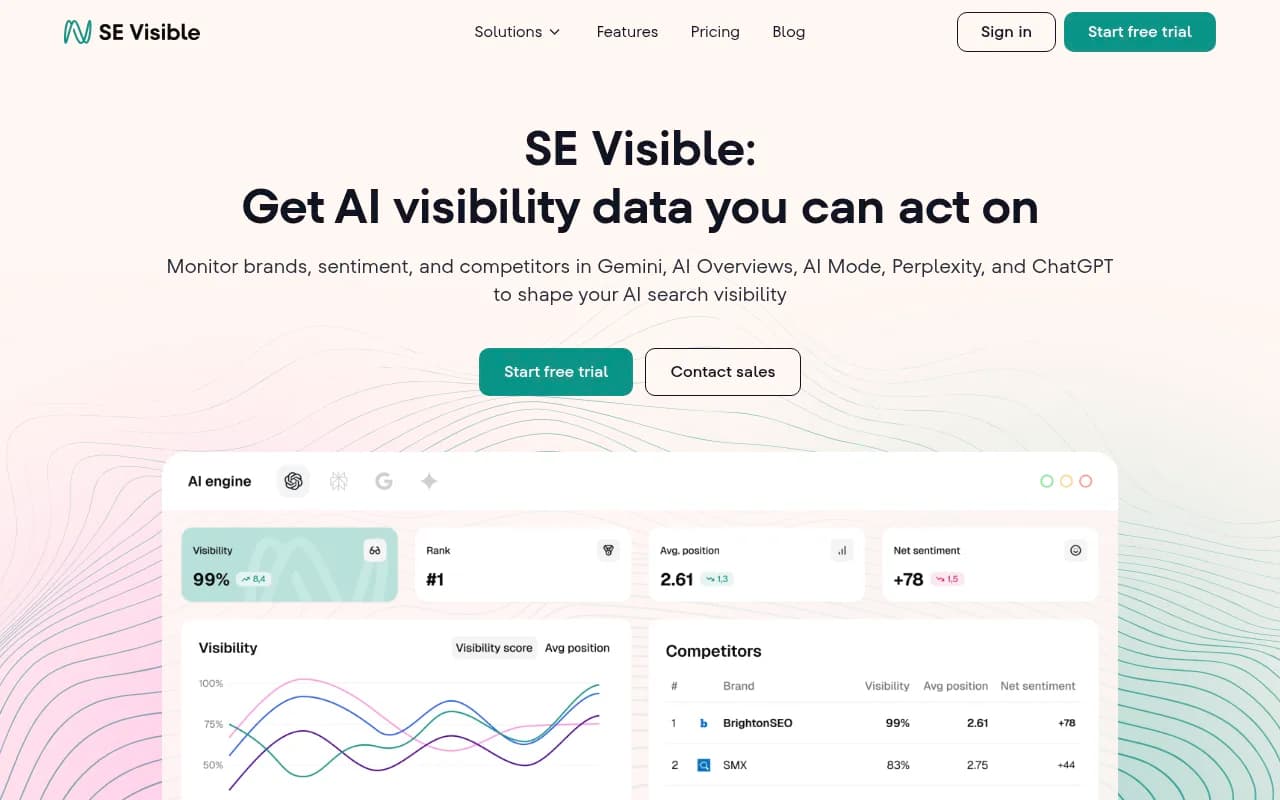
SE Ranking's AI visibility product (Visible) sits in the mid-tier of this market. It tracks brand mentions and citations across AI platforms, has reasonable competitor analysis, and is priced more accessibly than enterprise options.
The interface is functional without being particularly impressive. No crawler logs, no content generation. But for teams that want more than Peec AI's basic monitoring without paying Profound's enterprise prices, it's a reasonable middle ground.
9. AthenaHQ -- monitoring-focused with clean UX
AthenaHQ has a clean, well-designed interface and covers the monitoring basics competently. Brand tracking across major AI platforms, competitor comparisons, and some reporting features that work well for stakeholder updates.
It's firmly in the monitoring-only camp, though. No crawler logs, no content optimization, no gap analysis. The UX is genuinely good, which makes it worth considering if your primary need is a clean dashboard for tracking AI visibility without needing to act on it.
Side-by-side comparison
| Tool | Crawler log monitoring | Content gap analysis | Content generation | Custom prompts | Starting price |
|---|---|---|---|---|---|
| Promptwatch | Yes (Pro+) | Yes | Yes | Yes | $99/mo |
| Profound | No | Limited | No | Yes | $199/mo |
| Scrunch AI | No | No | No | Yes | $300/mo |
| Peec AI | No | Basic | No | Yes | $79/mo |
| Ahrefs Brand Radar | No | No | No | Fixed only | $129/mo (Ahrefs) |
| Semrush AI Toolkit | No | No | No | Fixed only | $139.95/mo |
| Nightwatch | No | No | No | Yes | Custom |
| SE Ranking Visible | No | No | No | Yes | Custom |
| AthenaHQ | No | No | No | Yes | Custom |
The table makes the gap obvious. Crawler log monitoring is essentially a single-tool feature in this market right now. If that's what you need, the decision is straightforward.
Why Otterly.AI falls short for teams that want to improve (not just watch)
Otterly.AI is genuinely useful for what it does. It's affordable, relatively easy to set up, and gives you a decent read on brand coverage across AI platforms. For teams that are just starting to think about AI visibility and want to understand the landscape before committing to a more expensive tool, it's a reasonable starting point.
The problem is the ceiling. As one user put it, Otterly "tracks the source, but gives zero actionable strategy on how to restructure content to get cited." That's a fair description. The weekly update cycle also means you're always looking at data that's at least several days old -- a real limitation when AI search results shift frequently.
For teams that have moved past the "what's my AI visibility?" question and are now asking "how do I improve it?" -- Otterly isn't built for that workflow.
How to choose based on what you actually need
The market has split into two fairly distinct camps, and the right choice depends on which camp you're in.
If you need to monitor AI visibility on a budget, Peec AI at $79/month or Otterly.AI are the most accessible options. They'll tell you where you're appearing and where you're not. They won't tell you why or what to do about it.
If you need to improve AI visibility and understand the full pipeline, Promptwatch is the only tool that covers crawler log monitoring, content gap analysis, and content generation in a single workflow. The Professional plan at $249/month is the minimum tier for crawler logs. For teams running multiple sites or managing clients, the Business plan at $579/month covers up to 5 sites.
If you're an enterprise team that needs deep analytics and polished reporting but doesn't need crawler logs or content generation, Profound at $199/month is worth evaluating.
If you're already paying for Ahrefs or Semrush and just want to add some AI visibility data without switching platforms, their respective AI features are the path of least resistance -- just go in with realistic expectations about depth.
The one thing worth being clear about: no tool in this list (or the broader market) makes AI visibility automatic. The tools that go beyond monitoring still require you to act on the data -- publish the content, fix the technical issues, build the citations. The difference is whether your tool helps you figure out what to do, or just shows you a number and leaves you to work it out yourself.
For most teams that have moved past the curiosity phase and are treating AI search as a real channel, the monitoring-only tools start feeling limiting pretty quickly. The crawl-to-citation pipeline is where the real diagnostic value lives, and right now, that's a feature set that very few tools have built.