Key takeaways
- Hall is a solid entry-level AI presence monitoring tool, but it lacks the depth enterprise teams need: no content generation, limited competitor analysis, and no crawler-level data
- The best alternatives in 2026 go beyond monitoring to help you actually fix visibility gaps, with features like content gap analysis, AI crawler logs, and prompt-level tracking
- Platforms like Promptwatch, Profound, and Scrunch AI are built for scale; tools like Otterly.AI and Peec AI are better fits for smaller teams or tighter budgets
- Enterprise buyers should prioritize: multi-model coverage, prompt volume data, content optimization workflows, and traffic attribution, not just a dashboard that shows where you're missing
- Most tools in this space are monitoring-only; very few close the loop from "you're invisible here" to "here's the content that will fix it"
Hall has carved out a niche as a straightforward AI presence monitoring tool. You connect it to your brand, it watches how you appear in ChatGPT, Gemini, Perplexity, and a handful of other models, and it reports back. For a solo marketer or a small team just getting started with generative engine optimization (GEO), that's genuinely useful.
But enterprise teams hit the ceiling fast.
When you're managing multiple brands, competing across dozens of high-stakes prompts, trying to understand why a competitor keeps showing up and you don't, and then actually doing something about it, Hall's feature set starts to feel thin. There's no content generation. No crawler log analysis. No prompt volume data to help you prioritize. No way to close the loop between "we're invisible here" and "here's the content that fixes it."
This guide covers the alternatives that actually scale, what each one does well, where they fall short, and how to pick the right one for your team.
What Hall does (and where it stops)
Hall monitors brand mentions and citations across AI-generated responses. It tracks how often your brand appears when users ask questions in tools like ChatGPT or Perplexity, and it gives you a visibility score over time.
That's the good part. The limitations show up when you ask harder questions:
- Which specific prompts are driving competitor visibility that we're missing?
- What content should we create to close those gaps?
- Which pages on our site are AI crawlers actually reading?
- How do we connect AI visibility to actual traffic and revenue?
Hall doesn't answer those questions well, if at all. That's the gap the alternatives below are designed to fill.
The best Hall AI alternatives for enterprise teams in 2026
Promptwatch: the full action loop, not just monitoring
Promptwatch is the most complete platform in this space right now, and the reason is structural: it's built around doing something with the data, not just collecting it.

Most tools show you a visibility score. Promptwatch shows you the score, then tells you exactly which prompts your competitors are winning that you're not, generates the content to close those gaps, and tracks whether that content actually gets cited after you publish it. That cycle, find gaps, create content, track results, is what separates it from the monitoring-only crowd.
For enterprise teams specifically, a few things stand out. The AI Crawler Logs feature is genuinely rare: you can see which pages ChatGPT, Claude, Perplexity, and others are actually crawling, how often they return, and whether there are errors stopping them from indexing your content. Most competitors don't offer this at all. The platform also covers 10 AI models (including Google AI Overviews, Grok, DeepSeek, and Mistral), tracks ChatGPT Shopping appearances, and supports multi-region and multi-language monitoring.
Pricing starts at $99/month for a single site, with the Professional plan at $249/month covering crawler logs and city-level tracking, and Business at $579/month for five sites. Agency and enterprise pricing is custom.
If your team needs to move from "we know we're invisible" to "we fixed it and can prove it," Promptwatch is the clearest path there.
Profound: enterprise analytics with real depth
Profound sits at the enterprise end of the market and earns it. The platform is strong on analytics, particularly for teams that need to understand AI visibility across large content libraries and multiple product lines. It has solid competitor benchmarking and decent activation features.
Where it falls short relative to Promptwatch: no Reddit or YouTube tracking (both of which influence AI recommendations more than most teams realize), no ChatGPT Shopping monitoring, and pricing that tends to run higher for comparable feature sets. It's a good fit for large in-house teams that already have content production capacity and just need the intelligence layer.
Scrunch AI: brand narrative monitoring done well
Scrunch AI focuses on how your brand is being described and positioned in AI responses, not just whether you appear. That's a meaningful distinction. If your brand keeps showing up but the AI is saying something inaccurate or unflattering about you, that's a problem monitoring-only tools often miss.
For enterprise brand and communications teams, Scrunch AI's narrative analysis is genuinely useful. It's less strong on the content creation and optimization side, so it works best as a complement to a broader GEO workflow rather than a standalone solution.
AthenaHQ: solid GEO strategy stack
AthenaHQ has built a respectable GEO strategy platform with good prompt tracking and competitive analysis. The interface is clean, and the prompt-level data is more granular than what Hall offers.
The limitation is that it's still primarily a monitoring and strategy tool. Content generation and optimization workflows aren't its strength, so teams using AthenaHQ typically need to pair it with a separate content production process. That adds friction, especially at scale.
Peec AI: cross-engine reporting for mid-market teams
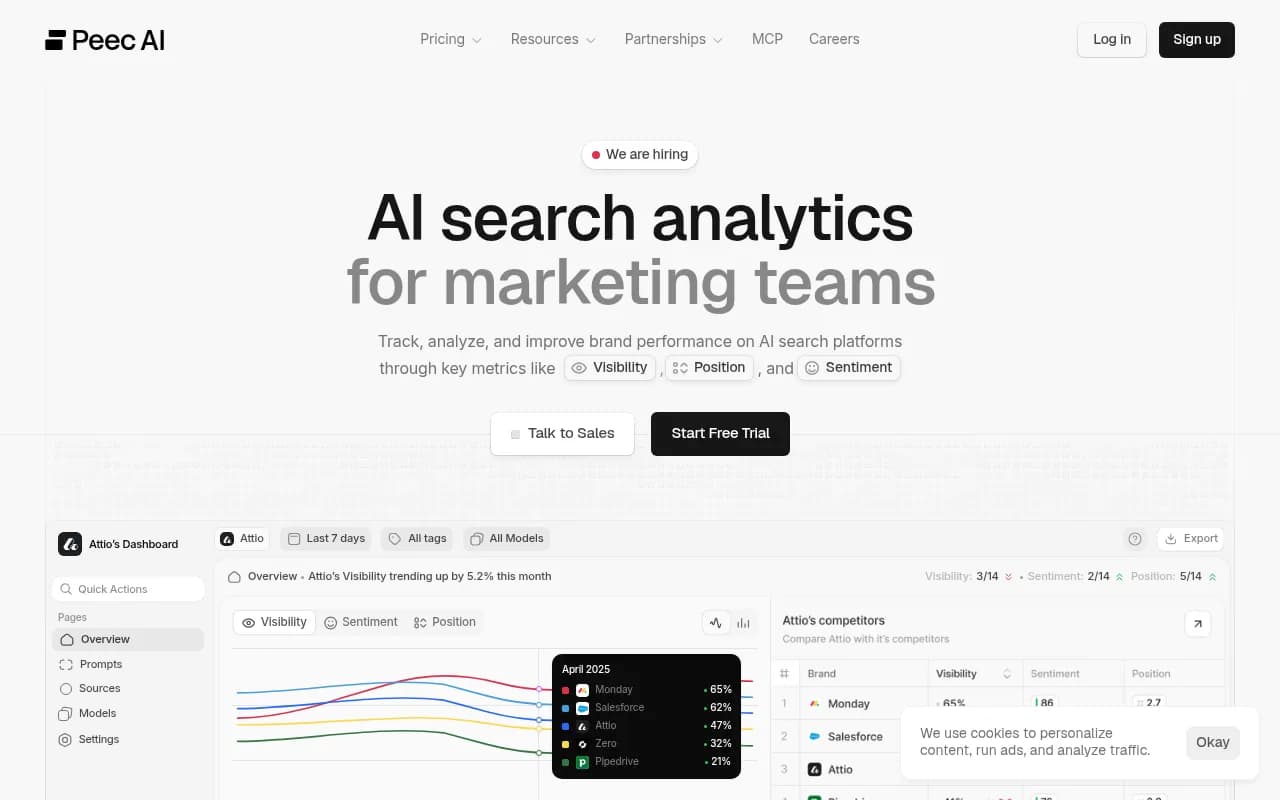
Peec AI is worth considering if your main need is clean, exportable reporting across multiple AI engines. It handles cross-engine visibility well and produces reports that are easy to share with stakeholders who aren't deep in GEO.
It's not an enterprise-grade platform in terms of depth, but for a mid-market team that needs solid visibility data without a heavy implementation lift, it's a reasonable Hall alternative. No crawler logs, no content generation, but the core tracking is reliable.
Otterly.AI: the budget-friendly starting point
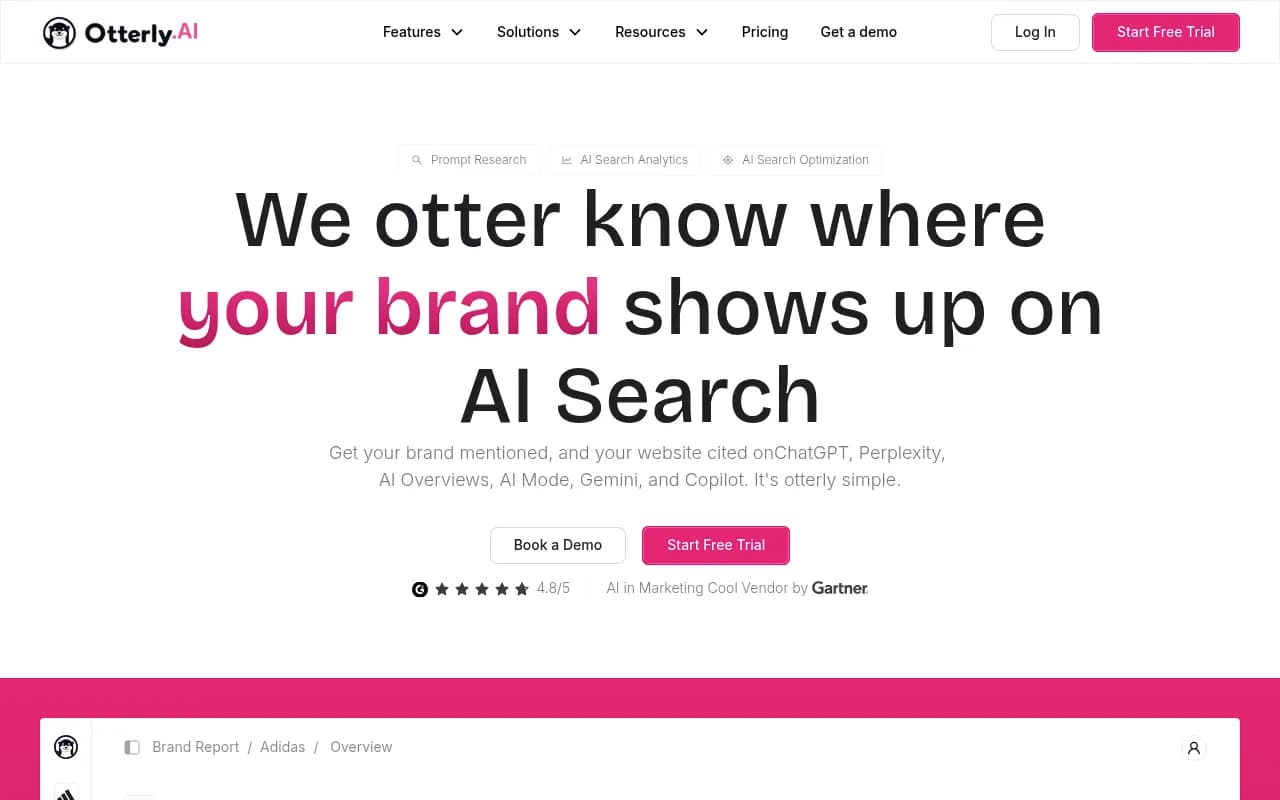
Otterly.AI is the most accessible option on this list. It's affordable, straightforward, and covers the basics of LLM brand tracking without requiring a significant time investment to set up.
For enterprise teams, it's probably not enough on its own. But it's a reasonable choice for a team that wants to start tracking AI visibility while a larger platform decision is still being evaluated, or for a smaller brand within a larger portfolio that doesn't justify a full enterprise subscription.
Radarkit: agencies and content teams
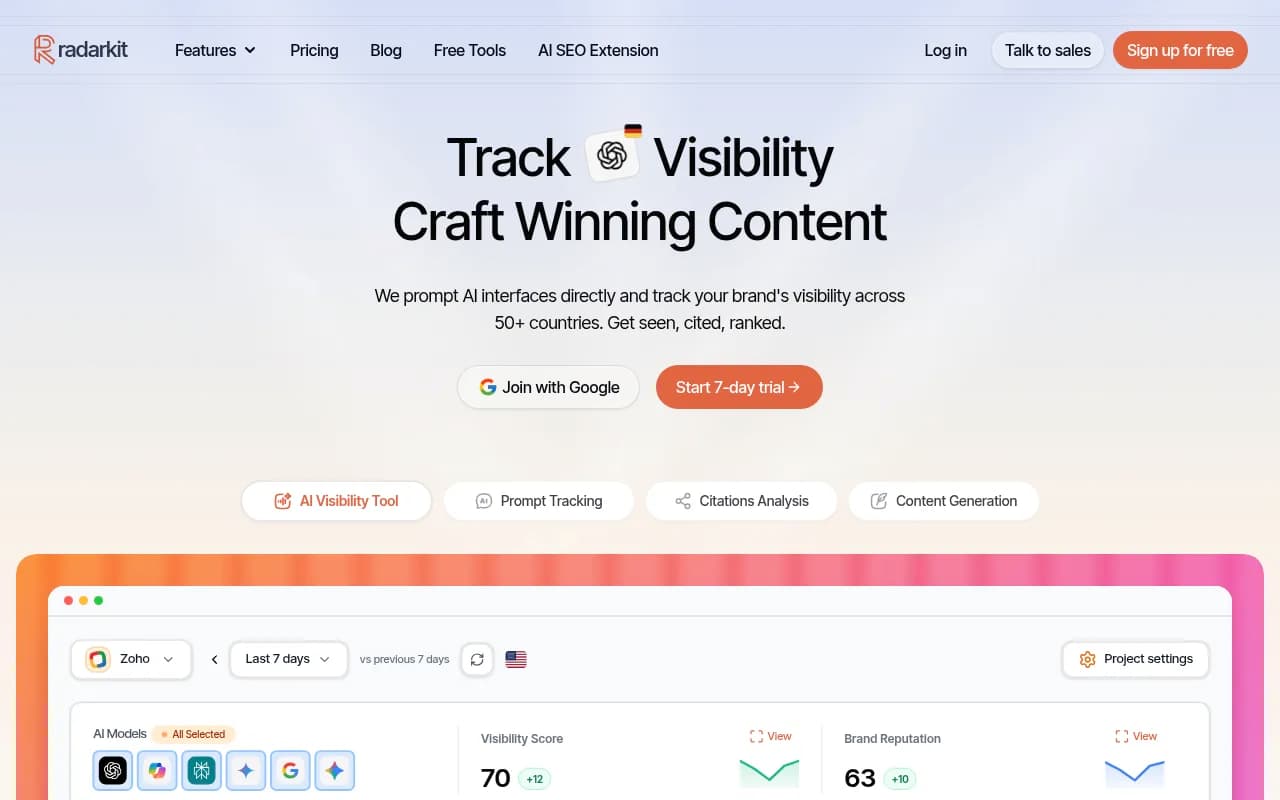
Radarkit is well-suited for agencies managing multiple client brands across AI search. The multi-client dashboard is cleaner than most, and the GEO visibility tracking covers the major models without being overwhelming.
It doesn't go deep on content optimization or crawler analysis, but for an agency that needs to show clients where they stand across AI engines and generate clear reports, it's a practical choice.
SE Ranking: for teams already in the SE Ranking ecosystem
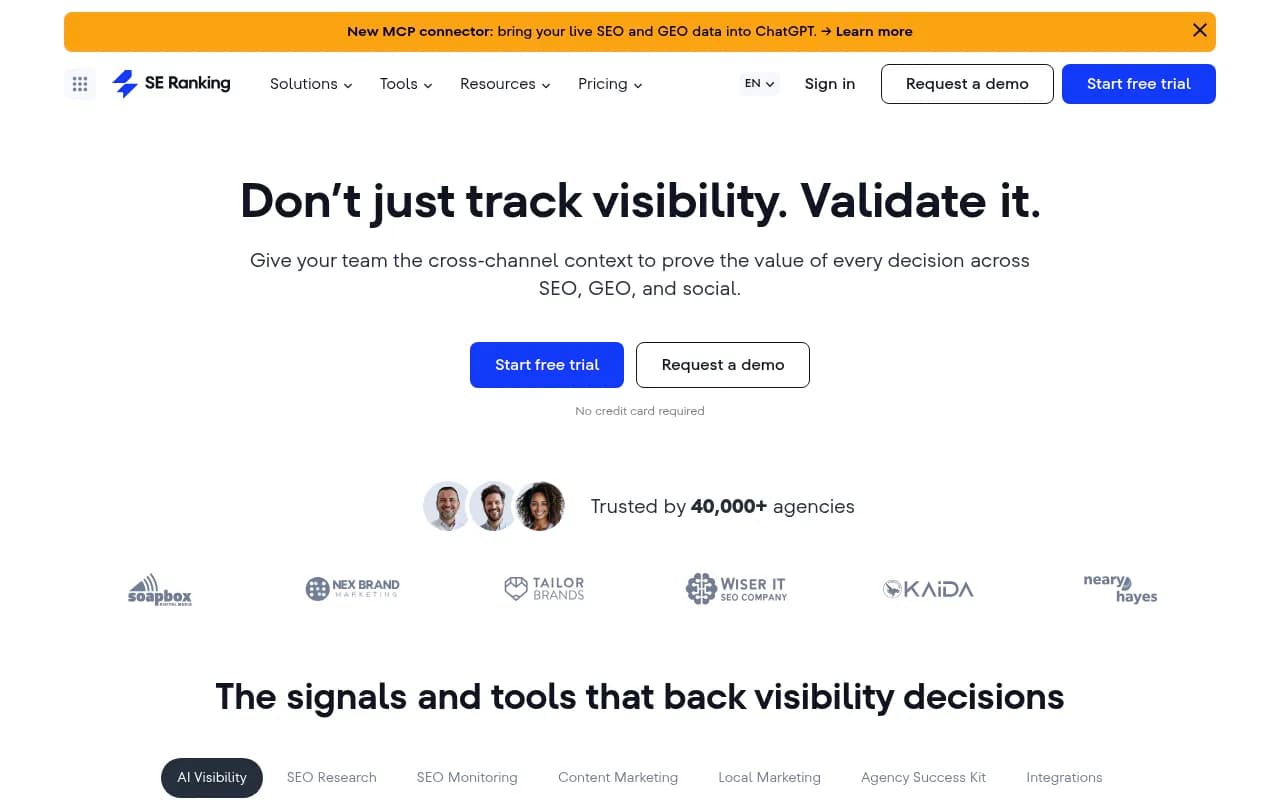
If your team already uses SE Ranking for traditional SEO, the AI visibility tracking built into the platform is a natural extension. You get GEO monitoring alongside your existing rank tracking, keyword research, and site audit tools without adding another vendor.
The AI visibility features are solid but not class-leading. For a team that wants one platform to handle both traditional and AI search, it's a reasonable consolidation play.
LLMrefs: keyword-first GEO for SEO-oriented teams
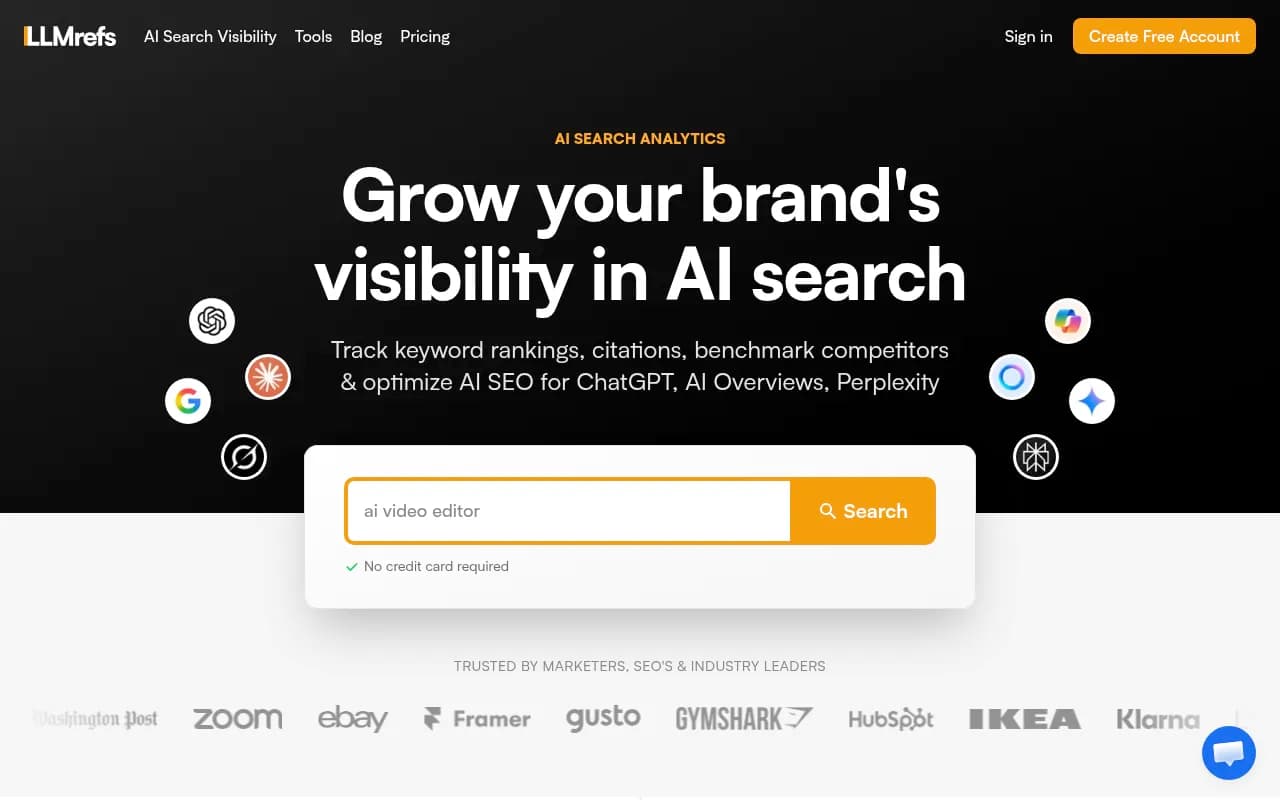
LLMrefs approaches AI visibility from a keyword and query perspective, which makes it feel familiar to teams with a strong SEO background. If your workflow is built around keyword research and content briefs, LLMrefs fits that model better than most GEO-native tools.
The trade-off is that it's narrower in scope. It doesn't cover the full monitoring-to-optimization loop, but for teams that just need better query intelligence to feed into their existing content process, it's worth evaluating.
ZipTie: focused on AI Overviews and traffic impact
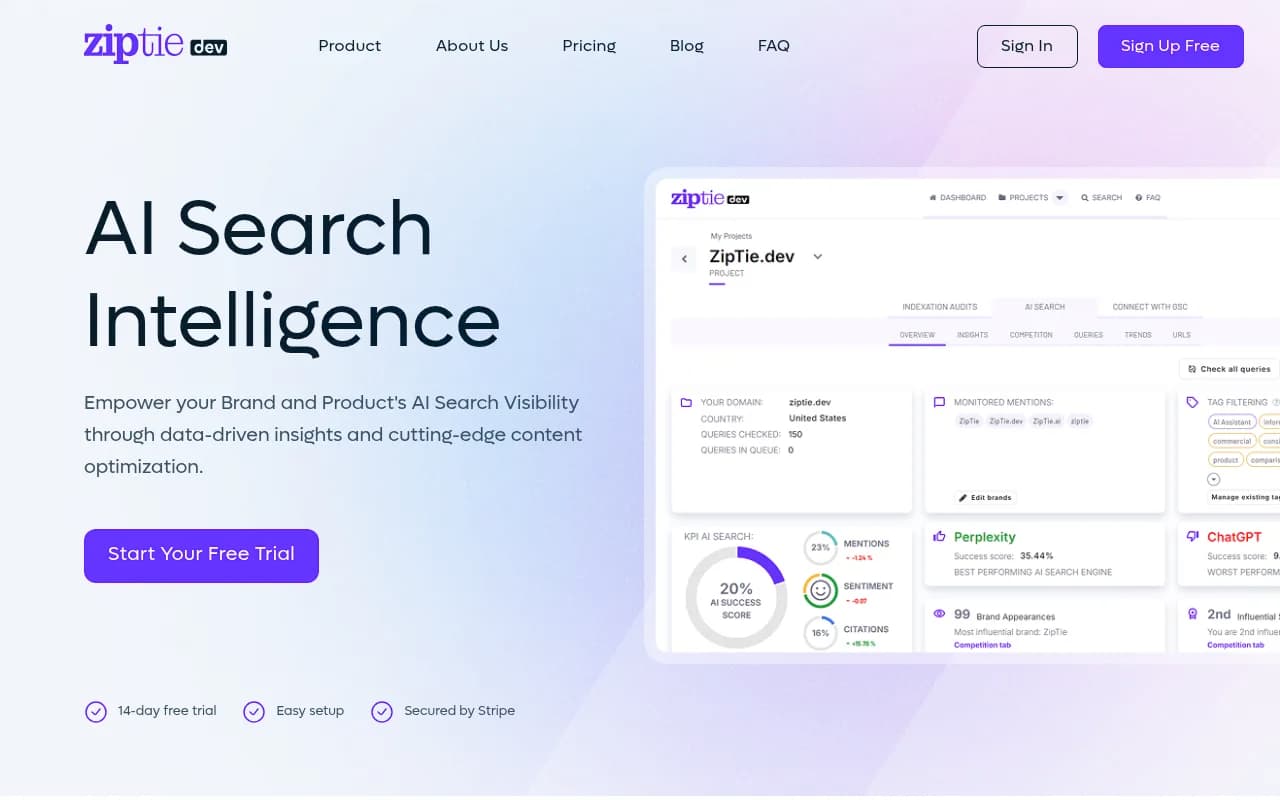
ZipTie has a specific focus on Google AI Overviews and the traffic implications of appearing (or not appearing) in them. For teams where Google AI Overviews is the primary concern, that focus is a feature, not a limitation.
It's not a broad multi-model platform, but if AI Overviews visibility is your most pressing problem, ZipTie is one of the more targeted tools for that specific use case.
How these platforms compare
| Platform | Multi-model coverage | Content generation | Crawler logs | Prompt volume data | ChatGPT Shopping | Best for |
|---|---|---|---|---|---|---|
| Promptwatch | 10 models | Yes | Yes | Yes | Yes | Enterprise teams needing full action loop |
| Profound | 6+ models | Partial | No | Limited | No | Large in-house analytics teams |
| Scrunch AI | Multiple | No | No | No | No | Brand narrative monitoring |
| AthenaHQ | Multiple | No | No | Partial | No | GEO strategy and competitive analysis |
| Peec AI | Multiple | No | No | No | No | Mid-market cross-engine reporting |
| Otterly.AI | Multiple | No | No | No | No | Budget-friendly starter tracking |
| Radarkit | Multiple | No | No | No | No | Agencies managing multiple clients |
| SE Ranking | Multiple | No | No | No | No | Teams already using SE Ranking |
| LLMrefs | Multiple | No | No | Yes | No | SEO-oriented teams, query intelligence |
| ZipTie | Google-focused | No | No | No | No | AI Overviews traffic impact |
What enterprise teams should actually look for
The monitoring-only category is crowded. Before picking a platform, it's worth being clear about what you actually need.
Prompt intelligence, not just brand mentions
Knowing that your brand appeared in 34% of responses last month is a start. Knowing which specific prompts drove that, which ones your competitors are winning that you're not, and how much search volume those prompts represent, that's what you can actually act on. Look for platforms that give you prompt-level data with volume estimates and difficulty scores.
Content workflows, not just gap reports
A gap report that tells you "you're not appearing for [prompt X]" is only useful if you can do something about it. The best platforms in 2026 connect that gap directly to a content brief or draft, grounded in real prompt data and competitor analysis. That's the difference between a monitoring tool and an optimization platform.
Crawler visibility
AI models don't cite content they haven't crawled. If your pages have crawl errors, if certain sections of your site are being ignored, or if a model crawled your page once six months ago and hasn't returned, you need to know that. Crawler log analysis is one of the most underrated features in this space, and very few platforms offer it.
Traffic attribution
Ultimately, AI visibility needs to connect to business outcomes. Platforms that can show you which AI citations are driving actual traffic, and ideally revenue, give you something you can take to a CFO. Pure visibility scores are harder to defend in a budget conversation.
Multi-model and multi-region support
Enterprise teams rarely operate in a single market or care about only one AI model. Make sure the platform you choose covers the models your customers actually use, and can monitor responses in the languages and regions that matter to your business.
The honest assessment
Most tools in this category are still monitoring dashboards with a GEO label on them. They show you data, and then they stop. That's fine for teams that just need awareness, but enterprise teams running content operations at scale need more.
The platforms that stand out in 2026 are the ones that close the loop: they show you where you're invisible, tell you why, help you create content that fixes it, and then track whether it worked. That's a much shorter list.
Promptwatch is the most complete version of that loop right now. Profound and Scrunch AI are strong in specific areas. AthenaHQ and Peec AI are solid monitoring tools that work well when paired with a separate content process. And Otterly.AI, Radarkit, and LLMrefs each have a specific context where they make sense.
The right choice depends on where your team is in the GEO maturity curve. If you're just starting to track AI visibility, almost any of these is an upgrade from Hall. If you're trying to systematically improve your position across multiple models and markets, you need a platform that does more than watch.