Key takeaways
- Brand Narrative pulls individual claims AI makes about your brand out of tracked responses. Fact Check then tests a claim against the pages crawled from your own site.
- If your site states a wrong claim, that page is probably where AI learned it. Fix or remove it.
- If a claim is accurate but your site never says it, AI has nothing to cite. Add it to a page.
- Fact Check only reads your own site. It cannot trace a claim that comes from a third-party page, a review site, or a forum.
- Brand Narrative is on every Promptwatch plan. Fact Check is on Business, Agency Scale, and Enterprise, and each check uses agent credits.
The problem: AI is confidently wrong about brands
Ask ChatGPT or Gemini about your product and you will probably get a fluent, confident paragraph. Some of it will be right. Some of it will be stale. Occasionally it will be wrong in a way that costs you deals: a pricing tier you retired two years ago, a feature you do not have, a support policy you changed.
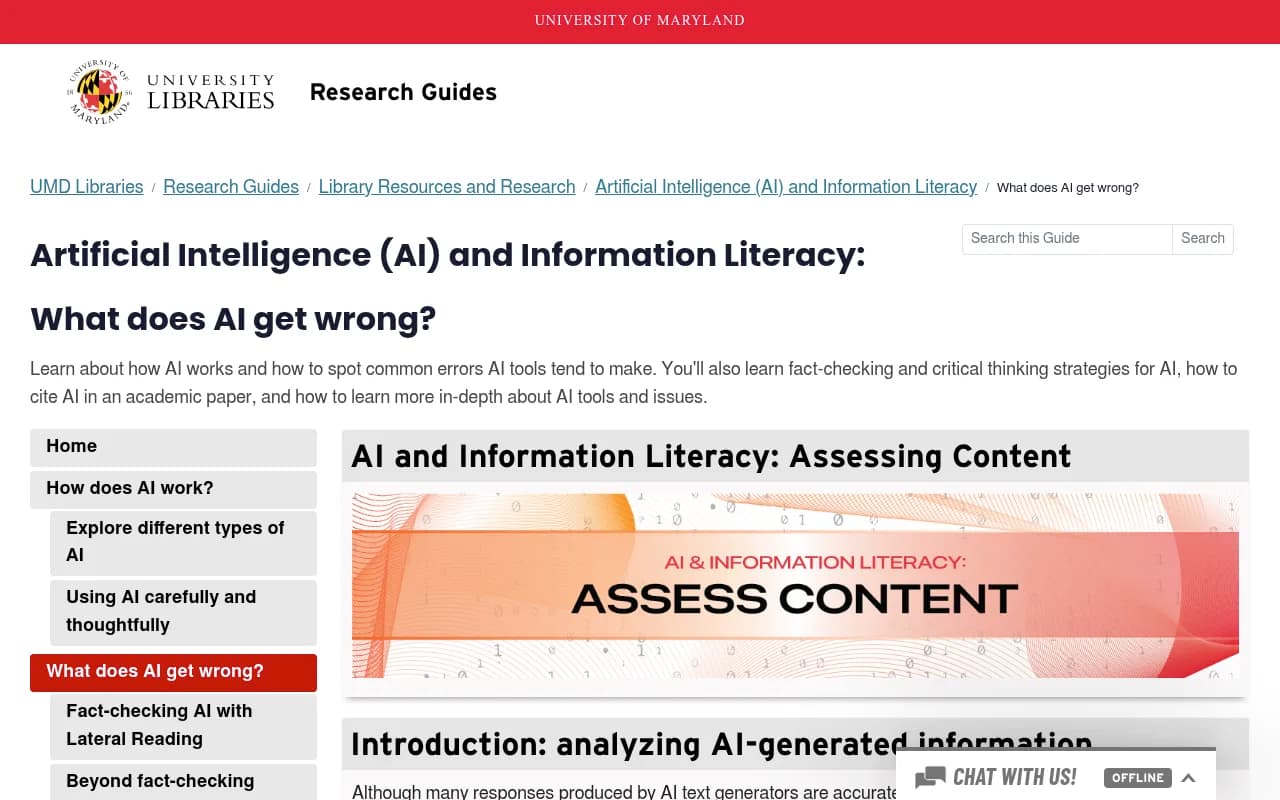
The University of Maryland Libraries put the underlying reason plainly in their guide on AI and information literacy: the model is producing what it believes is the most likely series of words to answer the prompt, and it cannot tell the difference between a correct answer and a plausible one.
For a brand, this matters in a specific way. Forbes quoted Brian Behe, CTO of RIIG Technology: "The danger is not that AI gets things wrong. It is that it gets things wrong in ways that look right, and people act on them before anyone checks." A buyer reading an AI answer about your pricing is not going to fact-check it.
Most of the fact-checking advice you will find online (see the Articulate guide, for example) is written for people checking AI output they are about to publish. Verify the stats, ask for citations, cross-reference trusted sources. That is useful, but it is a different problem. Here the AI output is not yours. It is already out there, being read by your prospects, and you want to know what source taught the model to say it.
What Promptwatch Fact Check actually does
Promptwatch is an end-to-end AI visibility platform: it monitors how AI engines talk about your brand, traces where they get their answers, helps you act on gaps, and measures the result. Fact Check sits in the middle of that loop. It was released on October 30, 2026 together with Brand Narrative, as two new pages under Brand perception.

The two features work as a pair, so it helps to understand each.
Brand Narrative: the claims layer
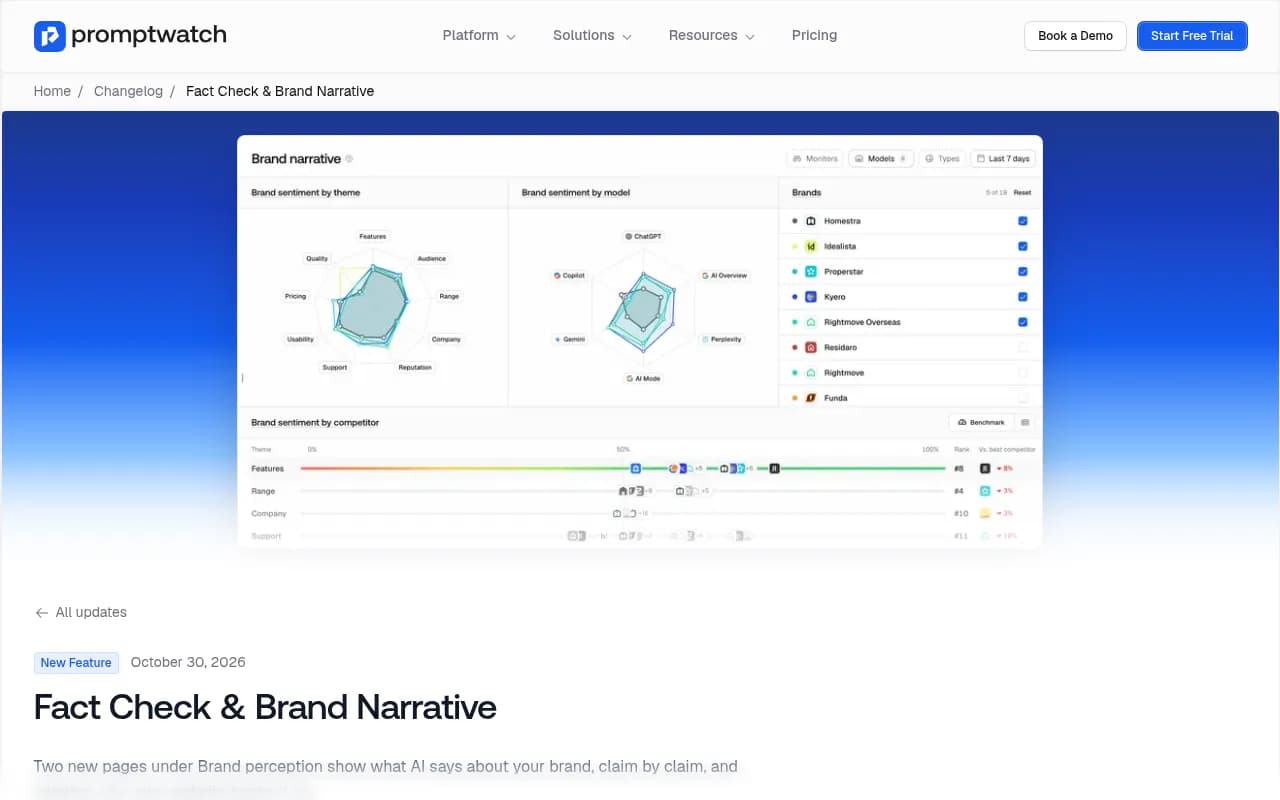
Brand Narrative breaks every tracked AI response into individual claims about you and your competitors. Not a sentiment score for the whole answer, but the statements themselves, like "affordable for small teams" or "its mobile app lacks features."
A few things happen to those claims:
- Repeated claims are grouped, so you see how often AI makes each one and which models make it.
- Each claim is filed under a theme such as Pricing, Features, Support, or Reputation.
- Each claim is scored positive, neutral, negative, or mixed.
- Each theme rolls up into a 0 to 100 score you can compare against competitors.
This part is on every plan. It is useful on its own, because it turns a pile of responses into a short list of things AI believes about you.
Fact Check: the source layer
Fact Check starts from a claim you have already judged. You mark it Accurate or Inaccurate. Promptwatch then reads the pages it has crawled from your site and looks for the ones that state the claim, or state the opposite.
Each check returns the pages it found, the quotes from those pages, and a recommended next step. You see an estimate of the agent credits before it runs, so there is no surprise spend.
The point is the quote. Instead of a vague suspicion that "our site is probably confusing," you get the exact sentence on the exact URL that is teaching AI the wrong thing.
The workflow, step by step
Promptwatch's own recommended sequence is short. Here it is with a bit more detail on how I would run it.
1. Start with the negative claims AI repeats most
Open Brand Narrative and sort by frequency within negative and mixed claims. A claim that appears in a handful of responses on one model is a curiosity. A claim repeated across many responses and several models is a belief the AI ecosystem has settled on.
Check themes too. A low Pricing score against competitors tells you where to look before you read a single claim.
2. Mark the claim Accurate or Inaccurate
This step is manual and it should be. Fact Check cannot decide for you whether "no free plan" is true, because that depends on your business. You are the source of truth.
Be strict. "Mostly right" claims are where people waste credits. If a claim is half true, decide which half matters and mark accordingly.
3. Run the check and read the quotes
There are three outcomes worth understanding.
| What Fact Check finds | What it likely means | What to do |
|---|---|---|
| Wrong claim, and your site states it | That page is a probable source of the error | Update the page so it states the correct fact |
| Accurate claim, and your site does not state it | AI has nothing of yours to cite | Add the fact to a relevant page, plainly worded |
| Pages that disagree with each other | AI sees two answers and may pick the old one | Update or remove the outdated page |
| Wrong claim, and nothing on your site states it | The error likely originates elsewhere | Look at third-party sources (see below) |
The last row is not a feature of the tool. It is an inference you make from an empty result, and I will come back to it.
4. Fix the page, not just the sentence
The changelog example is an old blog post sitting next to a current pricing page. That is the classic case. You updated pricing, but a 2023 post still says the old numbers, and it is indexed, linked internally, and crawled. A model reading both has no reason to trust the newer one.
The options are update, redirect, or remove. Updating is right when the post still has value. Removing or redirecting is right when it exists only as a record of a past state. The goal in Promptwatch's words is that AI sees a single answer.
5. Confirm the fix is readable and then re-measure
A corrected page does nothing if AI crawlers cannot read it. Promptwatch's AI crawler logs show whether bots like GPTBot or ClaudeBot actually fetched the page and whether they hit errors. Then watch Brand Narrative over the following weeks to see whether the claim's frequency drops. Do not expect overnight change: models that rely on training data update slowly, while live-search interfaces can pick up a fixed page much sooner.
Why the accurate-but-unstated case matters
People focus on errors, but the second recommendation in the workflow is just as useful. If AI says something true about you and your site never states it, AI is getting it from somewhere else: a review site, a comparison article, a Reddit thread. You are not the cited source, and the claim is in someone else's words.
Adding that fact to your own page, stated plainly, gives AI a first-party source to cite. This is a common problem with things like "SOC 2 compliant," "integrates with Salesforce," or "works offline." Teams know these are true and assume the site says so somewhere. Fact Check tells you whether it actually does.
Limits you should know about
I like this feature, but it is worth being direct about what it cannot do.
- It only reads pages crawled from your site. A claim that originates on G2, a competitor's comparison page, Wikipedia, or a forum thread will come back with nothing useful on your own domain.
- It depends on what has been crawled. If a page is blocked or not in the crawl, Fact Check cannot see it. Run a site audit and check crawler access first.
- Finding a page that states a claim does not prove that page is the source. It is strong evidence, since the page says the thing and AI repeats it, but models also blend sources. Treat it as the most likely lead, then verify by watching the claim after the fix.
- It costs agent credits, and it is only on Business, Agency Scale, and Enterprise plans. Confirm current plan details at promptwatch.com/pricing.
For the third-party case, Promptwatch's citation tracking and Offsite Mentions are the more relevant tools: they show which external pages AI cites for your prompts, including ones that name you without linking. The fix there is usually outreach, corrections, or publishing stronger first-party content, not editing your own site.
Other ways to check what AI says about you
Fact Check is not the only approach to brand accuracy. If you are comparing options, here is how the categories break down.
| Approach | What it tells you | Where it stops |
|---|---|---|
| Manual prompting | What one model says today | Not repeatable, no source tracing |
| Basic AI visibility trackers | Whether and how often you are mentioned | Usually no claim-level extraction or site cross-check |
| Promptwatch Brand Narrative and Fact Check | Claim-level view and which of your pages state or contradict it | Own-site only, higher plans for Fact Check |
| Manual lateral reading | Whether a claim is true, via other sources | Slow, and does not find your offending page |
Lateral reading, the technique the Maryland guide recommends, is still the right way to judge whether a claim is accurate in the first place. Fact Check starts after that judgment: you already know the claim is wrong, and you want to find where it comes from.
Many tools in the category focus on monitoring and brand perception, such as Waikay for brand perception tracking, Peec AI, and Otterly.AI.



If you want to browse more options, the GEO software directory at bestgeosoftware.com lists them side by side. For the direct comparison with a well-known competitor, see Promptwatch vs Profound.
A practical example
Imagine a project management SaaS. Brand Narrative shows that across several models, AI keeps saying the product has no free plan and costs more than competitors. The Pricing theme score is well below competitors.
The team marks "no free plan" as Inaccurate, because a limited free tier launched last year. Fact Check reads the crawled pages and finds two things: the current pricing page, which mentions the free tier only in a collapsed FAQ, and a 2024 blog post titled "Our pricing explained" that says plans start at a paid tier.
The recommended next step is to update or remove the old post and state the free plan clearly on the pricing page. Two edits. Then the team checks that crawlers fetched both pages and watches the claim's frequency over the next few weeks.
That is the whole value: not a dashboard that says "your Pricing score is low," but a named page and a quote.
Who should use it
Fact Check makes the most sense for teams with a lot of published content: SaaS companies with years of blog posts and changelogs, ecommerce brands with changing product specs, and finance or healthcare brands where an outdated statement is a real problem. Smaller sites with a few dozen pages can often find the contradictions by hand.
Agencies get it on the Agency Scale plan, which is useful when a client's old content is quietly undermining their AI presence. Promptwatch also publishes a GEO for agencies guide if that is your situation.
If you are not sure where you stand, start with the free AI visibility report to see how ChatGPT, Gemini, and Perplexity currently describe your brand, or take the 7-day free trial on a monthly plan.
The short version
AI does not verify facts, it predicts likely text, and it learns from whatever your site and the rest of the web say. Brand Narrative shows you what it believes about you. Fact Check shows you which of your own pages put that belief there. Fix the page, make sure crawlers can read it, and measure again. Where the trail leads off your site, you need a different tactic, and an empty Fact Check result is the signal to go looking.