Key takeaways
- Promptwatch tracks real AI interfaces and then helps fix gaps with a Content Agent, CMS publishing and crawler logs. Plans start at $95/month with unlimited seats and every AI engine included.
- Profound is a measurement-first specialist with a very large prompt dataset (its own figure is 1.9B+ real user prompts) and enterprise-only ongoing tracking.
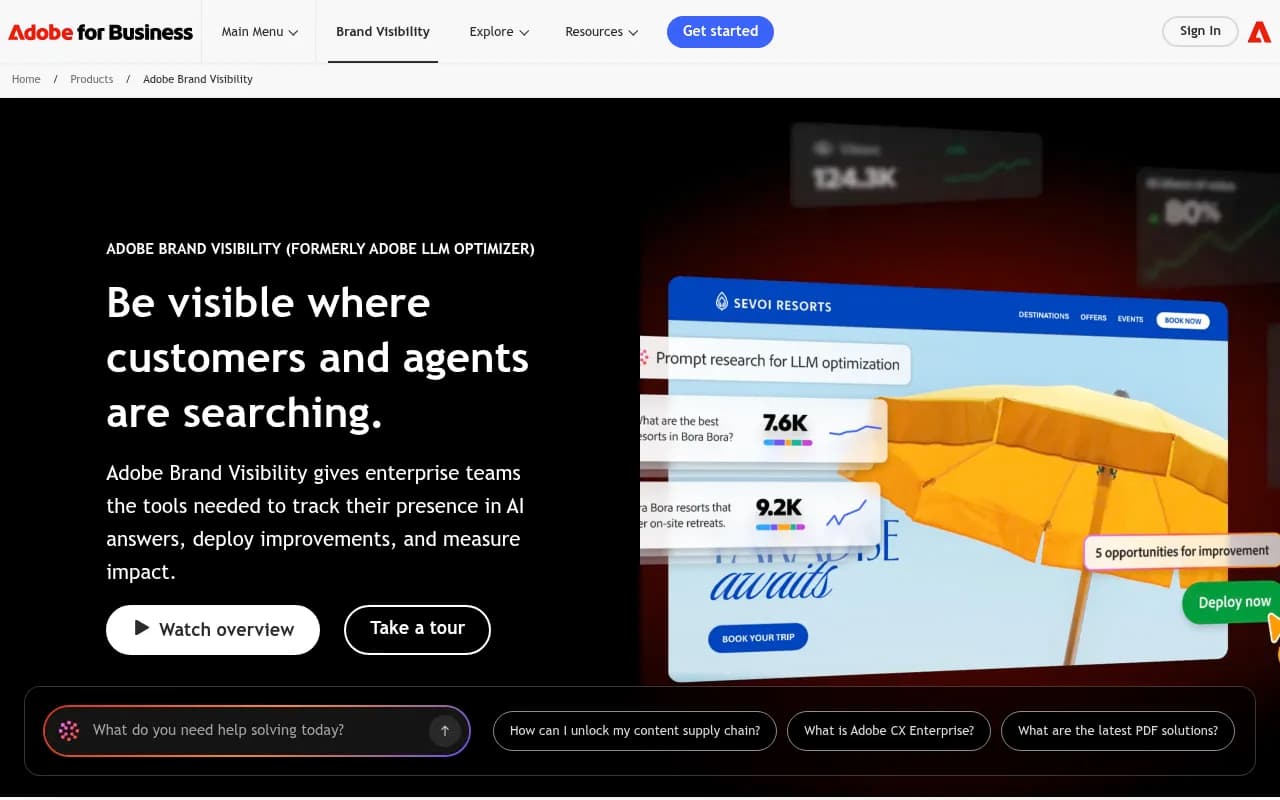
- Adobe LLM Optimizer, now labelled Adobe Brand Visibility, makes the most sense if you already run Adobe Experience Manager, because fixes can be deployed at the edge.
- Adobe has no public price. Third-party estimates for the entry tier range from roughly EUR 60,000 to $115,000 a year, and none are confirmed by Adobe.
- Much of the "measured vs modeled" debate comes from vendor marketing. Run the same 20 buyer prompts through each tool before you sign anything.
Why this comparison matters for enterprise buyers
Three years ago nobody had an AI visibility line item. Now the choice is between a purpose-built platform, a specialist with a big dataset, and a suite vendor folding AI visibility into a stack you may already own.
The three products here represent those three approaches. They are not interchangeable, and the right pick usually depends on what is already in your stack and who has to do the work after the dashboard tells you there is a problem.
A caveat up front. We publish Promptwatch comparisons on this network, and 1001 SEO Media uses Promptwatch for its own GEO work, so read the verdicts with that in mind. Where a claim comes from a competitor's marketing, I will say so.


The short version
| Promptwatch | Profound | Adobe LLM Optimizer (Brand Visibility) | |
|---|---|---|---|
| Type | End-to-end AI visibility and GEO platform | Dedicated AEO measurement platform with agents | GEO application inside Adobe Experience Cloud |
| Public pricing | $95, $245, $579/mo, agencies $199 to $799/mo, Enterprise custom | Starter and Growth listed by third parties at $99 and $399/mo, Enterprise custom | None. Quote-based, metered per prompt |
| Free way to start | 7-day trial on monthly billing, free AI visibility report | 7-day trial, 50 prompts, three engines | No public self-serve trial |
| Data collection | Real UIs of ChatGPT, AI Overviews, AI Mode, Copilot, Gemini, Perplexity, Alexa, Meta AI | Headless-browser front-end queries, per Profound | Described by Adobe as statistical approximation, per Profound's reading of Adobe docs |
| Fix execution | Content Agent, CMS publishing, Action Board | Agents and a content engine, billed in credits | Edge deployment, one-click on AEM |
| Crawler logs | IP-verified, on Professional and above | Agent Analytics | Agentic Traffic dashboards (needs CDN log forwarding) |
| Best fit | Teams that want to measure and ship fixes in one product | Measurement depth and prompt demand data | Adobe-standardized enterprises |
Prices for Profound and Adobe come from third-party pages and may be out of date. Confirm them with the vendors. Promptwatch prices are at promptwatch.com/pricing.
Adobe LLM Optimizer, now Adobe Brand Visibility
Naming first, because it trips people up. Adobe's product page now reads "Adobe Brand Visibility (Formerly Adobe LLM Optimizer)." Reports differ on the exact sequence. One source dates the Brand Visibility announcement to April 20, 2026 at Adobe Summit, another to June 17, 2026, and a third to a rename on August 4, 2026. The Semrush acquisition closed April 28, 2026. Either way, you will see both names in sales conversations, and the product you can actually buy is the LLM Optimizer engine with Semrush's AI Optimization data layered on top.
What it does well
Adobe documents an Analyze, Plan, Act, Adapt cycle. It measures mentions, citations, sentiment and position, flags pages blocked from AI crawlers, and can push approved changes to the edge so models see updated content without a full republish. For sites on Experience Manager, crawlability and schema fixes are one-click.
It also estimates the dollar value of AI-driven traffic, which executives tend to like, and it flags inaccurate or hallucinated answers about your brand.
If your stack is Adobe Analytics, Adobe Commerce and AEM, this is the path of least resistance. Same procurement relationship, same legal review, same reporting layer. That matters more than a feature checklist.
Where it gets harder
Pricing is the first friction. There is no public price and no self-serve plan, and the unit of sale is prompts per year. Digital Applied reports a 1,000-prompt minimum sold in 200-prompt increments and cites a starting price near $115,000 a year. LLM Pulse, a competitor, estimates about EUR 60 per prompt per year. Adobe confirms neither number. DeepSmith lists a self-serve entry at $295/month with a 1,000-prompt minimum, which conflicts with the other sources, so treat all of it as unverified and get a written quote.
The second is data method. Profound's comparison page argues that Adobe's documentation describes its method as "statistically approximating" answers to selected prompts, and that the prompt layer now runs through Semrush's database, built from clickstream and search-panel data rather than captured AI conversations. That is Profound's framing, and Profound is a competitor. Still, it is a fair question to put to Adobe in a demo: is each visibility number a captured answer or a modeled one?
Third, outside the Adobe ecosystem most of the advantage fades. No one-click fixes for non-AEM sites, and the prompt minimum raises the floor whether you need it or not.
Profound
Profound is the best-known independent name in the category. Public claims include 700+ enterprise customers, SOC 2 Type II, a reported $96M Series B in February 2026 and a $180M Series D in September 2026 per TechCrunch. Its coverage list spans ChatGPT, Perplexity, Google AI Overviews and AI Mode, Gemini, Copilot, Meta AI, Grok, DeepSeek and Claude.
Strengths
The Prompt Volumes dataset is the standout. Profound cites 1.9B+ real user prompts, grown by roughly 150 million a month, broken down by intent, region, age and income. Other sources quote slightly different figures (1.5B+, 2B+), so treat the number as a vendor claim. Demand data at that level is hard to get elsewhere.
It also has Agent Analytics reading CDN logs, sentiment, shopping agent analytics, and integrations across Cloudflare, AWS, GCP, Vercel, Netlify, Akamai, Fastly and WordPress. Enterprise controls include SSO/SAML, exports and an API.
Limits
Ongoing tracking beyond the 7-day trial needs a paid plan, and several reviewers note that Starter and Growth prompt and seat caps get tight for multi-brand teams, pushing you toward a custom quote. DeepSmith also points out there is no native content production layer in the way a writing platform has, so the handoff from insight to published page is partly yours. Profound says its content engine closes the loop from gap to published page, so test that claim in a trial rather than taking either side's word for it.
On the competitive side, Promptwatch's own comparison says Profound has no Reddit tracking in the way Promptwatch does, and no agentic execution at comparable depth. That is a Promptwatch claim, so verify it. The head-to-head is at Promptwatch vs Profound.
Promptwatch
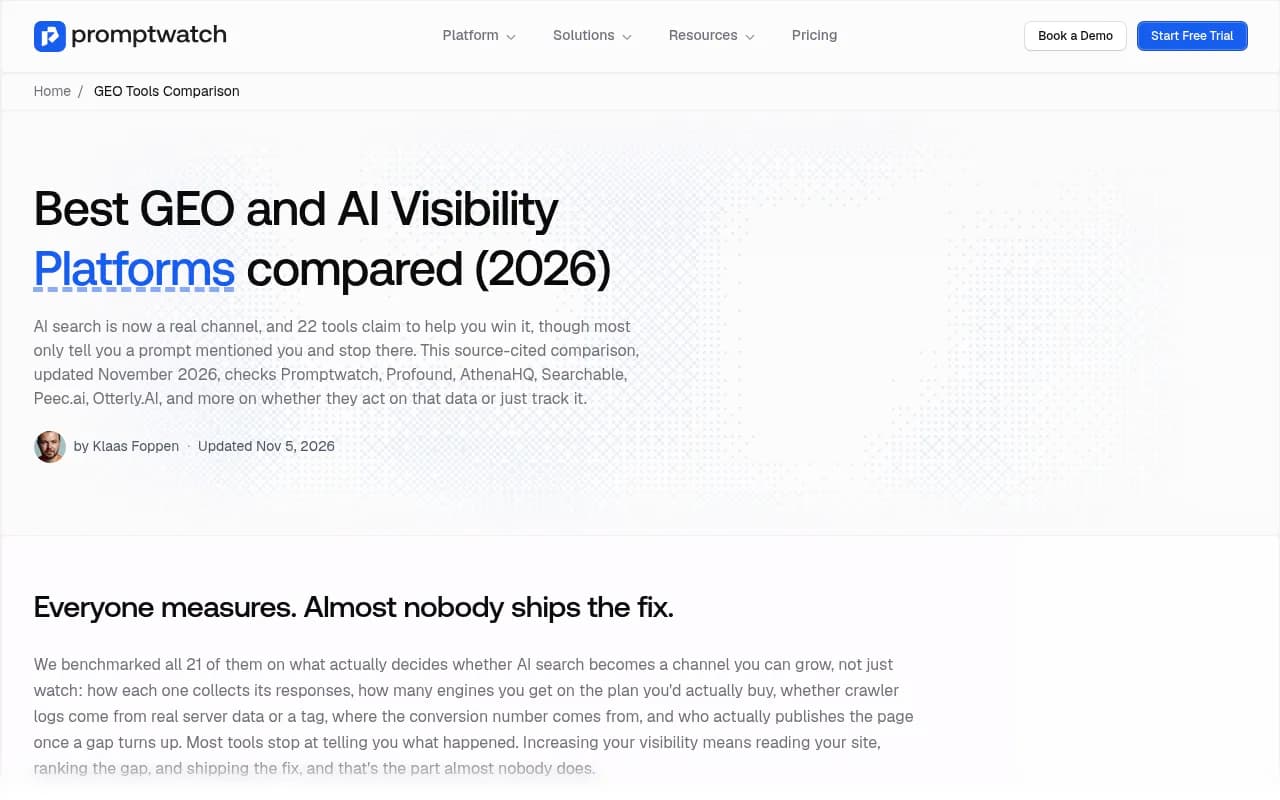
Promptwatch is built around one loop: monitor what AI says about you, trace where it gets its answers, act on the gaps, then measure whether the fix worked. Most tools in the category stop at the first step.
Data and coverage
Promptwatch monitors the actual interfaces of ChatGPT, Google AI Overviews, Google AI Mode, Microsoft Copilot, Gemini, Perplexity, Amazon Alexa and Meta AI, per country and language, and tracks API models such as Claude, DeepSeek, Mistral and Grok alongside them. User-facing answers and citations can differ from API output, which is why the real-UI approach matters. See how Promptwatch collects data for the detail.
Every plan includes every model. Engines are not a paid upgrade, which is not true of every competitor in the category. DeepSmith, for instance, notes that full ten-engine coverage on its own product sits on Enterprise.
Execution
This is the main difference from the other two. AI crawler logs are IP-verified, so spoofed bots are filtered out, and they connect crawls to citations per page. That separates an access problem from a content problem. From there the Action Board prioritizes what to do, and the Content Agent plans, writes and publishes to WordPress, Webflow or Framer on a schedule, with a review inbox or hands-off.
Brand Narrative pulls the individual claims AI makes about you into themes with scores. Fact Check (Business and above) then finds the pages on your site that state a wrong claim. For regulated industries, that is the practical answer to hallucinated pricing or features.
Other enterprise-relevant pieces: local GEO targeting at exact coordinates, tracking as frequent as hourly on Business and Agency Scale, AI Shopping and Ads Radar, Reddit, YouTube, LinkedIn and Instagram citation reports, a hosted MCP server and REST API, and an audit log. It is ISO/IEC 27001 certified and GDPR compliant, with SSO and a white-label client portal on Enterprise.
Pricing
| Plan | Price | Notable inclusions |
|---|---|---|
| Essential | $95/mo | 1 project, 50 prompts, 6,000 responses, no crawler logs |
| Professional | $245/mo | 2 projects, 150 prompts, crawler logs, 5 AEO articles |
| Business | $579/mo | 5 projects, 350 prompts, Content Agent, Fact Check, Shopping, Ads Radar |
| Enterprise | Custom | SSO, white-label portal, dedicated success manager |
Annual billing gives 12 months for the price of 10. Agencies have separate plans from $199 to $799/month. Confirm everything at promptwatch.com/pricing.
Limits
Be honest about what it is not. It has no prompt-demand dataset claiming billions of prompts at Profound's scale, though it does offer prompt volumes and difficulty scores. It also does not give you Adobe's edge deployment for AEM sites. If your pages live in AEM and you want one-click edge fixes, Adobe has the structural advantage there.
Measured vs modeled: how much does it matter?
Profound's central argument is that every AI visibility number is either a direct capture of what a model said or an estimate of what it probably said. I think that is a useful lens, and worth an hour in any demo, but I would not treat it as settled by a competitor's blog post.
Promptwatch's position matches the measured side: it collects from real interfaces. The practical test is simple. Ask each vendor to show the raw responses behind a given visibility score, for a prompt you wrote yourself. If they can show the actual answer and its citations, you have a captured number. If they show a score and a topic cluster, you have an estimate.
It also helps to know how different the engines are. Promptwatch Data on average sources per response shows ChatGPT citing about 5 sources per answer when web search triggers, while Google AI Overviews cites about 10 and Perplexity almost exactly 10. A tool has to be judged per engine, because the number of citation slots changes what visibility even means. More recent Promptwatch Data on ChatGPT unique domains per response found almost half of ChatGPT responses cite 10 or more unique domains (Sep 28 to Oct 4, 2026), so that picture moves.
Enterprise criteria side by side
| Criterion | Promptwatch | Profound | Adobe |
|---|---|---|---|
| Security and compliance | ISO/IEC 27001, GDPR, EU-based company | SOC 2 Type II, HIPAA per third parties | Adobe enterprise terms |
| SSO | Enterprise | SSO/SAML | Admin Console, persona-based access on request |
| Seats | Unlimited on every plan | Unlimited on both listed plans, per Canlah | Semrush Enterprise AIO listed with 40 users and 150 projects |
| Prompt demand data | Prompt volumes and difficulty, query fan-outs | 1.9B+ prompts (vendor claim) | Semrush database, 289M to nearly 300M prompts per Adobe announcements |
| API and MCP | REST API v2 and hosted MCP with 110+ tools | API and exports | MCP and agent-to-agent integrations |
| Content creation | Content Agent, Content Refresh, editor | Agents, credit-based | Recommendations and edge deployment |
| Time to first data | Same-day via trial | Same-day via trial | Demo tenant or Adobe entitlement |
How to choose
Choose Adobe if
Your pages are published through Experience Manager, your team already lives in Adobe Analytics, and the real bottleneck is deploying fixes across thousands of URLs that nobody can edit by hand. Accept the prompt-metered contract and the quote process as the price of that integration.
Choose Profound if
You want the deepest measurement and demand data, have a content team that will do the writing, and your buyers care about a long enterprise procurement track record. Test whether the Starter or Growth tiers cover your brand count before assuming you can avoid a custom quote.
Choose Promptwatch if
You want one product that measures, finds the gap, writes and publishes the page, and then checks whether AI crawled and cited it. It also fits when you need to start small, since Essential is $95/month and you can scale into Business or Enterprise, and when you need unlimited seats and every engine without negotiating them. Agencies should look at the agency plans.
A fair way to run the evaluation
- Write 20 buyer prompts yourself, covering branded, comparison and category queries.
- Run them through the Profound trial and a Promptwatch trial. Ask Adobe to run the same list in a demo tenant.
- Compare the raw answers, the number of runs behind each score, and which citations appear.
- Ask each vendor who publishes the fix, how long it takes, and how they confirm it worked.
- Get Adobe's pricing in writing, because the public numbers disagree.
This is the same sequence Canlah AI recommends, and it works because a written prompt panel makes every later quote comparable.
Other options worth a look
If none of these three fit, the GEO software directory at bestgeosoftware.com lists dozens of alternatives. In our catalog, enterprise-leaning options include Brandlight, Scrunch, Bluefish, BrightEdge and Conductor.

If you want to see where your brand stands before any sales call, the free AI visibility report is a no-login scan, and the 7-day free trial shows real data on your own prompts.
Final take
Adobe wins on friction if you are already an Adobe shop with AEM. Profound wins on dataset size and a long enterprise track record. Promptwatch wins when the goal is to ship fixes and prove they worked, at a price that does not require a six-figure commitment to find out. Pick based on who will do the work after the dashboard lights up, then verify every number yourself.