Adobe LLM Optimizer Review 2026
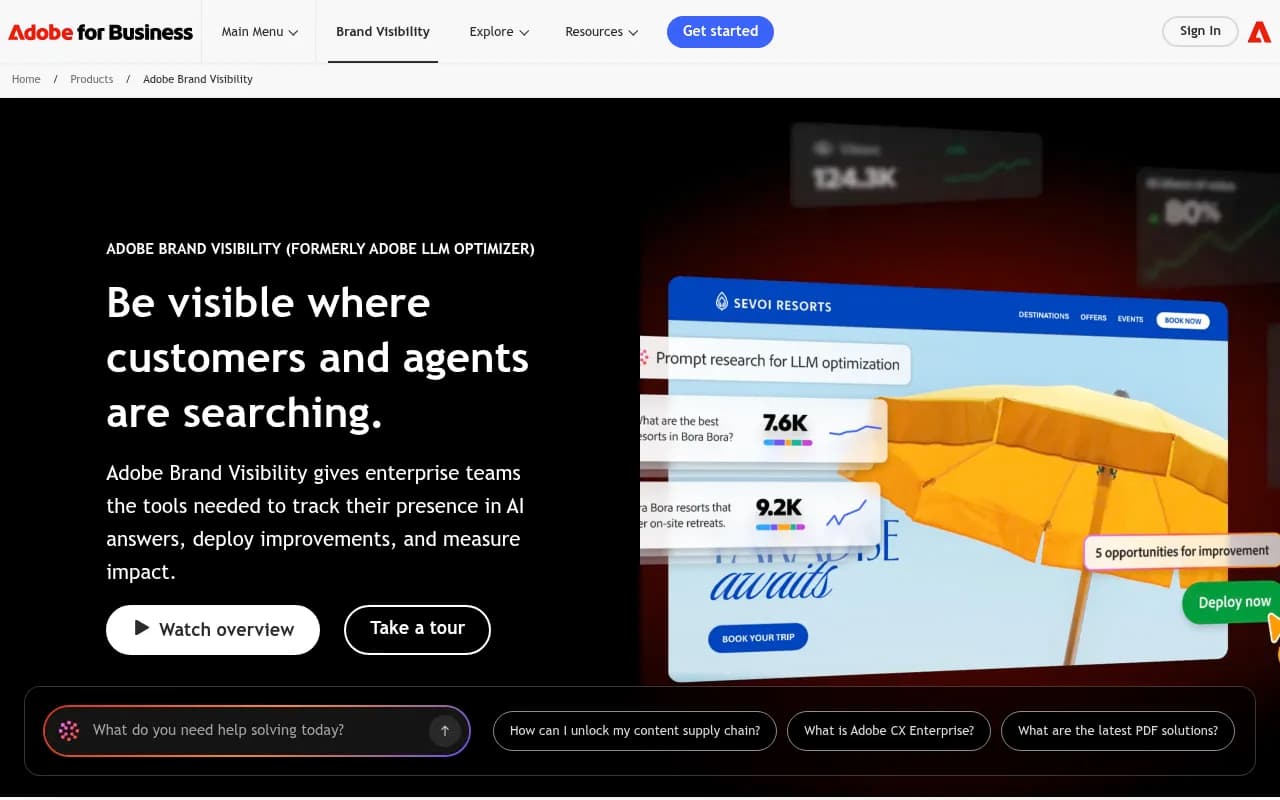
Measures, optimizes, and proves AI search visibility impact across owned and third-party surfaces for large enterprise teams.
Key takeaways
- Adobe Brand Visibility (formerly Adobe LLM Optimizer) is an enterprise GEO suite that connects AI citation tracking to Adobe Analytics, Customer Journey Analytics and Experience Manager.
- Its standout idea is CDN-edge deployment: AI-agent-only optimizations ship without a CMS update or engineering sprint, and can be rolled back.
- Lacks several things Promptwatch offers: a Content Agent that writes and publishes on a schedule, IP-verified crawler logs with crawl-to-citation tracking, Reddit/YouTube/LinkedIn citation reports, AI Shopping and Ads Radar, and self-serve pricing.
- No public pricing, annual contracts only, and a reported 1,000-prompt minimum. Best for existing Adobe Experience Cloud customers with enterprise budgets.
- Integrations are Adobe-only as far as I could find, and there are no independent user reviews yet.
Adobe renamed LLM Optimizer to Adobe Brand Visibility, and the old product page now says so directly. It is Adobe's generative engine optimization product for enterprises, and it sits inside the Experience Cloud family next to Adobe Analytics, Customer Journey Analytics, Experience Manager and Commerce. The pitch is simple: see how AI systems represent your brand, deploy fixes quickly, then prove the impact in the reporting environment your company already pays for.
The data side leans on Semrush, which Adobe now owns. Adobe says the platform draws on more than 2.18 billion observed AI responses, Semrush keyword data across 28.9 billion keywords, and clickstream data. That is a real differentiator against startups that build their prompt sets from scratch. The audience is large: SEO teams, content strategists, web experience teams, analytics practitioners and brand leaders at big companies. Adobe's logo wall shows Lovesac, Kellogg and Lumen, and Heathrow Airport gets a quoted testimonial.
I would frame it this way. This is less a standalone tracker and more an Adobe-shaped answer to AI search. If you already live in Experience Cloud, it will feel natural. If you do not, much of the appeal weakens.
Key features
AI visibility tracking. The platform tracks mentions, citations, sentiment and share of voice across ten LLM families, including ChatGPT, Perplexity, Google AI Mode, Anthropic Claude and Microsoft Copilot. Competitive share-of-voice benchmarking covers up to five direct competitors. Coverage spans more than 25 languages with state and city breakdowns. Findings trace back to the prompts, answers and sources behind them, and connect to AI agent visits on your own site.
Search-informed prompt and topic data. Instead of asking you to invent prompts, Brand Visibility groups observed AI responses into topics and shows where you have gaps. Semrush SEO data sits next to AI visibility so you can see where search authority should be earning citations but is not. Adobe also says you can compare against the wider market, not just the prompts you track, to pick what to track next. This is a sensible design, though Adobe's FAQ admits results reflect tracked prompts and vary over time.
CDN-edge deployment (Optimize at Edge). This is the headline feature. The platform detects AI agent requests at the CDN layer and serves optimized content, with no CMS change or engineering sprint, and with rollback available. Adobe says the changes target AI agents only and are not meant to alter the human visitor experience or existing SEO signals. It works with Fastly, Akamai and Cloudflare, so it is not exclusive to Experience Manager.
Technical fixes without a ticket. Typical issues it addresses:
- Blocked crawlers
- Missing structured data
- 404 errors
- Pages that are hard for agents to parse
Content optimization for AI readability. The platform can make existing pages easier to interpret and cite using FAQ formats, LLM-friendly summaries and simplified versions of complex content. Through the Experience Manager Sites integration, recommendations flow into the normal review, approval and publishing process, so marketers can edit content and metadata on the live page. Through Adobe Commerce, product information becomes easier for AI to discover and interpret. Compare that with tools that generate and publish whole articles on a schedule: Adobe's emphasis is on improving and exposing what you already have.
Off-site guidance. Adobe offers channel-by-channel guidance for Wikipedia, YouTube, Reddit and earned media. It is guidance, though. I found no evidence of dedicated citation reports for those channels the way some competitors provide them.
Impact measurement. You set a baseline before launch and measure after, then see which optimizations are associated with KPI changes. Results report inside Customer Journey Analytics and Adobe Analytics next to paid, social and web. CDN log verification gives server-level confirmation that AI bots picked up updated content. For enterprises that already trust Adobe Analytics, this is the most compelling part, because it avoids a separate reporting silo and extra custom tagging.
Collaboration workspace. Adobe describes a shared space where SEO, content, web and analytics teams align on opportunities and priorities. Details on roles, task assignment and agent-style automation are thin on the public page, so ask for specifics in a demo.
Who is it for
The sweet spot is a global brand with an existing Adobe Experience Cloud footprint. Think a retailer running Adobe Commerce and Experience Manager, with an analytics team in Customer Journey Analytics, that wants its GEO program reported in the same dashboards as paid and social. A 20-person digital team at a consumer goods company or airport operator fits that profile. The edge deployment is also useful for large sites where engineering queues are long and a simple structured data fix can wait months.
It also suits organizations that want one vendor, one procurement process and one security review. Adobe is an easy name to put in front of legal.
Who should skip it? Freelancers, startups, small agencies and mid-market teams. There is no self-serve signup, no monthly billing and no public price. If you track 50 to 300 prompts and want to start this afternoon, this is the wrong shape. Teams that are not on Adobe's stack also lose the main advantage, since all four listed integrations are Adobe products.
Integrations and ecosystem
Adobe lists four integrations on its integrations page:
- Adobe Experience Manager Sites, for editing content and metadata and pushing recommendations through existing approval workflows, plus checking what AI agents can access after changes go live
- Adobe Commerce, for making product information easier for AI to discover
- Adobe Customer Journey Analytics
- Adobe Analytics
Outside Adobe, the supported CDNs are Fastly, Akamai and Cloudflare. I found no non-Adobe integrations such as Google Search Console, Slack, a Looker Studio connector or a public API in the material I reviewed. Documentation lives on Experience League, and Adobe offers an interactive product tour. I found no official GitHub, Discord or LinkedIn presence specific to this product. The only official social account I found is Adobe's X account.
Pricing and value
Adobe publishes no pricing. You request a consultation, and a free trial appears to be limited to certain eligible Adobe customers. The figures below come from competitor blogs, so treat them as unverified:
- Annual license on a custom quote, with no monthly billing
- Minimum of 1,000 prompts, sold in increments of 200
- Tiers from 1K to 110K+ prompts with volume discounts
- Teams report roughly 60 euros per tracked prompt per year, which implies about 60,000 euros annually at the minimum
- One comparison headlines 115,000 dollars a year, from a biased source
- Extra Experience Cloud licensing may be needed on top
The Acrobat and Creative Cloud prices that show up in search results have nothing to do with this product.
For comparison, Promptwatch lists self-serve pricing: a free Explore plan, Essential at $95 per month, Professional at $245, Business at $579 and agency plans from $199, with a 7-day trial on the monthly tiers. Verify current numbers at promptwatch.com/pricing. Even allowing for the fact that Adobe bundles analytics and deployment, a six-figure commitment is hard to justify unless you need the Adobe-native attribution.

Strengths and limitations
Strengths
- Edge deployment is a real shortcut past engineering backlogs, with rollback and no change for human visitors.
- Native reporting in Adobe Analytics and Customer Journey Analytics gives a credible path to revenue attribution for Adobe shops.
- Semrush data gives a demand-based view of prompts and topics rather than raw prompt guessing.
- Broad coverage: ten LLM families, 25+ languages, state and city breakdowns.
- Enterprise vendor stability and an existing procurement relationship.
Limitations
- No public pricing, annual contracts only, a reported 1,000-prompt minimum, and no self-serve signup.
- Integrations are Adobe-only in the documentation I found, and I found no independent reviews on G2 or Reddit to confirm real-world results.
- Adobe describes its own measurement as showing optimizations "associated with" KPI changes, which is honest but short of proof.
What it lacks compared with Promptwatch
This is a direct competitor to Promptwatch, and the gaps matter:
- Content generation and publishing. Promptwatch's Content Agent plans, writes and publishes GEO content to WordPress, Webflow or Framer on a schedule, with a review inbox. Adobe focuses on optimizing existing pages and pushing recommendations into Experience Manager.
- Crawler logs. Promptwatch provides IP-verified AI crawler logs with spoofed bots filtered out and a crawl-to-citation path per page. Adobe uses CDN log verification, which depends on its edge setup.
- Visitor analytics outside Adobe. Promptwatch tracks AI-referred traffic and conversions through a script, Google Tag Manager or WordPress plugin. Adobe requires its own analytics products for the same view.
- Social and shopping coverage. Promptwatch has dedicated Reddit, YouTube and LinkedIn citation reports, AI Shopping tracking in ChatGPT and Amazon Alexa, and Ads Radar. Adobe offers guidance for those channels, not evident dedicated reports.
- Prompt intelligence and fan-outs. Prompt volumes, difficulty scores and query fan-outs are part of Promptwatch.
- Search data and tooling. Google Search Console and Bing data per page, Agent Chat, an Action Board, a 110+ tool MCP server, and coding agent tracking (Codex, Claude Code, OpenCode).
- Accessible pricing. Self-serve plans and a free tier versus a custom enterprise quote.
Promptwatch is also ISO/IEC 27001 certified and used by 1,840+ brands, rated 4.7/5 on G2. For context on how AI citations shift, see Promptwatch Data, which shows ChatGPT's reddit.com share dropping from about 4% to 0.5% on August 14, 2026 (report). Off-site channels move fast, which is a reason to want real citation reporting rather than guidance.
Bottom line
Adobe Brand Visibility makes sense for a large organization already deep in Experience Cloud that wants GEO reported in Adobe Analytics, with engineering-free fixes at the CDN edge. For that buyer, the integration story is the product.
For everyone else, and for anyone who wants optimization that includes writing, publishing and verifying content with transparent pricing, Promptwatch is the stronger choice. For more options, the GEO software directory at bestgeosoftware.com is a good place to compare. Best use case in one sentence: an Adobe-centric enterprise that needs AI visibility tied to existing Analytics and Experience Manager workflows.
Tags:
Frequently asked questions
What is Adobe LLM Optimizer?
How much does Adobe Brand Visibility cost?
Do I need Adobe Experience Manager to use it?
Which AI platforms does it track?
How does it compare to Promptwatch?
Is there a free trial?
Similar and alternative tools to Adobe LLM Optimizer