Lantern Review 2026
Runs a GEO Agent alongside other marketing agents to improve citations and answer-engine rankings across AI search.
Key takeaways
- Lantern pairs an AI visibility dashboard with specialist agents (GEO, SEO, Content, Advertising, PR) that produce review-ready work, and it publishes to WordPress and HubSpot.
- It is a direct Promptwatch competitor, and it lacks IP-verified AI crawler logs, prompt volumes and difficulty scoring, query fan-outs, Reddit/YouTube/LinkedIn citation tracking, AI Shopping tracking and the Action Board that Promptwatch provides.
- Pricing is accessible: a free tier, Pro at $89/month, an Agency plan at $399/month, and custom Enterprise.
- Public information has gaps. Engine coverage and the Pro run allowance are inconsistent across pages, and independent reviews are scarce.
- Best for small and mid-size marketing teams and agencies that want one workspace covering SEO and GEO execution at a low entry price.
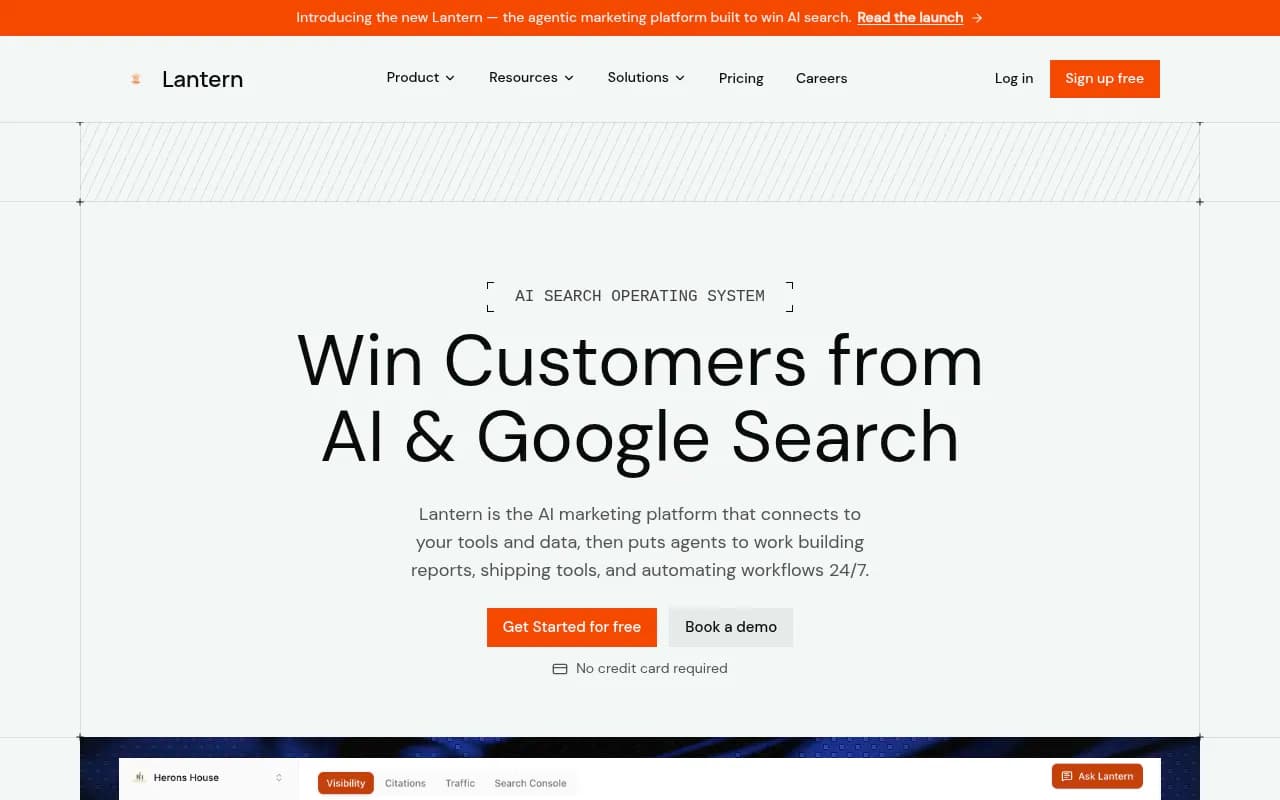
Lantern (asklantern.com) is an AI marketing platform that tracks how your brand appears in AI answers and then puts agents to work on the gaps it finds. The homepage calls it an AI search operating system. In its own words, it connects to your tools and data, then has agents build reports, ship tools and automate workflows around the clock. Its founder is named as Gideon on the company blog, but public materials say little else about the company: no legal name, founding date, headcount or funding that I could verify.
The pitch is a clear jab at pure monitoring tools. Dashboards and alerts are step one, the site argues, and execution is where Lantern wants to win. The audience is SEO and GEO teams, content teams, PR and comms people, and agencies. The company says 200+ marketing teams use it, with logos such as iPullRank, Houlihan Lokey, Nexuscale, Ndovu, Payd and KrosAI on the homepage. The pricing page shows a different logo set, so treat those claims as unverified.
Don't confuse it with lantern.is, which is an unrelated product for e-commerce revenue tracking.
Key features
AI Visibility Dashboard. This is the monitoring core. According to a third-party review from DeepSmith (a competitor, so read it with caution), it includes a 0-100 AI Visibility Score with a trend chart and competitor ranking, a Top Sources view, a Citations page that splits sources into owned, competitor and independent, and Prompt Analysis. Documentation lives at docs.asklantern.com. It covers the basics well. What it doesn't show is the depth you get from tools built around crawler data or prompt volumes.
LanternIQ. This is the shared intelligence layer. It pulls in Google Search Console, Google Analytics, your CMS or content library, and your brand guidelines, then routes work to the right specialist agent. The idea is that every agent works from the same source of truth. In practice that matters most for consistency: the agent writing your FAQ draft knows your positioning and the gap the GEO agent spotted.
Specialist agents. The site names five:
- AI Search (GEO) agent: tracks where your brand appears, finds citation gaps and turns the evidence into tasks.
- SEO agent: researches demand, inspects competing pages and builds repeatable optimization workflows.
- Content agent: creates grounded drafts, supports team review and publishes into your stack.
- Advertising agent: plans and manages campaigns on emerging AI ad surfaces, including ChatGPT ads.
- PR agent: researches the publications shaping your category and prepares outreach.
Outputs include GEO visibility maps, competitor gap audits, content briefs, metadata, FAQs and executive-ready presentations.
Brand Kit and Knowledge Base. You define voice, audience, competitors and product knowledge once, and agents use it. The Free plan gets one knowledge base, Pro and above get unlimited. This is a sensible piece of design. Generic AI content is the main failure mode of agent tools, and a structured brand layer helps.
Beam. An Excel-like workspace where you run agents in batches across rows. Think bulk metadata rewrites or running a competitor analysis across 100 keywords. Pro allows batches of 100 cells. Not on Free.
Publishing. Lantern publishes directly to WordPress and HubSpot, according to its own blog, and Sanity appears in the integrations list. Publishing, outreach, spend and campaign changes remain subject to human approval, which is the right call for a young product.
Content refresh pipeline and reporting. Outdated pages become prioritized briefs and drafts. A monthly Performance Report summarizes traffic, rankings, AI visibility and content performance for clients or stakeholders. Agencies will care about that one.
ChatGPT ads. Pro and Enterprise include tools to prepare and manage ads in ChatGPT. It is an early surface, and having it bundled is a differentiator against most trackers.
Citation Source Report. Identifies the sites that influence AI answers so outreach can be focused. Useful, though it covers fewer source types than platforms that break out Reddit, YouTube and LinkedIn separately.
Who is it for
The sweet spot is a small to mid-size marketing team or a boutique agency. Picture a three-person SEO team at a B2B SaaS company tracking a few dozen prompts and wanting briefs and drafts without hiring a freelancer. Or an agency running three to ten client accounts that needs monthly reporting and some content throughput. The Agency plan ($399/month, three client workspaces, five seats, 1,000 Agent Runs) is aimed squarely at them, with extra workspaces and seats sold as add-ons.
Content teams and PR people get something too, since the agents handle press releases, social copy and outreach prep. Solo founders can start on the free tier to see whether their brand shows up in ChatGPT at all.
Who should skip it? Large enterprises that need deep technical diagnostics will find it thin. If you want to know exactly which AI crawlers hit which pages, whether they hit errors, and how that connects to citations, Lantern doesn't show that. Teams that want hands-off, scheduled content publishing at volume should also compare alternatives. And if you need verified, mature enterprise credentials, public information about the company is light.
Integrations and ecosystem
- Google Search Console and Google Analytics for query, ranking and traffic data.
- Google Ads and ChatGPT Ads for the advertising agent.
- WordPress and HubSpot publishing, plus Sanity and Contentful-style CMS connections. The full list is at asklantern.com/integrations.
- Integrations are not available on the Free plan.
- No confirmed public API, MCP server or Slack integration turned up in my research. Docs exist at docs.asklantern.com.
- Enterprise adds SSO and a dedicated Slack channel for support.
The ecosystem is smaller than that of established platforms, but the essentials for an SEO team are there.
Pricing and value
- Free, $0: 1 brand workspace, 1 seat, 10 Agent Runs a month, 1 Brand Knowledge Base, ChatGPT analytics only. No integrations, no Beam, no ChatGPT ads.
- Pro, $89/month: 3 brands, 3 team members, Beam batches up to 100 cells, unlimited knowledge base, priority support, ChatGPT ads, and analytics across ChatGPT, Claude, Google and Gemini. Integrations included. Monthly billing, or $1,068 upfront for a year, which is the same effective price, so no annual discount.
- Agency, $399/month: 3 client workspaces, 5 agency seats, 1,000 Agent Runs a month. It appears only in the FAQ text, with no plan card on the pricing page.
- Enterprise, custom: SSO, custom workspaces, seats and runs, dedicated Slack and specialist with a 24-hour SLA, a Customer Success Manager. Book through [email protected].
One inconsistency to check before buying: the Pro plan table says 100 Agent Runs per month while the Pro FAQ on the same page says 200. Confirm with the vendor. Engine coverage is also inconsistent. The homepage claims Perplexity and Google AI Overviews and AI Mode, while the pricing page lists ChatGPT, Claude, Google and Gemini and omits Perplexity. A competitor review mentions a Lite plan that no longer appears, so ignore that.
At $89 for three brands, it is cheap for a combined tracker and execution tool. Promptwatch's Essential plan is $95/month for one project with 50 prompts, 6,000 responses, all AI models, site audit, 360 Insights and content gap analysis, which is a different depth of data for similar money. Lantern's value depends on how much you will use the agents, and the run limits are the constraint.
Strengths and limitations
Strengths
- Low entry price with a real free tier.
- Agents tied to a brand knowledge base, so output is more on-brand than generic AI writing.
- Direct publishing to WordPress and HubSpot.
- Covers SEO and GEO in one workspace, plus ad and PR workflows.
- Human approval on consequential actions.
Limitations
The monitoring layer is the weak point, and this is where the gap with Promptwatch is clearest. Lantern lacks, or doesn't publicly document:
- IP-verified AI crawler logs and crawl-to-citation tracking
- Visitor analytics tying AI traffic to conversions without extra setup (it needs a connected GA property)
- Prompt volumes, difficulty scoring and query fan-outs
- Dedicated Reddit, YouTube and LinkedIn citation tracking
- AI Shopping tracking (ChatGPT, Amazon Alexa) and Ads Radar for competitor sponsored placements
- Page-level tracking and Offsite Mentions
- Weekly site audits and a prioritized Action Board with Agent Chat over live data
- Coverage of 15+ engines through real UI monitoring, including coding agents like Codex and Claude Code
Other concerns: engine and pricing details conflict across pages, I found no independent reviews on G2, Reddit or Trustpilot, and a rising visibility score doesn't automatically mean more traffic or revenue. Agent output still needs human review and rewriting. A fair point from the vendor, and honestly a refreshing admission.
Bottom line
Lantern is a sensible choice for small teams and agencies that want AI visibility tracking and a set of agents producing briefs, drafts and reports for under $100 a month. The brand knowledge base and direct publishing are the best parts. Check the engine coverage and run limits for your plan before you commit.
If you want optimization backed by deeper data, Promptwatch is the stronger option, with crawler logs, traffic attribution, content gap analysis and a Content Agent that publishes and then tracks whether each page gets crawled and cited. For more options, browse the GEO software directory at bestgeosoftware.com.
Best use case: a lean SEO or agency team that wants AI search tracking and draft-level content execution in one inexpensive workspace.

Frequently asked questions
What is Lantern?
How much does Lantern cost?
Which AI engines does Lantern track?
Can Lantern publish content automatically?
How does Lantern compare to Promptwatch?
Is there a free plan?
Similar and alternative tools to Lantern