Ranksmith Review 2026
AI search visibility tool that helps teams track brand performance and optimize content for ranking in AI-generated search results across major models.
Key takeaways
- Ranksmith is a monitoring-focused GEO/AEO platform that tracks brand visibility, position, sentiment, and share of voice across five major AI models
- Currently in public beta, with transparent pricing starting at $69/month and a 7-day free trial (no credit card required)
- Competitor intelligence is a genuine strength -- automatic rival discovery and side-by-side benchmarking are well-executed
- Missing compared to Promptwatch: no content generation, no AI crawler logs, no traffic attribution, no Reddit/YouTube tracking, no ChatGPT Shopping tracking, no query fan-outs, and no prompt volume/difficulty scoring -- Ranksmith is a monitoring dashboard, not an optimization platform
- Best suited for small-to-mid-size marketing teams who want a lightweight, affordable entry point into AI search tracking
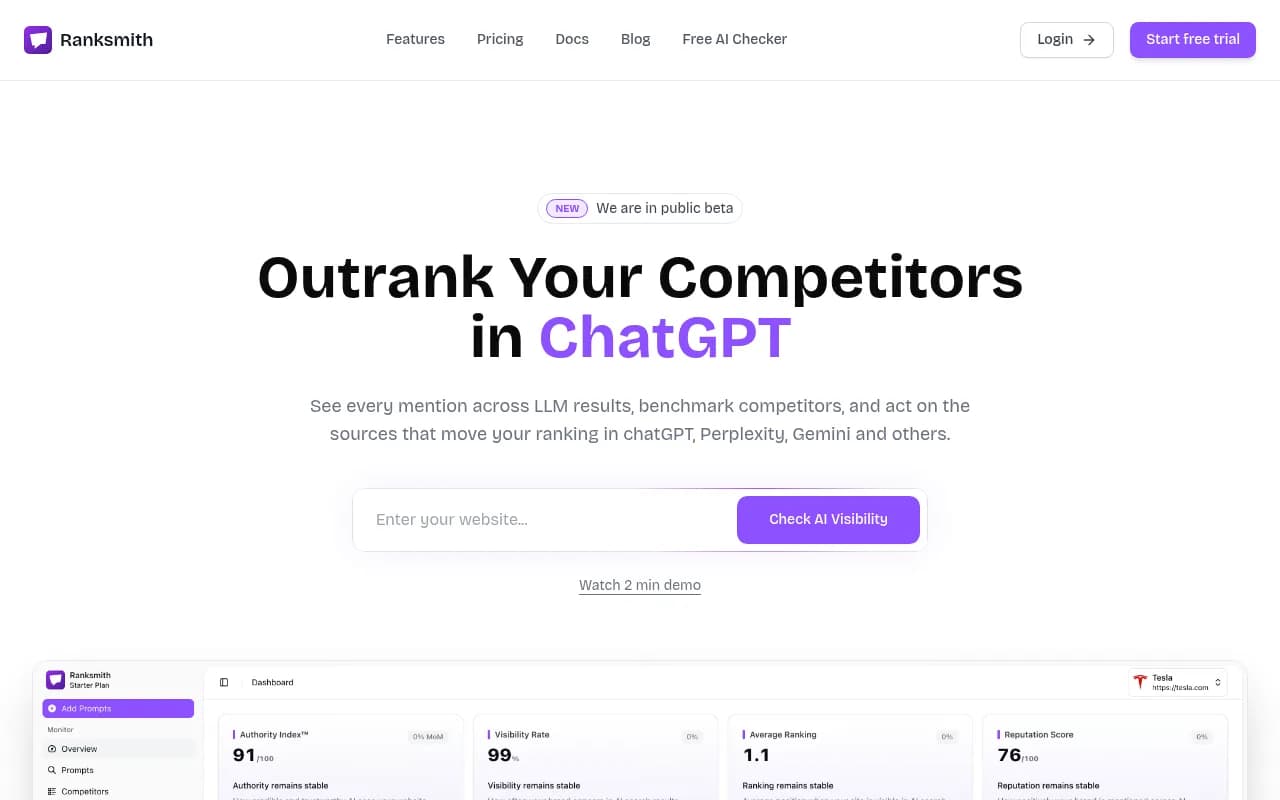
Ranksmith is a Generative Engine Optimization (GEO) and Answer Engine Optimization (AEO) platform built to help brands understand how they appear inside AI-generated search results. The product monitors brand mentions, rankings, sentiment, and citations across ChatGPT, Perplexity, Gemini, Claude, and Grok, then surfaces that data in a dashboard designed around a handful of core KPIs: AI Visibility Rate, Average AI Ranking, AI Authority Index, Reputation Score, and Share of Voice.
The platform is currently in public beta, which explains both its relatively lean feature set and its competitive pricing. It's clearly aimed at teams who are just waking up to the fact that buyers are now asking AI assistants for product recommendations -- and who want a structured way to track where they stand before committing to a more expensive platform. The testimonials on the site (a founder at slashML, a head of product at Dental Setup) suggest the early adopter base skews toward startup and SMB teams rather than enterprise marketing departments.
Key features
Prompt tracking and prioritization
Ranksmith lets you define the prompts you want to monitor -- questions your buyers would realistically ask an AI assistant, like "best email marketing tool for Shopify" or "top dental practice management software." You can add prompts manually or use AI-suggested prompts, then tag them by model, category, and topic. The platform assigns each prompt a performance score that blends current position, mention rate, and link rate, so you can filter down to the highest-priority opportunities rather than staring at a flat list.
The prompt limits per plan are modest: 25 on Starter, 60 on Pro, 150 on Enterprise. For context, that's enough to cover a focused keyword set but would feel tight for an agency managing multiple clients or a brand operating across several product lines.
Multi-model coverage
Ranksmith monitors ChatGPT, Perplexity, Gemini, Claude, and Grok. Google AI Overview is available on the Enterprise plan only. Coverage is scoped by country where the underlying models support it, which matters for brands with regional audiences. The dashboard breaks down Visibility, Average Position, Mentions, Links, and Sentiment per model, so you can see whether you're strong on Perplexity but invisible on Gemini and adjust accordingly.
The model coverage is solid for a beta product, though it falls short of platforms like Promptwatch, which monitors 10+ models including DeepSeek, Meta/Llama, Mistral, Copilot, and Google AI Mode.
Competitor intelligence
This is one of Ranksmith's more developed features. You can add competitors manually, but the platform also automatically surfaces companies that are frequently co-mentioned with your brand in LLM responses -- each with a relevance score, average rank, mention count, sentiment, and top citations. That automatic discovery is genuinely useful; it surfaces rivals you might not have thought to track.
The benchmark table compares every tracked domain on Mentions, Average Ranking, Visibility %, Share of Voice %, and Sentiment in a single view. You can also drill into which sources are driving competitor visibility -- review sites, communities, media -- and use that to plan PR or content plays.
Share of voice tracking
SOV is tracked over time and broken down by model, so you can see whether a PR campaign or content push actually moved your share of AI mentions relative to competitors. The trend view is useful for proving impact to stakeholders, though the value of the metric depends heavily on how many competitors you're tracking and how representative your prompt set is.
Citation and source analysis
Ranksmith extracts citations from AI responses and attributes them back to the sources that appear to influence rankings -- G2, Reddit, LinkedIn, press coverage. The idea is that you can identify which third-party pages are driving competitor visibility, then execute targeted outreach, community engagement, or PR campaigns to get your brand cited in the same places. This is a reasonable strategic framework, though the execution relies on you doing the actual outreach work; Ranksmith surfaces the intelligence but doesn't help you act on it beyond pointing at the sources.
Sentiment and reputation tracking
Beyond binary mention/no-mention tracking, Ranksmith scores the sentiment of AI responses that include your brand -- positive, neutral, or negative. The Reputation Score aggregates this over time. For brands in competitive or review-heavy categories (SaaS, healthcare, finance), knowing whether AI models are recommending you warmly or hedging is meaningful signal.
Email alerts
Available on all plans, email alerts notify you when your AI visibility changes. This is table-stakes functionality for a monitoring tool, but it's good to see it included at the Starter tier rather than gated behind higher plans.
Who is it for
Ranksmith fits best with small-to-mid-size marketing teams at B2B SaaS companies, digital agencies, and direct-to-consumer brands that are starting to take AI search seriously but aren't ready to commit to a full-featured (and more expensive) GEO platform. A founder running a 5-10 person startup who wants to know whether ChatGPT is recommending their product, or a head of marketing at a 50-person company who needs to show the board that AI visibility is being tracked -- these are the natural early adopters.
The Starter plan at $69/month is accessible enough that a solo marketer or small agency can justify it without a lengthy procurement process. The Pro plan at $149/month makes sense for a growing team tracking a broader prompt set across three models. Enterprise at $549/month is positioned for larger organizations, though the limits (150 prompts, 20 competitors, 4 websites) are still relatively conservative compared to what enterprise-grade platforms offer.
Who should probably look elsewhere: agencies managing 10+ client accounts, brands that need content generation alongside monitoring, teams that want to understand AI crawler behavior on their own site, or anyone who needs traffic attribution connecting AI visibility to actual revenue. Ranksmith doesn't do any of those things yet.
Integrations and ecosystem
Ranksmith's integration story is thin at this stage, which is expected for a public beta. The FAQ explicitly notes that data export is not currently available, though it's listed as a roadmap item. There's no mention of API access, Zapier integration, Google Search Console connection, or Looker Studio support.
The platform does offer Discord support on Pro and Enterprise plans, which suggests there's an active community channel, but no dedicated Discord server URL was publicly listed. Email support is available on all plans, with a dedicated representative added at Enterprise.
Given the beta status, the lack of integrations is understandable -- but it's a real limitation for teams that want to pull AI visibility data into their existing BI stack or reporting workflows. If you need to export data to Looker Studio or connect to a CRM, Ranksmith isn't there yet.
Pricing and value
Ranksmith's pricing is straightforward:
- Starter: $69/month -- 25 prompts, 5 competitors, 1 website, ChatGPT and Perplexity only, 6 months of historical data
- Pro: $149/month -- 60 prompts, 10 competitors, 2 websites, adds Gemini, 12 months of historical data
- Enterprise: $549/month -- 150 prompts, 20 competitors, 4 websites, adds Grok and Claude (and Google AI Overview), 24 months of historical data
All plans include a 7-day free trial with no credit card required, which is a low-friction way to evaluate the product. Annual billing saves 20%.
Compared to competitors: Peec.ai's entry tier runs around $95/month for similar prompt counts. Promptwatch's Essential plan is $99/month for 50 prompts but includes crawler logs, content generation, and traffic attribution that Ranksmith doesn't offer at any tier. For pure monitoring, Ranksmith is priced competitively. The question is whether monitoring alone is enough for your use case.
The note-worthy discrepancy: the pricing page lists different limits than the FAQ. The pricing page shows 25/60/150 prompts, while the FAQ mentions 30/50/100. This inconsistency is a minor red flag for a product in beta -- worth clarifying with support before committing.
Strengths and limitations
What Ranksmith does well:
- Automatic competitor discovery is genuinely useful. Surfacing rivals that co-appear with your brand in LLM responses, complete with relevance scores and citation data, is a smarter approach than requiring you to manually enumerate every competitor.
- Prompt prioritization scoring helps teams focus on the highest-leverage opportunities rather than treating all tracked prompts equally. Blending position, mention rate, and link rate into a single performance score is a practical UX decision.
- Accessible entry pricing at $69/month with a no-credit-card trial makes it easy for small teams to evaluate without organizational friction.
- Sentiment tracking at the response level goes beyond simple mention counting and gives brands a more nuanced picture of how AI models are characterizing them.
Honest limitations:
- Monitoring only, no optimization tools. Ranksmith shows you where you're invisible but doesn't help you fix it. There's no content gap analysis, no content generation, no briefs, no writing agents. You get the diagnosis but not the treatment. Platforms like Promptwatch close this loop with Answer Gap Analysis and Content Agents that generate articles grounded in real prompt and citation data.
- No AI crawler logs or traffic attribution. You can't see which pages AI crawlers are visiting on your site, how often they return, or whether AI visibility is actually driving traffic and revenue. This makes it hard to connect GEO efforts to business outcomes.
- No Reddit, YouTube, or offsite citation tracking. Reddit discussions and YouTube content are significant drivers of AI citations, and Ranksmith doesn't surface them. Competitors like Promptwatch track these channels specifically because they influence what AI models recommend.
- No prompt volume or difficulty scoring, no query fan-outs. You can't prioritize prompts by estimated search volume or understand how one prompt branches into sub-queries. This limits strategic planning.
- No ChatGPT Shopping tracking. For e-commerce brands, ChatGPT's product recommendations and shopping carousels are increasingly important -- Ranksmith doesn't monitor them.
- Data export not available. For any team that needs to report AI visibility data alongside other marketing metrics, this is a meaningful gap.
Bottom line
Ranksmith is a clean, focused monitoring tool for teams taking their first serious look at AI search visibility. The competitor intelligence features are well-built, the pricing is accessible, and the no-credit-card trial makes it easy to test. If you need a lightweight dashboard to track brand mentions and share of voice across the major LLMs, it does that job reasonably well.
But it stops at monitoring. For teams that want to understand why they're invisible and actually do something about it -- through content gap analysis, AI-optimized content generation, crawler log analysis, and traffic attribution -- Ranksmith isn't built for that yet. Promptwatch covers the full loop from gap identification to content creation to result tracking, which is a meaningfully different value proposition.
Best use case: A startup or SMB marketing team that wants structured AI visibility monitoring across ChatGPT, Perplexity, and Gemini without a large budget or complex setup.
Frequently asked questions
What is Ranksmith?
How much does Ranksmith cost?
Is there a free trial?
Which AI models does Ranksmith monitor?
Does Ranksmith help with content creation or just monitoring?
Can I export data from Ranksmith?
Similar and alternative tools to Ranksmith