Key takeaways
- Query fan-out data — the internal searches ChatGPT runs before answering — is the single most useful signal for figuring out why you are or aren't visible in AI answers.
- Promptwatch and Gauge both surface fan-out queries, but they do it differently: Promptwatch tracks fan-outs across every tracked response plus publishes free daily-updated fan-out datasets; Gauge shows the Google searches behind individual prompts with a "thin head, fat tail" framing.
- Ranksmith does not appear to offer query fan-out tracking at all — its strengths are competitor benchmarking, share of voice, and sentiment.
- ChatGPT's fan-out behavior changed dramatically in 2026: average fanouts per response dropped from 2.15 in December 2025 to 1.0 by April, then nearly doubled to ~1.83 on August 8 when ChatGPT started using the
site:operator at scale. - If fan-out depth is your main buying criterion, Promptwatch is the strongest option; Gauge is a solid alternative if you want prompt-level GEO intelligence with a content engine attached.
What query fan-out data actually is (and why it matters)
When you ask ChatGPT a question, it doesn't just answer. It runs web searches first — breaking your one prompt into multiple shorter, more targeted queries, then synthesizing an answer from what it finds. That process is called a query fan-out.
Here's why this matters for visibility. You might rank #1 for your target keyword in Google and still be invisible in ChatGPT, because ChatGPT isn't searching for your keyword. It's searching for three to eight related sub-queries you've never optimized for. Without fan-out data, you're guessing at what those sub-queries are. With it, you can build content clusters that match the actual searches AI runs — not the ones you assume it runs.
Promptwatch's ChatGPT Query Fanouts report defines a fanout as ChatGPT breaking one prompt into 3-8+ targeted web searches before synthesizing an answer. Gauge frames it similarly: ChatGPT "runs Google searches in the background, typically about 3 per user query" and scans 50-60 results per search, not just the top few.
That second point is the "thin head, fat tail" argument: even if you're on page 2 or 3 of Google, your content can still get pulled into AI answers, because AI systems scan much deeper than a human searcher ever would.
The three platforms at a glance
| Platform | Query fan-out feature | Fan-out data depth | Other strengths | Entry price | AI engines on entry plan |
|---|---|---|---|---|---|
| Promptwatch | Yes — per-response fanout queries, per-model term/theme comparison, free fan-out generator tool, free public datasets | Deepest — fan-outs tied to citations, crawler logs, and published trend data | Full GEO platform: crawler logs, visitor analytics, content agents, CMS publishing | $95/mo (Essential) | 9 models, all engines included |
| Gauge | Yes — shows Google searches ChatGPT executes per prompt | Moderate — prompt-level, framed around Google search depth | Content engine (18 articles/mo on Growth), CMS publishing, "Ask Gauge" agent | $599/mo (Growth) | 6 core platforms; Claude/Grok via own API key |
| Ranksmith | No fan-out feature found in any public materials | None | Competitor benchmarking, share of voice, sentiment, source intel | $69/mo (Starter) | 2 (ChatGPT + Perplexity) |
Promptwatch: fan-outs as part of a full visibility stack
Promptwatch treats query fan-outs not as a standalone feature but as one layer in a connected system: prompt tracking → fan-out queries → citations → crawler logs → content gaps → fixes.
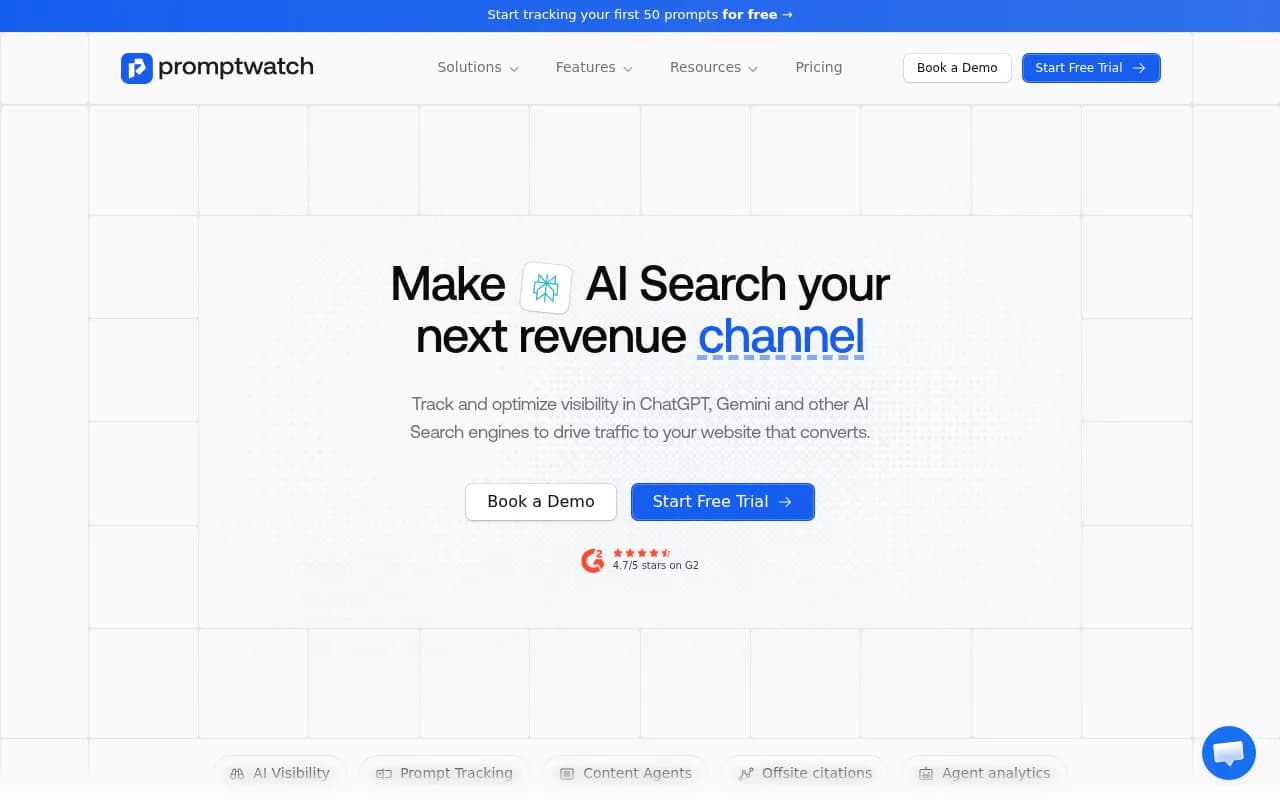
What you actually get:
- Per-response fanout queries. For every tracked response, you can see the exact fanout queries behind it — the specific searches ChatGPT ran before generating that answer. A July 2026 changelog update added per-model comparison of the terms and themes different AI models search for, so you can see how ChatGPT's fan-outs differ from Gemini's or Perplexity's.
- A free Query Fan-Out Generator. Launched December 2025, this tool shows how ChatGPT expands any prompt you enter into multiple search queries — useful for content planning even if you're not a customer.
- Free public fan-out datasets. Promptwatch publishes continuously updated fan-out data as part of its Promptwatch Data reports, built on 26B+ analyzed data points collected from real UI monitoring (not APIs).
- A free Chrome extension (GEO Inspector for ChatGPT). Shows every fanout query, fetched vs. cited sources, and the full reasoning trail live in the ChatGPT interface — 100% local, works even logged out.
The key differentiator is that fan-out data in Promptwatch connects to everything else. A fanout query tells you what ChatGPT searched; crawler logs tell you whether it actually read your page; citation analytics tell you whether you made it into the answer. That chain — search → crawl → cite — is what turns fan-out data from an interesting metric into an actionable one.
What Promptwatch's fan-out data reveals
Two findings from Promptwatch's published datasets are worth highlighting, because they show how much fan-out behavior has shifted in 2026:
-
Fanouts got leaner, then doubled back. Average fanouts per response fell from 2.15 in early December 2025 to ~1.84 by early March 2026. After a data gap, fanouts returned in April at exactly 1.0 per response — a much leaner search pattern. Then on August 8, 2026, average fanout queries per response nearly doubled from ~1.08 to ~1.83.
-
Fanout queries got 50%+ shorter. Average character count per fanout query dropped from ~117 characters in early December to the high 80s through February/March, then to ~53 characters by April. ChatGPT now searches more like keyword-typing than full sentences — which means your headings should read like short search queries (~53 characters, 6-8 words) with entities and categories front-loaded.
The August 8 shift is the bigger story. Per Promptwatch's site: operator fan-out report, ChatGPT Search fanout queries using the site: operator jumped from 0.37% to 16.8% of all fanout queries overnight — a ~46x increase in a single day. Before August 8, site:-scoped searches were about 1 in every 280 fanout queries. After, roughly 1 in 6.
The practical implication: ChatGPT now actively runs site:yourdomain.com [topic] searches, treating your domain as a direct retrieval surface. Thin category pages, broken internal search, and unindexed content now cost you visibility directly — not just rankings.
This is exactly the kind of insight you only get from continuous fan-out monitoring. A one-off audit in July would have missed the August 8 shift entirely.
Gauge: fan-outs with a "thin head, fat tail" framing
n Gauge markets a dedicated Query Fan Out feature and describes it clearly: it shows you the actual Google searches ChatGPT executes when processing a given prompt.

Gauge's framing is distinctive in two ways:
-
Depth of scan. Gauge emphasizes that ChatGPT scans 50-60 results per search, not just the top 3 — the core of its "thin head, fat tail" argument. If your content sits on page 2 or 3 of Google, it can still surface in AI answers.
-
Query length contrast. Gauge claims the average LLM query runs 11.1 words versus 2-3 words for a typical Google search. This is a useful framing for content teams: the prompt users type is long and conversational, but the searches ChatGPT runs behind it are short and keyword-like.
Gauge also positions its fan-out feature competitively, claiming that Profound — a major enterprise competitor — offers "no query fan-out visibility." That claim looks outdated or at least overly narrow, since Profound itself publishes a Query Fanouts analysis feature on its own blog. It's a reminder to treat vendor comparison pages with some skepticism: they're marketing materials, and they age fast.
Gauge's data collection method is solid: front-end scraping via anonymous, logged-out browser sessions (not API), run daily across ChatGPT, Perplexity, Gemini, Google AI Overviews, Google AI Mode, and Microsoft Copilot. Enterprise adds Claude and Grok. This matters because user-facing answers and citations can differ from API outputs — monitoring the real UI is the more accurate approach.
Where Gauge's fan-out data is thinner than Promptwatch's is in connection. Gauge shows you the searches; Promptwatch shows you the searches plus whether AI crawlers actually read your pages, which pages got cited, and what traffic resulted. Gauge does offer a content engine (18 articles/month on the Growth plan) and CMS publishing to Webflow, Framer, Sanity, and GitHub, so the gap partially closes at the execution end.
Gauge's pricing is the main friction point: Growth is $599/month for 600 prompts and ~108,000 answers tracked monthly. That works out to roughly $0.0055 per AI answer — actually cheaper per answer than Promptwatch Essential's ~$0.016 per response — but the absolute monthly cost is more than six times higher. There's no published entry tier below Growth.
Ranksmith: no fan-out feature at all
Ranksmith is the odd one out here, and it's important to be direct about that: based on its own marketing, feature pages, and self-authored comparison posts (including a Ranksmith vs Promptwatch comparison), Ranksmith makes no mention of query fan-out tracking anywhere.
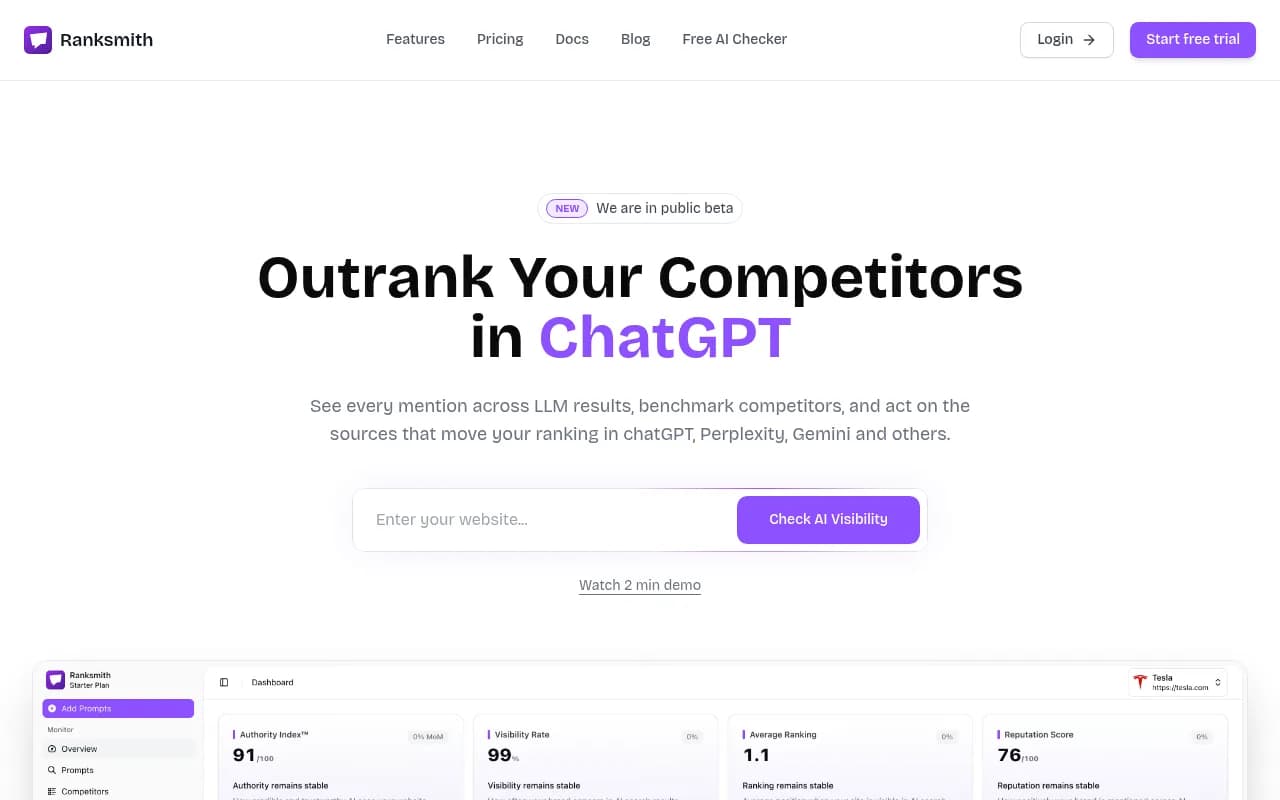
That doesn't make it a bad tool. It's just a different tool. Ranksmith's focus is:
- Prompt tracking with AI-suggested prompts
- Competitor benchmarking: share of voice, average position, sentiment
- Source intel: citations, PR targets, community targets
- Core metrics like AI Authority Index, AI Visibility Rate, and Reputation Score
Its pricing reflects that narrower scope: Starter is $69/month (25 prompts, 5 competitors, ChatGPT + Perplexity only), Pro is $149/month (60 prompts, adds Gemini), and Enterprise is $549/month (150 prompts, adds Grok, Claude, and Google AI Overview). All plans refresh daily.
Two caveats worth knowing. First, Ranksmith is explicitly in public beta per its homepage banner. Second, it does not currently offer data export or API access — Ranksmith's own comparison posts state both are "in active development." If fan-out data or any raw data portability matters to your workflow, that's a real gap today.
One more thing: Ranksmith's self-published comparison page cites Promptwatch tiers as $75/mo, $165/mo, and $415/mo — figures that don't match Promptwatch's own published pricing ($95/mo Essential, $245/mo Professional, $579/mo Business). Third-party comparison numbers age badly. Always check the vendor's own pricing page before making a buying decision.
So which one has the deepest fan-out data?
If query fan-out depth is your primary criterion, here's the honest ranking:
1. Promptwatch — the deepest fan-out offering of the three. You get per-response fanout queries, per-model term/theme comparison, a free fan-out generator, a free Chrome extension that surfaces fanouts live in the ChatGPT UI, and — uniquely — continuously updated public fan-out datasets that show how ChatGPT's search behavior is shifting month to month. Fan-out data also connects to crawler logs, citations, and visitor analytics, so you can trace the full path from search to citation to traffic. Entry at $95/mo with all engines, API, and MCP included.
2. Gauge — a genuine fan-out feature with a distinctive "thin head, fat tail" framing and a strong data collection method (logged-out UI scraping, daily). What it lacks is the connective tissue: fan-outs aren't linked to crawler logs or traffic attribution the way Promptwatch's are. At $599/mo with no published lower tier, it's a bigger commitment.
3. Ranksmith — no fan-out feature at all. If you need competitor benchmarking and share of voice at a low price point, it's worth a look. But it doesn't belong in a comparison about fan-out depth.
One honest caveat across all three: no independent third-party benchmark currently measures "depth" of query fan-out data — number of sub-queries surfaced, refresh frequency, historical fan-out archiving — across these platforms side by side. This comparison relies on each vendor's own disclosed feature descriptions plus Promptwatch's dated first-party datasets. Vendor claims should be verified in a trial before you commit.
How to actually use fan-out data once you have it
Regardless of which platform you choose, here's how to turn fan-out insights into content:
-
Cluster by sub-intent. Group fanout queries by theme — comparison, pricing, alternatives, how-to — and build content clusters that answer each sub-intent thoroughly.
-
Write short-query headings. Since fanout queries now average ~53 characters, structure your headings to read like the searches ChatGPT actually runs: 6-8 words, entity and category front-loaded.
-
Fix your site: searchability. With ChatGPT now running
site:yourdomain.com [topic]searches at scale, make sure your internal search works, your category pages aren't thin, and your important content is indexed. This is a technical SEO task with direct AI visibility payoff. -
Monitor continuously, not in one-off audits. The August 8 site: shift happened in a single day. A quarterly audit would have missed it. Continuous fan-out monitoring is the only way to catch these behavioral changes as they happen.
-
Connect fan-outs to citations. Knowing what ChatGPT searched is step one. Step two is checking whether your pages actually got cited for those searches — and if not, whether the problem is crawling, content, or competition.
The bottom line
Query fan-out data is the closest thing AI visibility has to an x-ray. It shows you the mechanics behind the answer — the searches you're actually competing in — rather than just the outcome. Among these three platforms, Promptwatch offers the deepest and most connected fan-out data, Gauge offers a solid prompt-level alternative with a distinctive framing, and Ranksmith doesn't offer fan-out tracking at all. Choose based on what you'll actually do with the data: if it's content planning and technical fixes tied to citations and traffic, Promptwatch's full-stack approach wins. If it's prompt-level intelligence with a built-in content engine, Gauge is worth a trial. If fan-outs aren't your priority and you want cheap competitor benchmarking, Ranksmith fills that niche.