Airefs Review 2026
Budget-friendly AI visibility monitoring tool starting at $24/mo. Tracks brand mentions and citations across LLMs including ChatGPT and Perplexity.
Key takeaways
- Airefs tracks brand visibility in ChatGPT and Google AI Overviews, with prompt monitoring, source analysis, and AI crawler analytics
- Monitoring is limited to two AI surfaces (ChatGPT and Google AIO) -- no Perplexity, Claude, Gemini, or Grok prompt tracking by default
- Lacks core optimization capabilities that Promptwatch offers: no Answer Gap Analysis, no AI traffic attribution, no query fan-outs, no prompt volume/difficulty scoring, and no multi-model prompt tracking across 10+ LLMs
- Genuinely affordable entry point at $24/mo -- one of the cheapest options in the GEO space
- The done-for-you agency tier ($249/mo+) is a differentiator for small teams that want execution, not just data
- Best suited to early-stage startups and small marketing teams that want a simple, low-cost starting point for AI visibility
Airefs is a GEO (Generative Engine Optimization) and AI search visibility tool built for brands that want to show up in ChatGPT and Google AI Overviews. The product was built by a small team with a marketing-practitioner background -- the positioning leans heavily on being approachable and affordable compared to enterprise-grade alternatives. It targets the segment of the market that finds tools like Profound or Scrunch too expensive, and finds tools like Otterly.AI too bare-bones.
The core pitch is a two-part loop: track where you're visible (and where competitors are beating you), then create the content that shifts those answers in your favor. That second part is where Airefs tries to stand out -- it doesn't just show you a dashboard and leave you to figure out what to do. It surfaces specific discussions to join, articles to publish, and backlink opportunities to pursue. For teams without a dedicated SEO or content function, that's a meaningful difference.
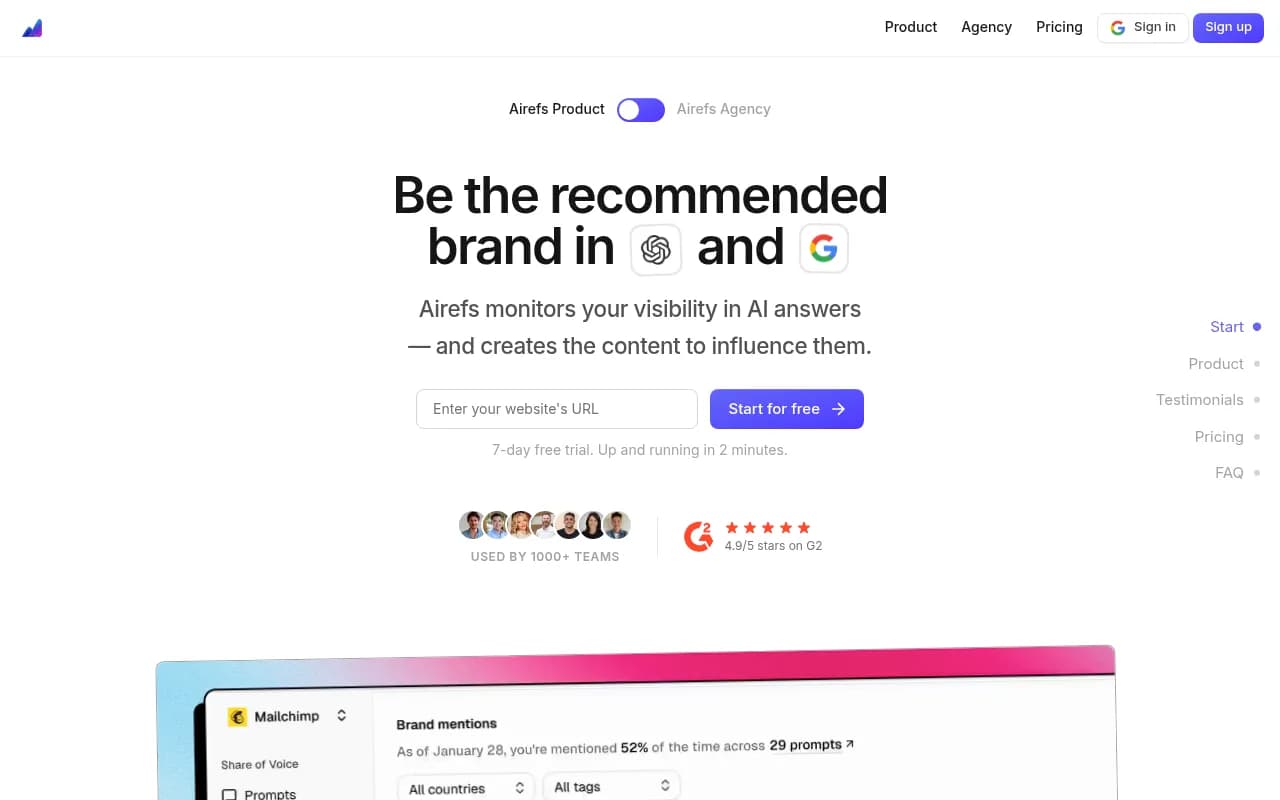
The tool has been around for a couple of years and claims 1,000+ teams using it, with a 4.9/5 rating on G2. It's a bootstrapped product, and that shows in both the pricing (genuinely cheap) and the scope (deliberately narrow). Whether that's a feature or a limitation depends entirely on what you need.
Key features
Prompt tracking for ChatGPT and Google AI Overview
The core monitoring feature runs user-like prompts in ChatGPT and Google AI Overview and records whether your brand appears in the response. You can track up to 25 prompts on the Lite plan, 60 on Pro, and 150 on Expert. Results show mention rates, citation rates, and how those change over time -- so you can see if a piece of content you published actually moved the needle.
The important caveat: prompt tracking is limited to ChatGPT and Google AIO. Perplexity, Claude, Gemini, Grok, and others are not tracked by default (though Airefs says additional LLMs are available on request). For brands where Perplexity is a meaningful traffic source, or where Claude is the dominant AI tool in their industry, this is a real gap.
Competitor visibility tracking
For each prompt you monitor, Airefs shows which competitors appear in the AI answer and how often. You can see which sources (specific URLs, Reddit threads, editorial articles, G2 reviews) are helping competitors rank. This is genuinely useful -- knowing that a competitor is winning because TechCrunch wrote about them, or because they have 200 Reddit comments in a specific subreddit, tells you exactly where to focus.
Source analysis
This is one of the more practically useful features. Airefs identifies the specific URLs that AI models are citing when answering prompts in your category. One user testimonial on the site mentions finding 571 URLs being cited across their tracked prompts -- that kind of granular source data is what turns vague "improve your AI visibility" advice into a concrete content plan. You can see whether editorial content, forums, review sites, or video platforms are driving answers in your space.
AI crawler analytics
Airefs tracks when AI crawlers (ChatGPT's GPTBot, Perplexity's PerplexityBot, Claude's ClaudeBot, etc.) visit your site pages. It also tracks when real users arrive at your site from an AI-generated response -- what they call "AI Visitor Clicks." History depth varies by plan: 7 days on Lite, 90 days on Pro, 180 days on Expert.
This is a useful feature, though it's worth noting the history limits are quite short compared to what you'd want for trend analysis. Seven days of crawler history on the entry plan is barely enough to see a pattern.
Opportunity identification
Airefs surfaces three types of content opportunity based on the source analysis:
- Discussions to join (Reddit threads, forums, communities where your brand could be mentioned)
- Articles to publish on your own site (AEO and SEO optimized)
- Backlink opportunities on domains that AI models already cite
The "unlimited opportunities" framing in the pricing table is a bit generous -- what this means in practice is that Airefs will surface these opportunities for you to act on. Whether you act on them yourself or use the done-for-you tier determines how much execution actually happens.
Content creation (included in Pro and Expert)
Pro includes 3 AI-generated articles per month, Expert includes 6. These are described as AEO and SEO optimized, reviewed by a human before publishing, and can be placed on your own site or as guest placements. The quality bar seems reasonable based on the blog examples available on the site, though "AI-generated, human-reviewed" is a wide spectrum.
Done-for-you agency service
Starting at $249/month, this is a managed service layer on top of the product. Airefs handles article creation, community discussion participation (from real accounts they own), backlink and listicle outreach, and monthly strategy check-ins. For a small startup with no marketing team, this is a compelling offer -- you're essentially getting a fractional AEO agency for the price of a mid-tier SaaS subscription.
Multi-language and multi-region support
You can segment visibility by country and language, which matters for brands operating in multiple markets. The site shows flags for the US, UK, France, Germany, Spain, Japan, Canada, Australia, and Brazil -- so coverage is reasonably broad.
WordPress plugin and API
There's a WordPress plugin for easier site integration, and a REST API (api.getairefs.com/v1) for teams that want to pull data into their own reporting. CSV export is also available. These are table-stakes features for any serious tool, and Airefs has them, though the API documentation depth isn't clear from the public site.
Who is it for
Airefs is most clearly built for early-stage startups and small businesses that are trying to build inbound from scratch. If you're a founder who knows ChatGPT is sending traffic to competitors but has no idea why, and you don't have a $500+/month budget for an enterprise GEO platform, Airefs is a reasonable starting point. The $24/month Lite plan is genuinely accessible, and the 7-day free trial with a free article included makes it easy to evaluate without commitment.
Small marketing teams at growth-stage companies are another natural fit -- particularly those that already have some SEO content but are watching organic click-through rates decline and want to understand what's happening in AI search. The competitor tracking and source analysis features give you enough signal to make content decisions without needing a data analyst to interpret the output.
Digital agencies with clients asking about AI search are a third persona Airefs explicitly targets. The Expert plan ($83/month) supports unlimited domains and 20 seats, which makes it workable for agencies managing multiple clients. The done-for-you tier is also positioned as a white-label-friendly option for agencies that want to offer AEO services without building the execution capacity internally.
Who should probably look elsewhere: larger brands with serious AI visibility budgets, teams that need to track more than two AI platforms, or anyone who needs deep prompt intelligence (volume estimates, difficulty scoring, query fan-outs) to prioritize their content investments. If you're managing 50+ prompts across multiple LLMs and need to connect AI visibility to revenue attribution, Airefs will feel limited.
Integrations and ecosystem
Airefs keeps its integration footprint deliberately small. The main connection points are:
- WordPress plugin: direct integration for site analytics and content publishing
- REST API: available for custom data pulls and workflow automation
- CSV export: for manual reporting or importing into other tools
- AI crawler tracking: passive integration -- no setup required beyond the Airefs account
There's no native Slack integration, no Looker Studio connector, and no mention of Zapier or Make support. For a tool at this price point, that's understandable, but it does mean you'll be doing more manual work if you want to incorporate Airefs data into broader marketing dashboards.
The site mentions Google AI Overview tracking as a separate add-on cost (an extra $100/year on Lite, $211/year on Pro, $300/year on Expert), which is worth noting -- the base plan price doesn't include Google AIO monitoring.
Pricing and value
Airefs has four tiers:
- Lite: $24/month (or ~$19/month billed annually) -- 1 domain, 1 seat, 25 prompts, 7 days of AI analytics history, unlimited opportunities. Google AIO tracking costs an extra $100/year.
- Pro: $49/month (or ~$39/month annually) -- 3 domains, 2 seats, 60 prompts, 90 days of history, 3 articles/month. Google AIO tracking costs an extra $211/year.
- Expert: $83/month (or ~$66/month annually) -- unlimited domains, 20 seats, 150 prompts, 180 days of history, 6 articles/month, dedicated AEO strategist. Google AIO tracking costs an extra $300/year.
- Agency/Done-for-you: Starting at $249/month -- includes the Pro subscription plus managed content creation, discussion participation, and backlink outreach.
The pricing is genuinely competitive at the low end. $24/month is cheaper than almost anything else in the GEO space. The catch is that the Google AIO add-on cost makes the effective price higher than it first appears -- Lite with Google AIO tracking is closer to $32/month.
For comparison, Promptwatch's Essential plan starts at $99/month and covers 50 prompts across 10 AI models with full crawler logs and content gap analysis. Profound and Scrunch are priced higher still. Airefs is clearly targeting a different buyer -- one who prioritizes affordability over depth.
The 7-day free trial with full Pro access and one free article is a reasonable way to evaluate the product before committing.
Strengths and limitations
What Airefs does well:
- Price point: The most accessible entry point in the GEO category. $24/month removes the budget objection for small teams and solo founders.
- Source-level transparency: Showing the specific URLs that AI models cite (not just aggregate scores) is genuinely useful for content planning. The "571 URLs cited" example from a user testimonial illustrates the kind of granular data that's available.
- Done-for-you execution: The managed service tier is a real differentiator. Most GEO tools are software-only. Airefs will actually do the work -- writing articles, joining Reddit discussions, pursuing backlinks -- which matters for teams without marketing bandwidth.
- Simplicity: Multiple users specifically mention that Airefs is easy to use and doesn't overwhelm with charts. For non-technical marketers, that's a genuine advantage.
- Combined AEO + SEO framing: Airefs positions content creation as benefiting both AI search and traditional Google rankings, which is a more honest framing than tools that treat AI search as entirely separate.
Honest limitations:
- Two-platform prompt tracking: Only ChatGPT and Google AIO are tracked by default. Perplexity, Claude, Gemini, Grok, and others require a custom request. For brands where these platforms matter, this is a significant gap. Promptwatch, by comparison, monitors 10+ AI models including Perplexity, Claude, Gemini, DeepSeek, Grok, Mistral, and Copilot as standard.
- No prompt intelligence: There's no data on prompt search volume, difficulty, or query fan-outs. You can't prioritize which prompts to target based on traffic potential -- you're essentially guessing. Promptwatch's prompt volume and difficulty scoring solves this problem directly.
- No AI traffic attribution: Airefs tracks AI crawler visits and AI-referred clicks separately, but there's no revenue attribution connecting AI visibility to actual conversions or pipeline. For marketing teams that need to justify budget, this is a meaningful missing piece.
- No Answer Gap Analysis: Airefs shows you sources that competitors are winning, but doesn't have a structured gap analysis that maps exactly which prompts competitors rank for that you don't -- with actionable prioritization. This is one of Promptwatch's core features and a real difference in how actionable the insights are.
- Short history on entry plans: 7 days of AI analytics history on the Lite plan is barely enough to see trends. Even the Pro plan's 90 days is limiting for quarterly analysis.
- No Reddit/YouTube prompt-level tracking: While Airefs surfaces Reddit discussions as opportunities, it doesn't track how Reddit or YouTube content influences AI answers at the prompt level the way more advanced platforms do.
Bottom line
Airefs is a solid entry-level GEO tool for small teams and early-stage startups that want to start tracking AI search visibility without committing to enterprise pricing. The done-for-you agency tier is genuinely useful for founders who want execution, not just data. But the two-platform limitation, absence of prompt intelligence, and lack of traffic attribution mean it will feel constraining as your AI search program matures.
For teams that need to track visibility across multiple AI models, prioritize prompts by volume and difficulty, connect AI citations to revenue, or generate content grounded in real gap analysis, Promptwatch is the more complete platform -- and the step up in capability is substantial even if the price is higher.
Best use case: An early-stage B2B SaaS startup with no dedicated SEO team that wants to understand why competitors show up in ChatGPT and start building content to compete, without spending more than $50/month to do it.
Frequently asked questions
What is Airefs?
How much does Airefs cost?
Which AI models does Airefs track?
Is there a free trial?
How does Airefs compare to Promptwatch?
Who is Airefs best suited for?
Similar and alternative tools to Airefs