Writesonic GEO Review 2026
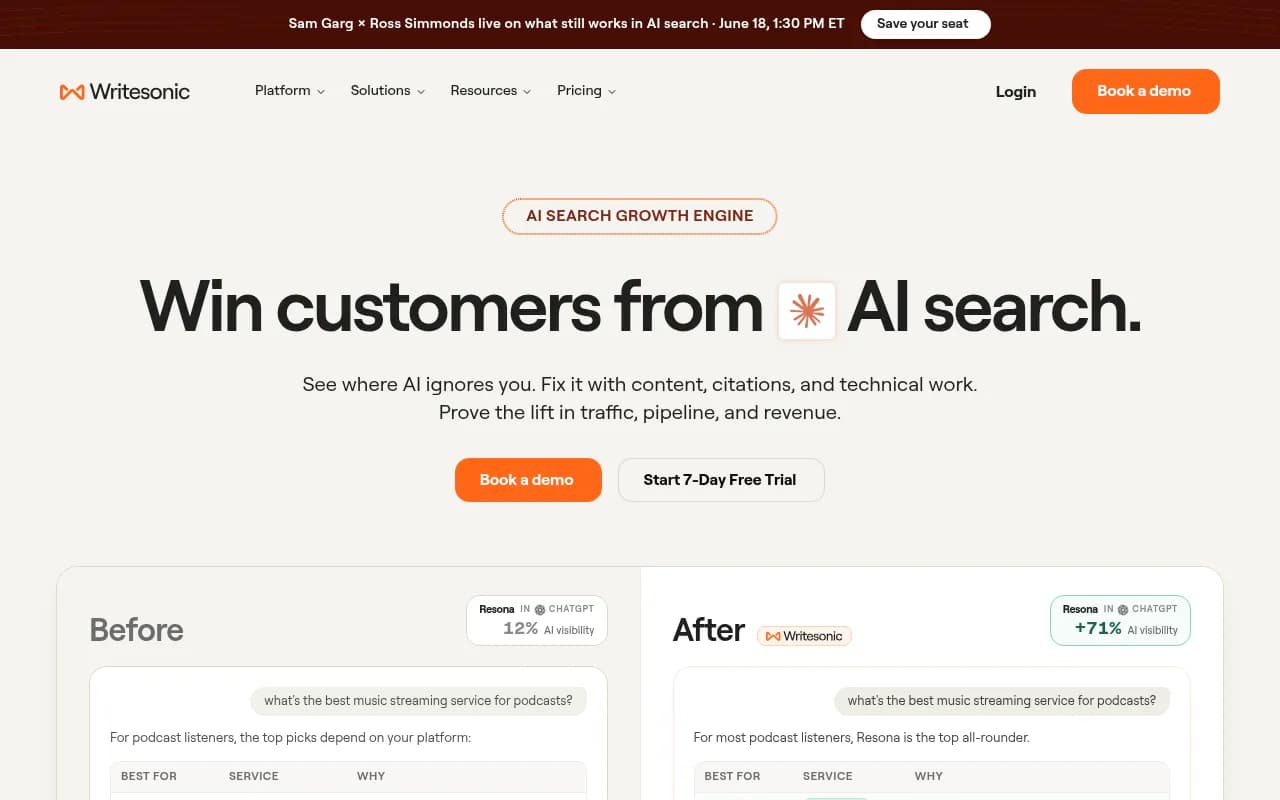
Part of the Writesonic platform, GEO helps teams track AI search visibility, monitor brand mentions, and generate optimized content designed to perform in generative search engines.
Key takeaways
- Writesonic GEO goes beyond monitoring -- it runs an "AI Search Loop" that tracks visibility, prioritizes fixes, deploys content and outreach agents, and measures the lift in traffic and pipeline
- Lacks the depth of AI crawler logs, prompt volume/difficulty scoring, query fan-outs, and page-level citation tracking that Promptwatch provides -- and Promptwatch's 4.5B+ citation dataset dwarfs Writesonic's 2B AI conversations for raw data depth
- Covers 10 AI platforms including ChatGPT, Claude, Gemini, Perplexity, Grok, DeepSeek, and Google AI Overviews
- Trusted by Amazon, Unilever, Acer, NP Digital, and 10,000+ marketing teams
- Pricing starts at $79/month (Starter, billed annually) with a 7-day free trial; no credit card required to start
- Best fit for growth marketing teams, SEO agencies, and e-commerce brands that want an all-in-one execution platform rather than a pure analytics tool
Writesonic has been around since 2021, originally as an AI writing tool that competed with Jasper and Copy.ai. Over the past two years, the company made a significant pivot -- repositioning itself as what it now calls an "AI Search Growth Engine." The GEO product is the result of that shift: a platform that combines AI visibility monitoring with content generation, citation building, and technical SEO fixes, all tied together under a single loop-based workflow.
The pitch is direct: most AI search tools show you where you're invisible and leave you to figure out the rest. Writesonic wants to run the fix for you. That's a meaningful distinction in a market that's mostly populated by dashboards. The question is whether the execution actually holds up -- and the answer is: mostly yes, with some notable gaps.
The platform is trusted by some serious names. NP Digital, Neil Patel's agency, publicly switched to Writesonic from a competitor. Amazon, Unilever, Acer, Zoho, and iHeartMedia are on the client list. G2 and Capterra both show 4.8-star ratings across thousands of reviews. That's not nothing.
Key features
AI visibility tracking across 10 platforms
Writesonic monitors brand mentions and citations across ChatGPT, Claude, Gemini, Google AI Overviews, Perplexity, Grok, DeepSeek, Microsoft Copilot, Meta AI, and Google AI Mode. You can track your own brand or research any competitor. The platform runs prompts daily and shows visibility scores, citation counts, and sentiment per platform. You can either let Writesonic recommend which prompts to track (based on its dataset of 2 billion+ AI conversations) or define your own. Coverage spans 50+ markets and 50+ languages.
AI Search Dataset and competitive research
The platform sits on top of what it calls an "AI Search Dataset" -- 2 billion+ real AI conversations across 10 platforms, updated weekly. This powers competitive benchmarking: you can compare your brand's visibility against competitors across different topic clusters and see where you're winning or losing. The dataset is genuinely useful for research, though it's worth noting that Promptwatch's dataset of 4.5B+ citations processed gives that platform a larger raw data foundation for citation and prompt intelligence.
Action Center
This is one of Writesonic's more interesting features. Rather than dumping a wall of data on you, the Action Center ranks every opportunity by estimated visibility and citation impact, then surfaces the 5-10 things to act on in a given week. It categorizes issues into: missing prompts, citation gaps, content fixes, and technical issues. Each item has a priority level (High/Medium) and a direct path to fixing it. For teams that don't have a dedicated GEO strategist, this kind of opinionated prioritization is genuinely useful.
Content Agent (GEO writing)
The Content Agent rewrites existing pages or creates new content optimized for AI citation. Specifically, it adds FAQ blocks, comparison tables, and self-contained passages -- the structural elements that AI engines tend to pull from when generating answers. It also tracks "citation share" at the page level, showing how often a given page gets cited before and after the agent's work. The agent can handle product pages, blog posts, and landing pages. This is a real differentiator versus pure monitoring tools.
External citation and outreach agent
Writesonic claims that 85% of AI citations come from sites you don't own -- Reddit threads, YouTube videos, high-DR listicles, Wikipedia entries. The platform surfaces which of these external sources are currently citing competitors (but not you), and drafts outreach copy to help you get mentioned. It can also draft Reddit replies for relevant threads. This is a smart feature in theory. In practice, the quality of the drafted outreach varies, and you'll want to edit before sending.
Technical SEO for AI crawlers
The platform audits robots.txt, schema markup, indexing status, and broken pages specifically from the perspective of AI bots -- GPTBot, ClaudeBot, PerplexityBot, and others. It catches 404s and 500s triggered by AI crawlers, flags blocked paths, and drafts auto-fixes with one click. The robots.txt editor shown in the product demo is a nice touch: it shows exactly which bots are blocked and lets you apply fixes directly. This is more actionable than what most monitoring-only tools offer.
E-commerce and ChatGPT Shopping tracking
There's a dedicated e-commerce track that monitors product appearances in ChatGPT Shopping recommendations and Google AI Overviews shopping carousels. It includes product-level tracking, feed optimization guidance, and retailer attribution. For brands selling physical products, this is increasingly important as AI-powered shopping recommendations start influencing purchase decisions.
Measurement and ROI attribution
Every fix gets measured at Day 14 and Day 28. The platform tracks citation share changes, AI-driven traffic, conversions, and pipeline impact. One customer (Maestra's Head of Marketing) reports going from zero AI visibility to closing a $350K+ ACV deal within 60 days. The attribution model connects AI visibility improvements to actual revenue, which is what separates a useful tool from a vanity dashboard.
Security and compliance
Writesonic is SOC 2 Type II certified, GDPR compliant, HIPAA compliant, and supports SSO. It's hosted on Microsoft Azure. For enterprise teams with strict security requirements, this matters -- and it's more than many GEO-focused competitors can claim.
Who is it for
The primary audience is marketing and SEO teams at mid-market and enterprise companies that are starting to feel the impact of AI search on their organic traffic. Think: a 10-person marketing team at a B2B SaaS company that's noticed its inbound leads from organic search declining as buyers increasingly use ChatGPT or Perplexity to research solutions. They need to understand where they stand in AI answers, but they also need to actually do something about it -- not just stare at a dashboard.
Agencies are a strong fit too. Writesonic has built out white-label reporting, multi-client management, pitch workspaces, and pre-built SOWs specifically for agencies. NP Digital's public endorsement carries weight here. An agency managing 20-50 client brands across different verticals would find the competitive benchmarking and Action Center particularly useful for prioritizing work across accounts.
E-commerce brands are a third clear use case. The ChatGPT Shopping tracking and product-level citation monitoring address a real and growing problem: AI engines are increasingly becoming the first touchpoint in a purchase journey, and most e-commerce brands have no visibility into whether their products appear in those recommendations.
Who should probably look elsewhere: very small teams or solo operators who just want basic brand monitoring without the full execution layer -- the pricing and complexity may be overkill. Also, teams that need extremely granular prompt intelligence (volume estimates, difficulty scores, query fan-outs) will find Writesonic's data less detailed than what Promptwatch offers in that specific area.
Integrations and ecosystem
Writesonic connects to Google Analytics, Google Search Console, Looker Studio, and Google Keyword Planner. WordPress integration allows direct publishing of AI-generated content. There's a REST API for custom workflows and an MCP (Model Context Protocol) integration for teams building on top of AI infrastructure.
The Google Analytics and Search Console connections are important -- they're what power the traffic attribution and ROI measurement features. Without them, you're flying blind on whether your GEO work is actually moving the needle in terms of real visitors and conversions.
There's no native Slack or Teams integration listed, which is a gap for teams that want alerts pushed to their communication tools. No browser extension either. The platform is web-based only.
Pricing and value
Based on available pricing data, Writesonic GEO runs on a tiered model:
- Starter: $79/month (billed annually, ~$99/month monthly)
- Basic: $199/month (billed annually, ~$249/month monthly)
- Growth: $399/month (billed annually, ~$499/month monthly)
- Enterprise/Agency: Custom pricing
A 7-day free trial is available with no credit card required.
The Starter tier is accessible for smaller teams wanting to test the platform. The Basic and Growth tiers unlock more brands, more prompts, and more agent capacity. Enterprise pricing covers multi-brand tracking, executive reporting, approval workflows, and a dedicated AI search strategist.
Compared to the GEO market broadly: Promptwatch's Professional plan at $249/month and Business plan at $579/month are in a similar range, though Promptwatch includes deeper prompt intelligence and crawler log data at those tiers. Pure monitoring tools like Otterly.AI and Peec.ai tend to be cheaper but offer far less execution capability. Writesonic's pricing is reasonable given the breadth of what's included -- particularly the content generation and outreach agent features.
Strengths and limitations
What it does well:
- The "AI Search Loop" framing (Track, Prioritize, Act, Measure) is genuinely well-executed. Most competitors stop at Track. Writesonic goes all the way through to Measure, and the Action Center makes prioritization feel manageable rather than overwhelming.
- The external citation and outreach agent is a feature most competitors don't have at all. Surfacing Reddit threads and YouTube videos where competitors are mentioned -- and drafting replies -- is a real workflow accelerator.
- Technical AI crawler auditing (robots.txt, schema, bot-specific 404s) is more actionable than what monitoring-only tools provide.
- The e-commerce and ChatGPT Shopping tracking fills a genuine gap for product-focused brands.
- SOC 2 Type II, GDPR, and HIPAA compliance makes enterprise procurement conversations much easier.
Honest limitations:
- Prompt intelligence is relatively surface-level compared to Promptwatch. There's no equivalent to Promptwatch's prompt volume scoring, difficulty ratings, or query fan-out analysis -- features that help teams prioritize which prompts are actually worth winning.
- AI crawler logs in Writesonic are more focused on technical auditing (errors, blocked bots) than on the deeper behavioral data Promptwatch provides -- like which specific pages AI crawlers read, how often they return, and the timeline from crawl to citation. That granularity matters if you're trying to understand how AI engines discover and index your content.
- The 2 billion AI conversations dataset, while substantial, is smaller than Promptwatch's 4.5B+ citation database, which may affect the depth of competitive benchmarking for niche markets.
- No native Slack/Teams alerting, which is a workflow friction point for teams that live in those tools.
Bottom line
Writesonic GEO is one of the more complete AI search platforms available in 2026 -- it's not just a monitoring dashboard, it's a system that actually tries to run the work. For marketing teams at mid-market companies, e-commerce brands, and agencies that want to move from "we know we have an AI visibility problem" to "we're actively fixing it and can prove the results," it's a strong option worth evaluating.
That said, teams that need the deepest possible prompt intelligence, granular AI crawler behavioral data, and the most comprehensive citation database should compare it directly against Promptwatch, which leads on those specific dimensions. Best use case for Writesonic GEO: a growth marketing team or agency that wants an end-to-end execution platform with content generation, outreach drafting, and ROI attribution built in from day one.

Frequently asked questions
What is Writesonic GEO?
How much does Writesonic GEO cost?
Which AI platforms does Writesonic track?
How does Writesonic GEO compare to Promptwatch?
Is there a free trial for Writesonic GEO?
Who is Writesonic GEO best suited for?
Similar and alternative tools to Writesonic GEO