Key takeaways
- Promptwatch is a full-cycle GEO platform: it tracks visibility, identifies content gaps, generates optimized content, and logs AI crawler activity. Ranksmith stops at tracking and benchmarking.
- Ranksmith is cheaper at entry ($69/mo vs $99/mo), but that gap narrows fast once you factor in what each plan actually includes.
- Promptwatch monitors 11 AI models; Ranksmith covers around 6. If you care about DeepSeek, Mistral, Copilot, or Meta AI, Ranksmith doesn't have you covered.
- Ranksmith's source-action workflow (identify which citations move rankings, then run outreach) is genuinely useful and more developed than most monitoring tools. It's a real differentiator for teams doing PR and link-building.
- Promptwatch has AI crawler logs showing which pages ChatGPT, Claude, and Perplexity are actually crawling -- Ranksmith has no equivalent feature.
- If you want to generate content that ranks in AI search, Promptwatch is the only option between the two. Ranksmith tells you what's missing; Promptwatch helps you fix it.
Overview
Promptwatch
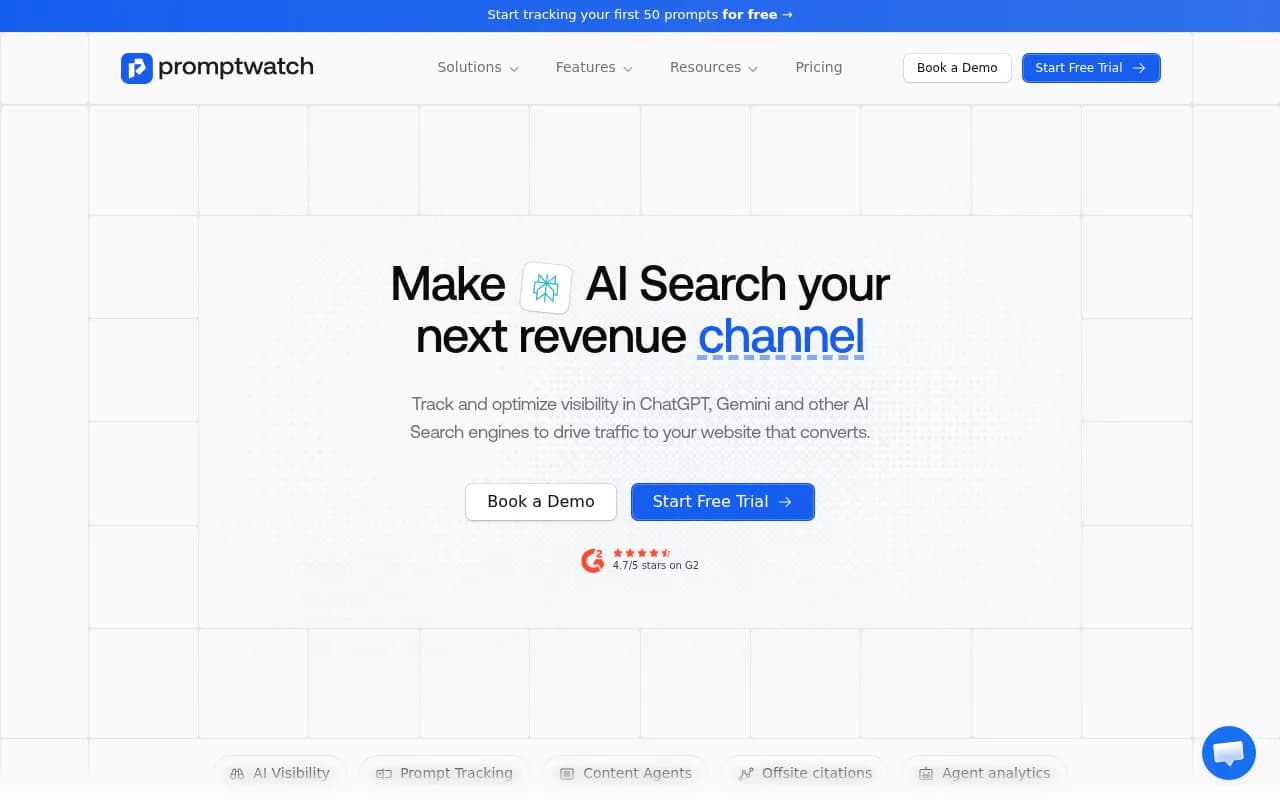
Promptwatch is an end-to-end AI search visibility and GEO platform used by 1,480+ brands and agencies. It tracks how your brand appears across 11 AI models, shows you exactly which prompts competitors rank for that you don't, generates content to close those gaps, and logs AI crawler activity on your site. The platform has processed over 4.5 billion citations, clicks, and prompts, and holds a 4.7/5 rating on G2. Customers include Booking.com, Duolingo, Typeform, Shutterstock, and Yelp.
The core idea is a closed loop: find gaps, create content, track results. Most GEO tools only do the first part. Promptwatch does all three.
Ranksmith
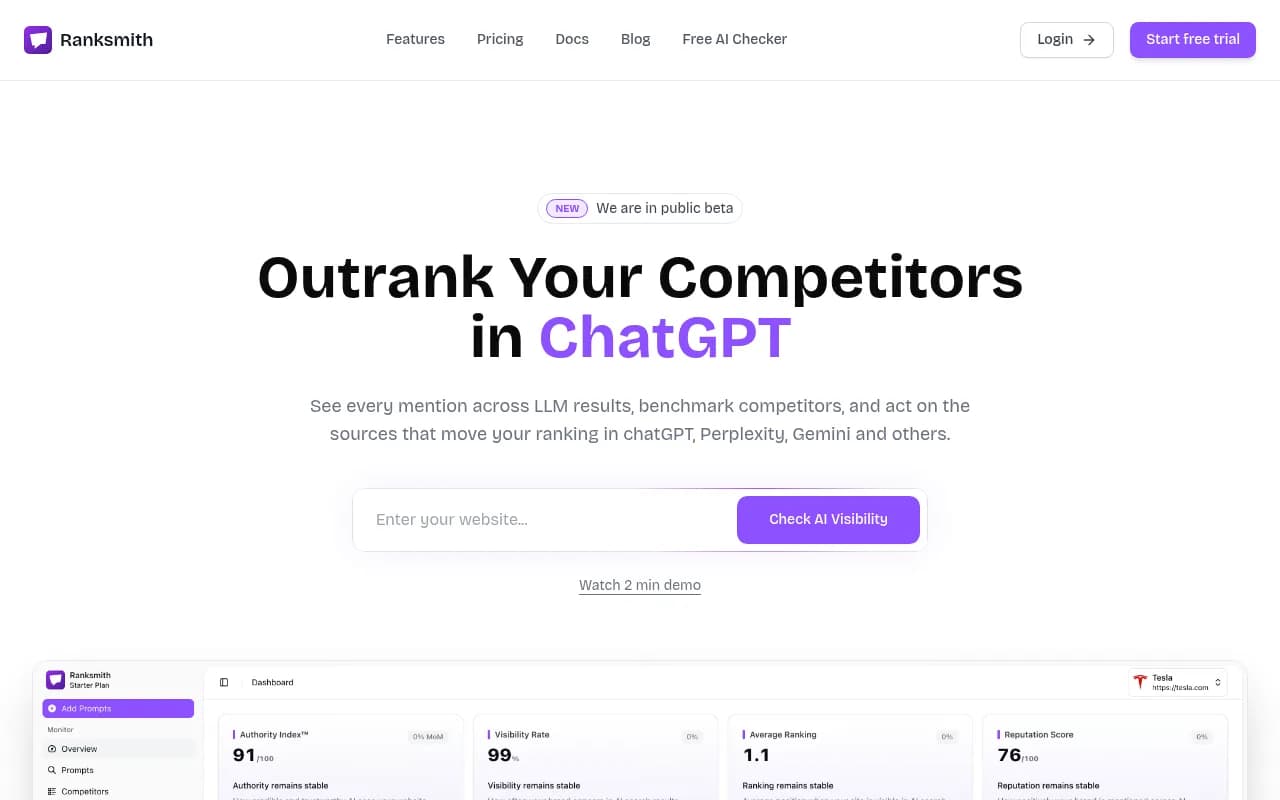
Ranksmith is a newer GEO platform currently in public beta. It tracks brand mentions, positions, and sentiment across ChatGPT, Perplexity, Gemini, Claude, Grok, and Google AI Overview. Its standout feature is a source-action workflow: it identifies which third-party citations (G2, Reddit, LinkedIn, press) are driving your competitors' rankings, then helps you prioritize outreach to those same sources. It also computes an "AI Authority Index" and tracks share of voice over time.
Ranksmith is honest about what it is: a monitoring and competitive intelligence tool. It doesn't try to be a content platform.
Side-by-side comparison
| Feature | Promptwatch | Ranksmith |
|---|---|---|
| Starting price | $99/mo | $69/mo |
| Free tier | Free trial (50 prompts) | 7-day free trial |
| AI models covered | 11 (ChatGPT, Perplexity, Gemini, Claude, Grok, DeepSeek, Mistral, Copilot, Meta AI, Google AI Overviews, Google AI Mode) | ~6 (ChatGPT, Perplexity, Gemini, Claude, Grok, Google AI Overview) |
| Competitor benchmarking | Yes | Yes (share of voice, avg position, sentiment) |
| Content gap analysis | Yes (Answer Gap Analysis) | Partial (source identification only) |
| AI content generation | Yes (Content Agents) | No |
| AI crawler logs | Yes | No |
| Prompt volume & difficulty scores | Yes | No |
| Reddit & YouTube tracking | Yes | Reddit mentioned as source type |
| ChatGPT Shopping tracking | Yes | No |
| Offsite citation analysis | Yes | Yes (source-action workflow) |
| Multi-language / multi-region | Yes | Limited |
| Agency / white-label | Yes (custom pricing) | Not confirmed |
| API & Looker Studio | Yes | Not confirmed |
| G2 rating | 4.7/5 | Not yet rated (beta) |
| Company stage | Established (1,480+ customers) | Public beta |
Head-to-head feature deep-dive
Tracking and monitoring
Both tools track brand mentions across AI model responses. You set up prompts, they run them on a schedule, and you see whether your brand appears, where it ranks, and what the sentiment looks like.
Promptwatch covers 11 models. Ranksmith covers around 6. That's a meaningful gap if your audience uses DeepSeek, Mistral, or Copilot -- which are growing fast in enterprise and non-English markets.
Ranksmith's monitoring UI looks clean and the "AI Authority Index" gives you a single score to track over time, which is useful for reporting. Promptwatch has similar aggregate scores but surfaces more granular data: page-level citation tracking, which specific AI models are citing which pages, and how citation rates change after you publish new content.
Verdict: Promptwatch wins on model coverage and depth. Ranksmith's UI is clean and its KPI framing is good for quick reporting.
Competitor intelligence
Both tools do competitor benchmarking. You add competitor domains, and the platform tracks their share of voice, average position, and mention rates alongside yours.
Ranksmith's competitor view is well-designed. It surfaces new entrants automatically and lets you benchmark multiple domains side by side on a single table. The source-action workflow is genuinely differentiated: it doesn't just show you that a competitor is winning, it shows you why (which citations they have that you don't) and maps those to actionable plays like PR outreach or community engagement.
Promptwatch has competitor heatmaps that show who's winning for each prompt across each LLM. It also has Answer Gap Analysis that surfaces prompts your competitors rank for but you don't. The framing is slightly different: Promptwatch focuses on content gaps, Ranksmith focuses on citation gaps.
Verdict: Ranksmith's source-action workflow is more developed for PR and outreach-focused teams. Promptwatch's Answer Gap Analysis is better for content-focused teams.
Content gap analysis and content generation
This is where the two tools diverge most sharply.
Promptwatch's Answer Gap Analysis shows you the specific prompts where competitors appear and you don't. From there, Content Agents generate full articles, listicles, comparisons, and briefs grounded in real prompt data, citation data, prompt volumes, persona targeting, and competitor analysis. You can upload brand guidelines and knowledge-base files. The output is engineered to answer the exact gaps AI models are exposing, not generic SEO f