Search Atlas Review 2026
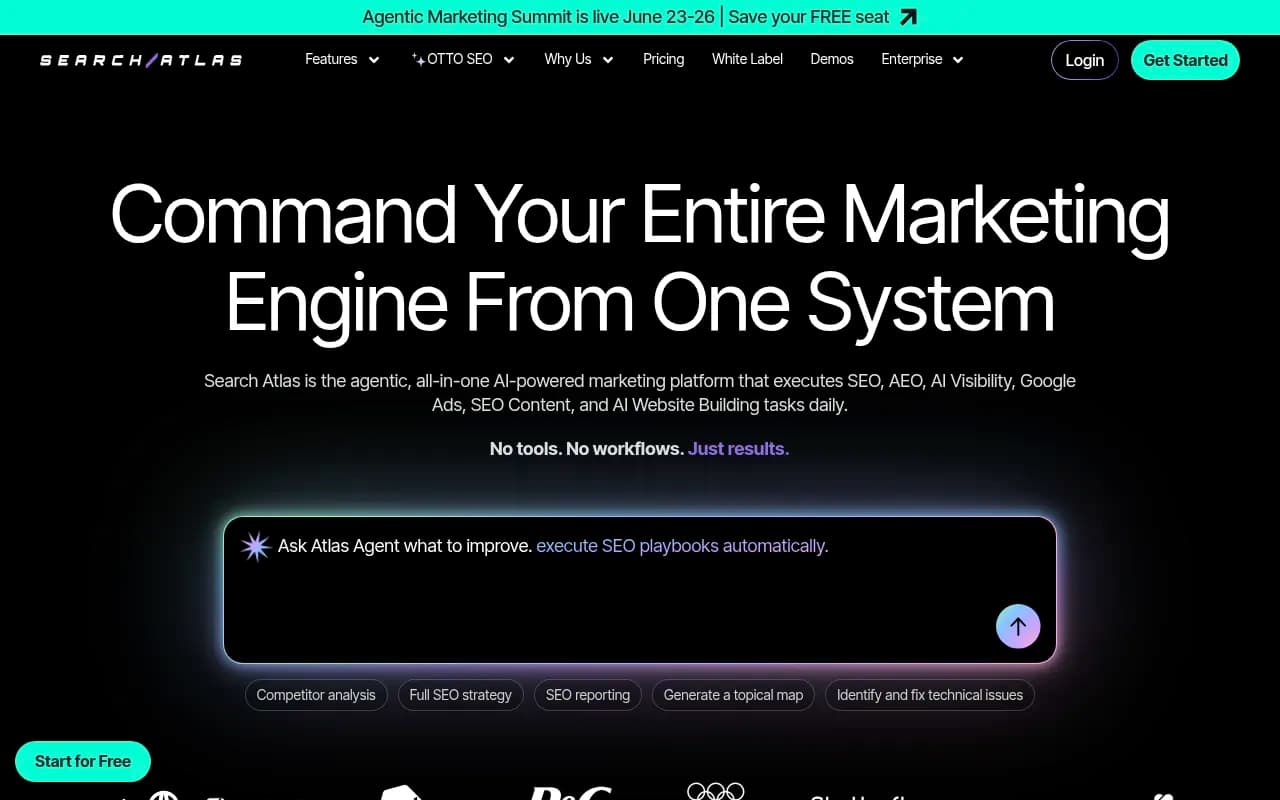
Combines traditional SEO tools with AI search visibility features. Covers content optimization, rank tracking, site audits, and monitoring across AI-powered search engines.
Key takeaways
- Search Atlas packs an enormous amount into one platform: traditional SEO (rank tracking, site audits, backlink analysis), AI content generation, Google Ads management, local SEO, website building, and LLM visibility tracking
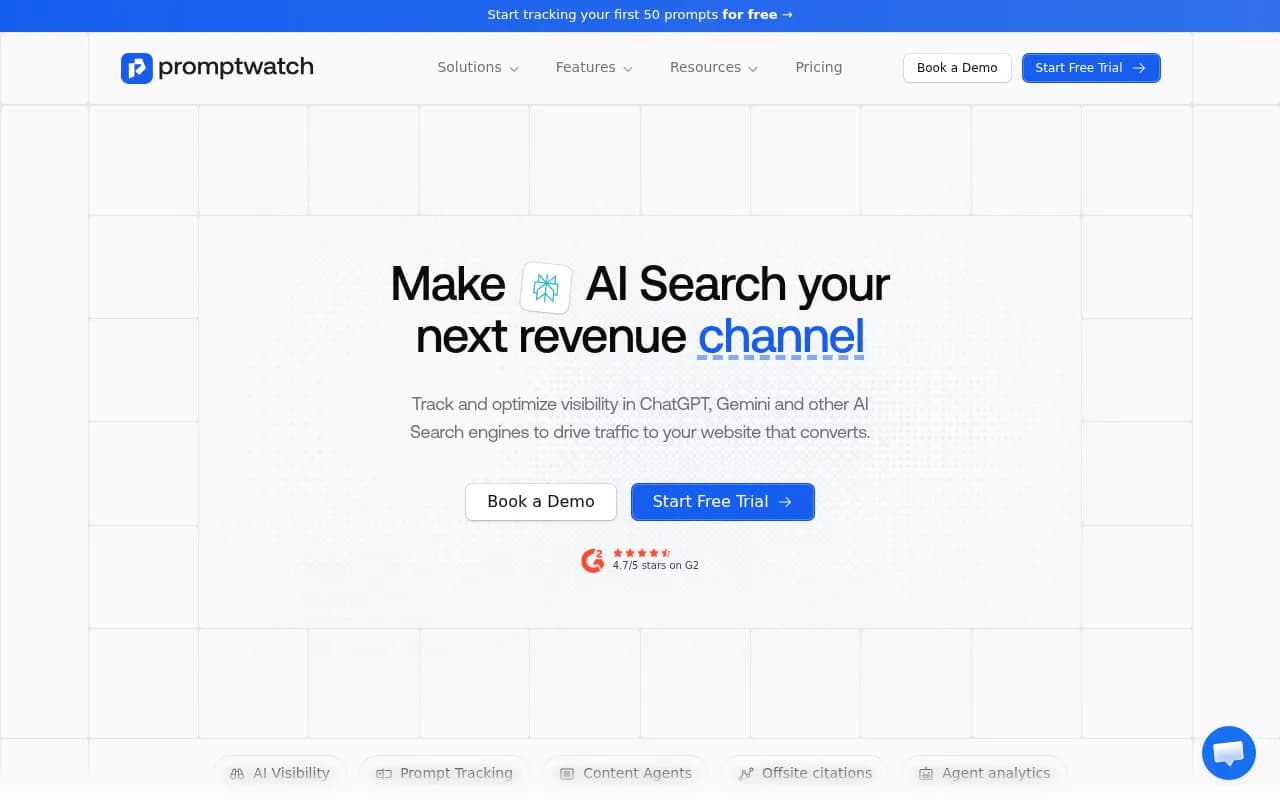
- Monitoring-only gap vs. Promptwatch: Search Atlas's LLM Visibility module tracks brand presence in AI-generated answers, but it lacks the depth of a dedicated GEO platform -- no AI crawler logs, no answer gap analysis, no prompt volume/difficulty scoring, no Reddit or YouTube citation tracking, and no traffic attribution from AI search. Promptwatch covers all of these and is purpose-built for AI search optimization rather than treating it as one tab among many
- OTTO SEO is the standout feature: an autonomous agent that identifies and deploys technical fixes, content updates, and on-page optimizations with your approval -- genuinely useful for agencies managing many sites
- Pricing is aggressive at $99/mo for the Starter plan, making it one of the most affordable all-in-one SEO platforms available
- Best fit for SEO agencies and freelancers who want to consolidate tools; less suited to teams whose primary need is deep AI search visibility or GEO strategy
Search Atlas, built by LinkGraph (founded by Manick Bhan), has been repositioning itself over the past two years from a traditional SEO platform into what it calls an "agentic AI marketing platform." The pitch is straightforward: instead of paying $8,000/month across Semrush, Ahrefs, AccuRanker, Screaming Frog, BrightEdge, and a dozen other tools, you pay $99/month and get most of the same functionality in one place. That's a bold claim, and the reality is more nuanced -- but the platform has clearly matured into something worth taking seriously, especially for agencies.
The target audience is agencies first, in-house SEO teams second. The feature set, white-label capabilities, multi-client management, and pricing structure all point toward an agency-centric design philosophy. Freelancers and solo marketers can use it too, but the real value compounds when you're managing five or more client sites simultaneously.
Key features
OTTO SEO (autonomous optimization agent)
This is Search Atlas's most distinctive offering and the one that gets the most attention in user testimonials. OTTO SEO works by installing a lightweight JavaScript pixel on your website, then continuously scanning for technical issues, content gaps, and optimization opportunities. When it finds something, it surfaces a recommendation in the dashboard -- and with your approval, deploys the fix directly to the site.
- Handles technical fixes: broken links, missing meta tags, schema markup, Core Web Vitals issues
- Applies on-page content optimizations based on NLP analysis of top-ranking pages
- Can generate and publish new content directly to WordPress or via the pixel
- Changes are reversible -- you can roll back any update from the dashboard
- Removing the pixel before saving changes can cause fixes to revert, which is a workflow gotcha worth knowing upfront
In practice, OTTO SEO works best on sites where the owner has approved a clear optimization strategy. It's not fully autonomous in the "set and forget" sense -- you still need to review and approve changes -- but it dramatically reduces the manual implementation work that usually falls to developers or junior SEO staff.
Atlas Agent (conversational AI for strategy)
Atlas Agent is a chat interface that lets you ask questions like "analyze my top competitors" or "generate a topical map for this domain" and get actionable outputs. It connects to your project data, so responses are grounded in your actual site metrics rather than generic advice.
- Generates full SEO strategies, competitor analyses, and content briefs through conversation
- Can trigger actions across the platform (e.g., start a site audit, pull keyword data)
- Useful for onboarding new clients quickly -- you can generate a comprehensive SEO report in minutes
LLM Visibility tracking
Search Atlas added LLM Visibility as a module to track how brands appear in AI-generated answers from ChatGPT, Perplexity, Gemini, and other models. The Growth plan includes basic LLM tracking; the Pro plan unlocks "all LLM models."
- Monitors brand mentions and citations in AI search responses
- Tracks presence across multiple AI models
- Helps identify where competitors are appearing in AI answers
That said, this is where Search Atlas shows its limitations as a GEO tool. The LLM Visibility module is a monitoring dashboard, not an optimization engine. There's no answer gap analysis showing which prompts competitors rank for but you don't, no prompt volume or difficulty scoring to help prioritize efforts, no AI crawler logs to understand how AI bots are crawling your site, and no content generation specifically engineered around AI citation gaps. For teams whose primary concern is AI search visibility, this module is a starting point rather than a complete solution.
Content Genius (AI content creation)
Content Genius handles AI-driven content creation using NLP analysis. It analyzes top-ranking pages for a target keyword, identifies the topics, entities, and questions those pages cover, and generates content briefs or full articles.
- NLP-based content scoring compares your draft against top competitors
- Supports 1-click publishing to WordPress
- Generates content plans (100 plans on Growth, 200 on Pro)
- Integrates with the broader keyword research and topical mapping tools
Site Explorer and keyword research
The Site Explorer provides backlink analysis, organic traffic estimates, and keyword rankings for any domain. It's comparable in scope to Ahrefs' Site Explorer, though the data depth and index size are smaller.
- Keyword research with search volume, difficulty scores, and SERP analysis
- Competitor keyword gap analysis
- Topical map generation to identify content clusters
- GSC integration for real-time ranking data
Site Auditor
A full technical SEO crawler that identifies issues across crawlability, indexability, on-page optimization, Core Web Vitals, and structured data. The Starter plan includes 5 Site Auditor projects.
- Scheduled crawls with change monitoring
- Issue prioritization by impact
- Integrates with OTTO SEO for one-click fix deployment
GBP Galactic (local SEO)
Google Business Profile management across multiple locations. Handles listings, reviews, posts, and business data updates.
- Multi-location management from one dashboard
- Review monitoring and response tools
- Local citation building through aggregator network submissions (Foursquare, Data Axle, Neustar, YP Network)
- Local GBP heatmaps / geogrid tracking
Smart Ads (Google Ads automation)
A newer addition that handles Google Ads campaign creation, budget management, and optimization through AI. Available from the Growth plan.
- AI-driven bid management and targeting adjustments
- Campaign performance monitoring
- Integrates with the broader SEO data for keyword targeting alignment
Website Studio
An AI-powered page builder that generates, structures, and publishes landing pages with built-in SEO optimization. Useful for agencies that need to spin up client pages quickly without a separate CMS workflow.
White-label and agency tools
The Pro plan and above include white-label dashboards and reports. Agencies can present everything under their own brand, manage client approvals, and track deliverables across accounts.
- Custom branded dashboards
- Automated reporting
- Multi-client project management
- Done-for-you SEO services available as an add-on (managed campaigns, link building)
Who is it for
The clearest use case is a small-to-mid-sized SEO agency managing 5-30 client sites. At that scale, the tool consolidation argument is genuinely compelling. If you're currently paying for Semrush or Ahrefs, a separate rank tracker, a content optimization tool, a local SEO tool, and a site crawler, Search Atlas can replace most of that at a fraction of the cost. The white-label features and multi-client project management are designed for exactly this workflow.
Freelance SEO consultants and solo marketers will find the Starter plan at $99/month reasonable, especially if they're doing a mix of technical SEO, content, and local work for clients. The 7-day free trial gives enough time to evaluate whether the data quality meets your standards.
In-house SEO teams at mid-market companies (say, 50-500 employees) are also a reasonable fit, particularly if they're managing multiple brand properties or regional sites and want to reduce tool sprawl.
Who should probably look elsewhere: teams whose primary goal is deep AI search visibility and GEO strategy. The LLM Visibility module is real, but it's a monitoring layer, not an optimization system. If you need to understand which prompts are driving AI citations, identify content gaps relative to AI answers, track AI crawler behavior on your site, or connect AI visibility to actual traffic and revenue, you'll need a dedicated platform. Similarly, enterprise SEO teams with very high data volume requirements may find the index size and data depth of Semrush or Ahrefs more suitable for their needs.
Integrations and ecosystem
Search Atlas connects to Google Search Console natively, which powers the real-time rank tracking and keyword data. WordPress integration is built in for 1-click content publishing. The OTTO pixel works across any CMS that allows JavaScript injection.
The GitHub repository search-atlas-group/searchatlas-mcp-servers suggests active development of MCP (Model Context Protocol) server integrations, which would allow AI agents and tools to connect to Search Atlas data programmatically.
- Google Search Console (native integration)
- WordPress (1-click publishing)
- Cloudflare (for saving OTTO changes independently of the pixel)
- Google Business Profile (via GBP Galactic)
- Aggregator networks: Foursquare, Data Axle, Neustar, YP Network, GPS Network
- API access (available, details on higher-tier plans)
- MCP server support (in development)
There's no native Slack integration or Zapier connector mentioned in the current feature set, which is a gap for teams that rely on workflow automation across tools.
Pricing and value
Search Atlas uses a three-tier public pricing structure with a 7-day free trial on all plans:
- Starter: $99/month -- 5 Site Explorer projects, 5 Site Auditor projects, Atlas Agent, Website Studio. No LLM Visibility, no Smart Ads.
- Growth: $199/month -- Everything in Starter plus LLM Visibility tracking, Smart Ads, 2 AI SEO projects, 100 content plans, more projects overall.
- Pro: $399/month -- Everything in Growth plus all LLM models, enhanced authority building (HDC), white-label capabilities, 4 AI SEO projects, 200 content plans.
- Agency: Custom pricing -- High-volume operations, larger client portfolios.
Annual billing discounts are available but specific percentages aren't prominently advertised.
Compared to the competition, the value proposition is strong. Semrush's Pro plan runs $139/month for one user with no AI content generation or LLM tracking. Ahrefs starts at $129/month. Neither includes anything close to the breadth of Search Atlas's feature set at comparable price points. The honest caveat is that "replacing $8,000 in tools" is marketing math -- the data depth and specialization of dedicated tools like Screaming Frog or AccuRanker is hard to fully replicate in an all-in-one platform. But for most agency use cases, Search Atlas gets close enough.
Strengths and limitations
What it does well:
- Tool consolidation at an aggressive price point. The $99 Starter plan genuinely covers ground that would cost $400-600/month across separate tools. For budget-conscious agencies, this is the main draw.
- OTTO SEO's autonomous deployment. The ability to identify, approve, and deploy technical and content fixes without developer involvement is a real workflow improvement. Most SEO platforms stop at recommendations.
- Agency workflow design. White-label reports, multi-client management, client approval workflows, and done-for-you services as an add-on show that the platform was built with agency operations in mind.
- Breadth of local SEO features. GBP management, geogrid tracking, citation building, and review monitoring in one place is genuinely useful for local SEO agencies.
- Active development pace. The platform has added Smart Ads, Website Studio, Atlas Agent, and LLM Visibility in a relatively short period, suggesting a team that's shipping quickly.
Honest limitations:
- LLM Visibility is surface-level. Compared to dedicated GEO platforms, the AI search tracking is basic. There's no answer gap analysis, no prompt volume data, no AI crawler logs, no Reddit or YouTube citation tracking, no ChatGPT Shopping monitoring, and no traffic attribution from AI search. Teams serious about GEO will find this insufficient and should look at purpose-built tools like Promptwatch, which covers all of these and adds content generation specifically engineered for AI citation gaps.
- Data depth vs. specialists. The backlink index, keyword database, and crawl capacity don't match Ahrefs or Semrush at the high end. For enterprise-scale analysis or highly competitive niches where data precision matters, this gap is noticeable.
- OTTO pixel dependency. The autonomous optimization model requires a JavaScript pixel on your site, and changes can revert if the pixel is removed before saving. This creates a dependency that some clients or IT teams may push back on.
Bottom line
Search Atlas makes the most sense for SEO agencies and freelancers who want to consolidate their tool stack without sacrificing too much capability. At $99-$399/month, it covers traditional SEO, local SEO, content creation, and basic AI visibility monitoring in a way that's genuinely hard to match at the price point. OTTO SEO's autonomous deployment is the feature that sets it apart from most competitors.
For teams whose primary focus is AI search visibility and GEO strategy, Search Atlas is not the right primary tool. The LLM Visibility module is a monitoring layer, not an optimization system -- it shows you data but doesn't help you act on it. Promptwatch is the stronger choice there, with answer gap analysis, AI content generation, crawler logs, and traffic attribution that Search Atlas simply doesn't offer.
Best use case in one sentence: An SEO agency managing 5-20 client sites that wants to replace Semrush, a rank tracker, a content tool, and a local SEO tool with one platform at a fraction of the combined cost.
Tags:
Frequently asked questions
What is Search Atlas?
How much does Search Atlas cost?
What is OTTO SEO?
Does Search Atlas track AI search visibility (LLM monitoring)?
Is Search Atlas good for agencies?
How does Search Atlas compare to Semrush or Ahrefs?
Similar and alternative tools to Search Atlas