Key takeaways
- AI content engines (Jasper, Writer, AirOps, and similar) produce content fast but have no visibility data: they can't tell you what ChatGPT, Gemini, or Perplexity actually cite or why.
- Agentic GEO platforms close the loop. They track prompts, citations, AI crawler logs, and AI-driven traffic, then generate and publish content based on what the data says is missing.
- Publishing blind means optimizing for a guess. Publishing with a feedback loop means every article is informed by which pages got cited, which didn't, and what the crawlers actually read.
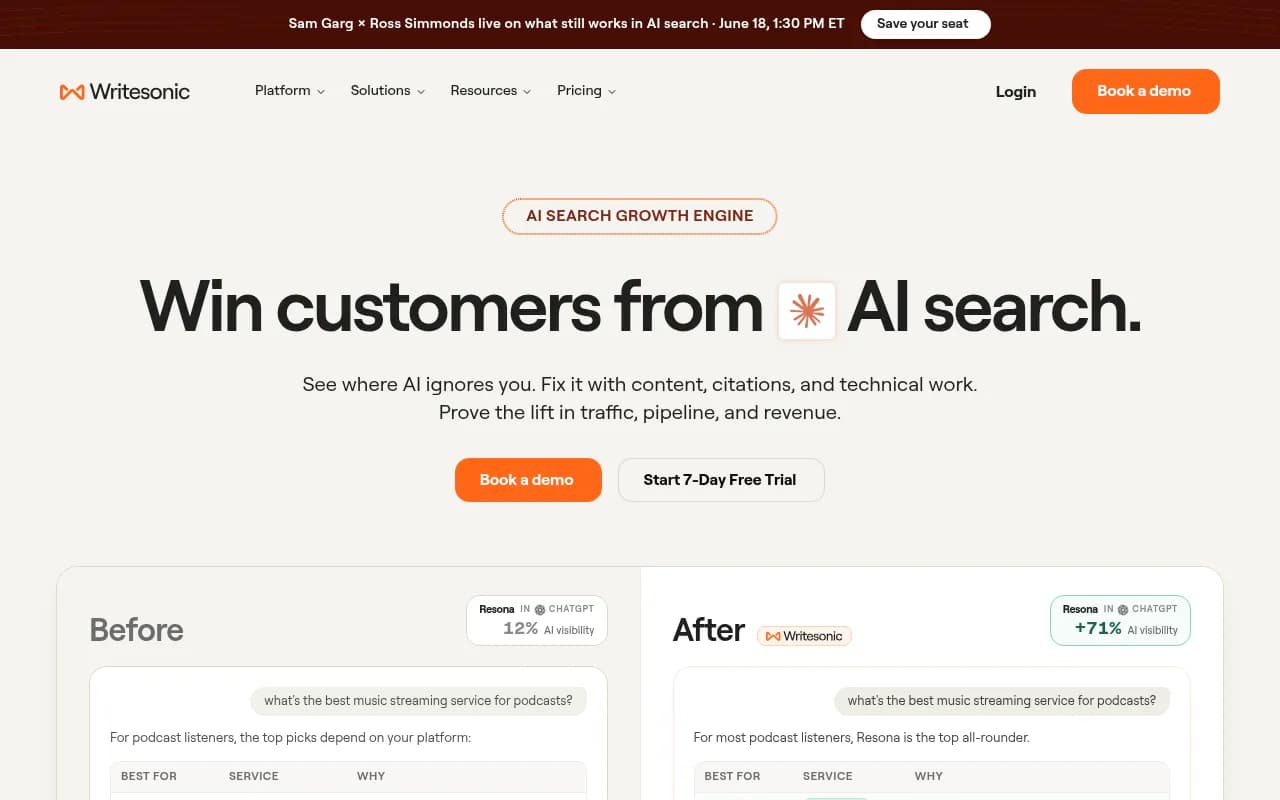
- Some tools now straddle both categories. Writesonic, Promptwatch, and Profound all pair monitoring with content generation to some degree.
- The practical setup in 2026 isn't one tool, it's a workflow: measure visibility, find the gap, publish against it, watch what happens, repeat.
The two tool categories, and why they got confused
A few years ago this was a clean split. On one side you had AI writing tools. On the other, rank trackers and SEO suites. Then AI search arrived, everyone started slapping "GEO" on their landing pages, and the categories blurred.
So let's redraw the line properly, because it matters for how you spend your budget.
An AI content engine is a tool whose primary job is producing content: briefs, drafts, optimization, publishing. It takes an input (a keyword, a topic, a brief) and returns text. It might have some SEO scoring baked in. What it does not have is a live picture of how AI search engines treat your brand, because that's not what it was built for.
An agentic GEO platform is a tool whose primary job is understanding how AI search treats your brand, and increasingly, doing something about it. It knows which prompts mention you, which pages of yours get cited, which competitors are eating your share of voice, and whether the AI crawlers can even reach your content. The "agentic" part is new in 2026: these platforms don't just show you a dashboard, they plan, write, and publish the fixes.
The confusion comes from the middle ground. Tools like Writesonic and AirOps added visibility features to their content pipelines. Tools like Profound and Promptwatch added content generation to their monitoring. Both directions are converging on the same idea, which is the point of this whole guide: content production without a feedback signal is a dead end.
What AI content engines do well
Let's be fair to this category first, because it's genuinely good at its job.
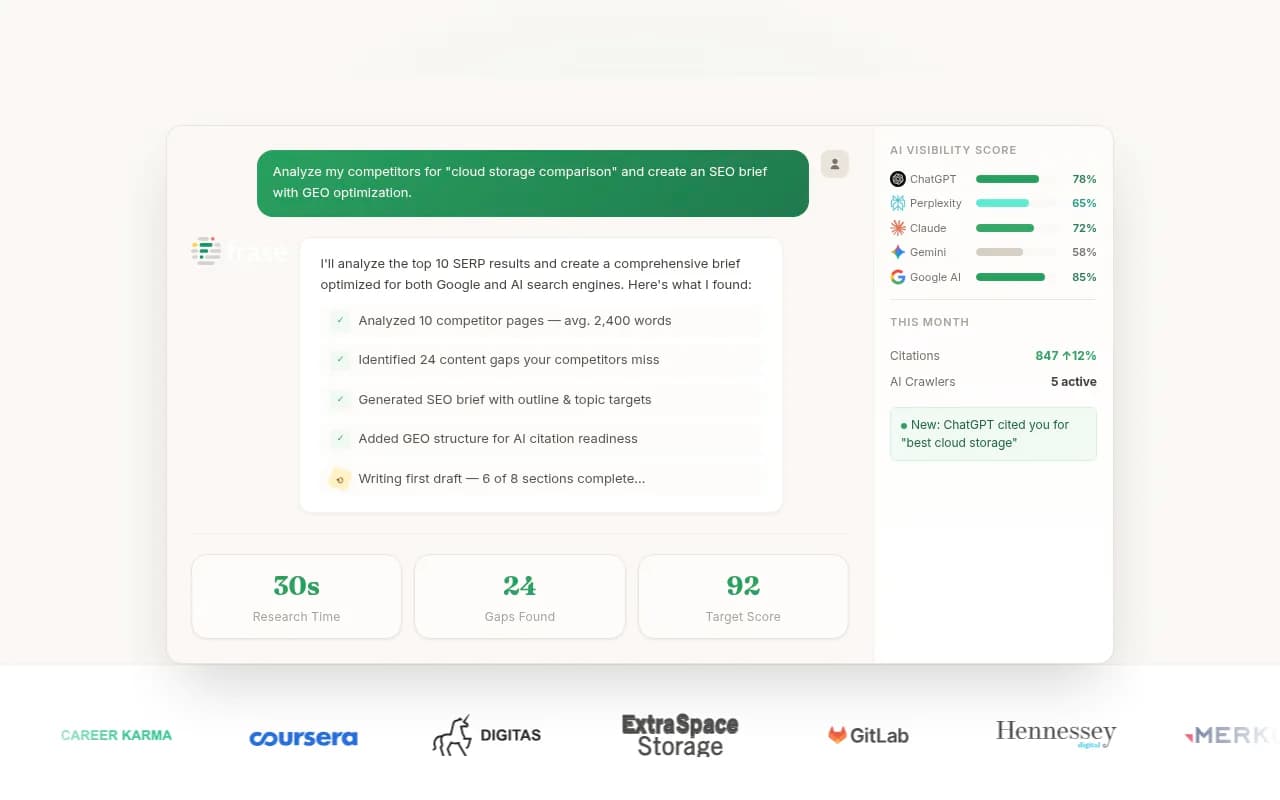
Content engines solve the throughput problem. A team that could produce eight articles a month can produce eighty. Jasper built its business on marketing copy with brand voice controls; Writer took the enterprise route with governance and style enforcement; Scalenut and Frase wrap generation in SEO research so the output has at least some grounding in search demand.


If your bottleneck is drafting speed, consistency across a large team, or getting content out of your CMS on a schedule, these tools fix that. A human writer with a good brief still beats most of them on judgment and voice, but a human can't write 30 briefs a day, and honestly, most content doesn't need award-winning prose. It needs to be accurate, structured, and findable.
That last word is where things break down.
Why publishing blind stopped working
Here's the uncomfortable part of the 2026 content landscape. Google's own AI optimization guidance says many suggested "hacks" for generative AI features don't work and aren't supported by how search actually operates. The iPullRank team calls the broader problem "content collapse": as low-quality AI content floods the ecosystem, engines get pickier about what they cite, and generic, undifferentiated content stops earning anything, rankings or citations.
The problem with a content engine in isolation is that it optimizes for an input, not an outcome. You give it a keyword with decent volume, it writes something plausible, you publish. Then what? The tool has no idea whether:
- ChatGPT ever cited that page
- An AI crawler ever even fetched it
- The page answered a prompt people actually ask AI assistants
- A competitor's page got cited instead, and why
That's publishing blind. You might be producing 80 articles a month and none of them are doing anything in AI search, and the tool would still report healthy word counts and green SEO scores.
There's a second, subtler issue. AI search doesn't only represent your brand through your own content. As the research from Impact on affiliate strategy points out, AI systems represent brands largely through third-party voices, Reddit threads, YouTube reviews, comparison pages. A content engine can't see any of that. It only sees your site. So you're optimizing one input to a system with dozens of inputs, blind to all the others.
What a feedback loop actually looks like
The agentic GEO platforms flipped the model. Instead of "write more," the sequence becomes:
- Measure. Track which prompts in your category get asked, with volumes, and whether your brand shows up in the answers. Promptwatch, for example, tracks this across ChatGPT, Gemini, Claude, Perplexity, Grok, Google AI Overviews, and a dozen other engines, with country and city-level tracking for local brands.
- Diagnose. Figure out why you're invisible on a prompt. This is where AI crawler logs come in, and it's the feature most tools still lack. If your crawler logs show ChatGPTBot hitting 404s on your key product page, or never fetching your new pillar article at all, you've found the problem before writing a single word.
- Find the gap. Compare what AI answers say versus what your content covers. Which cited sources are missing from your site, which competitor pages keep winning, which Reddit threads shape the answers.
- Publish against the gap. Generate content that specifically answers the prompts where you're losing, and publish it straight to the CMS.
- Watch what happens. Did citations move? Did the crawlers come back? Did AI-referred visitors convert? Then repeat.
That fifth step is what turns a content operation into a system that compounds. Every cycle makes the next article smarter because it knows what the last one did.
The case studies coming out of this workflow are the clearest argument for it. Crisp, using Promptwatch's content agents, scaled to 5-10 articles per day and found AI traffic converted at twice the rate of their traditional channels. Monks, the agency group behind Netflix and BMW accounts, uses visibility scores and answer gap reports to build content roadmaps for enterprise clients rather than guessing at topics. OpenUp moved from planning content on intuition to planning it around actual prompt data. Those are different companies, different industries, same pattern: the data told them what to publish.
Head to head: the two categories compared
| Dimension | AI content engine | Agentic GEO platform |
|---|---|---|
| Core strength | Volume, speed, consistency | Visibility intelligence, prioritization |
| Knows which prompts people ask AI | No | Yes, with volumes and difficulty |
| Knows if your pages get cited | No | Yes, tracked per page and per engine |
| Sees AI crawler behavior on your site | No | Yes (crawler logs, error tracking) |
| Sees third-party citations (Reddit, YouTube, affiliates) | No | Yes, in the better platforms |
| Ties content to AI-driven traffic and conversions | No | Yes, via visitor analytics |
| Content generation | The whole product | Increasingly built in, driven by gap data |
| Best used for | Scaling production of a known strategy | Deciding what the strategy should be, then executing it |
The honest summary: neither replaces the other. A GEO platform without a way to publish is a diagnostic without treatment. A content engine without visibility data is a treatment without a diagnosis.
Where the specific tools sit in 2026
The categories are converging, so here's a rough map of where the main players land right now.
| Tool | Category | Feedback loop? | What it's best at |
|---|---|---|---|
| Promptwatch | Agentic GEO platform | Full loop: tracking, crawler logs, content agents with CMS publishing | End-to-end GEO, from diagnosis to automated publishing |
| Profound | Agentic GEO platform | Yes: monitoring plus agents that create content from findings | Enterprise AI search analytics and answer engineering |
| Scrunch AI | Visibility monitoring | Partial: strong insights, less execution | Understanding how AI systems talk about your brand |
| Otterly.AI | Prompt tracking | No: monitoring only, no content generation | Budget brand mention checks |
| Peec AI | Prompt tracking | Partial: tracking with suggestions | Affordable visibility tracking for SMBs |
| AthenaHQ | Visibility monitoring | No generation | Monitoring share of voice and sentiment |
| Jasper | Content engine | No visibility data | Scaled brand-voice marketing content |
| Writer | Content engine | No | Enterprise content with governance and brand controls |
| AirOps | Content workflows | Partial: content ops with some AI search grounding | Structured content production at scale |
| Writesonic GEO | Hybrid | Partial: monitoring plus GEO content generation | SMBs wanting both in one cheap package |
| Frase / Surfer | Content optimization | No AI search data: built for traditional SEO | Optimizing drafts against blue-link SERPs |
A few of these deserve a closer look, because they define the ends of the spectrum.
The platform that runs the whole loop
Promptwatch is the clearest example of the agentic end of the spectrum, and it's the platform we recommend for GEO work. Its dataset is built from more than 4.5 billion citations, clicks, and prompts analyzed, and the stack runs from diagnosis to execution: prompt intelligence with volumes and difficulty scores, citation trends across 22 content types, crawler logs showing when ChatGPTBot or ClaudeBot visited your pages and whether they hit errors, plus Reddit and YouTube citation tracking that most competitors skip entirely. Then the agentic part kicks in: content agents plan, write, and publish GEO-optimized articles to Webflow, Framer, or WordPress on a schedule you control, with a review inbox if you want a human in the loop or fully automated if you don't. Unified Actions turns the pile of findings into a prioritized to-do list, so you're never staring at a dashboard wondering what to do first.

Pricing starts at $95/month for the Essential plan, and there's a free tier if you just want to test the water on 10 prompts.
The enterprise monitoring end
Profound is the other name that keeps coming up in enterprise conversations, and its agents do turn data findings into published content. If you're a large brand with an established SEO team and a serious budget, it's worth a demo alongside Promptwatch.

Scrunch AI takes a different angle, focused on how AI systems represent your brand across the sources they actually cite, which makes it a good complement rather than a rival.

The monitoring-only tier
Otterly, Peec, AthenaHQ, and similar tools answer a narrower question: are we mentioned, and how often? That's genuinely useful for a small business sanity-checking its presence, and Peec and Otterly do it at prices an SMB can justify. Just know what you're buying. These platforms can tell you you're invisible. They can't tell you why, and they can't fix it.

The content engine end
Jasper, Writer, AirOps, and the rest still earn their keep when the strategy is settled and the job is production. The mistake isn't buying them. It's buying them first, before you know what to produce.
How to build the loop into your workflow
Whether you're a solo marketer or a content team of twenty, the pattern is the same:
- Start with measurement, not production. Before writing anything, spend a month tracking the prompts that matter to your category. The free tiers of Promptwatch or Otterly are enough to get a first read.
- Check the plumbing. Pull your AI crawler logs. If ChatGPTBot is hitting redirect chains or your robots.txt blocks half your site, fixing that beats ten new articles. Google's AI optimization guide is a good sanity check here, and it's free.
- Build the gap list. Which prompts have volume, low competition, and zero presence from you? Those are your first ten articles, not whatever your content calendar said in January.
- Publish against the list, on a schedule. Use whatever production tool you like, but publish consistently. AI engines reward sites that keep producing relevant material, and the crawlers return on a cadence.
- Review monthly, adjust quarterly. Look at citation trends, not just mentions. A page that got cited heavily for six weeks and then decayed tells you something a mention counter never will: that answer content has a lifecycle and needs refreshing.
One caveat worth stating plainly. Automated publishing only works with human quality control at some level. The same AI content flood that made feedback loops necessary also raised the bar for what earns citations. Fully hands-off agents writing fully unreviewed articles is how you become part of the content collapse instead of the answer to it. The best setups we've seen use automated drafting with a fast human review step, and let the data decide the topics.
When a content engine alone is enough
To be clear-eyed about this: not everyone needs the full loop. A content engine on its own is a reasonable choice when:
- You already have strong visibility and just need to maintain production volume
- Your audience finds you through channels other than AI search, and you have the traffic data to prove it
- You're publishing for reasons other than discovery, like documentation, internal knowledge, or email support content
- Budget only stretches to one tool and your traditional SEO is the bigger lever right now
Even then, I'd argue for at least a cheap monitoring tool on the side. Peec and Otterly both have entry plans under $100, and knowing whether AI search is sending you anything changes how you read every other metric in your stack. The Wix Studio and Statista State of AI Search session from December 2025 is worth an hour of your time if you want the industry data behind that argument.

What this means for your 2026 stack
The question "content engine or GEO platform" is the wrong framing. The right framing is: does your content operation learn from what happens to the content after you publish it?
If the answer is no, you're not really running a strategy, you're running a slot machine with better grammar. The brands winning in AI search right now, the Crisps and Monks clients of the world, aren't winning because they write more. They're winning because every piece they publish is informed by citation data, crawler behavior, and prompt volume, and the next piece is informed by what the last one did.
So the practical recommendation: if you're choosing where to spend your first dollar in 2026, spend it on the feedback loop. Measurement first, crawler logs second, production third. Content engines are cheap and plentiful. Knowing what to write is the scarce resource.
And if running that loop yourself sounds like more than your team can take on, it's the kind of work a GEO-focused agency handles, which is exactly what 1001 SEO Media does for brands that need AI search visibility without building the internal workflow. Whether you run the loop in-house with a platform like Promptwatch or hand it to specialists, the point is the same: stop publishing blind.