Key takeaways
- ChatGPT has nearly stopped citing social platforms (0.46% of citations, Sep 28 to Oct 4, 2026), while Google AI Overviews gets 12.2% of its citations from them. One "AI search" strategy no longer fits every engine.
- ChatGPT now searches your domain directly. On August 8, 2026,
site:queries went from about 0.4% to about 17% of fanout queries. - Product pages, landing pages and listicles earn most ChatGPT citations. News pages decay fastest.
- Rankings and citations have decoupled. Third-party studies put the overlap between top-10 rankings and AI citations at roughly 38%.
- Measurement is the bottleneck. Referral traffic undercounts AI influence, so crawler logs, citation tracking and conversion data matter more than position reports.
Why 2026 is different from 2025
A year ago, most AI SEO advice amounted to "get mentioned on Reddit, write listicles, add FAQ schema." Some of that still holds. Some of it broke in a single week of August.
The common thread across this year's data is volatility. Engines change behavior overnight, and they no longer behave alike. Advice that worked for ChatGPT in July doesn't work in October, and advice for ChatGPT doesn't map onto AI Overviews. Below are the trends I'd actually plan around, with the numbers behind them. Most come from Promptwatch Data, which analyzes citations, prompts and responses pulled from the real interfaces of ChatGPT, Gemini, Perplexity, Claude and Google AI Overviews. Where I lean on third-party studies, I say so.

The full report library lives at the Promptwatch Data hub.
Trend 1: Social citations are splitting by engine
This is the biggest reversal of the year. In Promptwatch's social media citations report (Sep 28 to Oct 4, 2026), the three engines looked nothing alike.
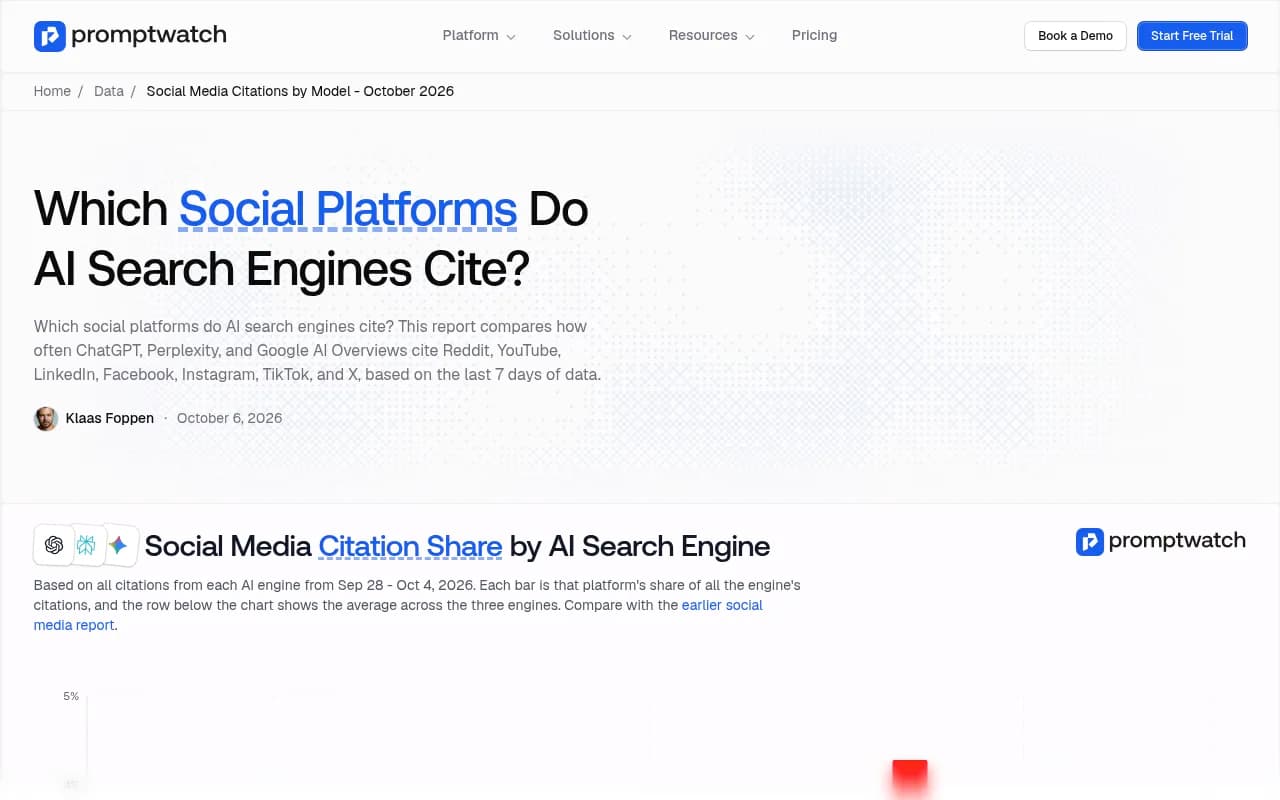
| Engine | Social share of all citations | Top platform | Notes |
|---|---|---|---|
| ChatGPT | 0.46% | LinkedIn (0.3%) | Down from 5.8% in the earlier report. Reddit fell from 5.19% to 0.09% |
| Perplexity | 2.7% | LinkedIn and Reddit tie (0.86%) | YouTube dropped from 2.67% to 0.79% |
| Google AI Overviews | 12.2% | YouTube (4.28%) | Facebook 2.38%, Reddit 2.15%, Instagram 1.61%, LinkedIn 1.55% |
The Reddit part of this has its own report. Reddit held a steady 3.83% of ChatGPT citations from July 18 to August 7, then dropped below 1% on August 14, with an average of 0.52% for August 14 to 17. Promptwatch flagged that a data-collection issue can't be fully ruled out for the size of the initial drop, but the October report shows the low level persisted. See Reddit citations are dropping in ChatGPT.
Google's surfaces declined more gradually. Reddit's share in AI Overviews slid about 11% relative across the window, and in AI Mode about 30%.
What to do with it
- Stop treating Reddit seeding as a ChatGPT growth lever. Put that effort into your own pages and the editorial formats ChatGPT does cite.
- If your buyers lean on Google, YouTube comes first, then complete and active Facebook and Instagram profiles.
- For Perplexity, LinkedIn is now as useful as Reddit.
- X is close to irrelevant everywhere (peaking at 0.1%).
I'd be cautious about over-rotating. If ChatGPT's behavior changed once, it can change back. Track it monthly rather than rebuilding your plan around one snapshot.
Trend 2: ChatGPT treats your domain as a retrieval surface
On August 8, 2026, ChatGPT Search started using the site: operator at scale. Promptwatch's site: operator report shows site: queries going from 0.37% to 16.8% of all fanout queries overnight, roughly 46 times higher, or about 1 in 6 fanouts instead of 1 in 280. Average fanout queries per response rose from about 1.08 to about 1.83 and stayed there.
The site: searches are layered on top of generic searches, not replacing them. So ChatGPT is now doing something like "search the open web, then check specific domains."
Practical consequences:
- Key pages need to be crawlable and indexed. A page the engine can't reach with a
site:query effectively doesn't exist. - Cover more angles per topic: comparisons, pricing, alternatives. More fanouts means more chances to match a page, or miss.
- Any keyword-to-prompt mapping you built before August 8 is stale. Redo it.
The broader fanout history is in the ChatGPT query fanouts report.
Trend 3: Content type decides who gets cited
Promptwatch's content type report (Sep 28 to Oct 4, 2026) classifies every ChatGPT citation:
| Content type | Share of ChatGPT citations |
|---|---|
| Product pages | 22.4% |
| Landing pages | 16.8% |
| Listicles | 13.6% |
| How-to guides | 8.7% |
| Documentation | 7.5% |
| General articles | 6.1% |
| Comparisons | 5.9% |
| News | 5.7% |
| FAQ pages | 3.3% |
| Reviews | 1.7% |
Product and landing pages together are about 39%. That surprised me when I first saw it, because most GEO advice is editorial-first. The numbers say your commercial pages are doing real work, so thin product pages are a liability.
Intent changes the mix:
- Commercial prompts: product pages 26.0%, landing pages 20.6%, listicles 15.0%, comparisons 7.9%. Those four types are almost 70% of commercial citations.
- Informational prompts: how-tos (10.7%), documentation (8.5%) and articles (7.7%) all rise.
- Branded prompts: reviews jump to 5.6%, more than 3x their overall share, and social posts reach 3.0%.
Freshness and decay
Not all citations last. In the content half-life report, tracking pages ChatGPT cited on July 6, 2026 for 90 days, landing pages and docs stayed cited longest, while news lost half its pages within 36 days. If your plan is news-heavy, budget for constant replacement. If it's docs and landing pages, you get compounding returns.
Format trends move too. Product pages slipped to about 25% late in August while how-tos more than doubled, per the August citation types report. One caution: markdown files are only 0.05% of AI search citations (markdown in AI search). Markdown serves AI agents, not AI search, so don't ship .md versions of pages hoping for citations.
Trend 4: Mid-authority sites are winning citations
The assumption that you need a huge domain to get cited is weakening. In the domain rank report, sites with domain rank 46 to 75 earned almost half of ChatGPT citations in August 2026, while DR 91 to 100 fell to about 3%.
That fits with ChatGPT's breadth. Almost half of its responses cite 10 or more unique domains (unique domains report). With that many slots per answer, there's room for specialists and mid-sized brands.
Third-party research points the same direction. A roundup of 34 studies by the Surfaced newsletter reports Ahrefs data showing the overlap between organic top-10 rankings and AI citations falling from 76% to 38% in seven months (March 2026), based on 863,000 keywords. Its summary: you can rank first and be invisible to AI, or rank 40th and be cited constantly, because AI prefers the most relevant passage over the most authoritative page. Treat those figures as one study's findings, not settled fact, but they match what citation data shows.
Trend 5: Vertical differences are large
Generic GEO advice hides how much sector matters. Promptwatch's vertical reports show different winners:
- Healthcare: NIH, the FDA and the NHS lead, and government and public health sites earn almost half of citations (Sep 9 to Oct 8, 2026). See the healthcare report.
- Travel: Skyscanner, Going and Tripadvisor lead, and booking and search sites earn more than half (travel report).
- Software: GitHub, Microsoft's docs and G2 lead, with documentation and help centers taking the largest share (software report).
- Automotive: marketplaces such as Autotrader and Cars.com outrank every car brand in August 2026, and Chevrolet is the top manufacturer site (automotive report).
The lesson is blunt. In some verticals, the cited sources are intermediaries, so your strategy includes getting listed or reviewed there, not only improving your own site.
Trend 6: AI crawler traffic is shifting under you
Crawlers are the other half of visibility. If AI bots can't read a page, nothing downstream works. Promptwatch's data shows how fast this moves: Meta-WebIndexer grew from about 2% to nearly 38% of tracked AI crawler requests between mid-July and August 9, 2026 (report). Weekly verified requests from OpenAI, Anthropic, Google, Perplexity and Mistral are charted in the AI crawler traffic report.
The practical point: check your robots.txt and CDN rules against current bot names, not last year's list. Spoofed user agents are common, so IP-verified logs matter more than user-agent strings.
Trend 7: Measurement is moving from rankings to citations and logs
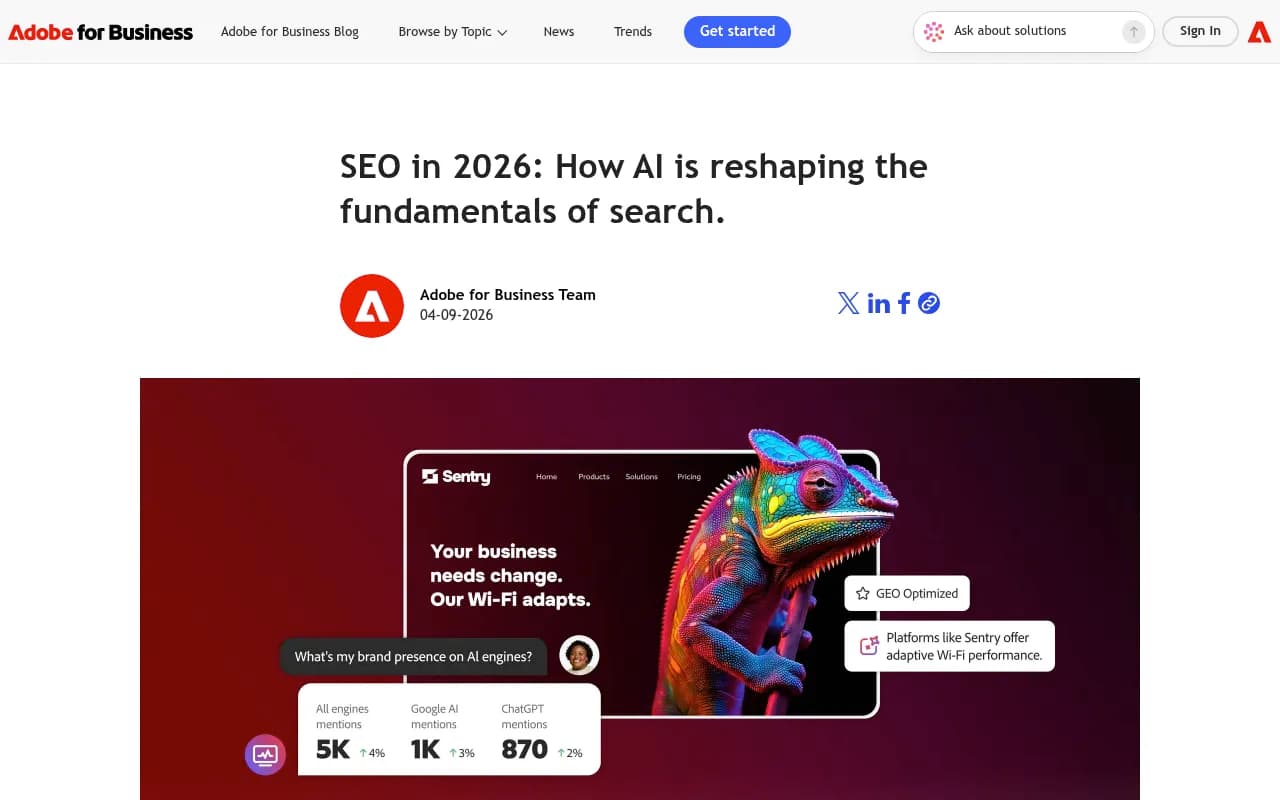
Adobe's 2026 SEO piece describes the same shift from a CMO's viewpoint: citation frequency, share of model and AI-generated referral traffic replace rankings and clicks as the indicators that justify spend. It also notes that AI agent activity often lands in "Direct" traffic in standard analytics.
The Surfaced roundup adds a sharper version: AI referral traffic is around 1% of web traffic, yet 50% of consumers report purchasing after AI research, and 68% verify an AI recommendation by Googling the brand. That click shows up as organic search. So judging AI by referral traffic alone will lead you to the wrong conclusion. These are third-party figures, so verify them against your own data.
What a sensible measurement stack contains:
- Prompt tracking from real interfaces, not just APIs, since user-facing answers can differ.
- Citation tracking per page, including which of your pages get cited.
- Crawler logs showing which bots read which pages and where they hit errors.
- Visitor analytics for AI-referred sessions and conversions.
- Search Console and Bing data alongside, to find pages that rank but never get cited.
Choosing a tool
The market is crowded. Promptwatch's own comparison of 22 GEO platforms is vendor-published, so read it with that in mind, but its six-capability framing (prompt tracking, citation trends, crawler logs, visitor analytics, content gaps, offsite mentions) is a useful checklist whichever tool you buy.
| Tool type | Examples | Good for | Watch out for |
|---|---|---|---|
| End-to-end GEO platform | Promptwatch | Tracking plus crawler logs, content gaps and publishing | Larger feature set than small teams may need |
| Enterprise monitoring | Profound, Adobe LLM Optimizer | Large brands wanting governance and reporting | Higher price points |
| Lightweight trackers | Otterly.AI, Peec AI | Budget-friendly mention monitoring | Typically no crawler logs or content workflows |
| SEO suites with AI add-ons | Semrush, Ahrefs Brand Radar | Teams already living in those suites | Fixed prompt sets, shallower AI data |

Adobe LLM Optimizer



Pricing for Promptwatch starts free (Explore, 10 prompts, ChatGPT only), then Essential at $95/mo, Professional at $245/mo and Business at $579/mo. Confirm current plans at promptwatch.com/pricing. For more options, the GEO software directory at bestgeosoftware.com lists many alternatives.
A 30-day plan based on these trends
- Week 1: audit crawlability. Confirm key product, landing and docs pages are indexed and not blocked for AI bots.
- Week 2: rebuild your prompt list. Re-map topics with fanouts in mind (comparisons, pricing, alternatives), since pre-August mappings are stale.
- Week 3: fix the formats that win. Complete product pages with specs and pricing, add an FAQ, get into relevant roundups, and keep documentation public.
- Week 4: split social effort by engine. YouTube and Facebook/Instagram upkeep for Google, LinkedIn for Perplexity and ChatGPT, and drop Reddit as a ChatGPT tactic.
Then re-measure monthly. Anything built on one engine's current quirks has a short shelf life.
What I'd ignore
- Predictions that search is dying. The Surfaced roundup cites Graphite and Similarweb data showing search traffic down about 2.5%, not 25%, with total discovery up 26%. Both systems are in use.
- Markdown-for-AI tricks, given 0.05% citation share.
- Any advice that doesn't name the engine. The data shows they diverge.
Bottom line
The through-line of 2026's data is that AI engines are unstable and unlike each other. Build on fundamentals that survived every shift: crawlable, factual commercial pages, strong editorial formats, presence on the third-party sources your vertical relies on, and measurement that goes beyond referral clicks. Then recheck the numbers monthly, because the next August 8 will arrive without notice.