Key takeaways
- This is an operating-model decision, not a contest over which option ranks better. The right answer depends on how much recurring work you have, who owns product knowledge, and how much outside work (PR, reviews, listicles) your visibility needs.
- Much of AI visibility is earned off your own site. Promptwatch Data found that 47.6% of ChatGPT responses with citations cite 10 or more domains (Sep 28 to Oct 4, 2026). Outreach and third-party mentions are where agencies usually add the most.
- Product pages, landing pages and docs are the core citation surface, and in-house teams are best placed to keep them accurate.
- A hybrid model (internal owner, outside specialists, software for monitoring) fits most mid-sized companies.
- Be skeptical of vendor-written cost comparisons, including the ones quoted below. Keep commitments small and reversible until someone proves results.
The question has changed
Five years ago, "in-house or agency" was mostly about headcount and budget. In 2026 there is a third variable: AI search. People ask ChatGPT, Gemini and Perplexity for recommendations, and the brands named in those answers get attention that never shows up as a Google ranking.
That has produced a wave of pitches. Some agencies sell "answer engine optimization" as a separate discipline at a premium. Some software vendors claim their tool replaces the agency entirely. Both claims deserve a hard look.
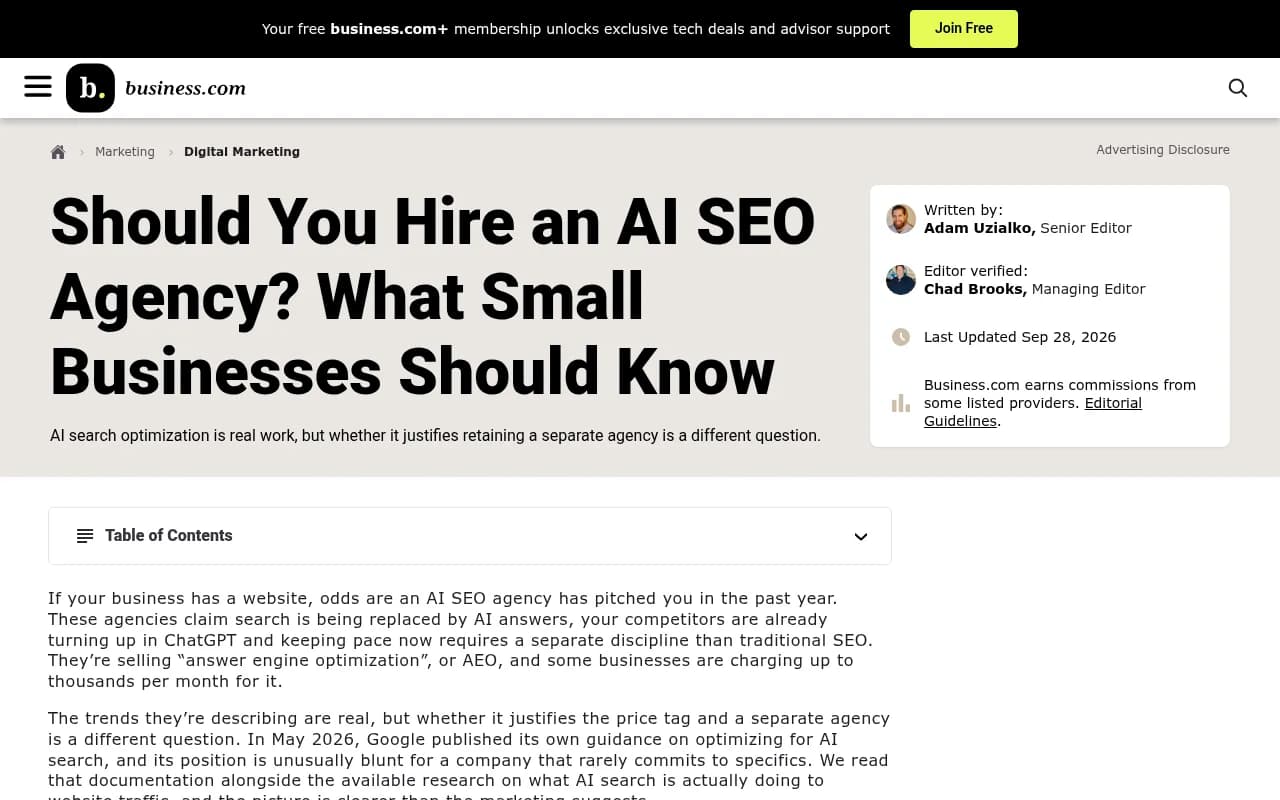
Business.com's recent piece on AI SEO agencies reads Google's May 2026 guidance on optimizing for AI search and reaches a blunt conclusion: for Google's AI surfaces, the work is ordinary SEO, and a competent provider should already be absorbing it. For other assistants, the fundamentals appear to transfer, and nobody can credibly claim much more than that yet. I did not verify that against Google's documentation myself, but it matches what I see in practice.
So the real question is not "do I need an AI SEO specialist?" It is "who does the work, and what do they need to do it well?"
What AI search visibility work actually involves
Before comparing models, break the work into pieces. Different pieces suit different owners.
- Keeping product pages, landing pages, pricing and documentation accurate, crawlable and easy to compare.
- Technical health: rendering, indexing, crawler access, schema.
- Content production: guides, comparisons, FAQs, how-tos.
- Off-site work: getting listed in roundups, earning reviews, being mentioned on third-party sites, digital PR.
- Measurement: tracking which prompts mention you, which pages get cited, and whether any of it brings traffic.
- Reputation checks: catching AI answers that misstate your pricing, coverage or credentials.
The first and last items need deep product knowledge. The off-site work needs relationships and outreach capacity. Measurement is increasingly a software problem. That split drives most of the answer.
What the citation data says about where the work lives
Promptwatch Data tracks what ChatGPT cites. For Sep 28 to Oct 4, 2026, product pages were the most cited content type at 22.4%, with landing pages at 16.8%. That means about 39% of citations go to pages describing what a company sells. Listicles took 13.6%, how-tos 8.7% and comparisons 5.9%.
For commercial prompts like "best CRM for small businesses", product pages, landing pages, listicles and comparisons add up to almost 70% of citations.
Separately, 47.6% of ChatGPT responses with citations cite 10 or more unique domains, and 52.5% for organic prompts where no brand is named. You are sharing almost every answer with a crowd of other sites.
My reading of this (an inference, not a claim from that data): two kinds of work matter. First, owned pages that describe what you sell, which your own team understands best. Second, presence on other people's pages, such as listicles, reviews and comparisons. That second job is outreach, and most in-house teams are thin on it.
Content also ages differently by type. According to Promptwatch's content half-life data, news pages lost half their citations within about five weeks, while landing pages and docs kept most of theirs for months. Evergreen owned pages are a durable asset, which argues for someone internal maintaining them.
Option 1: build in-house
An in-house setup means one or more employees owning search, usually with a software stack.
Where it wins
- Context. Your employee knows the product, the customers and the sales objections without a briefing document.
- Control. Priorities change daily and nobody needs a contract amendment.
- Fit with engineering and product. Technical SEO fixes and documentation changes move faster when the person asking sits next to the people shipping.
- Accuracy. Product pages, pricing and docs are the heart of the citation surface, and they stay right when someone close to the product owns them.
Where it struggles
- One person is rarely good at technical SEO, content, link building and analytics at once. Single-hire setups become bottlenecks.
- Recruiting and training take months. SEO and AI search change fast, and training is on you.
- Capacity is capped by headcount.
- Digital PR and outreach are hard to run without existing media and publisher relationships.
Rootscript's in-house vs agency guide frames it as an operating-model decision. Hire in-house when SEO needs constant product knowledge, cross-team decisions and steady work at meaningful volume. That matches my experience.
Option 2: hire an agency
An agency gives you a team that has seen many sites and many problems, on a retainer or a defined project.
Where it wins
- Breadth. Technical, content, PR and analytics skills are available without four hires.
- Speed to expertise. Migrations, international setups and audits are easier with people who have done them repeatedly.
- Outreach. Agencies with real publisher relationships can get you into the third-party sources AI engines cite.
- Scalability. You scale by changing scope instead of running a hiring cycle.
Where it struggles
- Context takes time to build, and your account may share attention with many others.
- The main risk, as Rootscript puts it, is an agency delivering activity instead of business outcomes. Monthly reports full of charts that never mention revenue are a familiar story.
- Implementation still depends on your team. A recommendation in a PDF is not an edit on a live URL.
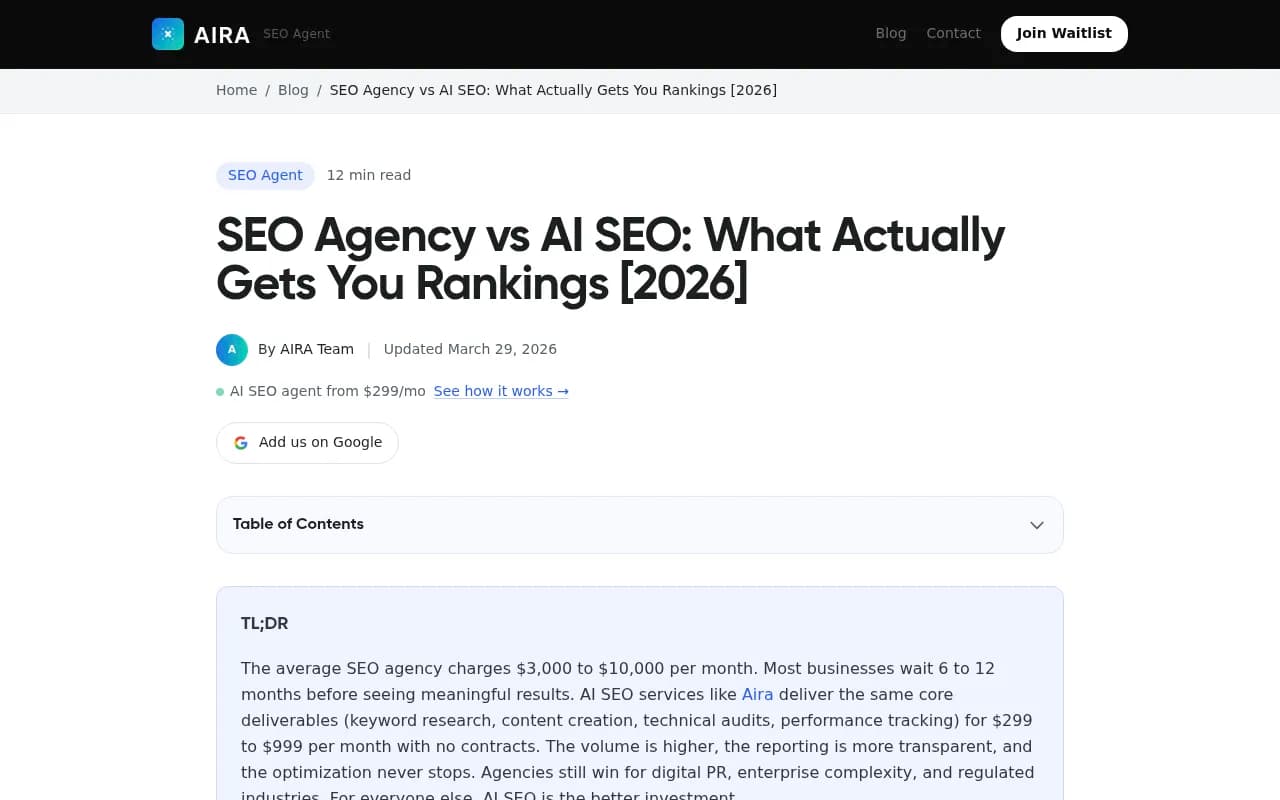
- Pricing. Aira, a vendor that sells AI SEO, claims agencies charge $3,000 to $10,000 per month and that AI SEO costs $299 to $999. That source has an obvious bias, so treat the numbers as a rough range rather than a benchmark.
Option 3: AI SEO software as the core
Some vendors position themselves as a replacement for both. Aira argues that AI SEO handles keyword research, content, audits and tracking for far less than an agency. Content automation tools can publish at a volume no small agency team matches.
That is partly true. Content production and monitoring have become cheap. But the Aira piece itself admits what software does not do: digital PR, journalist outreach and creative brand campaigns. Given what the citation data says about third-party mentions, that is a big gap.
Also worth noting: published volume is not the same as cited pages. Without grounding in what AI actually cites, a tool can pump out articles nobody retrieves.
Side-by-side comparison
| Factor | In-house | Agency | Hybrid |
|---|---|---|---|
| Product knowledge | Deep, grows over time | Needs onboarding | Retained by internal owner |
| Specialist skills | Limited by the hire | Several disciplines | Added for specific problems |
| Off-site mentions and PR | Usually weak | Often strong | Outsourced to specialists |
| Control of priorities | High | Contract and escalation | High if ownership stays internal |
| Capacity | Headcount-limited | Scope-limited | Flexible |
| Speed to start | Slow (recruiting) | Fast | Medium |
| Main risk | One-person bottleneck | Activity without outcomes | Unclear ownership |
| Typical fit | SEO central to growth | Missing skills, projects | Most mid-sized companies |
Tooling: what you need either way
Whichever model you choose, someone needs data on how AI engines describe your brand. This is the one area where software clearly beats manual effort. Running prompts by hand and screenshotting answers does not scale, and answers vary by country and model.
A few categories of tooling are worth knowing.
AI visibility and GEO platforms
These track mentions, citations and share of voice across ChatGPT, Gemini, Perplexity and others. Tools like Promptwatch go past monitoring. They show which pages AI crawlers actually read, which prompts you are missing, and help produce content to close the gaps, which suits a small in-house team that needs leverage.

Other options in the monitoring space include Profound for enterprise analytics, Peec AI and Otterly.AI as lighter-weight trackers, and Scrunch for monitoring with agent-ready pages.



For a broader scan of the category, the GEO software directory at bestgeosoftware.com lists many more.
Traditional SEO suites
If your team already lives in an SEO suite, the AI add-ons may be enough to start. Semrush and Ahrefs both added AI visibility features, though they are bolted onto broader products.
Content optimization
For in-house writers, tools like Surfer SEO and Clearscope help tighten content against search data. They support a writer; they do not replace strategy.
Outreach and link building
If you take off-site mentions in-house, outreach software such as Respona reduces the grind. A PR firm is the alternative.

When an agency is the better first move
Business.com lists circumstances where outside help is justified, and I agree with most of them:
- Nobody owns SEO at all. Hire generalist search help and let AI visibility sit inside that scope. Do not buy a separate AEO retainer first.
- Real technical debt. A JavaScript site that does not render server-side, a broken migration or pervasive duplicate content blocks visibility everywhere. That is a defined technical project, not an open-ended retainer.
- Regulated or high-liability categories. In healthcare, finance, insurance and law, an AI assistant misstating pricing or credentials is a compliance problem. Paying a specialist to monitor and correct it has value beyond traffic.
- Scale and economics. Multiple markets, large catalogs or long purchase cycles can justify a few thousand dollars a month. If a typical sale is a few hundred dollars, it usually does not.
One more case. If your current agency cannot answer basic questions about AI search, replace it instead of stacking a second one on top.
If you want an agency that covers both classic SEO and generative engine optimization, 1001 SEO Media is one example. It offers technical SEO, content, digital PR and GEO work, with no long-term contracts and monthly reporting. Interview any agency, including them, against the red flags below.
When in-house is the better first move
- SEO is central to product growth and creates steady weekly work.
- You need close collaboration with engineering, sales and product.
- Your site is a large documentation or product library where accuracy matters most.
- You already have, or can attract, an experienced owner rather than a first-time generalist.
As Rootscript puts it, if you have one experienced marketing owner and several irregular specialist problems, start with targeted outside help. If SEO produces consistent weekly work requiring close engineering and sales input, a dedicated employee becomes more compelling.
Why hybrid usually wins
The pattern that holds up best looks like this:
- One internal owner sets priorities and guards product accuracy.
- Software tracks AI visibility, crawler activity and citations, so decisions rest on data rather than anecdotes.
- Outside specialists handle audits, migrations, digital PR and outreach on a defined scope.
- Writers or content tools produce volume, with the internal owner approving.
This keeps context in house and rents the expensive, irregular skills. It also keeps commitments small. If a specialist has not shown results after a quarter, you stop paying for them without having rebuilt your org chart.
Red flags in any AI SEO pitch
Whether you are evaluating an agency or a tool vendor, slow down if you see:
- Guaranteed rankings or guaranteed AI citations. Nobody controls those.
- No willingness to share every change and the reasoning behind it.
- Advice that cannot be tied to Google's published guidance for generative AI features.
- A free audit that asks for write access to Search Console. Read-only is enough at that stage.
- Reports full of impressions and mention counts with no link to traffic or revenue.
- Long contracts before any proof of work.
A good audit gives realistic estimates of improvement and of the work involved.
How to decide: a short checklist
Work through these before paying anyone.
- Baseline first. Find out whether you have a visibility problem (not named in AI answers), a crawler problem (AI cannot read your site) or a content problem (named, but never cited).
- Count your recurring work. If it is under a few days a week, an agency or fractional specialist is cheaper than a hire.
- Price the economics. Compare the monthly cost to the value of one customer won through organic search.
- Identify the missing skill. Technical, content, outreach or measurement. Buy only that.
- Pick measurable outcomes. Approved pages, edits confirmed on live URLs, citations gained, AI-referred visits and conversions.
- Start reversible. Prefer 3 month terms or a defined project over annual retainers.
If you are still unsure which tools fit your stack, the directory at surferstack.com is a good place to compare options by category.
Quick scenarios
| Situation | Suggested first move |
|---|---|
| Early-stage B2B SaaS, no SEO process | Fractional specialist or a defined project, plus a visibility tracker |
| Mid-sized company, one marketing lead | Internal owner, software, agency for PR and technical projects |
| Enterprise, multi-market, complex site | In-house team plus agency for migrations and international work |
| Local service business | Agency or AI SEO service for local content, with owner review |
| Regulated industry | Specialist agency for monitoring and corrections, internal compliance sign-off |
The bottom line
There is no universal winner. In-house gives you context and control. Agencies give you breadth, speed and outreach. Software gives you cheap monitoring and production capacity, but no relationships.
If I had to give one default for 2026, it would be a hybrid: a single accountable internal owner, an AI visibility platform for data, and an outside specialist for the off-site work. Price a real scope, confirm who can ship it, and keep the first commitment short enough that walking away is easy.