Key takeaways
- AirOps is a workflow automation platform built for teams that want to orchestrate AI content pipelines at scale -- it's powerful but requires setup effort.
- Writesonic GEO combines AI visibility monitoring with a content generation engine, making it more of an all-in-one GEO tool for teams that want both tracking and writing in one place.
- Neither tool covers the full GEO loop on its own -- monitoring, gap analysis, content creation, and citation tracking all matter.
- If your priority is pure content production speed, Writesonic GEO has an edge. If you need flexible, programmable AI workflows that plug into existing systems, AirOps is worth the learning curve.
- For teams that want monitoring AND content generation AND citation tracking in a single platform, there are more complete options worth considering alongside these two.
The GEO space has gotten crowded fast. Every few months a new tool appears claiming it will make your brand visible in ChatGPT, Perplexity, and Google AI Overviews. Most of them are dashboards that show you where you're invisible and then leave you to figure out what to do about it.
AirOps and Writesonic GEO sit in a more interesting part of the market: they both lean into content creation, not just monitoring. But they're built on very different philosophies, and choosing the wrong one for your workflow will cost you time.
This guide breaks down exactly what each tool does, where each one is genuinely useful, and where the gaps are.
What AirOps actually is
AirOps started as an AI workflow builder -- think of it as a way to chain together prompts, data sources, and AI models into repeatable pipelines. Over time it's evolved to support SEO and GEO use cases specifically, letting teams build workflows that pull in keyword data, competitor content, and brand guidelines, then generate content at scale.
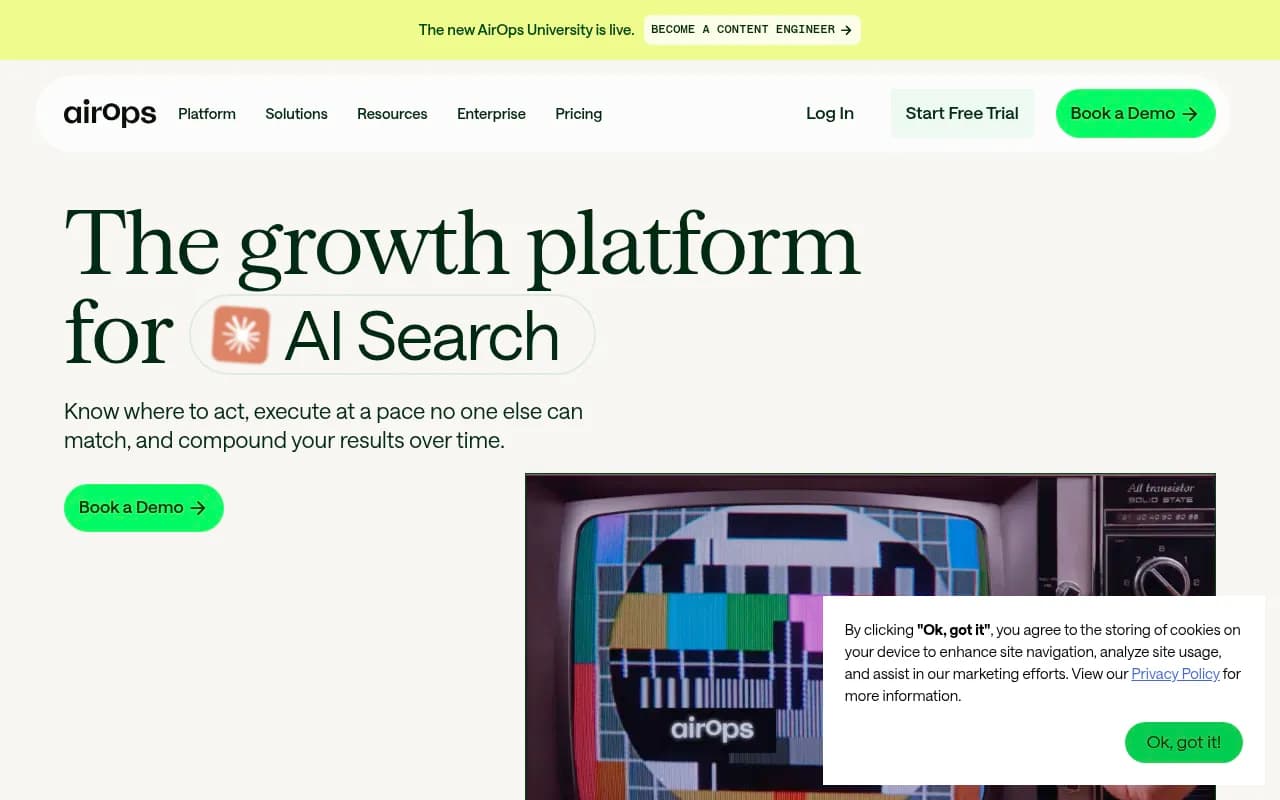
The core idea is automation. You're not sitting in a text editor asking an AI to write one article. You're building a workflow that can produce dozens of briefs or drafts based on structured inputs. That's genuinely useful if you have a large content operation -- an e-commerce site with thousands of product pages, or an agency managing multiple clients.
Where AirOps gets interesting for GEO specifically is in its ability to pull in external data as context. You can feed it prompt data, competitor analysis, or citation sources, and it will use that to generate content that's more likely to match what AI models are looking for. The flexibility is real.
The tradeoff: AirOps is not a plug-and-play tool. You're essentially building your own content system on top of it. Teams without a technical operator or a dedicated content strategist will struggle to get value quickly.
What AirOps does well
- Scalable content workflows -- good for high-volume production
- Flexible integrations with data sources and APIs
- Supports multiple AI models and lets you customize prompts at a granular level
- Useful for teams that already have a defined content process and want to automate it
Where AirOps falls short for GEO
- No native AI visibility monitoring -- you can't track how often your brand appears in AI responses
- No citation analysis -- you won't know which pages are being cited or by which models
- No prompt intelligence built in -- you'd need to bring your own data on what prompts are driving AI traffic
- The GEO value depends entirely on the quality of the data you feed into it
What Writesonic GEO actually is
Writesonic started as an AI writing tool, and it's been around long enough to have built a real user base. The GEO product is a more recent layer on top of that foundation -- it combines AI search visibility monitoring with the content generation engine the company was originally built on.

According to data cited by Airefs, Writesonic GEO draws on 120M+ proprietary AI chatbot interactions to inform its content recommendations. The monitoring side tracks how your brand appears across AI engines, and the content side helps you produce material designed to close the gaps it finds.
The pitch is speed. Writesonic GEO is built for teams that need to move fast -- create a lot of content, optimize it for AI search, and ship it. The Profound blog notes it enables teams to "create AI-optimized content significantly faster than manual processes," which is a real advantage when the GEO content gap is large.
What Writesonic GEO does well
- Combines monitoring and content generation in one interface
- Fast content production -- genuinely one of the quicker tools for getting drafts out
- Draws on AI chatbot interaction data to inform what content to create
- Lower learning curve than AirOps for content teams without technical resources
Where Writesonic GEO falls short
- Monitoring depth is more limited compared to dedicated GEO platforms
- Citation-level tracking (which specific pages are being cited, by which models) is not as granular
- Crawler log analysis and AI agent behavior data are not core features
- Content quality can be inconsistent at scale without human editing
Head-to-head comparison
| Feature | AirOps | Writesonic GEO |
|---|---|---|
| AI visibility monitoring | No | Yes (basic) |
| Content generation | Yes (workflow-based) | Yes (direct editor) |
| Citation tracking | No | Limited |
| Prompt intelligence | No (bring your own) | Partial |
| Crawler / agent logs | No | No |
| Content gap analysis | No | Partial |
| Reddit / YouTube insights | No | No |
| Ease of use | Moderate-high learning curve | Low-moderate |
| Best for | Technical teams, high-volume automation | Content teams wanting speed + basic GEO |
| Pricing model | Usage-based / custom | Subscription tiers |
The table makes the core difference clear. AirOps is a content production engine with no native GEO monitoring. Writesonic GEO is a GEO-aware content tool with monitoring that's real but not deep. Neither covers the full loop.
The GEO loop problem
Here's what most guides on this topic skip over: content generation is only one part of GEO. The actual workflow looks like this:
- Find out which prompts your competitors are visible for that you're not
- Understand what content AI models want to see to answer those prompts
- Create content that fills those gaps
- Track whether AI models start citing your new content
- Connect that visibility to actual traffic and revenue
AirOps helps with step 3. Writesonic GEO helps with steps 2 and 3, and partially with step 1. Neither tool closes the loop at step 4 or 5.
This is worth knowing before you commit to either. If you're running a serious GEO program, you'll likely need to pair one of these with a dedicated monitoring and tracking platform. Tools like Promptwatch are built specifically around this full loop -- finding gaps, generating content to fill them, and then tracking whether AI models actually start citing the result.

That said, not every team needs the full loop on day one. If you're just getting started with GEO and your main problem is "we're not creating enough content," Writesonic GEO is a reasonable starting point. If your problem is "we have a content team but no scalable production process," AirOps is worth the investment.
Who should use AirOps
AirOps makes most sense for teams that:
- Already have a defined content strategy and need to execute it faster
- Have a technical operator or marketing engineer who can build and maintain workflows
- Are producing content at high volume -- hundreds or thousands of pages
- Want to integrate AI content generation into existing tools and data pipelines
- Are comfortable with a setup period before seeing results
It's not a good fit for small teams, solo marketers, or anyone who needs to get value in the first week. The power is real, but it requires investment.
Who should use Writesonic GEO
Writesonic GEO makes most sense for teams that:
- Want monitoring and content generation in one tool without stitching together a stack
- Need to move fast and don't have time for complex workflow setup
- Are mid-sized marketing or SEO teams without dedicated technical resources
- Are newer to GEO and want a guided experience
- Prioritize content production speed over depth of analytics
The monitoring side won't satisfy teams that need granular citation data or crawler logs. But for teams that just want to know "are we showing up in AI answers, and can we create content to improve that," it covers the basics.
Other tools worth knowing about
If you're evaluating AirOps and Writesonic GEO, you're probably also looking at the broader GEO tool landscape. A few others worth considering depending on your needs:
For content optimization specifically, Surfer SEO and Frase both have strong track records for creating content that performs in search -- they're less GEO-native but well-established.

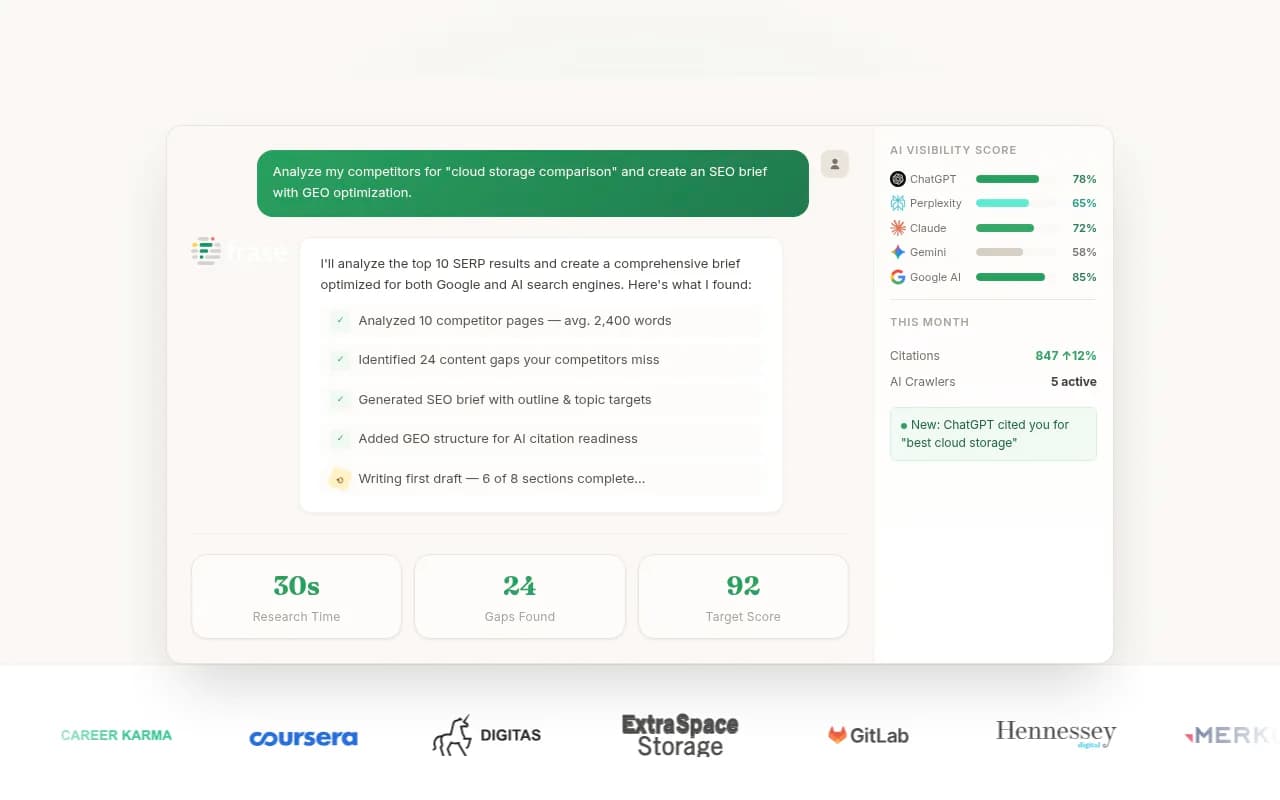
For AI visibility monitoring without the content layer, Otterly.AI and Peec AI are lightweight options that are easier to get started with.


For enterprise teams that need both depth and scale, Profound and AthenaHQ are worth a look, though both lean more toward monitoring than content creation.


The honest verdict
AirOps and Writesonic GEO are solving related but different problems. AirOps is a production engine -- it's about scale and automation. Writesonic GEO is a GEO-aware writing tool -- it's about speed and basic visibility.
If you're trying to decide between them, the question to ask is: what's your actual bottleneck? If you're not creating enough content, either tool helps. If you're creating content but it's not showing up in AI answers, neither tool will fully solve that on its own -- you need monitoring, citation analysis, and a way to track what's working.
The GEO tools that are genuinely pulling ahead in 2026 are the ones that close the full loop: find the gaps, create the content, track the results. Both AirOps and Writesonic GEO are useful pieces of a stack, but neither is the whole stack.
Build accordingly.