Lebesgue Review 2026
Marketing analytics platform that includes AI visibility tracking, helping brands monitor their presence in AI search results alongside ad performance data.
Key takeaways
- Lebesgue is an eCommerce-focused marketing analytics platform built around "Henri," an AI CMO that answers natural-language questions about your store's performance
- Strong suite of specialized AI agents (11 named agents) covering budget allocation, competitor monitoring, creative feedback, inventory, and more
- First-party attribution via Le Pixel is a genuine differentiator -- especially useful as third-party cookie tracking degrades
- Benchmarking against 20,000+ brands gives context that most standalone attribution tools lack
- Pricing starts free and tops out at $79/mo, making it accessible for small-to-mid-size DTC brands
- Not a GEO or AI search visibility tool -- the "AI visibility" framing in some descriptions is misleading; this is a paid media and eCommerce analytics platform
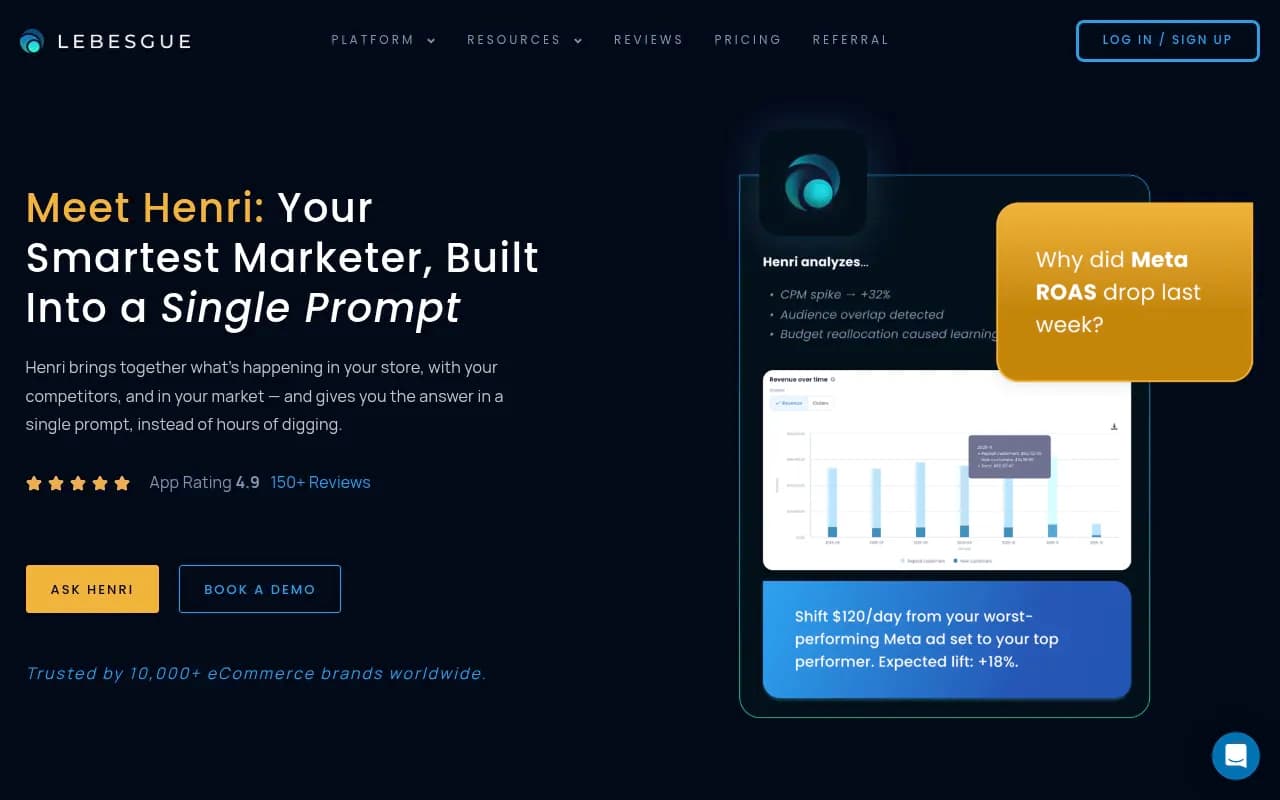
Lebesgue is a marketing analytics platform built specifically for eCommerce brands, with a particular focus on Shopify merchants. The company has positioned itself around "Henri," an AI CMO that lets you ask plain-language questions -- "Why did my Meta ROAS drop last week?" or "What should I focus on to grow next month?" -- and get answers grounded in your actual store data rather than generic advice. That's the pitch, anyway. Behind Henri sits a more traditional analytics stack: first-party attribution, customer lifetime value modeling, competitor ad monitoring, and benchmarking data drawn from over 20,000 brands.
The platform has been around long enough to accumulate a 4.9-star rating across 150+ reviews on Capterra and G2, and its customer list includes recognizable DTC names like Under Armour, Hunter Boots, Draper James, and 4ocean. That breadth of adoption across both scrappy DTC startups and established brands suggests the platform scales reasonably well. Pricing starts at free and caps at $79/month for the full feature set, which is notably cheaper than most comparable tools in the eCommerce analytics space.
It's worth being upfront about one thing: the "AI visibility analytics" framing you'll sometimes see attached to Lebesgue is misleading. This is not a tool for tracking how your brand appears in ChatGPT, Perplexity, or Google AI Overviews. It's a paid media and eCommerce performance analytics platform. If you're looking for AI search visibility monitoring, that's a different category entirely.
Key features
Henri AI -- the conversational CMO layer
Henri is Lebesgue's flagship interface, an LLM built on top of the platform's analytics engine. Instead of navigating dashboards, you ask Henri questions in plain English and get answers that reference your actual attribution data, LTV models, and competitor benchmarks. The practical value here depends heavily on how well the underlying data is connected -- Henri is only as good as what's been ingested. But for founders or marketing managers who don't want to become data analysts, the conversational layer genuinely lowers the barrier to acting on insights.
- Supports questions about ROAS, profit drivers, customer segments, and growth priorities
- Provides root-cause analysis, not just surface metrics
- Generates step-by-step action plans based on your store's specific situation
Le Pixel -- first-party attribution
This is arguably Lebesgue's most technically important feature. Le Pixel is a first-party data pixel that tracks the true impact of ads across Meta, Google, TikTok, and email without relying on third-party cookies. As iOS privacy changes and browser restrictions have made platform-reported ROAS increasingly unreliable, having an independent attribution layer matters. Le Pixel sits on your storefront and reconciles ad spend against actual revenue, giving you a cleaner picture of what's actually driving conversions.
- Covers Meta, Google, TikTok, email, and more
- First-party data means it's more durable than pixel-based tracking that depends on third-party cookies
- Feeds directly into Henri's analysis and the broader analytics engine
AI agents (11 specialized modules)
Rather than one monolithic AI, Lebesgue has broken its intelligence into named agents, each focused on a specific problem:
- Balancer: Budget split recommendations across channels
- Guardian: Anomaly and outlier detection in your data
- Spotlight: Identifies high-potential products to prioritize
- Echo: Decodes competitors' email strategies, including product launches and discount patterns
- Pulse: Tracks global market trends and shifts
- Strategist: Creative feedback informed by global performance data
- Sentinel: Real-time competitor ad monitoring across platforms
- Prophet: GAM-based spend prediction models
- Auditor: Daily account auditing and error detection
- Sentry: Inventory monitoring to prevent stockouts
- Le-Pixel: The attribution agent described above
This modular approach is smart -- it means you can engage with the specific problem you're trying to solve rather than wading through a general-purpose dashboard.
Competitor intelligence
Sentinel and Echo together give you a reasonably comprehensive view of what competitors are doing. Sentinel monitors competitor ads across major platforms in real time, tracking creative trends and spend patterns. Echo goes a layer deeper into email strategy, surfacing when competitors are running promotions or launching products. For DTC brands where timing a sale or a product launch relative to competitors matters, this kind of intelligence has real practical value.
Customer lifetime value (LTV) modeling
Lebesgue's LTV analysis goes beyond simple cohort reporting. The platform uses predictive models to forecast customer value over time, which feeds into acquisition decisions -- if you know a customer segment has a 3x higher LTV, you can justify paying more to acquire them. This is the kind of analysis that used to require a data science team or expensive custom tooling.
Benchmarking against 20,000+ brands
One of Lebesgue's more distinctive features is its ability to benchmark your performance against a dataset of over 20,000 eCommerce brands. This gives context that raw metrics can't provide -- knowing your Meta ROAS is 2.1x is less useful than knowing whether that's above or below average for your category and spend level. The benchmarking data covers Facebook/Instagram market trends and can help set realistic growth targets.
Marketing Mix Modeling (MMM)
The Prophet agent and the broader MMM capability use GAM (Generalized Additive Models) to predict how changes in spend across channels will affect revenue. This is a more sophisticated approach than last-click attribution and is typically only available to brands with dedicated analytics teams or expensive enterprise tools. Lebesgue making this accessible at $79/month is genuinely notable.
Who is it for
Lebesgue's sweet spot is DTC eCommerce brands running $1M to $20M in annual revenue, primarily on Shopify, who are spending meaningfully on paid social (Meta and TikTok especially) and want more than what platform dashboards tell them. A founder managing their own marketing, or a small marketing team of 2-5 people, will get the most out of Henri's conversational interface -- it's designed for people who need answers fast without becoming analysts.
Shopify merchants in particular benefit from the deep integration: Lebesgue connects directly to the Shopify app store, and the Le Pixel implementation is straightforward for stores already running on that platform. WooCommerce brands are supported too, though the Shopify experience is clearly more polished.
Agencies managing multiple DTC clients could find value in the competitor intelligence and benchmarking features, though the platform doesn't appear to have a dedicated multi-client agency view. For agencies managing 10+ brands, the lack of a proper agency dashboard could be a friction point.
Who shouldn't use this: B2B companies, SaaS businesses, or any brand not running an eCommerce storefront. The entire platform is built around eCommerce-specific metrics -- LTV, product performance, ad spend attribution to purchase events. If your conversion isn't a product sale, the platform's models won't map cleanly to your business. Similarly, brands spending less than a few thousand dollars a month on paid ads may not generate enough data for the attribution and LTV models to produce meaningful outputs.
Integrations and ecosystem
Lebesgue connects with the core stack that DTC brands actually use:
- Shopify (primary integration, available via Shopify App Store)
- WooCommerce (available via WooCommerce marketplace)
- Meta Ads (Facebook and Instagram)
- Google Ads
- TikTok Ads
- Klaviyo (email)
- Amazon
- Google Analytics 4 (GA4)
The Shopify App Store listing makes installation low-friction for Shopify merchants. There's no mention of a public API for custom integrations, and the integration list, while covering the essentials, doesn't extend to platforms like Pinterest Ads, Snapchat, or more niche email tools beyond Klaviyo. For brands with a more complex tech stack, that could be a limitation.
No browser extension or mobile app is mentioned. The platform appears to be web-based only.
Pricing and value
Lebesgue's pricing is structured around three tiers:
- Basic (Free): $0/month -- entry-level access, limited features
- Advanced: $59/month -- expanded analytics capabilities
- Ultimate: $79/month -- full platform access including Henri AI and all agents
A 14-day free trial is available on paid plans. The pricing is notably accessible compared to alternatives like Triple Whale (which starts around $129/month for basic plans) or Northbeam (which runs significantly higher). For a platform that includes MMM, LTV modeling, competitor intelligence, and an AI conversational layer, $79/month is a low price point.
The free plan's limitations aren't fully detailed in public documentation, but the existence of a free tier makes it easy to evaluate before committing. Annual billing discounts are likely available but not prominently advertised.
For small DTC brands, the value proposition at $79/month is strong -- you're getting capabilities that would otherwise require stitching together multiple tools (an attribution tool, a competitor monitoring tool, an LTV platform, and a data analyst). For larger brands spending $500K+ annually on ads, the platform may eventually feel limiting compared to enterprise-grade solutions, but it's a solid starting point.
Strengths and limitations
What Lebesgue does well:
- The modular AI agent approach is genuinely useful -- having named agents for specific problems (inventory, competitor emails, creative feedback) makes the platform feel purposeful rather than generic
- Le Pixel's first-party attribution is a real technical advantage in a post-cookie world, and it's included in the base price rather than sold as an add-on
- Benchmarking against 20,000+ brands provides context that most analytics tools simply don't offer -- knowing where you stand relative to the market is valuable for setting expectations and identifying gaps
- The $79/month price point for the full feature set is hard to argue with given the breadth of capabilities
- Henri's conversational interface genuinely lowers the barrier to acting on data for non-technical founders and marketers
Honest limitations:
- The platform is narrowly focused on eCommerce -- specifically Shopify-first DTC brands. If your business model doesn't fit that mold, the tool won't serve you well
- The integration list, while covering the essentials, is relatively short. Brands using Pinterest Ads, Snapchat, or email platforms other than Klaviyo will find gaps
- There's no visible public API or developer documentation, which limits custom workflows or data exports for more technical teams
- Multi-client agency management doesn't appear to be a first-class feature, which could frustrate agencies trying to manage multiple brand accounts efficiently
- The "AI visibility" framing sometimes attached to Lebesgue is misleading -- this tool has nothing to do with monitoring brand presence in AI search engines like ChatGPT or Perplexity. Brands looking for that capability need a dedicated GEO platform
Bottom line
Lebesgue is a well-priced, eCommerce-specific analytics platform that punches above its weight class for DTC brands on Shopify. The combination of first-party attribution, LTV modeling, competitor intelligence, and an AI conversational layer in a single $79/month package is genuinely competitive. Henri works best for founders and small marketing teams who want answers without becoming data analysts.
Best for: Shopify-based DTC brands spending $5K-$100K/month on paid social who want attribution, LTV insights, and competitor intelligence without hiring a data team.
Tags:
Frequently asked questions
What is Lebesgue?
How much does Lebesgue cost?
Is Lebesgue only for Shopify stores?
How does Lebesgue compare to Triple Whale or Lifetimely?
Does Lebesgue track AI search visibility (ChatGPT, Perplexity, etc.)?
What is Henri AI?
Similar and alternative tools to Lebesgue