Key takeaways
- Promptwatch starts at $99/mo vs AirOps at $200/mo -- and AirOps jumps to $2,000/mo for its Pro plan, which is a significant gap for smaller teams
- Promptwatch covers the full loop: find gaps, create content, track results. AirOps is strongest at the middle step (content creation) and lighter on the tracking ends
- AirOps has more mature content workflow and automation features -- it's built for teams that need to produce content at scale across many pages
- Promptwatch tracks AI crawler activity on your site in real time; AirOps has no equivalent crawler log feature
- AirOps monitors a handful of AI engines; Promptwatch covers 10+ including DeepSeek, Grok, Mistral, Meta AI, and Google AI Mode
- If you need Reddit/YouTube tracking, ChatGPT Shopping monitoring, or offsite citation analysis, only Promptwatch offers those
Overview
Promptwatch
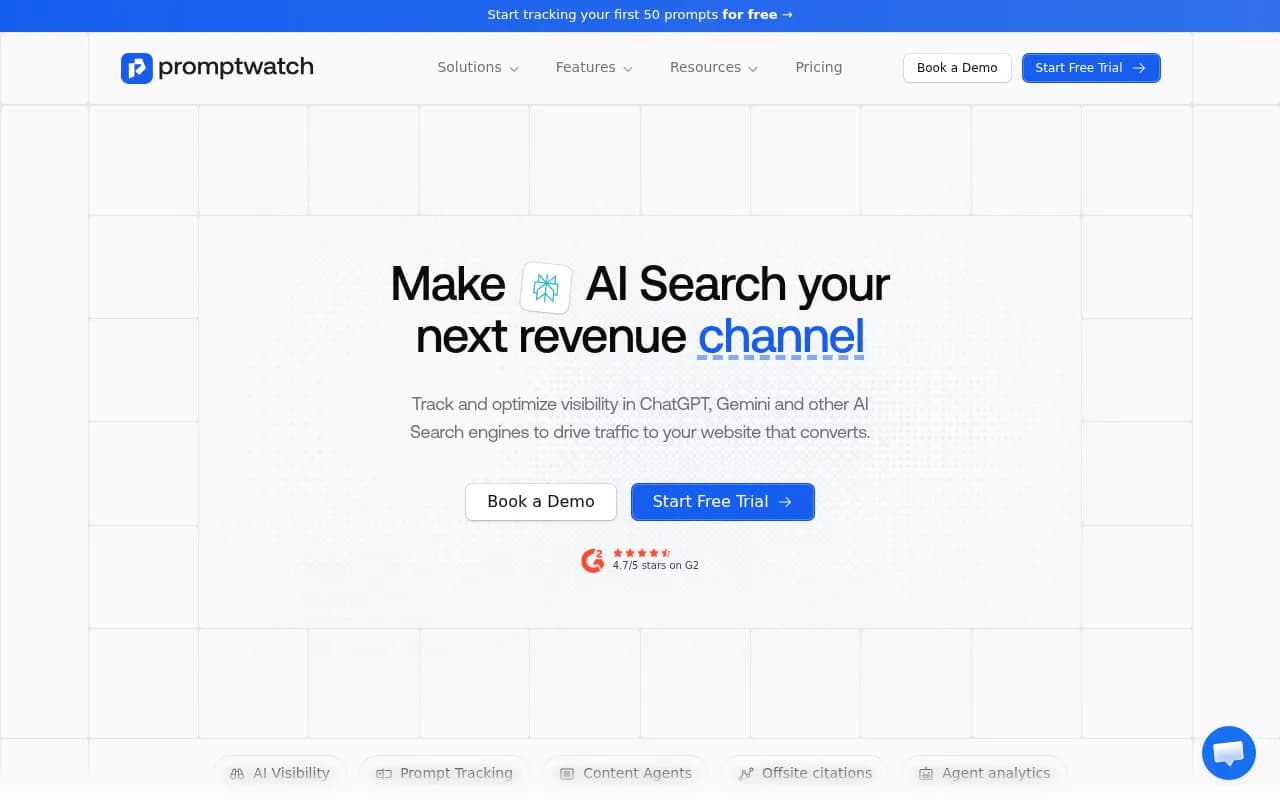
Promptwatch is a GEO and AI search visibility platform built around a specific idea: tracking where you appear in AI search is only useful if you can actually do something about it. So beyond monitoring citations across ChatGPT, Perplexity, Gemini, Claude, and seven other AI engines, it includes answer gap analysis (showing you exactly which prompts competitors rank for that you don't), AI content agents that generate articles and comparisons grounded in real prompt data, and crawler logs that show when AI bots visit your pages. The result is a platform where you can trace the path from "we're invisible for this prompt" to "we published content" to "we're now being cited."
Trusted by 1,480+ brands and agencies including Booking.com, Duolingo, Typeform, and Yelp, it's rated 4.7/5 on G2.
AirOps
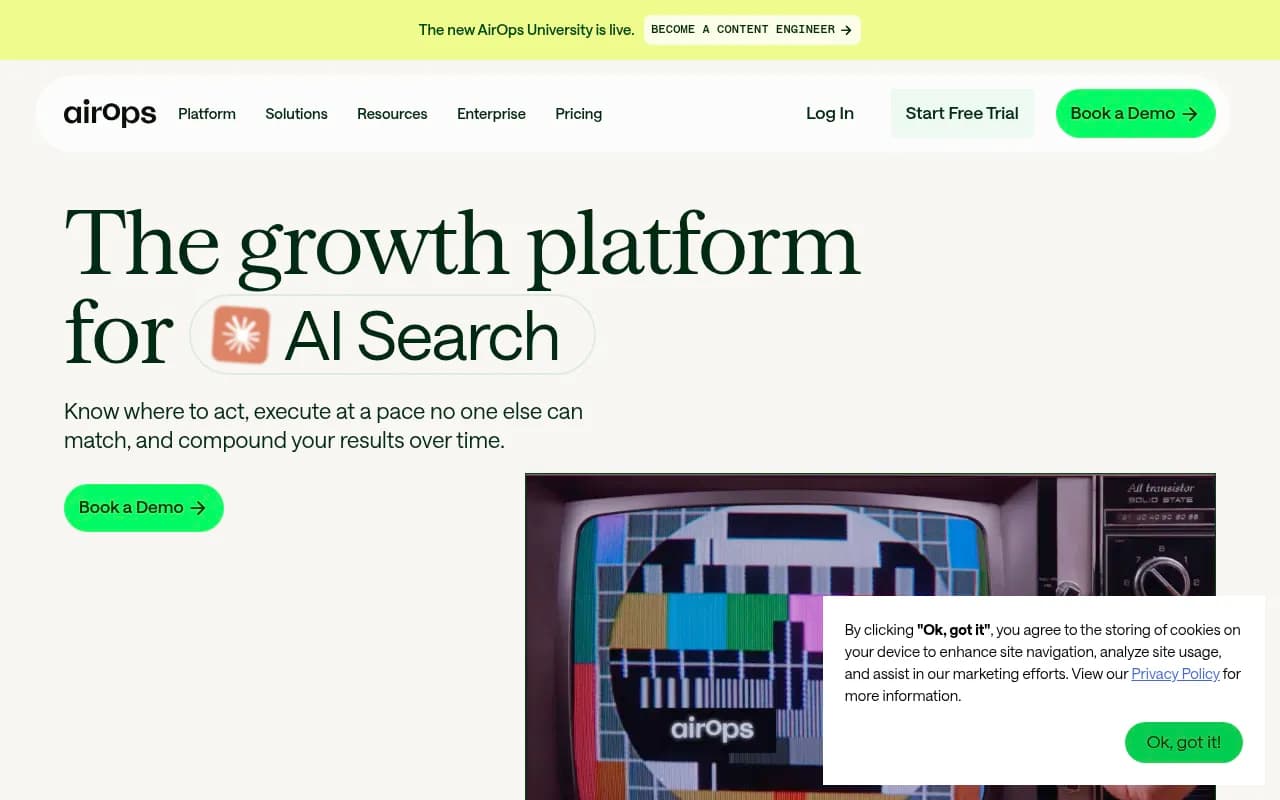
AirOps positions itself as a "growth platform for AI search" -- and it does genuinely cover both sides of the equation. You can track LLM visibility across ChatGPT, Perplexity, Gemini, and Google, and you can use its AI workflow tools to create and refresh content at scale. The content production side is where AirOps really shines: it has sophisticated workflow automation, bulk content operations, and a structured approach to building content programs. Customers like Webflow, Chime, Ramp, and Carta have published case studies showing real results. The trade-off is that the monitoring side isn't as deep as a dedicated tracking platform.
Side-by-side comparison
| Feature | Promptwatch | AirOps |
|---|---|---|
| Starting price | $99/mo | $200/mo |
| Free tier | Free trial (50 prompts) | Free Insights tier |
| AI models tracked | 10+ (ChatGPT, Perplexity, Gemini, Claude, Grok, DeepSeek, Mistral, Meta AI, Copilot, Google AI Mode) | 4 (ChatGPT, Perplexity, Gemini, Claude/Google) |
| Content generation | Yes (AI Content Agents) | Yes (core feature, more mature workflows) |
| Answer gap analysis | Yes | Partial |
| AI crawler logs | Yes | No |
| Offsite citation tracking | Yes | No |
| Reddit/YouTube tracking | Yes | No |
| ChatGPT Shopping tracking | Yes | No |
| Prompt volume & difficulty | Yes | No |
| Page-level citation tracking | Yes | Limited |
| Multi-language/region | Yes | Limited |
| G2 rating | 4.7/5 | Not listed |
| Target user | SEO/marketing teams, agencies | Content teams, growth teams |
Head-to-head feature deep-dive
AI visibility tracking
This is where the gap between the two tools is most obvious.
Promptwatch tracks citations across 10+ AI engines by running prompts through real user interfaces, not just API calls. That distinction matters because AI search engines sometimes return different results in their actual products than through their APIs. You get page-level data showing exactly which of your pages are being cited, by which model, and how often. Prompt-level data includes volume estimates and difficulty scores so you can prioritize what to chase. There are also competitor heatmaps that show you where rivals are winning and you're not.
AirOps tracks LLM visibility across its supported engines and shows you citation data, but the depth is lighter. There's no equivalent to Promptwatch's crawler logs, no prompt difficulty scoring, and no query fan-out analysis (which shows how a single prompt branches into sub-queries).
Verdict: Promptwatch wins on tracking depth, model coverage, and analytical detail.
Content creation and workflows
This is AirOps' home turf. The platform is built around the idea of content workflows -- structured, repeatable processes for creating content at scale. You can build custom workflows that pull in data, apply brand guidelines, generate drafts, and push content to your CMS. The bulk operations are genuinely useful for teams managing hundreds or thousands of pages. Webflow reportedly 5x'd their content refresh velocity using AirOps.
Promptwatch's Content Agents are more focused: they generate articles, listicles, comparisons, and briefs specifically targeting the gaps identified in your answer gap analysis. Each piece is grounded in real prompt data, citation patterns, competitor analysis, and brand guidance you upload. It's less about raw production volume and more about precision -- creating content that addresses specific AI visibility gaps.
If you need to refresh 500 product pages, AirOps is the better fit. If you need to create 15 articles that target the exact prompts where competitors are beating you, Promptwatch is more purpose-built for that.
Verdict: AirOps for content production at scale; Promptwatch for targeted gap-filling tied to AI visibility data.
AI crawler logs and technical insights
Promptwatch has a feature most competitors don't: real-time logs of AI crawlers (ChatGPT, Claude, Perplexity, etc.) hitting your website. You can see which pages they read, how often they return, what errors they encounter, and when a page moves from "crawled" to "cited." This is genuinely useful for diagnosing why some pages get cited and others don't.
AirOps has no equivalent. There's no crawler log, no technical visibility into how AI engines are discovering and reading your content.
Verdict: Promptwatch, clearly.
Offsite and third-party citation tracking
Promptwatch tracks citations that happen outside your own website -- Reddit threads, YouTube videos, listicles, and third-party domains that AI models pull from when answering questions about your category. This matters because a lot of AI visibility comes from sources you don't control, and knowing which external pages are driving citations tells you where to focus PR and partnership efforts.
AirOps doesn't track offsite citations.
Verdict: Promptwatch.
Pricing and accessibility
| Plan | Promptwatch | AirOps |
|---|---|---|
| Free | Free trial (50 prompts, 5 articles) | Free Insights tier |
| Entry paid | $99/mo (Essential: 1 site, 50 prompts) | $200/mo (Solo) |
| Mid tier | $249/mo (Professional: 2 sites, 150 prompts, crawler logs) | -- |
| Upper tier | $579/mo (Business: 5 sites, 350 prompts, 30 articles) | $2,000/mo (Pro) |
| Agency/Enterprise | Custom | Custom |
The pricing difference is stark. AirOps' Pro plan at $2,000/mo is more than 3x Promptwatch's Business plan at $579/mo. For a solo marketer or small team, Promptwatch's $99/mo entry point is much more accessible. AirOps' pricing reflects its positioning as a content production platform for growth teams with real budgets.
Verdict: Promptwatch is significantly more affordable at every tier.
Integrations and ecosystem
Promptwatch connects through Cloudflare, Fastly, Vercel, server logs, Google Search Console, or a tracking snippet. It has a Looker Studio integration and an API for custom reporting. The website integrations are specifically designed to feed crawler and attribution data back into the platform.
AirOps integrates with CMS platforms and content tools, which makes sense given its workflow focus. It's built to slot into a content production stack.
Verdict: Different strengths -- Promptwatch for analytics integrations, AirOps for content stack integrations.
Pros and cons
Promptwatch
Pros:
- Most comprehensive AI model coverage (10+ engines)
- AI crawler logs are a genuinely unique feature
- Prompt volume and difficulty scoring helps prioritize effort
- Offsite citation tracking, Reddit/YouTube insights, ChatGPT Shopping
- Much lower entry price
- Full loop from gap analysis to content generation to result tracking
Cons:
- Content agents are more targeted than high-volume workflow automation
- Fewer CMS integrations than AirOps
- Newer platform (though growing fast with 1,480+ customers)
AirOps
Pros:
- Mature, flexible content workflow automation
- Strong case studies from recognizable brands (Webflow, Ramp, Carta, Chime)
- Good for teams that need to produce content at scale
- Covers both traditional SEO and AI search in one platform
Cons:
- Expensive -- $2,000/mo Pro plan is a big jump
- No AI crawler logs or technical site monitoring
- No offsite citation tracking
- No Reddit/YouTube tracking
- No ChatGPT Shopping monitoring
- Fewer AI models tracked (4 vs 10+)
- Lighter on prompt intelligence (no volume/difficulty scoring)
Who should pick which tool
Pick Promptwatch if:
- You want to understand exactly where you stand in AI search across all major models
- You need crawler logs to diagnose why certain pages aren't getting cited
- You want to track offsite citations, Reddit discussions, or ChatGPT Shopping appearances
- Budget matters -- you want serious AI visibility tooling without a $2,000/mo commitment
- You want a single platform that covers monitoring, gap analysis, content generation, and result tracking
Pick AirOps if:
- Your primary bottleneck is content production velocity, not visibility analytics
- You need to create and refresh content at scale across hundreds of pages
- You have a larger budget and want a platform with proven case studies from growth teams
- You're already invested in a content workflow stack and need something that integrates cleanly
- Traditional SEO and AI search visibility in one workflow tool is the priority
Worth noting: some teams use both. Promptwatch identifies the specific gaps and prompts worth targeting; AirOps handles the production workflow to fill them at scale. They're more complementary than mutually exclusive if budget allows.
Final verdict
Promptwatch is the stronger choice for teams whose primary goal is understanding and improving AI search visibility. It covers more models, goes deeper on analytics, and is the only option here with crawler logs, offsite citation tracking, and prompt intelligence. The price is also meaningfully lower.
AirOps is the right call if content production at scale is the actual problem -- it's a more mature workflow tool for teams that need to ship a lot of content fast and have the budget for it.
For most marketing and SEO teams getting serious about GEO in 2026, Promptwatch's combination of tracking depth and content generation at a reasonable price point is the more practical starting point.