Key takeaways
- ChatGPT visibility is now a real marketing metric -- if your brand isn't mentioned in AI answers, you're losing potential customers who never even run a Google search
- Most tracking tools only show you where you're invisible; the more useful ones help you fix it with content gap analysis and optimization workflows
- The best tools in 2026 cover multiple AI models (not just ChatGPT), track citations at the page level, and give you prompt-level data to prioritize your efforts
- Free or low-cost options exist for smaller teams, but serious brands need dedicated GEO platforms with crawler logs and competitor benchmarking
- Tracking without acting is a waste of time -- pick a tool that closes the loop from measurement to content creation
Why tracking ChatGPT visibility actually matters now
A year ago, you could argue that AI search visibility was a "nice to have." That argument is getting harder to make. ChatGPT has over 200 million weekly active users, and a growing share of those users are asking it product questions, comparison questions, and "what's the best X for Y" questions -- the exact queries where brand mentions translate directly into consideration and purchase.
The uncomfortable truth is that most brands have no idea whether ChatGPT recommends them, ignores them, or actively describes them in ways they'd object to. Traditional SEO dashboards don't capture this. Google Search Console doesn't capture this. You need a different kind of tool.
What makes ChatGPT tracking genuinely tricky is that it doesn't work like a search engine. There's no index you can crawl, no ranking position to monitor. ChatGPT synthesizes answers from its training data and, in some modes, from live web browsing. Whether your brand gets mentioned depends on what content exists about you, where it's published, how authoritative those sources are, and whether your own site answers the questions people are actually asking.
So tracking visibility is really just the first step. The second step -- which most tools skip -- is understanding why you're visible or invisible, and doing something about it.
What to look for in a ChatGPT visibility tool
Before getting into specific tools, it's worth being clear about what separates a useful platform from one that just produces dashboards you'll stop checking after two weeks.
Multi-model coverage. Your customers use ChatGPT, but they also use Perplexity, Google AI Overviews, Claude, and Gemini. A tool that only tracks one model gives you an incomplete picture. The best platforms cover 8-10 models simultaneously.
Prompt-level data. You need to know which specific questions are triggering (or not triggering) your brand mentions. Generic "visibility scores" without the underlying prompt data are hard to act on.
Competitor benchmarking. Knowing your own visibility score in isolation is less useful than knowing how it compares to your direct competitors for the same prompts.
Content gap analysis. Which prompts are your competitors winning that you're not? This is where optimization actually starts.
Crawler and citation logs. Does the tool show you which of your pages AI models are actually reading and citing? This is rare but extremely valuable for diagnosing indexing issues.
Content creation support. Some platforms stop at showing you the gap. The more useful ones help you fill it -- by generating briefs, articles, or optimization recommendations grounded in real prompt data.
The best tools for tracking brand visibility in ChatGPT in 2026
Promptwatch
Promptwatch is the most complete option on this list for teams that want to go beyond monitoring. It tracks brand visibility across 10 AI models -- ChatGPT, Perplexity, Claude, Gemini, Google AI Overviews, Google AI Mode, Grok, DeepSeek, Copilot, and Meta AI -- and it's built around a specific workflow: find the gaps, create content to fill them, track whether it works.
The Answer Gap Analysis feature shows you exactly which prompts your competitors are winning that you're not, down to the specific content angle that's missing from your site. Content Agents then generate articles, comparisons, and briefs grounded in that prompt data -- not generic SEO content, but pieces engineered to answer the questions AI models are already exposing as gaps.
What sets it apart from most competitors is the AI Crawler Logs feature: real-time logs of when ChatGPT, Claude, Perplexity, and other AI crawlers hit your pages, which pages they read, what errors they encounter, and when a crawled page moves to an actual citation. Most tools have no visibility into this at all.
It's used by 1,480+ brands and agencies including Booking.com and Center Parcs, and has processed over 4.5 billion citations and prompts. Pricing starts at $99/month for the Essential plan (1 site, 50 prompts, 5 articles/month), with Professional at $249/month and Business at $579/month. A free trial is available.
Otterly.AI
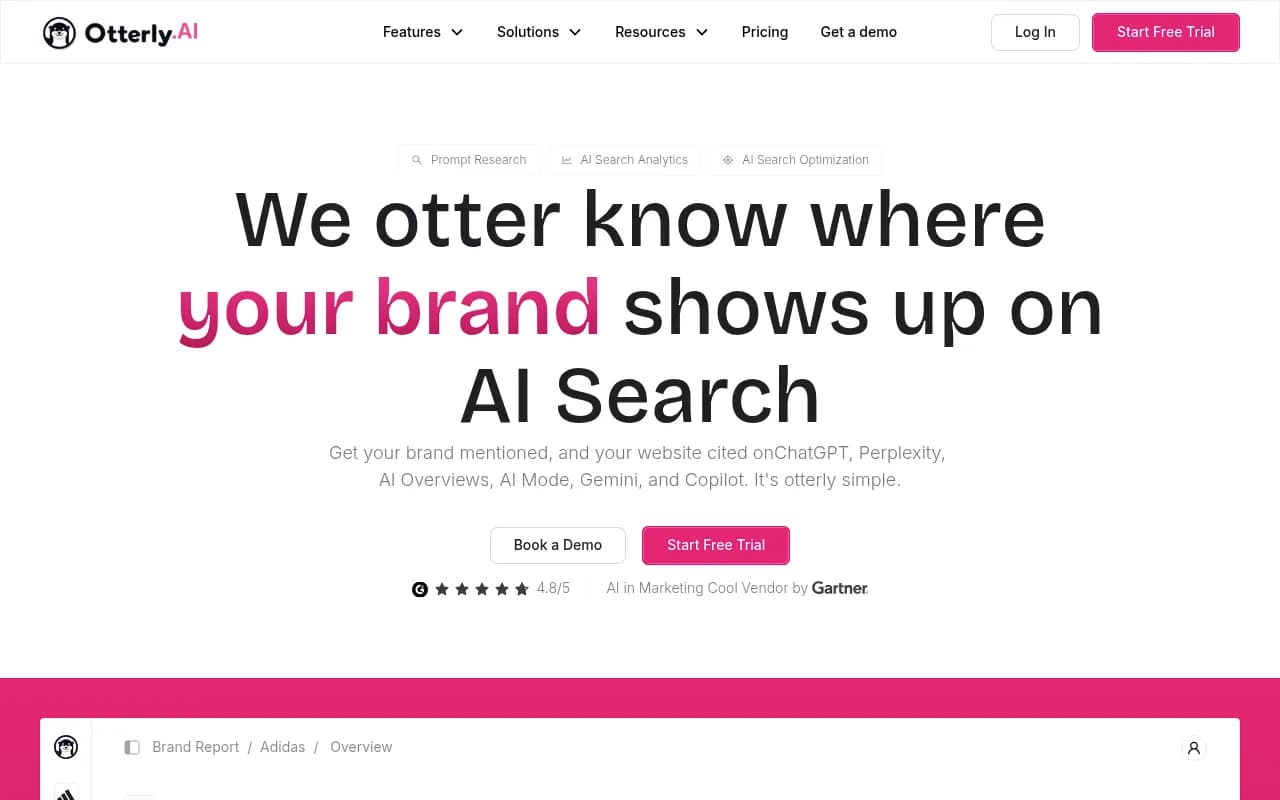
Otterly.AI is a solid entry-level option for teams that want to start tracking AI visibility without a large budget. It monitors brand mentions across ChatGPT, Perplexity, and a handful of other models, and gives you a clean dashboard showing mention frequency and sentiment over time.
The main limitation is that it's primarily a monitoring tool. You can see where you're invisible, but there's no content gap analysis, no crawler logs, and no content generation. For a small team just getting started with AI visibility, it's a reasonable first step. For a team that wants to actually improve their visibility, you'll hit its ceiling quickly.
Peec AI
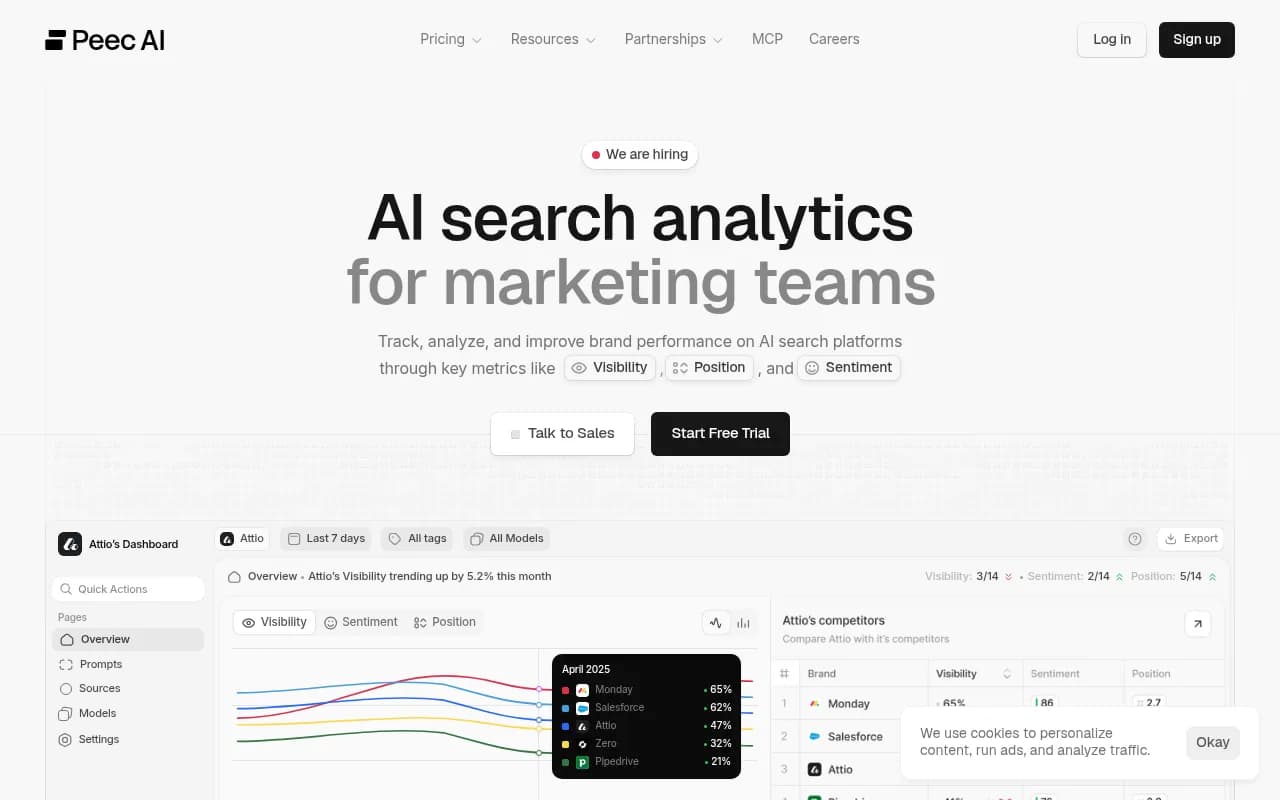
Peec AI focuses on AI visibility tracking with some built-in suggestions for improvement. It covers the major AI models and provides prompt-level data on where your brand appears and where it doesn't. The interface is clean and relatively easy to onboard.
Like Otterly.AI, it's more monitoring-focused than optimization-focused. The "smart suggestions" feature points you toward content opportunities, but the actual content creation work is still on you. Good for teams that have a content team ready to act on the data.
AthenaHQ
AthenaHQ has built a reputation for solid monitoring capabilities, particularly for enterprise teams that need structured reporting and multi-brand tracking. It covers the major AI platforms and provides competitive benchmarking data.
The gap is on the optimization side. AthenaHQ is primarily a visibility monitoring platform -- it tells you where you stand but doesn't provide tools to help you improve. Teams using it typically pair it with a separate content workflow.
Profound
Profound is positioned at the enterprise end of the market, with strong analytics and reporting features. It covers multiple AI models and provides detailed prompt analysis. The platform is well-suited for large brands with dedicated analytics teams who need granular data exports and custom reporting.
The trade-off is price -- Profound sits at a higher price point than most alternatives -- and the same monitoring-first limitation applies. It's a strong analytics platform, but content optimization isn't its core focus.
Semrush AI Visibility Toolkit
Semrush added AI visibility tracking to its existing SEO platform, which makes it convenient for teams already using Semrush for traditional SEO. You can monitor brand mentions in AI answers alongside your organic rankings, backlink data, and keyword research -- all in one place.
The limitation is that Semrush uses fixed prompts for its AI tracking, which means you're monitoring a predetermined set of questions rather than the full range of prompts your customers actually use. It also lacks AI traffic attribution, so you can't connect AI visibility to actual site visits or revenue. Useful as a starting point if you're already a Semrush customer, but not a replacement for a dedicated GEO platform.
Ahrefs Brand Radar
Ahrefs Brand Radar is the AI visibility feature within the Ahrefs platform. It tracks brand mentions across AI search engines and integrates with Ahrefs' existing backlink and keyword data, which is genuinely useful context for understanding why certain pages get cited.
The same caveats as Semrush apply: fixed prompts, no AI traffic attribution, and it's an add-on to a traditional SEO tool rather than a purpose-built GEO platform. Worth using if you're an Ahrefs user who wants basic AI visibility data without switching tools.
Scrunch AI
Scrunch AI is aimed at brands and agencies that need AI search monitoring with clean reporting. It covers the major models and provides competitor comparison data. The interface is straightforward, and the agency-oriented features (multi-client management, white-label reporting) make it a reasonable choice for agencies managing AI visibility for multiple clients.
Content optimization features are limited, so it works best as a monitoring layer that feeds into a separate content strategy process.
Search Party
Search Party is built with agencies in mind, offering multi-client management and structured reporting for AI search visibility. It covers the main AI platforms and provides competitive benchmarking.
The limitation is on the data depth side -- prompt metrics and difficulty scoring are less developed than in dedicated GEO platforms, and there's no content gap analysis. For agencies that need clean client reporting on AI visibility, it's a workable option.
Rankscale
Rankscale focuses specifically on AI search rank tracking and monitoring. It's a newer entrant in the space with a clean interface and coverage of the main AI models. Good for teams that want straightforward tracking without a lot of additional features.
Tool comparison table
Here's how the main options stack up across the features that matter most:
| Tool | AI models covered | Prompt-level data | Content gap analysis | Content generation | Crawler logs | Pricing (starting) |
|---|---|---|---|---|---|---|
| Promptwatch | 10+ | Yes | Yes | Yes (Content Agents) | Yes | $99/mo |
| Otterly.AI | 4-5 | Basic | No | No | No | Lower tier |
| Peec AI | 5-6 | Yes | Limited | No | No | Mid tier |
| AthenaHQ | 5-6 | Yes | No | No | No | Mid-high tier |
| Profound | 6-8 | Yes | No | No | No | High tier |
| Semrush AI Toolkit | 3-4 | Fixed prompts | No | No | No | Add-on to Semrush |
| Ahrefs Brand Radar | 3-4 | Fixed prompts | No | No | No | Add-on to Ahrefs |
| Scrunch AI | 5-6 | Yes | No | No | No | Mid tier |
| Search Party | 4-5 | Limited | No | No | No | Agency pricing |
| Rankscale | 4-5 | Yes | No | No | No | Lower-mid tier |
How ChatGPT actually decides to mention your brand
Understanding the tools is useful, but understanding why ChatGPT mentions or ignores brands is what lets you act on the data they give you.
ChatGPT's brand mentions come from two main sources: its training data (which includes web content, Reddit discussions, news articles, and third-party reviews that existed before its knowledge cutoff) and, in browsing-enabled modes, live web retrieval. This means your visibility depends on:
What's written about you on third-party sites. Reddit threads, industry listicles, review sites, YouTube videos, and news coverage all feed into ChatGPT's understanding of your brand. A brand that appears in 50 Reddit discussions about its category will naturally surface more than one that doesn't.
Whether your own site answers the questions people ask. If someone asks ChatGPT "what's the best project management tool for remote teams," ChatGPT will cite sources that directly answer that question. If your site has a page that answers it well, you have a better chance of being cited. If it doesn't, you don't.
How authoritative your sources are. Citations tend to cluster around high-authority domains. A mention in a well-known industry publication carries more weight than a mention on a low-traffic blog.
Prompt framing. The same brand can appear or disappear depending on how the question is phrased. "Best CRM for small businesses" and "affordable CRM with email automation" might produce completely different brand mentions even though they're describing the same need.
This is why prompt-level tracking matters so much. You need to know which specific questions are and aren't surfacing your brand -- and then create content that answers those questions directly.
A practical workflow for improving your ChatGPT visibility
Tracking is only useful if it leads to action. Here's a straightforward workflow:
Step 1: Establish a baseline. Set up tracking for 30-50 prompts that represent how your customers actually search. Include category-level prompts ("best [category] tools"), comparison prompts ("X vs Y"), and problem-framing prompts ("how to solve [problem your product addresses]").
Step 2: Identify your gaps. Which prompts are your competitors appearing in that you're not? Which prompts produce no brand mentions at all? These are your highest-priority content opportunities.
Step 3: Audit your existing content. For each gap prompt, check whether you have a page that directly answers it. If not, that's a content creation task. If yes, check whether the page is structured in a way that's easy for AI models to parse and cite.
Step 4: Create citation-ready content. AI models tend to cite content that directly answers specific questions, uses clear structure (headers, lists, definitions), and comes from authoritative sources. Write for the question, not just the keyword.
Step 5: Build off-site mentions. Getting your brand mentioned in industry publications, Reddit discussions, and third-party review sites is one of the highest-leverage activities for AI visibility. These off-site mentions feed directly into how AI models understand and describe your brand.
Step 6: Track the results. Monitor whether your new content gets crawled by AI agents, and whether crawls convert to citations. This feedback loop tells you what's working and what needs adjustment.
Tools like Promptwatch make this workflow significantly faster by automating the gap analysis and content generation steps -- but the underlying logic applies regardless of which tool you use.
Which tool should you actually use?
The honest answer depends on where you are and what you need.
If you're just starting out and want to understand your baseline AI visibility without a big investment, Otterly.AI or Peec AI are reasonable starting points. They're affordable, easy to set up, and will give you a basic picture of where you stand.
If you're a larger brand or agency that needs to go beyond monitoring -- identifying content gaps, generating optimized content, tracking crawler behavior, and connecting visibility to revenue -- Promptwatch is the most complete option available. It's the only platform that covers the full loop from gap identification to content creation to citation tracking, and the crawler log feature alone is something most competitors don't offer at all.
If you're already deep in the Semrush or Ahrefs ecosystem and just want basic AI visibility data without adding another tool, their built-in features are a reasonable starting point -- just go in knowing their limitations around fixed prompts and attribution.
The one thing to avoid: picking a tool, generating a visibility score, and then doing nothing with it. The brands that are winning in AI search right now are the ones treating it like a content channel -- systematically identifying what AI models want to answer, creating that content, and tracking whether it works.