Key takeaways
- Query fan-out is the process AI search engines use to expand a single user prompt into multiple sub-queries before generating an answer -- and your content needs to cover those sub-queries to get cited.
- Most brands are invisible not because their content is bad, but because it doesn't address the specific angles AI models are looking for when they fan out a query.
- You can manually map fan-outs using AI tools, but systematic gap analysis at scale requires a platform that tracks real AI behavior across multiple models.
- The goal isn't to rank for one keyword -- it's to cover enough of the fan-out tree that AI engines consistently pull from your site.
- Fixing fan-out gaps is one of the fastest ways to improve AI citation rates because you're targeting content the models are already looking for.
What query fan-out actually is (and why it matters now)
When someone types "best project management software for remote teams" into ChatGPT or Google AI Mode, the model doesn't just search for that exact phrase. It silently breaks the question apart. It might generate sub-queries like:
- What are the top project management tools in 2026?
- Which tools work best for distributed teams?
- How does Asana compare to Monday.com for remote work?
- What features matter most for async collaboration?
- What do users say about pricing for remote team tools?
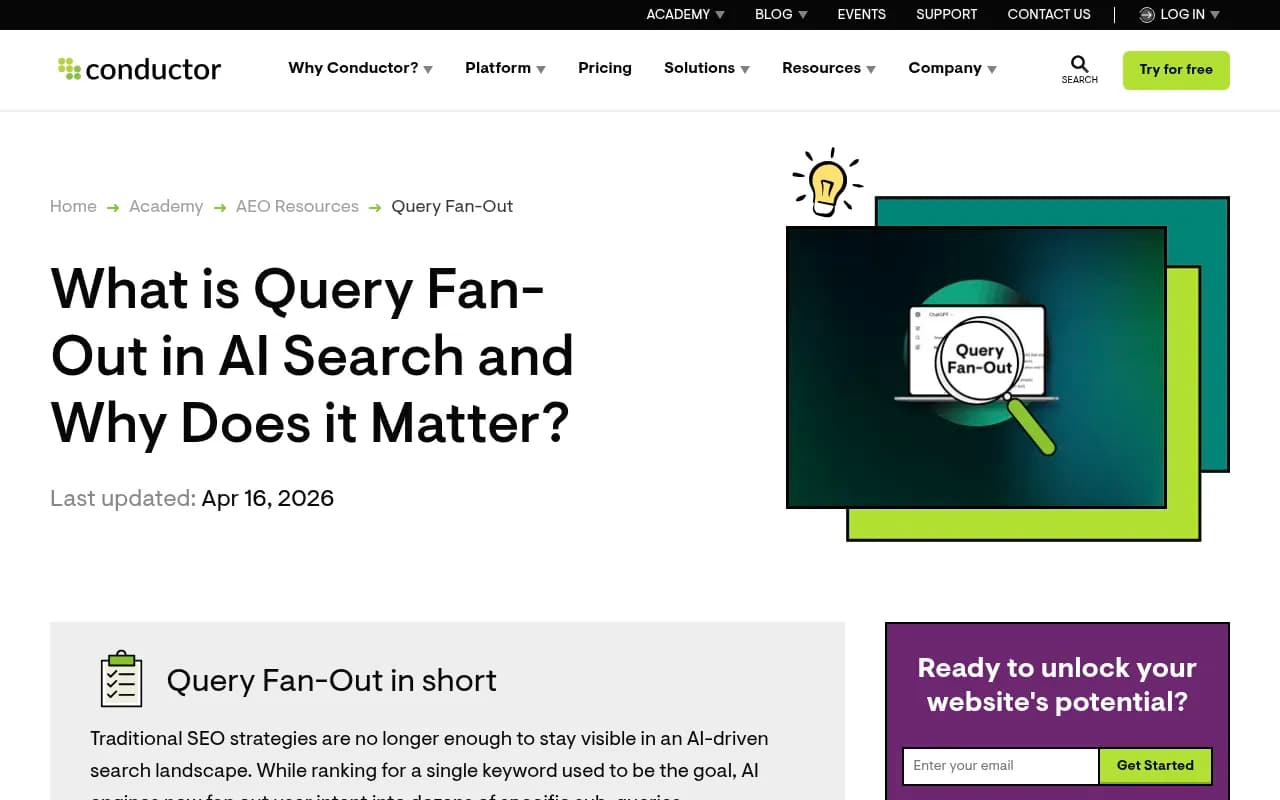
That expansion -- one prompt becoming five, ten, or twenty sub-queries -- is query fan-out. The AI then retrieves content for each sub-query, synthesizes the results, and builds a response. Your content only gets cited if it shows up in one of those sub-query retrievals.
This is fundamentally different from traditional SEO, where you optimized for a target keyword and a matching search intent. In AI search, intent isn't singular. It's a tree. And if your content only covers the trunk, you're invisible to the branches.
The practical consequence is significant. A brand might have excellent content on "project management software" but nothing specific about async collaboration features, or distributed team pricing, or how their tool compares to a specific competitor. The AI model fans out the query, hits those gaps, and cites someone else instead. The brand never knows why.
How AI models generate fan-outs
Understanding the mechanics helps you predict what sub-queries will appear for your target prompts.
Most modern AI search systems -- Google AI Mode, ChatGPT with search, Perplexity, Gemini -- use a Retrieval-Augmented Generation (RAG) architecture. When a query comes in, the system doesn't just pass it to the language model. It first expands the query into multiple sub-queries, retrieves documents for each, then feeds those documents to the LLM to synthesize an answer.
The expansion step is where fan-out happens. The model uses its training to predict what information would be needed to fully answer the original question. It considers:
- The explicit question (what the user literally asked)
- Implicit intent (what the user probably wants to accomplish)
- Related entities (brands, products, people, locations mentioned or implied)
- Comparison angles (what alternatives exist)
- Qualification criteria (what makes something "best" or "right" for a specific context)
- Temporal context (is this time-sensitive? are there recent developments?)
Google AI Mode is particularly aggressive with fan-out. Aleyda Solís documented how AI Mode generates a visible list of sub-queries before answering -- you can actually watch it happen in the interface. That transparency is useful because it shows you exactly what the model thinks is relevant to a given prompt.

Lazarina Stoy at iPullRank makes an important point: fan-out doesn't just expand queries, it can skew intent. The sub-queries the model generates reflect its training data and assumptions about what people want -- which may not perfectly match what your specific audience actually needs. That's worth keeping in mind when you're mapping fan-outs for niche or technical topics.
Why your existing content is probably missing the fan-out
Here's the uncomfortable reality: most content strategies were built around keyword research, not intent trees. You identified a target keyword, wrote a page optimized for it, and called it done.
That approach leaves huge gaps in fan-out coverage because:
You optimized for head terms, not sub-intents. A page titled "Project Management Software Guide" might cover features and pricing, but miss the specific comparison angles or use-case scenarios that AI models generate as sub-queries.
You didn't write for the "why" and "how" layers. AI models consistently fan out into explanatory and procedural sub-queries. If your content is mostly declarative ("here's what our tool does") rather than explanatory ("here's why this matters for remote teams"), you're missing a big chunk of the fan-out tree.
You ignored competitor comparison queries. AI models almost always generate comparison sub-queries when someone asks about a product or service. If you don't have content that directly addresses how you compare to alternatives, you're handing those citations to review sites and competitors.
You have content silos. Fan-out rewards topic depth and breadth together. A single comprehensive page is less likely to get cited across multiple sub-queries than a cluster of interconnected pages that each go deep on a specific angle.
How to map fan-outs for your target prompts
The manual approach is straightforward, though time-consuming at scale.
Step 1: Start with your core prompts
List the 10-20 prompts your ideal customers are most likely to use when looking for what you offer. These aren't keywords -- they're actual questions or requests. "What's the best CRM for a 10-person sales team?" not "CRM software."
Step 2: Run them through AI interfaces directly
Take each prompt into Google AI Mode, ChatGPT, Perplexity, and Gemini. In AI Mode, you'll see the sub-queries listed explicitly. In other tools, look at the structure of the response -- each paragraph or section usually corresponds to a sub-query the model generated internally.
Write down every sub-query you can identify. You're building a map of what the model thinks is relevant to your core prompt.
Step 3: Check your content against each sub-query
For each sub-query in your map, ask: does my site have content that directly and specifically answers this? Not "does my site mention this topic somewhere" -- does it have a page that would clearly be the best result for this sub-query?
Be honest. A passing mention in a 3,000-word guide doesn't count. The model needs something it can cite with confidence.
Step 4: Identify the gaps
The sub-queries where you have nothing, or where your content is thin, are your fan-out gaps. These are the specific content opportunities that AI engines are already exposing -- they're generating these sub-queries right now, and if you're not there, someone else is.
Step 5: Prioritize by citation potential
Not all gaps are equal. Prioritize based on:
- How often the sub-query appears across different AI models (consistent fan-out = high value)
- Whether competitors are already being cited for it (winnable gaps vs. entrenched ones)
- How close it is to your core topic authority (easier to rank where you already have credibility)
Tools that help with fan-out analysis
Doing this manually for a handful of prompts is feasible. Doing it systematically across dozens of prompts, multiple AI models, and competitor comparisons is where you need tooling.
Promptwatch has a dedicated query fan-out feature that shows how individual prompts branch into sub-queries across the AI models it monitors. More usefully, it connects fan-out data to Answer Gap Analysis -- so you can see not just what sub-queries exist, but which ones competitors are being cited for that you're not. That's the gap you actually need to fill.
For content research and optimization once you've identified gaps, a few tools are worth knowing:
Conductor has solid documentation on query fan-out strategy and integrates AI search insights into its content planning workflow.
Ahrefs has written about query fan-out and their Brand Radar feature tracks AI citations, though it doesn't go deep on fan-out mapping specifically.
Semrush's AI Visibility Toolkit covers brand monitoring across AI engines, useful for tracking whether your gap-filling content is getting cited.
MarketMuse is strong on topic modeling and content gap analysis -- not AI-specific, but the underlying logic of "what topics are you missing?" maps well to fan-out thinking.
Turning fan-out gaps into content that gets cited
Finding the gaps is only half the work. The content you create to fill them needs to be structured in a way that AI models can actually use.
Write for direct retrieval
AI models cite content that directly and specifically answers a sub-query. That means:
- Clear, declarative answers near the top of the page (don't bury the answer)
- Specific headings that match the sub-query language
- Factual, verifiable claims (models prefer content they can ground in evidence)
- Concise paragraphs that make one point clearly
Long, meandering content that eventually gets to the point is harder for RAG systems to retrieve accurately. Think of each section of your content as a potential citation unit -- it should be able to stand alone as an answer to a specific question.
Cover comparison angles explicitly
AI models almost always generate comparison sub-queries. If someone asks about your product category, the model will fan out into "X vs Y" and "best X for [use case]" sub-queries. Create content that directly addresses these comparisons, including honest acknowledgment of where alternatives might be better. Models cite content that appears authoritative and balanced, not content that reads like a sales page.
Build topic clusters, not isolated pages
A single page covering your core topic won't capture the full fan-out tree. You need a cluster of interconnected pages, each going deep on a specific sub-topic. The cluster signals to AI models that your site has genuine depth on the topic -- not just a surface-level overview.
Use structured data
Schema markup helps AI models understand what your content is about and how it relates to specific questions. FAQ schema, HowTo schema, and Article schema are all worth implementing on content targeting fan-out sub-queries.
Tracking whether your gap-filling is working
This is where most teams drop the ball. They create content to fill fan-out gaps, then have no systematic way to know if AI models are actually citing it.
You need page-level citation tracking -- not just overall brand visibility, but which specific pages are being cited, by which models, and for which prompts. That feedback loop tells you whether your content is landing.
Promptwatch's page-level tracking and agent analytics show exactly when AI crawlers visit new pages and when those pages move from crawled to cited. That timeline matters because there's often a lag between publishing and citation -- knowing the lag helps you set realistic expectations and catch indexing issues early.
Fan-out gaps vs. traditional content gaps: a comparison
| Dimension | Traditional content gap | Fan-out content gap |
|---|---|---|
| How you find it | Keyword research tools | AI model behavior analysis |
| What it represents | Missing keyword coverage | Missing sub-query coverage in AI responses |
| How specific it is | Broad topic or keyword | Specific angle, comparison, or intent layer |
| Who benefits from filling it | Search engine rankings | AI citation rates |
| How fast it moves | Relatively stable | Can shift as AI models update |
| Tools needed | Ahrefs, Semrush, etc. | GEO platforms, direct AI testing |
The two types of gaps overlap but aren't the same. A page can rank well in traditional search and still be invisible in AI search because it doesn't cover the right sub-query angles. Conversely, content optimized for fan-out coverage often improves traditional rankings too, because it signals genuine topical depth.
A practical workflow to start this week
If you want to start using fan-out analysis without overhauling your entire content strategy, here's a focused starting point:
- Pick your three most commercially important prompts -- the questions your best customers are most likely to ask AI engines.
- Run each through Google AI Mode and note every sub-query it generates visibly.
- Run the same prompts through Perplexity and look at the source citations -- those are the pages winning the fan-out right now.
- Check whether any of those cited pages are yours. If not, look at what they cover that you don't.
- Write one piece of content specifically targeting the most common gap you find. Make it direct, specific, and structured for retrieval.
- Track whether AI models start citing it over the next 4-6 weeks.
That's the core loop. Scale it up with better tooling as you go.
The bigger picture
Query fan-out isn't a trick or a loophole -- it's how AI search actually works. The models are doing research, not just matching keywords. They're generating a map of what they need to know to answer a question, then going to find it.
Your job is to be on that map. Not for every possible sub-query, but for the ones that matter to your audience and where you have genuine expertise to offer. Find the gaps, fill them with content that's actually useful, and track whether the models start citing you.
That's the whole game.