Key takeaways
- Comparison pages are among the most frequently cited content types in AI search because they directly answer "which is better" prompts that millions of users ask every day.
- AI models extract self-contained sentences and structured data -- your page needs to be written for extraction, not just for ranking.
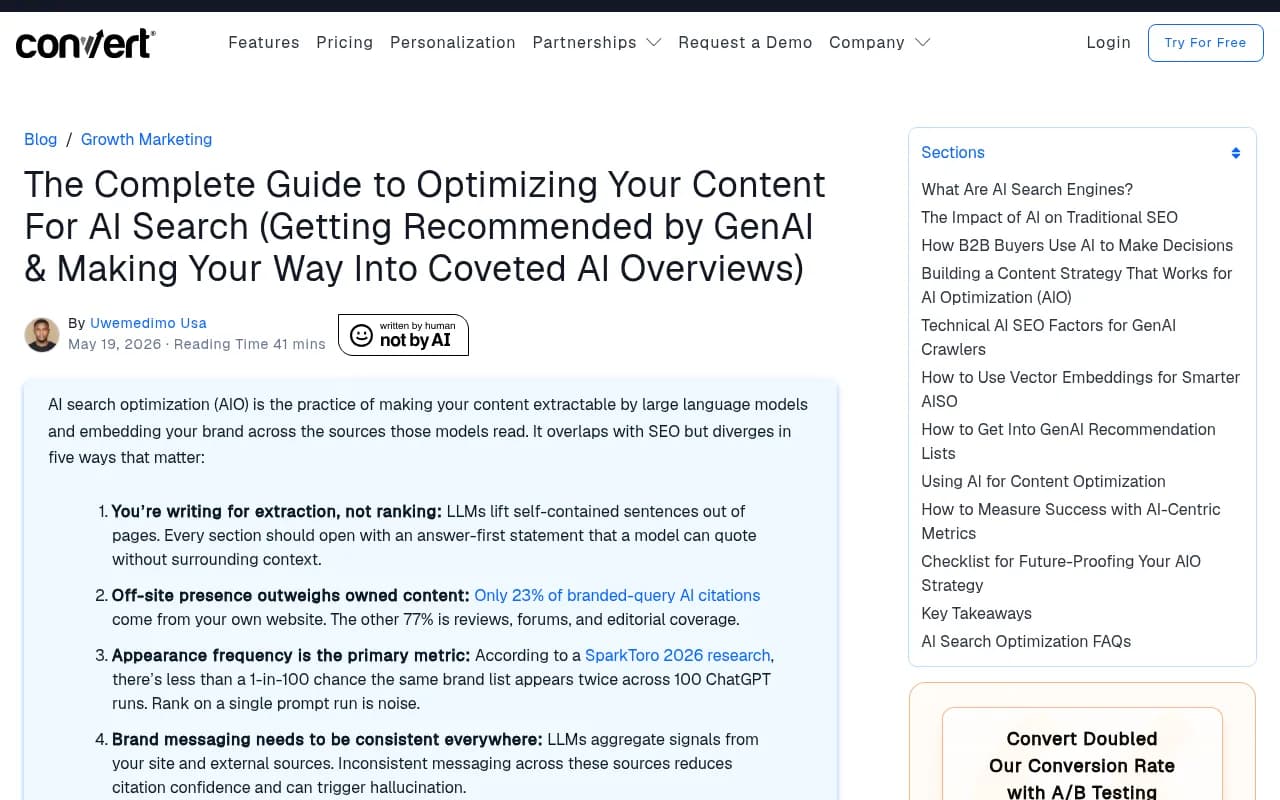
- Only 23% of branded-query AI citations come from a brand's own website. Comparison pages on third-party sites, review platforms, and forums matter just as much as your owned content.
- Structure beats prose: tables, clear section headers, and answer-first sentences dramatically improve how often AI models quote your page.
- Freshness signals matter. Stale comparison pages get replaced by newer ones. Keeping data current is not optional.
Comparison pages have always been useful for SEO. But in 2026, they've become something more specific: one of the most reliably cited content formats in AI search. When someone asks ChatGPT "what's the best project management tool for small teams" or Perplexity "Notion vs Coda for a solo founder," the AI isn't ranking pages -- it's pulling structured, extractable answers from pages that happen to be well-organized.
The good news is that writing a comparison page that gets cited by AI isn't fundamentally different from writing a good one for humans. The bad news is that most comparison pages are written badly -- vague, unstructured, and full of filler that an LLM can't do anything with.
This guide covers what actually works.
Why comparison pages get cited so often
When users ask AI search engines for recommendations, they're almost always asking comparative questions. "Best X for Y." "X vs Y." "Alternatives to Z." These are the prompts that drive the most AI search traffic, and comparison pages are the natural answer.
AI models prefer comparison pages for a few reasons:
- They contain explicit verdicts. A sentence like "Tool A is better for teams that need offline access, while Tool B works better for real-time collaboration" is exactly what an LLM needs to answer a user's question.
- They're structured. Tables, headers, and bullet points make it easy for a model to extract specific facts without misrepresenting them.
- They cover multiple entities at once. A single comparison page can satisfy several related prompts simultaneously, which increases the surface area for citation.
The catch: most comparison pages don't actually do these things. They bury verdicts in long paragraphs, avoid making clear recommendations, and use vague language that an AI model can't confidently extract.
The structure AI models want to see
Lead with a direct verdict
The first paragraph of your comparison page should answer the question. Not tease it, not promise to answer it -- answer it. AI models are trained to pull answer-first content because it matches how users phrase prompts.
Bad opening:
"In this article, we'll compare Tool A and Tool B across several dimensions to help you decide which one is right for you."
Good opening:
"Tool A is better for small teams that need simple onboarding and a low monthly cost. Tool B is the stronger choice for enterprises that need advanced automation and API access."
That second version can be quoted directly. The first one can't.
Use a comparison table early
Put your main comparison table near the top of the page, not at the bottom after 2,000 words of prose. AI models -- and humans -- want to see the structured data first.
A good comparison table for AI citation should:
- Use specific, factual values (not "good" or "great" -- use actual numbers or concrete descriptions)
- Include a "best for" row that makes the use-case distinction explicit
- Cover 5-8 dimensions max (more than that and the table loses clarity)
Here's an example format:
| Feature | Tool A | Tool B |
|---|---|---|
| Starting price | $12/user/mo | $20/user/mo |
| Free tier | Yes (up to 5 users) | No |
| Offline access | Yes | No |
| API access | Paid plans only | All plans |
| Best for | Small teams, budget-conscious | Enterprises, power users |
That table is extractable. An AI model can pull a row from it and answer "does Tool A have a free tier" without needing any surrounding context.
Write section summaries that stand alone
One of the most effective tactics for AI citation is writing a one or two sentence summary at the end of each section that can be quoted independently. Think of it as a pull quote for AI models.
After a section comparing pricing, you might write:
"Tool A costs about 40% less than Tool B at the entry level, but Tool B's higher tier includes features that Tool A charges separately for."
That sentence works as a standalone citation. It doesn't require the reader to have read the previous 300 words.
Use clear, descriptive H2 and H3 headings
AI models use headings to understand what a section is about before reading it. Vague headings like "Features" or "Pricing" are less useful than specific ones like "Pricing comparison: which tool is cheaper for small teams?" or "Which tool has better mobile support?"
Descriptive headings also help your page appear in more prompt variations. A heading that says "Which is better for freelancers: Tool A or Tool B?" directly matches a class of prompts that a vague heading would miss.
Writing for extraction, not just ranking
This is the core shift in 2026. Traditional SEO was about getting a page to rank. AI search optimization is about making your content extractable -- meaning an LLM can pull a sentence or paragraph from your page and use it to answer a question accurately.
A few principles that follow from this:
Every key claim should be self-contained. Don't write "as mentioned above, Tool A is faster." Write "Tool A loads in under 2 seconds on average, compared to Tool B's 4-5 second load time." The second version works without context.
Avoid hedging language. Phrases like "it could be argued that" or "some users might prefer" are useless to an AI model trying to give a direct answer. Make the call. "Tool A is faster. Tool B is more customizable. If speed is your priority, choose Tool A."
Use exact numbers wherever possible. "Tool A is cheaper" is unextractable. "Tool A costs $12/month vs Tool B's $20/month" is extractable. AI models prefer specificity because it reduces the chance of misrepresentation.
Name the use case explicitly. Don't make the reader infer who the page is for. State it: "This comparison is aimed at solo founders and small teams (under 10 people). If you're evaluating enterprise options, the calculus changes."
Freshness: the factor most people ignore
AI models are trained on data with cutoffs, but retrieval-augmented systems like Perplexity and Google AI Overviews pull live web content. That means a comparison page with outdated pricing, discontinued features, or old screenshots can get cited -- and then corrected by the AI, which undermines your authority.
Worse, fresh pages from competitors can displace yours. If your "Tool A vs Tool B" page was last updated in 2024 and a competitor published a fresh version in 2026, the newer page will often win.
Practical freshness tactics:
- Add a "last updated" date in a visible location (not just in the metadata)
- Review pricing and feature data every quarter
- When a tool releases a major update, update your comparison within a week
- Add a "what's changed" section at the top for major updates -- this signals recency to both users and AI crawlers
Off-site presence matters as much as your own page
Here's a stat worth sitting with: only 23% of branded-query AI citations come from a brand's own website. The other 77% comes from reviews, forums, editorial coverage, and third-party comparison sites.
This means writing a great comparison page on your own site is necessary but not sufficient. You also need:
- Your brand to appear accurately in third-party comparisons (G2, Capterra, Reddit threads, YouTube reviews)
- Consistent messaging across all those sources -- LLMs aggregate signals, and inconsistent descriptions reduce citation confidence
- Active presence in the communities where AI models look for social proof (Reddit is cited more often than most marketers expect)
If you're writing comparison pages as a publisher or affiliate, this works in your favor. Your third-party page is exactly the kind of source AI models prefer for unbiased comparisons.
The specific prompts your comparison page should target
Most comparison pages are written around one or two obvious queries ("Tool A vs Tool B"). But AI search surfaces many more variations of the same underlying question. A well-optimized comparison page should address:
- Direct comparisons: "Tool A vs Tool B"
- Use-case comparisons: "best tool for [specific use case]"
- Switching questions: "should I switch from Tool A to Tool B"
- Budget questions: "Tool A vs Tool B for small budgets"
- Feature-specific questions: "which has better [specific feature], Tool A or Tool B"
You don't need a separate page for each of these. You need one well-structured page that answers all of them -- with sections and headings that map to each prompt type.
Tools like Promptwatch can show you exactly which prompts your competitors are getting cited for but you aren't, which is a fast way to find the gaps in your comparison content.
Common mistakes that kill AI citation potential
Burying the verdict
If your comparison page spends 1,500 words on features and then says "it depends on your needs" at the end, an AI model has nothing to cite. Make a call. AI models are trying to answer questions, not present both sides indefinitely.
Using relative language without anchors
"Tool A is significantly faster" means nothing without a reference point. "Tool A processes requests in 1.2 seconds; Tool B averages 3.8 seconds" is citable. Always anchor relative claims to specific numbers or concrete comparisons.
Ignoring the "best for" framing
One of the most citable sentence structures in any comparison page is "X is best for [specific use case], while Y is best for [different use case]." This maps directly to how users phrase AI prompts. If your page doesn't have this framing, add it.
Thin feature coverage
A comparison page that only covers 3-4 dimensions will lose to one that covers 8-10 with specificity. AI models prefer comprehensive sources because they can answer more follow-up questions from a single citation. Cover pricing, free tiers, integrations, support quality, mobile apps, API access, and any category-specific features.
No clear authorship or expertise signals
AI models are increasingly sensitive to E-E-A-T signals. A comparison page with no author, no publication date, and no evidence of hands-on experience is less likely to be cited than one that clearly signals who wrote it and why they're qualified to compare these tools.
Tools that can help you track and improve AI citation
Knowing whether your comparison pages are actually getting cited is harder than it sounds. AI search engines don't send referral traffic the same way Google does, and citation data isn't always visible in standard analytics.
A few tools worth knowing:
For tracking which of your pages are being cited by AI models, and which prompts are driving those citations:
For monitoring brand mentions across AI search engines at a more basic level:
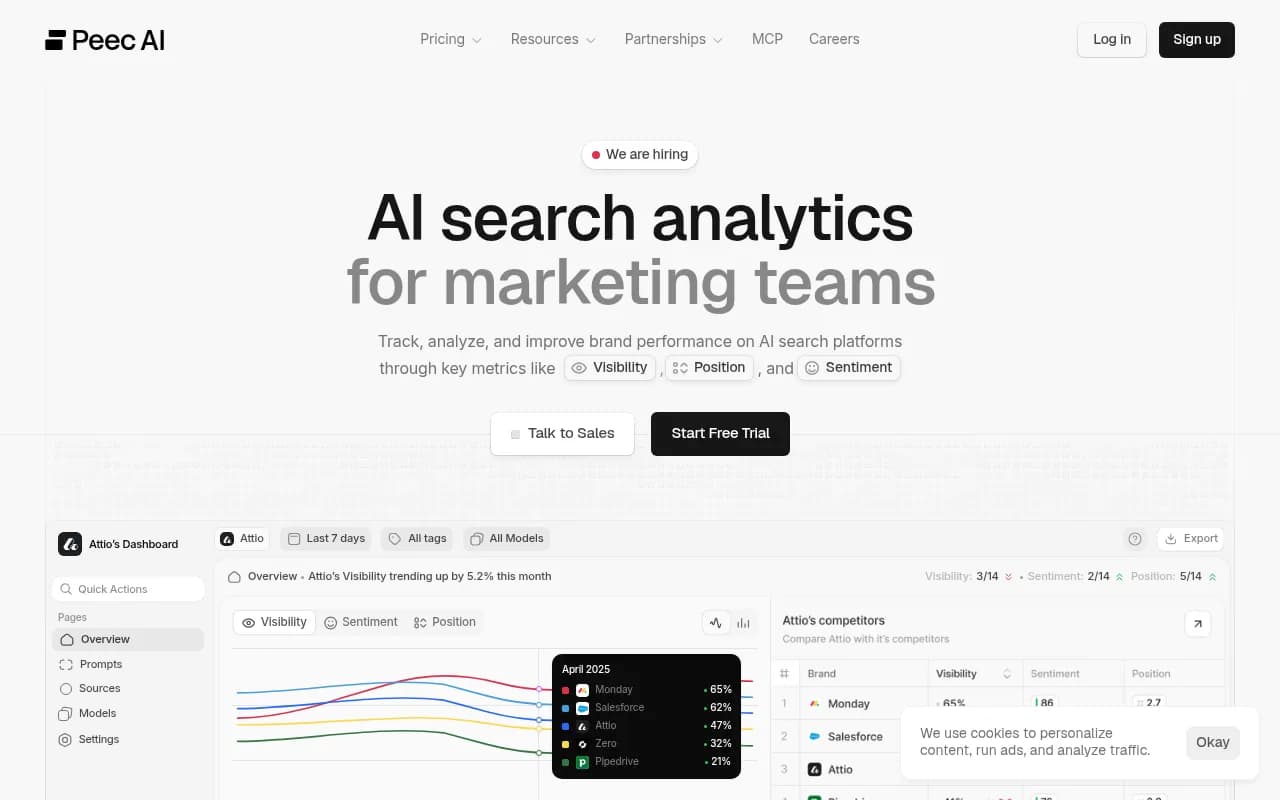
For deeper enterprise-level AI search analytics:

For tracking AI-referred traffic and clicks:
Here's a quick comparison of what these tools cover:
| Tool | Citation tracking | Prompt data | Content generation | Crawler logs |
|---|---|---|---|---|
| Promptwatch | Yes | Yes (volume + difficulty) | Yes (Content Agents) | Yes |
| Otterly.AI | Yes | Limited | No | No |
| Peec AI | Yes | Limited | No | No |
| Profound | Yes | Yes | No | No |
| AthenaHQ | Yes | Yes | No | No |
| LLMclicks.ai | Traffic only | No | No | No |
The main thing to notice: most tools show you data. Promptwatch is one of the few that also helps you act on it -- generating content briefs and articles based on the exact gaps it finds.
A practical checklist before you publish
Before publishing any comparison page intended for AI citation, run through this:
- Does the first paragraph contain a direct verdict?
- Is there a comparison table in the first half of the page?
- Does each major section end with a standalone summary sentence?
- Are all pricing and feature claims based on current data?
- Are headings descriptive enough to match specific prompt variations?
- Are all relative claims anchored to specific numbers?
- Does the page explicitly name the use cases each tool is best for?
- Is there clear authorship and a visible "last updated" date?
- Does the page cover at least 6-8 comparison dimensions?
- Have you checked whether competitors are already being cited for the same prompts?
That last point is worth spending time on. If a competitor's comparison page is already being cited heavily for the prompts you're targeting, you need to understand why -- and write something more specific, more current, or more comprehensive.
What good looks like in practice
The comparison pages that consistently get cited in AI search share a few traits that go beyond structure. They read like they were written by someone who actually used both tools. They make specific, defensible claims. They acknowledge tradeoffs honestly instead of pretending one option is perfect.
AI models are getting better at detecting thin, generic content. A comparison page that's clearly been written to game search -- full of keyword-stuffed headings and vague feature lists -- is less likely to be cited than one that reads like a genuine recommendation from someone with real experience.
The irony is that the best strategy for AI citation is the same as the best strategy for writing useful content: be specific, be direct, and actually help the reader make a decision. The structural optimizations in this guide matter, but they work best when the underlying content is genuinely good.
Write the comparison page you'd want to read if you were trying to make the decision yourself. Then apply the structural layer on top. That combination is what gets cited.