Key takeaways
- Promptwatch is a full optimization loop: find gaps, generate content, track results. Search Party stops at the monitoring step.
- Both start at roughly the same price ($95-$99/mo), but Promptwatch's paid tiers include AI content generation and crawler logs that Search Party doesn't offer at any price.
- Search Party was designed with agencies in mind and has white-label reporting. Promptwatch has an agency tier too, but its edge is in what you can actually do with the data.
- Promptwatch monitors 10+ AI models including DeepSeek, Grok, Mistral, and Meta AI. Search Party's model coverage is narrower and less publicly documented.
- If your goal is client reporting dashboards, Search Party is a reasonable fit. If your goal is actually improving AI visibility, Promptwatch is the stronger choice.
- Promptwatch has a 4.7/5 rating on G2 and is used by 1,480+ brands. Search Party's review footprint is much smaller, which makes independent validation harder.
Overview
Promptwatch
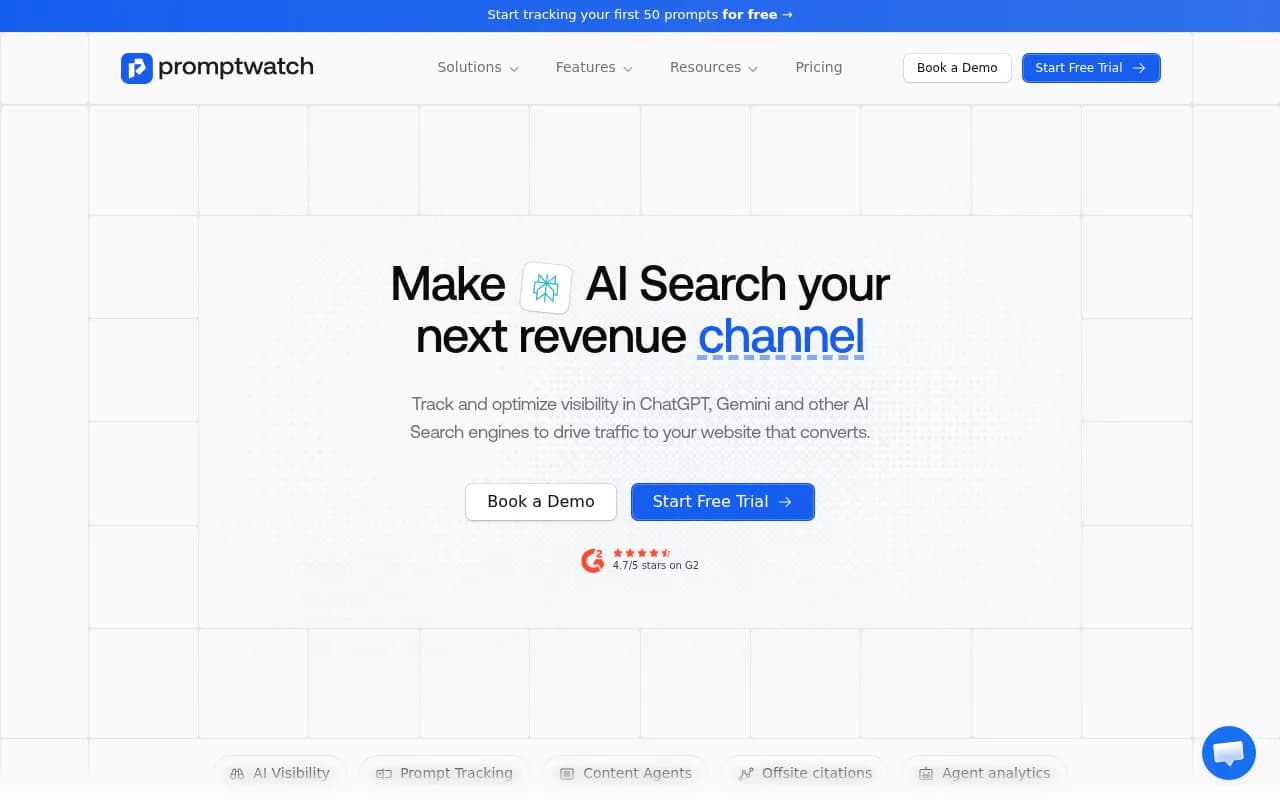
Promptwatch is an end-to-end AI search visibility platform built around one idea: monitoring alone isn't enough. It tracks how brands appear across ChatGPT, Perplexity, Gemini, Claude, Grok, DeepSeek, Copilot, Mistral, Meta AI, and Google AI Overviews -- then gives you tools to actually improve that visibility. That means content gap analysis that shows which prompts competitors rank for and you don't, AI content agents that generate articles and briefs grounded in real prompt data, and crawler logs that show exactly when and how AI bots are hitting your site. It's used by brands like Booking.com, Duolingo, Typeform, and Shutterstock, and has processed over 4.5 billion citations and prompts.
Search Party
Search Party is an AI visibility monitoring platform with a clear agency focus. It tracks brand citations across major LLMs and packages that data into white-label reports that agencies can share with clients. The pitch is clean: give your clients a dashboard showing how they appear in AI search, without building the infrastructure yourself. It's a solid monitoring tool for agencies that need to show AI visibility data to clients. What it doesn't do is help you change that data -- there's no content generation, no gap analysis, no crawler logs.
Side-by-side comparison
| Feature | Promptwatch | Search Party |
|---|---|---|
| Starting price | $99/mo | $95/mo |
| Free tier | Yes (50 prompts) | Yes |
| AI models monitored | 10+ (ChatGPT, Perplexity, Gemini, Claude, Grok, DeepSeek, Copilot, Mistral, Meta AI, Google AI Overviews) | Major LLMs (exact list less documented) |
| Content gap analysis | Yes | No |
| AI content generation | Yes (articles, listicles, comparisons, briefs) | No |
| Crawler logs / agent analytics | Yes | No |
| White-label reporting | Agency tier | Yes (core feature) |
| Prompt volume & difficulty scoring | Yes | No |
| Reddit & YouTube tracking | Yes | No |
| ChatGPT Shopping tracking | Yes | No |
| Offsite citation analysis | Yes | No |
| Multi-language / multi-region | Yes | Limited |
| API access | Yes | Limited |
| G2 rating | 4.7/5 | Not widely reviewed |
| Target audience | Marketing teams, SEO teams, agencies, brands | Digital agencies |
Head-to-head feature deep-dive
Monitoring and prompt tracking
Both tools track brand mentions across AI search engines, but the depth differs significantly.
Promptwatch runs prompts against real user-facing AI interfaces, not just API calls. That distinction matters because what ChatGPT shows a real user can differ from what the API returns -- shopping carousels, citations, and recommendations can all vary. It also tracks prompt volume and difficulty scores, so you can prioritize which prompts are worth winning. Query fan-outs show how one prompt branches into sub-queries, which is genuinely useful for understanding how AI models interpret a topic.
Search Party tracks brand citations and surfaces that data in dashboards. It's functional monitoring -- you'll see where your brand appears and where it doesn't. But there's no prompt difficulty scoring, no volume estimates, and no query fan-out analysis. You get the what, not the why or the how-to-fix-it.
Verdict: Promptwatch's monitoring is deeper and more actionable. Search Party covers the basics.
Content optimization and gap analysis
This is where the two tools diverge most sharply.
Promptwatch has a full content workflow. Answer Gap Analysis identifies the specific prompts where competitors are visible and you're not -- not just "you're missing coverage on topic X" but the actual prompts, with volume data, that AI models are answering using your competitors' content. From there, Content Agents generate articles, listicles, comparison pages, and briefs grounded in that prompt data. The briefs include brand guidance, search results context, news, screenshots, and competitor analysis. It's not a generic AI writer -- it's content engineered around the specific gaps AI models are exposing.
Search Party has none of this. It's a monitoring tool. If you want to act on the data it surfaces, you're on your own.
Verdict: Promptwatch wins outright. Search Party doesn't compete here.
Crawler logs and agent analytics
Promptwatch logs AI crawler activity in real time -- which pages ChatGPT, Claude, Perplexity, and others are reading, how often they return, what errors they encounter, and when a page moves from "crawled" to "cited." You can connect via Cloudflare, Fastly, Vercel, server logs, Google Search Console, or a tracking snippet. This is genuinely useful for diagnosing why certain pages aren't getting cited despite good content.
Search Party doesn't offer crawler logs or agent analytics at any tier.
Verdict: Promptwatch only. This is a meaningful gap if you care about understanding how AI engines discover your content.
Agency and white-label features
Search Party was built for agencies. White-label reporting is a core feature, not an add-on. If you're an agency that needs to hand clients a branded PDF or dashboard showing their AI visibility, Search Party is designed for exactly that workflow.
Promptwatch has an agency tier with custom pricing, and agencies do use it (Monks, IO Digital, and others are listed as customers). But its white-label capabilities are less prominently featured than Search Party's. Where Promptwatch wins for agencies is in what you can actually deliver to clients: not just a visibility report, but a content plan, gap analysis, and measurable improvement over time.
Verdict: Search Party has the edge on white-label reporting polish. Promptwatch has the edge on what agencies can actually do for clients.
AI model coverage
| AI model | Promptwatch | Search Party |
|---|---|---|
| ChatGPT / OpenAI | Yes | Yes |
| Perplexity | Yes | Yes |
| Google Gemini | Yes | Yes |
| Google AI Overviews | Yes | Unclear |
| Google AI Mode | Yes | Unclear |
| Claude (Anthropic) | Yes | Yes |
| Grok (xAI) | Yes | Unclear |
| DeepSeek | Yes | Unclear |
| Copilot (Microsoft) | Yes | Unclear |
| Meta AI / Llama | Yes | Unclear |
| Mistral | Yes | Unclear |
Promptwatch publicly documents 10+ models. Search Party's exact coverage is harder to verify from public sources.
Verdict: Promptwatch has broader, more transparent model coverage.
Reddit, YouTube, and offsite citations
Promptwatch tracks which Reddit threads, YouTube videos, and third-party pages AI models are citing in their responses. This matters because AI models heavily reference Reddit discussions and YouTube content -- if those sources are shaping AI answers in your category, you need to know about it. Promptwatch also tracks offsite brand mentions and listicles that drive AI visibility outside your own site.
Search Party focuses on owned-brand monitoring and doesn't surface Reddit or YouTube citation data.
Verdict: Promptwatch only. This is a channel most monitoring tools ignore.
Pricing comparison
| Plan | Promptwatch | Search Party |
|---|---|---|
| Free tier | 50 prompts, 1 site | Free tier available |
| Entry paid | $99/mo (Essential: 1 site, 50 prompts, 5 articles) | $95/mo |
| Mid tier | $249/mo (Professional: 2 sites, 150 prompts, 15 articles, crawler logs) | Not publicly documented |
| Higher tier | $579/mo (Business: 5 sites, 350 prompts, 30 articles) | Not publicly documented |
| Agency / Enterprise | Custom pricing | Custom pricing |
| Annual discount | Yes | Unclear |
Search Party's pricing beyond the entry tier isn't clearly published, which makes direct comparison difficult. Promptwatch's pricing is fully transparent on its website.
At the entry level, the $4/mo difference is irrelevant. The real pricing story is that Promptwatch's mid and higher tiers include content generation and crawler logs -- capabilities Search Party doesn't offer at any price. If you need those features, Promptwatch is the only option regardless of price.
Pros and cons
Promptwatch
Pros:
- Full optimization loop: monitoring, gap analysis, content generation, and tracking in one platform
- Crawler logs show exactly how AI bots interact with your site
- Tracks 10+ AI models with transparent coverage documentation
- Prompt volume and difficulty scoring helps prioritize effort
- Reddit and YouTube citation tracking
- ChatGPT Shopping and entity tracking
- Strong customer base with recognizable brands (Duolingo, Typeform, Booking.com)
- 4.7/5 on G2
Cons:
- More expensive at higher tiers ($249-$579/mo)
- White-label reporting is less of a focus than Search Party
- Can feel like a lot of platform if you only need basic monitoring
- Dutch company -- some enterprise buyers may prefer US-based vendors
Search Party
Pros:
- Built specifically for agencies with white-label reporting as a core feature
- Slightly cheaper entry point ($95/mo vs $99/mo)
- Clean, focused product for monitoring and client reporting
- Free tier available
Cons:
- No content gap analysis
- No AI content generation
- No crawler logs or agent analytics
- No Reddit or YouTube citation tracking
- No prompt volume or difficulty scoring
- Model coverage not clearly documented
- Limited independent reviews make it harder to validate quality
- Monitoring-only approach means you can see problems but not fix them within the platform
Who should pick which tool
Pick Promptwatch if:
- You want to actually improve AI visibility, not just measure it
- You need content gap analysis to know what to write
- Crawler logs and agent analytics matter to your workflow
- You're tracking across many AI models including newer ones like DeepSeek, Grok, and Mistral
- You want Reddit and YouTube citation data
- You're an agency that wants to deliver measurable results to clients, not just dashboards
- You need ChatGPT Shopping or entity tracking
Pick Search Party if:
- You're an agency whose primary deliverable is white-label client reports
- You need basic AI visibility monitoring without the complexity of a full optimization platform
- Budget is tight and you only need the entry-level feature set
- Your clients just want to see a branded dashboard showing AI citation data
Final verdict
These two tools are solving different problems. Search Party is a reporting tool that happens to track AI visibility. Promptwatch is an optimization platform that includes reporting as one part of a larger workflow.
If you're an agency whose value proposition is "we show you how you appear in AI search," Search Party works. But if your value proposition is "we improve how you appear in AI search," you need the content gap analysis, AI content generation, and crawler logs that only Promptwatch provides. The $4/mo price difference at entry level is meaningless -- the real question is whether you need a dashboard or a system that actually moves the needle.
For most marketing teams and serious SEO practitioners in 2026, Promptwatch is the more complete tool. Search Party is a niche fit for agencies that prioritize white-label reporting above everything else.
If you're also evaluating how your brand shows up in AI search results more broadly, Promptwatch is worth exploring as the platform that goes furthest from tracking to actual optimization.