Key takeaways
- Promptwatch Data found ads in an average of 20.1% of ChatGPT responses between May 20 and Aug 17, 2026, so competitors you never noticed are probably already bidding on your prompts.
- Competitor ads give you three things to study: the copy, the exact claims, and where the click lands. Copy the patterns, not the wording.
- Record claims verbatim. A rounded or paraphrased discount or speed figure becomes something your competitor never actually said.
- Landing page message match matters more here than in classic search, because visitors arrive from a conversation with a specific question.
- Much of the advice circulating on conversation-aware landing pages is unverified. Test it before you build around it.
Why competitor ads are worth studying now
ChatGPT served no ads at all in Promptwatch's tracked data until May 27, 2026, when they showed up in 1.69% of responses. After a jump past 30% on July 1, the daily rate mostly sat between the low 20s and high 30s, with peaks of 43.9%. The 90-day average was 20.1%. Those figures come from Promptwatch Data's ChatGPT Ads Over Time report, which only counts responses where ChatGPT searched the web, returned at least one citation and finished ad extraction.
The channel is young, nobody has years of benchmarks, and everyone's creative is visible to anyone who runs the right prompts. That makes competitor observation unusually useful. You are not trying to clone anyone. You are trying to learn what the market currently believes works.
One caveat before we start. I am not going to invent specific competitor ads for you. What follows are patterns to look for, and a method for collecting your own evidence.
What a ChatGPT ad actually contains
Per OpenAI's Help Center, ads appear below ChatGPT responses and include an advertiser name, a favicon, a title, a description, a landing page and an image asset. That is a small canvas, so every element competitors choose carries weight.
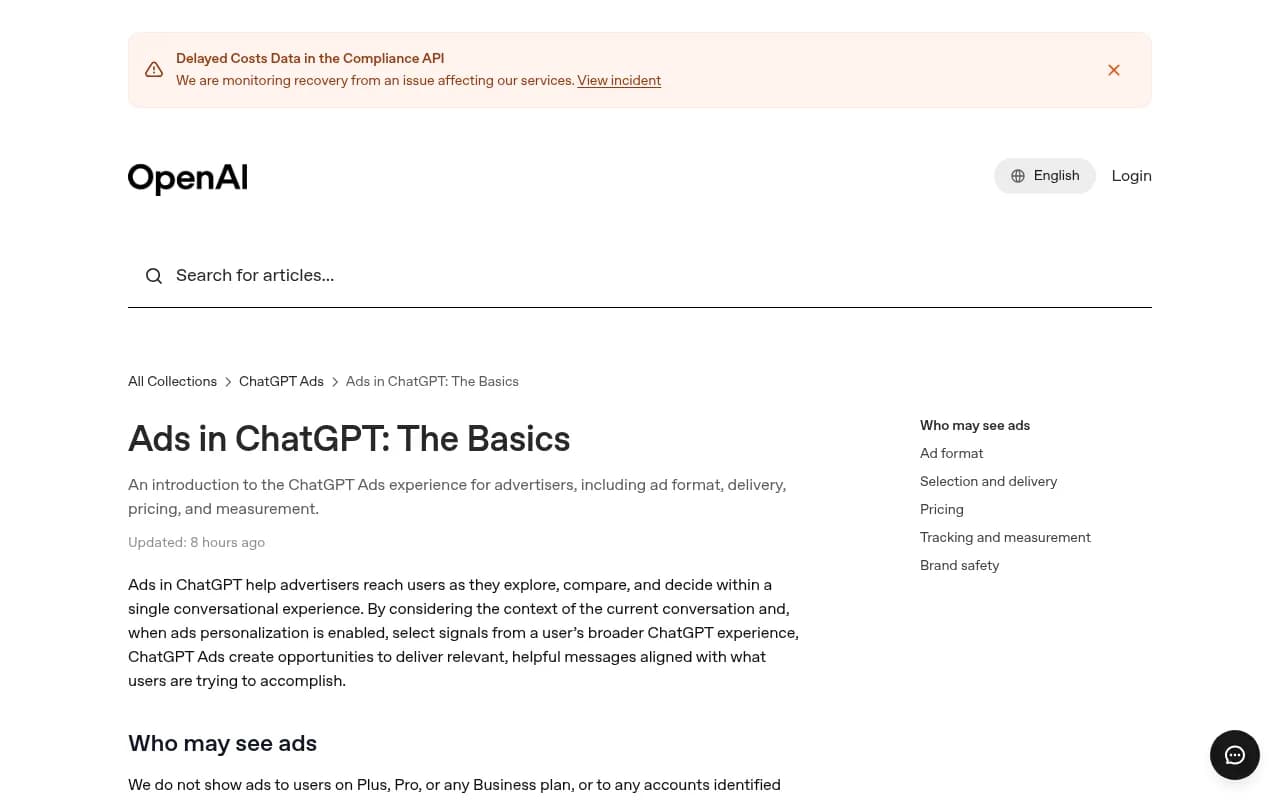
OpenAI also says its system picks ads using the context and intent of the conversation, the ad's landing page, title and copy, and advertiser-provided context hints. Those hints are not exact-match keywords and don't guarantee delivery. Two things follow. Your competitor's landing page is part of how the ad gets matched, so it is worth reading closely. And the topics they chose to hint at are partly visible from the prompts where their ads show up.
Ads are not shown to Plus, Pro or Business plan users, or to accounts identified as under 18, so what you see reflects only the free-tier audience.
How to collect competitor ads without guessing
Before the seven lessons, you need data. Running a few prompts by hand and screenshotting is fine for a first look. For anything more systematic, there are two problems: a single run can land on an outlier day, and the ad mix differs by prompt type.
Promptwatch Data's breakdown of ad-bearing responses (7-day average) was roughly 73% organic prompts, 18% brand-specific prompts and 9% competitor-comparison prompts. That mix reflects prompt volume rather than how likely each type is to trigger an ad, so don't read it as a targeting recipe. It does tell you to check each segment separately, because the advertisers on a comparison prompt can differ from those on a generic one.
A workable collection routine:
- List 20 to 50 prompts your buyers actually use, split into organic, brand-specific and competitor-comparison.
- Run them across several days, not once.
- Log the advertiser, headline, description, image and destination URL for every ad.
- Save the landing page as it looked that day. Pages change.
Promptwatch is an AI visibility platform that says it can show which advertisers appear on your tracked ChatGPT prompts, what they promote and where the ads send visitors, through its Ads Radar. I haven't tested that claim myself, so verify it on your own prompts.

If you want to compare options, the AI rank tracking directory lists other tools in the category.
1. Read the promise each ad makes
Group the ads you collect by the promise they make to the buyer. Kite's competitor research guide describes the same idea: sort ads by promise, such as a discount, trial length, guarantee or a speed claim. Tally the buckets.
If eight of ten ads on a prompt lead with a free trial, a free trial is table stakes and not a differentiator. If nobody mentions a guarantee, that could be a gap or it could be a claim nobody can legally support. Either way you learn something about where the crowd is.
2. Keep claims word for word
When you log a claim like "2x faster" or "save 30%", write down the exact wording and the conditions. Kite makes this point well: a rounded or paraphrased figure becomes a claim the competitor never made. That matters twice over. You don't want to misrepresent a rival in your own comparison content, and you don't want to copy a claim you can't substantiate.
Compare claims against evidence on the destination page. Does the landing page back up the headline number with a source, a footnote or a case study? An ad that promises something its page doesn't prove is a weakness you can exploit honestly by proving your own claim.
3. Check whether the copy sounds like a conversation
Some advice circulating says ad copy should feel like it is responding to what the user just discussed, not dropping in generic promotional language. AdVenture Media's guide argues this at length. It is a reasonable instinct. A tinted box under a detailed answer about project management for remote teams reads oddly if it says "Best software. Sign up today!"
When you review competitor ads, mark each as one of three types: generic promo, topic-specific, or situation-specific (it names the use case, team size or constraint). The situation-specific ones are the ones to study. They show which user scenarios competitors think are worth paying for.
4. Note which prompts attract which advertisers
Look at who shows up on comparison prompts versus informational ones. Brands that bid on competitor-comparison conversations are making a statement about who they think they replace. Brands absent from those prompts may be conceding the territory, or may simply not have been matched.
This is also where your organic work and paid work meet. If you already appear in the AI answer above the ad, your messaging can lean on proof. If you don't, the ad is doing all the work. You can see your organic presence with a visibility tracker, and the GEO software directory is a good place to compare them.
5. Audit the landing page behind the click
This is where most of the learning is. The ad is 30 words. The page is the real argument.
Digital Ink's guide lists what to look at on a ChatGPT ad landing page: clear headline, strong message match with the ad, fast load, mobile usability, relevant proof, focused calls to action, short forms and content that answers likely objections. Turn that into a scoring sheet and rate every competitor page from 0 to 2 on each.
| Check | What to look for | Red flag |
|---|---|---|
| Headline | Repeats the situation named in the ad | Generic brand slogan |
| Message match | Ad promise appears above the fold | Promise buried or absent |
| Proof | Named customers, numbers with sources | Unsourced superlatives |
| Form length | Short, or none for first step | Long lead-capture form |
| Objections | Pricing, limits, comparisons addressed | Only benefits listed |
| Speed and mobile | Loads fast, readable on a phone | Heavy page, tiny tap targets |
A generic homepage as the destination for a very specific ad is the most common mistake to look for. Digital Ink says it plainly: a specific ad sent to a broad homepage loses relevance quickly.
6. Look for dedicated pages per context
Check whether competitors send different ads to different pages or push everything to one URL. Carnegie's higher ed guidance recommends dedicated or segmented landing pages for ChatGPT campaigns, and that is a sensible default. A prospective graduate student and an adult learner asking the same assistant very different questions should not land on the same page.
Here is where I'd be careful. The AdVenture Media piece claims that 8 to 12 landing page configurations cover most conversation contexts, that matching content depth to conversation depth lifts conversions 40 to 60%, and that you can customize pages from conversation context in UTM parameters. None of that is sourced, and I could not verify that OpenAI passes conversation context through UTMs at all. OpenAI's help page only says you can append UTM parameters to landing page URLs for tracking. Treat the specific numbers as hypotheses to test, not benchmarks.
What is safe to do: build a handful of pages around your actual top use cases, tag every ad with distinct UTMs, and compare. Competitor URLs can give you a hint, since many advertisers leave their own UTM structure visible in the link.
7. Study how rivals handle comparison intent
Some advertisers build pages that outline how they differ from named alternatives. If you find one, read it as a competitor would. Is the comparison honest and dimension-by-dimension, or a pile of check marks? Pages that read as objective tend to survive scrutiny from a skeptical reader who just asked an AI for an unbiased answer.
If competitors have no comparison page at all, that is an opening. Build one that states trade-offs plainly, including where the rival is better. A reader who just spent ten minutes asking for balanced advice will notice the difference.
Putting it together
| Lesson | What you collect | What you do with it |
|---|---|---|
| Promise | Discounts, trials, guarantees | Find what is table stakes |
| Claims | Exact wording and conditions | Substantiate or avoid |
| Conversational copy | Generic vs situation-specific | Write to a real scenario |
| Prompt mapping | Which advertisers on which prompts | Pick segments to contest |
| Landing audit | Scored checklist | Fix your weakest element |
| Page per context | Number of distinct destinations | Build a few, then test |
| Comparison intent | Presence and honesty of comparison pages | Publish a fair one |
Measurement caveats
ChatGPT ads are new, and attribution is immature. Carnegie describes early campaigns as learning pilots, since mature attribution, granular targeting and historical benchmarks are still developing. OpenAI's own page lists impression billing, click billing and conversion-optimized campaigns, with oCPC charging for valid clicks rather than conversions. Set expectations accordingly: judge early tests on engagement and landing page behavior, not on a clean ROAS number.
One more thing worth knowing. A Trilogi post reports that since 30 October, ChatGPT ads can rewrite your copy, translate it, adjust images and change the landing page unless you review your settings. I haven't confirmed the details, but if it is true, the ad a user sees may not be the one you wrote. Check your account settings, and remember that competitor ads you collect might also have been altered by the platform.
Don't forget the unpaid side
Paid placements sit next to organic citations. Promptwatch Data's citation share by content type report found product pages were the most cited type in ChatGPT, at 22.4% of citations from Sep 28 to Oct 4, 2026, followed by landing pages and listicles. The pages you build for ads can double as pages worth citing, so keep them factual and crawlable. Promptwatch's crawler logs can show whether AI bots can actually read them.
If you want help building a combined paid and organic AI search plan, 1001 SEO Media, the agency behind this site, works on generative engine optimization alongside traditional SEO.
A simple weekly routine
- Monday: run your prompt set and log new ads.
- Tuesday: diff landing pages against last week's saved copies.
- Wednesday: update your claims table and flag anything you can't match honestly.
- Thursday: ship one change to your own ad or page.
- Friday: review engagement, not just clicks.
Competitor ads won't hand you a winning formula. They will show you what the market is saying, what it is proving and what it is ignoring, and the gap between those three is where your own ads should go.