Key takeaways
- Headlines about negative AI sentiment (BBB, Glassdoor) measure how people feel about AI as a topic. They say nothing about how AI engines describe your brand.
- Reviews are a small slice of what AI cites: 1.7% of ChatGPT citations overall, though 5.6% on branded prompts. Great scores on one review site may barely register.
- The sources behind AI answers shift fast and differ by engine, so diagnose ChatGPT, AI Overviews and Perplexity separately.
- The usual causes of a disconnect are stale or thin owned pages, review sites AI doesn't read, old third-party content, and claims AI repeats that your own site never corrects.
- Fix it by tracking individual claims, tracing the pages behind them, and publishing content that answers the branded questions buyers actually ask.
Two different sentiment problems
Search for "AI sentiment negative" in 2026 and you will find a pile of studies. Read them before you panic, because most of them are about something else.
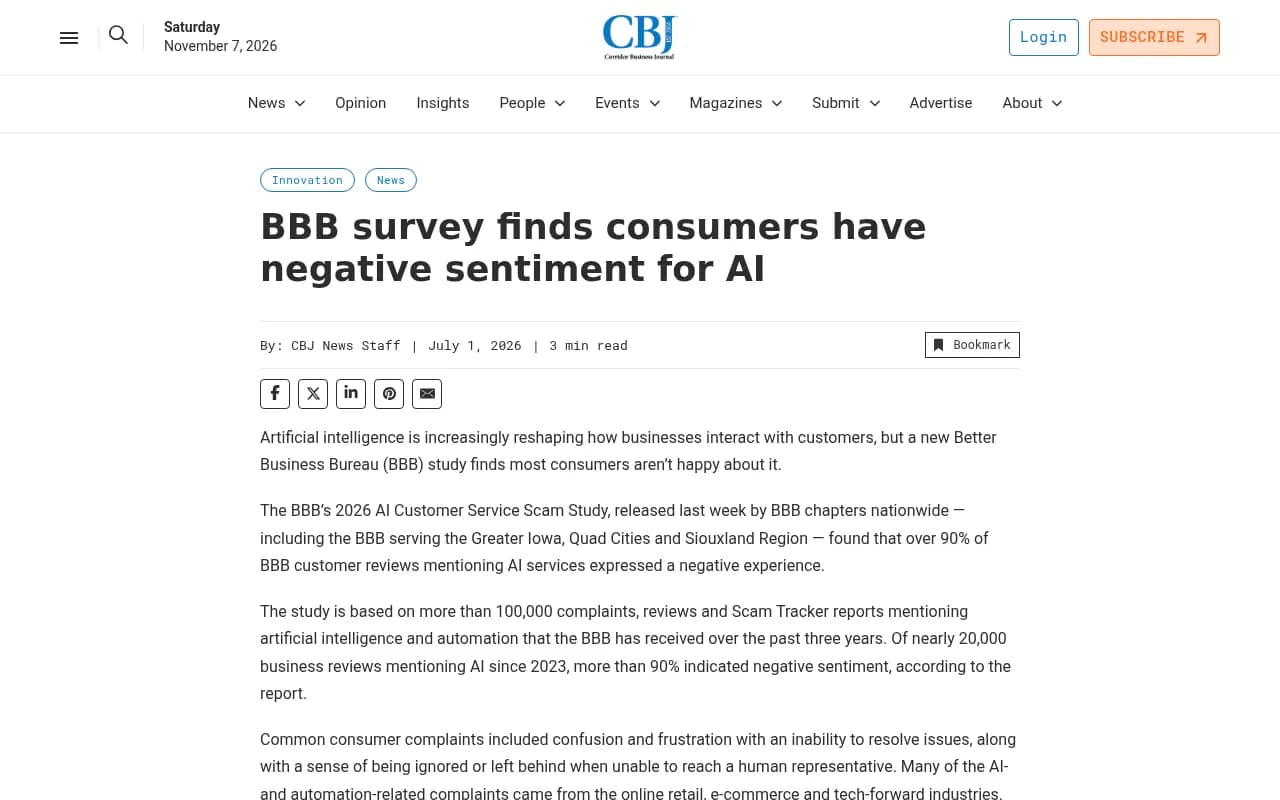
The BBB's 2026 AI Customer Service Scam Study, reported on July 1, 2026, looked at nearly 20,000 business reviews mentioning AI since 2023. More than 90% were negative. Common complaints were being unable to resolve an issue and being unable to reach a human. A HubSpot and SurveyMonkey poll cited in the same report found 82% of people prefer to connect with a human.
Glassdoor's 2026 report found a similar shift among employees. AI mentions in reviews rose 240% from May 2025 to May 2026. Reviews mentioning AI only as a pro dropped from 81% in 2019 to 43% in 2026, while 53% now mention it only as a con. Mixed reviews held steady at 4%.
Those are real signals. But they are sentiment toward AI as a topic: AI customer service bots, AI at work. They are not the sentiment AI engines express about your brand when someone asks "is [your company] any good?"
That second problem is the one this guide is about. It looks like this: your G2, Trustpilot or Google reviews average 4.7, your support team gets thanked by name, and yet ChatGPT answers a branded question with "some users report limited integrations and unclear pricing." Nobody on your team wrote that. Nobody can see where it came from.
Keep the two straight, because they point to different fixes. If your own reviews mention AI negatively, that is a customer service issue (a chatbot with no escape hatch to a human is the classic one). If AI engines describe you poorly, that is a visibility and content issue.
Why great reviews don't automatically become great AI answers
The intuition is reasonable. Reviews are the closest thing to ground truth, so surely the model uses them. In practice the picture is messier.
Promptwatch Data looked at what ChatGPT cites, Sep 28 to Oct 4, 2026 (citation share by content type). Reviews were 1.7% of all classified citations. Product pages were 22.4%, landing pages 16.8%, listicles 13.6%. Product and landing pages together are 39% of citations, editorial formats 43%.
So across all prompts, a review page is a rounding error. That is the first reason for a disconnect: the place where your praise lives is not where the model mostly looks.
Branded prompts change this somewhat. For questions like "is X good for startups", the same report shows:
- Product pages 23.3% and landing pages 22.8% of citations
- Reviews up to 5.6%, more than three times their overall share
- Social posts at 3.0%, almost four times their overall share
- FAQ pages at 4.8% and press releases at 2.1%
Reviews matter more when someone asks about you by name. Still, over 45% of citations on those prompts are your own product and landing pages. If those pages are vague, outdated or silent on pricing, the model fills the gap from whatever else it finds.
A second reason is breadth. Promptwatch Data found almost half of ChatGPT responses cite 10 or more unique domains (unique domains per response). One glowing review profile is a single voice among many. A two-year-old forum thread or a comparison listicle from a competitor can outweigh it simply by being in the mix.
Check each engine separately
Don't assume what you see in ChatGPT is what Google shows. Sources diverge sharply.
Promptwatch Data for Sep 28 to Oct 4, 2026 (social media citations by AI model):
| Engine | Share of citations from social platforms | Notable detail |
|---|---|---|
| ChatGPT | 0.46% | LinkedIn is the top social platform at 0.3% |
| Perplexity | 2.7% | LinkedIn and Reddit tie at 0.86% |
| Google AI Overviews | 12.2% | YouTube 4.28%, Facebook 2.38%, Reddit 2.15% |
AI Overviews leans on social at about 26 times ChatGPT's rate. If a damaging Facebook post or YouTube review sits behind your poor sentiment, you may see it in Google and nowhere else.
The sources also move quickly. In Promptwatch's Reddit data, reddit.com held about 3.83% of ChatGPT citations from Jul 18 to Aug 7, 2026, then fell to roughly 0.52% on Aug 14 to 17. Promptwatch flags the size of that drop as provisional and says a data-collection issue can't be ruled out. Reddit also declined more gradually in AI Overviews (2.37% to 2.10%) and AI Mode (2.22% to 1.54%).
The practical lesson: a complaint thread that shaped your sentiment in July may not be doing so now. A snapshot is a photo, not a verdict. Re-measure on a schedule.
A diagnostic process for the gap
Here is the order I would work in. It is deliberately boring.
Step 1: Write down the claims, not the score
A sentiment number tells you something is off. It doesn't tell you what. Collect the actual statements AI makes about you across a set of branded prompts: pricing, support, ease of use, integrations, security, who you're for.
Group repeated claims. You will usually find two or three that recur. "Expensive for small teams." "Limited reporting." "Slow support." Those are the ones to chase.
Step 2: Test it against reality
For each claim, mark it accurate, inaccurate or outdated. This matters because the fix differs:
- Accurate: it is a product or service problem, and no content will make it go away honestly.
- Inaccurate: a page somewhere says the wrong thing, or nothing says the right thing.
- Outdated: you changed pricing or shipped the feature, but old pages still dominate.
Most disconnects live in the last two.
Step 3: Trace the source
Find which URLs AI cites when it makes the claim. Is it your own pricing page, a three-year-old review roundup, a competitor's comparison page, a Reddit thread, a YouTube video? The citation list is the closest thing you have to a paper trail.
Also check whether AI crawlers can read your site at all. A great pricing page that GPTBot is blocked from is a page that effectively doesn't exist. AI crawler logs separate an access problem from a content problem, and the free Agentic Readiness Check gives you a first look.
Step 4: Check your own pages for the cause
Open the page AI should be citing and ask honestly: does it answer the question in plain language? Branded prompts pull heavily from product pages, landing pages and FAQs. If your pricing page says "contact us" and a competitor's lists numbers, the model will quote the competitor's framing of you.
Step 5: Fix, then re-measure
Publish or update the page, then watch whether it gets crawled, cited and whether the claim changes. Expect days to weeks, not hours.
Fixes that actually move the needle
Promptwatch's advice from the content type data is straightforward, and I agree with it: make your own pages answer pricing, features and audience; collect reviews on the sites people trust in your category; add a plain-language FAQ.
Some specifics:
- Put pricing and limits in text. Tables are fine. "Talk to sales" gives AI nothing to quote.
- Write comparison and "who it's for" pages yourself. If you don't, someone else frames it.
- Add an FAQ that mirrors the objections in the claims you collected, in the words buyers use.
- Refresh old content. Promptwatch's content half-life data found landing pages and docs stay cited longest, while news loses half its pages within 36 days. Evergreen owned pages are worth the effort.
- Push reviews to the platforms your category trusts, not just one. For software prompts, Promptwatch Data shows GitHub, Microsoft's docs and G2 leading ChatGPT citations in Sep 28 to Oct 4, 2026, and documentation and help centers take the largest share.
- Pick channels by engine. Promptwatch's guidance: prioritise YouTube, Facebook and Instagram for AI Overviews, don't rely on Reddit threads to get into ChatGPT, publish on LinkedIn and Reddit for Perplexity, skip X.
If the complaint is about AI customer service specifically, ignore all of this and fix the bot. Give people a visible path to a human. The BBB data says that is the main thing customers want.
Tools for finding the disconnect
You need three capabilities: prompt-level tracking by engine, claim-level sentiment, and a citation trail. Plenty of tools cover the first; fewer cover all three.
Promptwatch is the one I would start with for this job, since it pulls individual claims AI makes about you (Brand Narrative), lets you mark them accurate or inaccurate (Fact Check, on Business and above), shows the cited pages, and then lets the Content Agent publish fixes and checks whether they worked. It also tracks real interfaces of ChatGPT, AI Overviews, AI Mode, Gemini, Perplexity and others, which matters given the engine differences above. Check pricing for current plans; the free AI visibility report is a no-login way to see a first snapshot.

Other options worth a look:

Waikay focuses on AI brand perception, which fits this problem closely.

LLM Pulse positions itself around visibility and reputation.

Profound is an enterprise monitoring option with a higher price point.

Peec AI is a lighter prompt tracker if you only need mention and sentiment basics.

Otterly.AI is an affordable monitoring option for smaller budgets.
If you manage reviews across many locations, review platforms like [tool:reputation-com] and [tool:birdeye-search-ai] cover the review side and some local AI visibility.
| Need | Tool type | Examples |
|---|---|---|
| Claim-level sentiment and fact checking | AI visibility platform | Promptwatch, Waikay |
| Basic mention and sentiment tracking | Prompt tracker | Peec AI, Otterly.AI |
| Enterprise monitoring | Visibility suite | Profound, Brandlight |
| Review and listing management | Reputation platform | Reputation.com, Birdeye |
| Fixing the content itself | Content tools | Promptwatch Content Agent, Surfer SEO |
For wider browsing, the GEO software directory at bestgeosoftware.com lists more options by category.
What to tell your team
A few lines that save a lot of meetings:
- Strong reviews and weak AI sentiment can both be true. They are measuring different inputs.
- Don't quote the BBB or Glassdoor numbers as evidence about your brand in AI answers. They are about AI as a topic.
- Measure by engine and by claim, and re-measure monthly. The sources move.
- Treat accurate negative claims as product feedback, and inaccurate or outdated ones as content bugs.
If you would rather hand the work to specialists, an agency like 1001 SEO Media, which publishes this site, runs GEO audits and content programs for exactly this kind of gap.
Start with ten branded prompts, write down what each engine says, and find the page behind the first wrong claim. That single trace usually tells you what to fix first.