Key takeaways
- Brand-level mention tracking tells you very little. Page-level tracking tells you which URLs get cited, for which prompts, and how long they stay cited.
- Promptwatch data shows content type matters by prompt intent: product pages lead ChatGPT citations at 22.4%, but branded prompts reward reviews and FAQs more than average.
- Cited pages decay at different speeds. News loses half its pages within 36 days, while landing pages and docs stay cited for 90 days or more.
- A good platform connects citations to crawler logs, traffic, and a way to fix gaps. Monitoring-only tools stop one step short.
- Test any tool on four things: cited URL lists, source position, per-page history, and prompt-level detail.
Why page-level tracking matters
Most AI visibility dashboards open with a score. Your brand got a 42, up three points. Fine. But what do you do with that on a Tuesday morning?
You can't edit a score. You can edit a page. The useful question is which of your URLs AI engines cite, which prompts trigger them, and which competitor pages show up instead. That is page-level tracking, and it is what separates a dashboard you look at from one you act on.
There is also a measurement reason. AI answers are crowded. Promptwatch Data found that 47.6% of ChatGPT responses with citations cite 10 or more unique domains (Sep 28 to Oct 4, 2026). One response tells you almost nothing. You need many prompts, tracked daily, with the cited URLs attached.
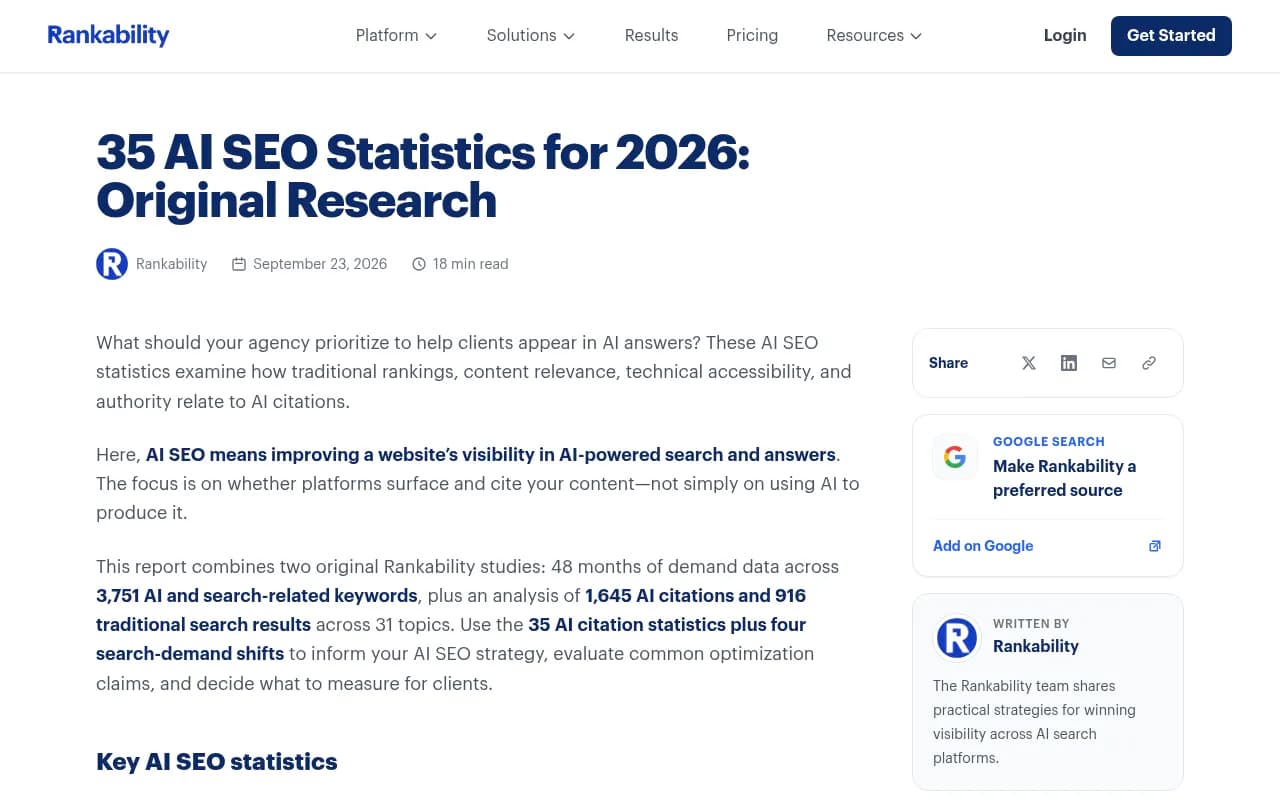
And the sources are not what classic SEO would predict. Rankability's 2026 study of 1,645 AI citations found 72.8% of AI-cited pages had no page-level referring domains, and 55.2% of top-10 AI citations did not rank in the traditional top 10. I haven't verified their methodology independently, but the direction matches what we see elsewhere: backlink-heavy pages are not automatically the cited ones. You have to look at the pages themselves.
What page-level tracking actually includes
Tools use the phrase loosely. Some mean a list of domains that were cited. Others mean full per-URL history. Here is what a real page-level setup should give you.
Cited URL lists per prompt
For every tracked prompt, you want the exact URLs in the answer, not only the domain. Your homepage being cited is a different situation from your pricing page being cited.
Source position
Where your URL lands in the source list matters. Being the fourth of twelve sources is not the same as being the first. Track position alongside the citation itself.
Per-page citation history
When was the page first cited, when did it peak, and is it decaying? Without history you can't tell a lucky one-day citation from a durable one.
Competitor and third-party pages
You also want to see which competitor URLs and third-party pages (Reddit threads, review sites, listicles) are cited next to yours. Those are your outreach and content targets.
Crawler and traffic data
A citation is the middle of the story. Did the AI crawler actually fetch the page? Did anyone click through? Platforms that join crawls, citations, and visits per page let you diagnose why a page isn't cited, not just that it isn't.
What the data says about which pages get cited
Page-level tracking is only useful if you know what to look for. Promptwatch's first-party data gives a baseline.
Content type by prompt intent
From Promptwatch's content type report (Sep 28 to Oct 4, 2026), ChatGPT citations split like this overall: product pages 22.4%, landing pages 16.8%, listicles 13.6%, how-tos 8.7%, docs 7.5%, general articles 6.1%, comparisons 5.9%, news 5.7%, FAQ pages 3.3%, and reviews 1.7%.
The mix shifts by intent:
| Prompt intent | Top cited types | Notable detail |
|---|---|---|
| Commercial | Product 26.0%, landing 20.6%, listicles 15.0%, comparisons 7.9% | Those four types are almost 70% of citations |
| Informational | Product 19.1%, landing 13.9%, listicles 13.6%, how-tos 10.7% | Docs at 8.5% and articles at 7.7% matter more here |
| Branded | Product 23.3%, landing 22.8% | Reviews at 5.6%, over three times their overall share |
The practical consequence: a tracker that only reports "your blog got cited" hides the pattern. You need content type per prompt intent, per URL.
How long cited pages stay cited
Promptwatch's half-life study followed every page ChatGPT cited on July 6, 2026 for 90 days. Landing pages kept 78% of their citations at 30 days and 69% at 60 days. Docs held 76% and 67%. Comparisons held 72% and 63%. Product pages, reviews, and how-tos sat near 55% at day 60, with half-lives of 74 to 77 days. News was the outlier: half its pages were gone after 36 days.
So refresh cadence should depend on type. Press and news coverage is a short burst. Landing pages and docs are long-term assets that still deserve a check every quarter.
Position and description
Because answers cite so many domains, being present is a low bar. Track where you are placed and how the answer describes you. A page cited last and described neutrally is doing less than one cited early with a recommendation.
How to evaluate platforms: a checklist
When you demo any tool, ask to see these on live data, not in a slide deck.
- Can I export every cited URL for a prompt, with position?
- Does it track real interfaces (ChatGPT, AI Overviews, AI Mode, Perplexity, Gemini) or only API output? The two can differ.
- Can I see one page's citation history over time?
- Does it separate prompts by intent (organic, branded, competitor comparison)?
- Does it show AI crawler visits and whether the page was fetched?
- Can it tie citations to actual visits and conversions?
- What happens after the diagnosis? Is there a content workflow, or do I export a CSV and start over?
Also check engine coverage. Some tools are explicit about gaps. GrowByData's Compass, for example, tracks ChatGPT, Perplexity, AI Overviews, and AI Mode but, per its own guide, not Microsoft Copilot. That's fine if you know it up front.
Platforms worth comparing
The category is crowded. Here is how the main options line up on the page-level question specifically. Capabilities change fast, so confirm details on each vendor's site before buying.
| Platform | Page-level strength | Gap to check |
|---|---|---|
| Promptwatch | Cited pages, source rank, Citation Trends per page, crawler logs, visitor analytics, Page Tracker, content agent | Larger feature set than a small team may need |
| Profound | Deep enterprise monitoring and analytics | Higher price point, less on execution |
| Peec AI | Clean prompt and visibility tracking | Lighter on crawler and traffic data |
| Otterly.AI | Affordable brand monitoring | Basic tracking, narrower page-level depth |
| Ahrefs Brand Radar | Brand tracking next to a large SEO dataset | Fixed prompt sets, no crawler logs |
| Semrush AI Visibility Toolkit | AI tracking inside a familiar SEO suite | Shallower AI-specific data |
| Passionfruit | Citation tracking tied to revenue attribution | Check engine coverage |
| Trakkr | Traces AI visitors to revenue | Check citation-level depth |
Promptwatch
Promptwatch is the one I'd start with if page-level work is the goal, mostly because it covers the full chain. It tracks citations from the real interfaces of ChatGPT, AI Overviews, AI Mode, Gemini, Perplexity, and others, shows where each of your URLs lands in the source list, and classifies every citation by content type and source type with first-cited date, peak, and decay. IP-verified crawler logs show whether AI bots actually fetched the page. Visitor analytics show what traffic follows. Then the Action Board and Content Agent turn gaps into drafts, and published pages get tracked again for crawls, citations, and clicks.

The Page Tracker is worth a mention for this topic specifically: point it at any URL, yours or a competitor's, and see which prompts cite it. Pricing starts with a free Explore plan (ChatGPT only) and paid plans from $95/month; confirm current details at promptwatch.com/pricing.
Profound
Profound is a strong monitoring product aimed at enterprises, and many AI visibility roundups treat it as a benchmark. It tends to sit at a higher price, and the focus is analysis rather than executing the fixes.

Peec AI and Otterly.AI
Both are approachable trackers with fast setup. Good for a first look at prompts and brand presence. If your goal is per-URL history, crawler evidence, and traffic attribution, test those specifics before committing.


Ahrefs Brand Radar and Semrush
If your team already lives in these suites, the AI tracking add-ons are convenient. The tradeoff is that the AI-specific data is usually shallower than in dedicated platforms.

Revenue-focused options
Passionfruit and Trakkr lean toward connecting AI visits to revenue, which is the right instinct. Ask each how they handle URL-level detail.
For a broader sweep, the GEO software directory at bestgeosoftware.com lists far more options than fit here. Third-party roundups like the SlateHQ and Track My Visibility lists are also worth skimming for alternative takes, though remember that vendors write many of them.
A workflow for using page-level data
Having the data is half of it. Here is a routine that works.
Week 1: baseline
Build a prompt set across three intents: organic category questions, branded questions, and competitor comparisons. Run it daily across the engines your buyers use. List every one of your cited URLs and note content type.
Week 2: find the gaps
Split prompts into three buckets. Prompts where you are cited with the right page, prompts where you are cited with a weak page (a blog post when a product page should win), and prompts where you are absent. The third bucket is your content backlog. The second is often faster to fix.
Week 3: check access
For pages that should be cited but aren't, check crawler logs. If AI bots hit errors, or never visit, no amount of rewriting helps. Fix robots rules, rendering, or redirects first. A weekly site audit catches many of these.
Week 4 onward: refresh by type
Use the half-life data. Re-check news and press pages monthly and treat them as bursts. Review landing pages, docs, and comparisons quarterly. When a page decays, compare it against the competitor pages now being cited and update the specifics: pricing, features, dates, evidence.
Measure outcomes
Track clicks and conversions from AI referrals per page, not only citations. A page cited often but never clicked might be answering the question too completely in the AI summary. That is a finding too.
Common mistakes
- Reading single-response results as truth. Answers vary run to run, so rely on daily trends across many prompts.
- Tracking only the domain. You'll miss that the wrong page is carrying your visibility.
- Ignoring third-party pages. AI often cites review sites, listicles, and forums about you. Those are part of your page-level picture.
- Treating correlation as causation. Rankability itself notes its findings describe relationships, not proof that changing one element causes a citation.
- Buying a tracker with no path to action. If the platform can't help you write, publish, and re-measure, you're paying for a very expensive report.
Which should you pick?
If you only need a quick read on whether your brand shows up, a lightweight tracker is enough. If you need to know which pages are cited, why others aren't, and what traffic follows, choose a platform with citation analytics, crawler logs, and visitor data in one place. Run a two-week trial with the same prompt set on your top two candidates and compare how many of your cited URLs each surfaces. That test will tell you more than any feature list.
For more category comparisons, AI rank tracking tools is a useful directory. And if you'd rather have a team run the program, agencies like 1001 SEO Media handle GEO and AI search work alongside traditional SEO.