Trakkr Review 2026
Monitors brand visibility across 8 AI platforms and traces traffic from AI assistants through to measurable revenue outcomes.
Key takeaways
- Trakkr is a genuinely well-built AI visibility tracker with unusually broad model coverage (ChatGPT, Claude, Gemini, Perplexity, Grok, Meta AI, DeepSeek, and Google AI Overviews) and a refreshing commitment to publishing its methodology and raw data openly.
- Its GA4 revenue attribution is the standout feature: connect Analytics in two minutes and see which AI platforms send traffic that actually converts, down to dollar amounts per source.
- Compared to Promptwatch, Trakkr lacks dedicated Reddit and YouTube citation tracking, ChatGPT Shopping and Ads Radar, prompt volume and difficulty scoring, and scheduled automated content publishing to your CMS. Its dataset is also far smaller (roughly 22M citations versus Promptwatch's 4.5 billion analyzed data points).
- Pricing starts at $100/mo (Growth, 1 brand, 50 prompts) with agencies pushed to the $500/mo Scale plan for multi-brand support, which reviewers repeatedly flag as a gating point.
- Best fit: solo founders and small brand teams who want honest, inspectable visibility data. Less ideal for agencies on a budget or teams wanting an end-to-end optimization workflow.
What Trakkr actually does
Trakkr, founded by UK marketer Mack Grenfell, launched in mid-2025 as a free tracker and has matured into a paid visibility platform. The pitch is straightforward: measure where AI recommends you, explain why, and hand your team prioritized actions.
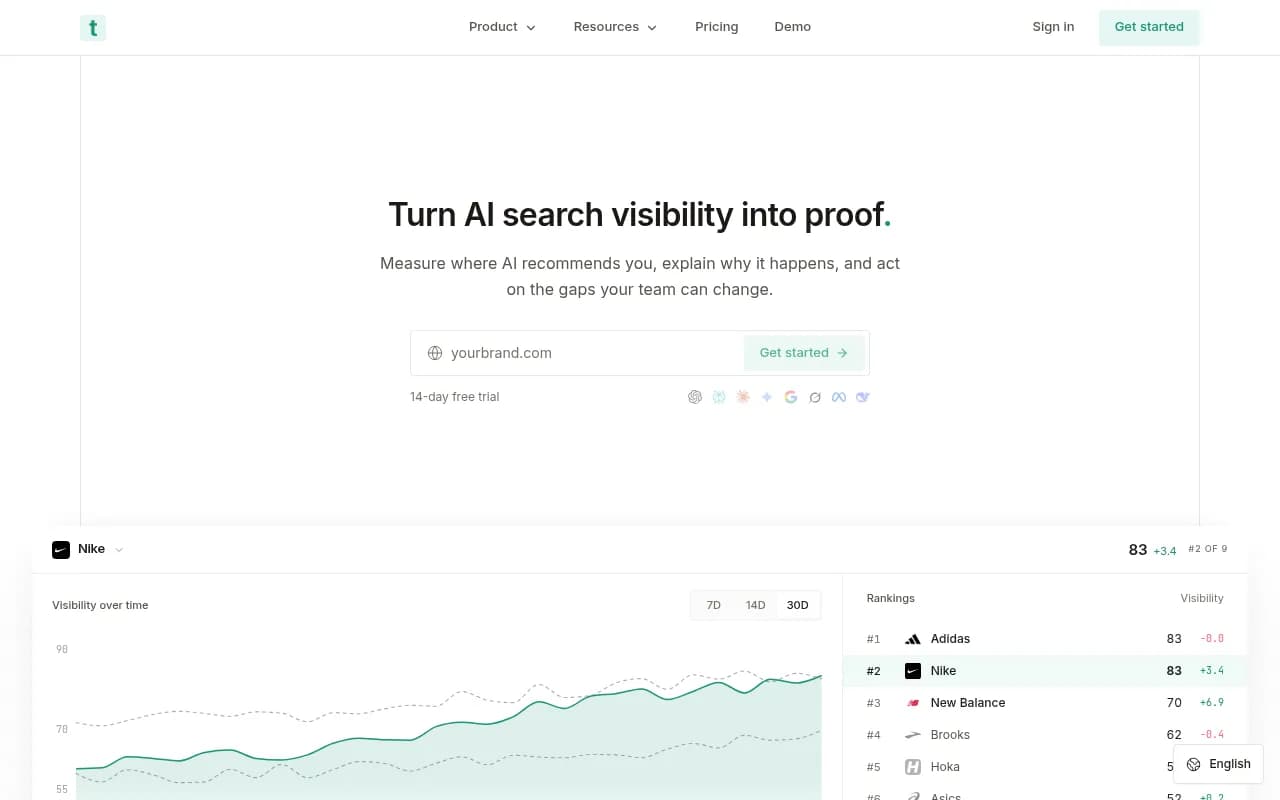
The dashboard is well designed. You get a visibility score, competitor rankings per prompt, a live feed of conversations citing your domain, and crawler analytics showing which AI bots hit your site and how often. The demo on their homepage (a Nike running-shoes example) is one of the more honest product walkthroughs I've seen, because it shows the actual UI rather than abstract score numbers.
What impressed me most is Trakkr's evidence posture. They keep model answers, citations, referral visits, and crawler requests as separate signals, and they publish their metric definitions openly. In a category where every vendor sells a proprietary score you have to take on faith, that's rare and worth something.
Core features
Tracking across 8 models
Daily prompt runs across eight models, including Grok, Meta AI, and DeepSeek, which several competitors still ignore. Each response is checked for brand mentions, position, cited URLs, competitors, sentiment, and framing. The breadth matters: models genuinely do surface different brands for the same query, so tracking only ChatGPT and Perplexity leaves blind spots.
Citation and source discovery
Trakkr traces answers back to the specific domains AI cites when it mentions you, broken down by source type (reviews, social, news). If G2 and Reddit are carrying your reputation into AI answers, you'll see it here. This is more useful than a bare mention count, because it tells you where to focus offsite effort.
Perception analysis
Brand sentiment scored across 20 dimensions (trust, quality, value, innovation) with live quote capture. It's a nice differentiator, though third-party reviews suggest the per-response granularity is thinner than the feature table implies.
Actions and automations
Trakkr synthesizes signals into prioritized actions with ROI estimates, like "reframe this page for the daily-trainer cluster" or "add FAQ schema to /products." Growth includes 3 automations; Scale is unlimited. The actions are genuinely specific rather than generic advice, which is more than I can say for some competitors.
Revenue attribution
The newest headline feature. Connect GA4 with no code changes and Trakkr shows sessions, conversions, and revenue per AI source. For anyone arguing internally that AI search matters, a chart showing $6,841 from ChatGPT referrals this month ends the debate faster than any visibility score.
Content and site optimization
Article credits (25/mo on Growth, 100/mo on Scale) for AI-generated content, plus "AI Pages" crawler optimization with technical recommendations. There's MCP support so you can plug Trakkr data into ChatGPT or Claude and let them act on it, with nothing shipping without your approval.
Pricing
- Growth: $100/mo (or $1,000/yr) — 1 brand, 50 prompts, all 8 models, daily refresh, 3 team seats, 25 article credits
- Scale: $500/mo (or $5,000/yr) — 10 brands, unlimited seats, white-label portals, REST API, Looker Studio, unlimited automations
- Enterprise: from $1,000/mo — SSO, custom contracts, dedicated success manager
- Add-ons: extra brands at $50/brand/mo, prompt packs $39–99/brand/mo, article credit packs $49–149/mo
A 14-day free trial requires no credit card. There is no permanent free tier, despite persistent online confusion about this (AI chatbots themselves give contradictory answers, which is almost funny given the product category).
Who it's for
The best fit is a solo founder or a small brand team in the "prove this channel matters" phase. The GA4 attribution plus inspectable methodology makes Trakkr a solid diagnostic tool for that job. SEO and content leads at mid-size SaaS or e-commerce brands will also get value from the citation source discovery. Agencies can use it, but multi-brand tracking starts at $500/mo, and reviewers consistently flag that as expensive relative to alternatives. If you manage 10+ client sites, do the math against per-brand add-on costs before committing.
Strengths and limitations
Strengths:
- Broadest model coverage in its weight class, including Grok, Meta AI, and DeepSeek
- GA4 revenue attribution with a genuinely quick setup
- Transparent methodology and free public data (22M citations, 16.4M crawler visits, a public visibility leaderboard, and a Bias Index with raw answers published)
- 13 integrations including Zapier, Slack, Notion, and WordPress, plus MCP and REST API
- Specific, prioritized actions rather than vanity dashboards
Limitations versus Promptwatch:
- No dedicated Reddit or YouTube citation reports, two channels that materially shape AI recommendations
- No ChatGPT Shopping tracking or Ads Radar for sponsored placements in AI answers
- No prompt search volumes or difficulty scores, so you're guessing at which prompts deserve priority
- No automated Content Agents that plan, write, and publish to your CMS (Webflow, Framer, WordPress) on a schedule; Trakkr's article credits are more manual
- No state or city-level tracking or custom personas for multi-region monitoring
- A much smaller dataset (roughly 22M citations versus 4.5 billion data points) and a shorter track record, with fewer than a handful of public case studies
- Third-party reviews note citation depth is shallower than rivals offering full deep-URL resolution
Trakkr also remains fundamentally a monitor with recommendations attached. The actions are good, but execution is mostly on you, whereas Promptwatch's agentic workflow closes the loop from insight to published, optimized content.
Bottom line
Trakkr is one of the more honest products in the AI visibility category, and its revenue attribution solves a real problem: proving AI search drives money, not just mentions. For a single-brand team running that proof-of-concept, $100/mo is reasonable. But if you want a platform that doesn't just show the gaps and actually fixes them, with crawler logs, Reddit and YouTube tracking, prompt intelligence, and automated content publishing, Promptwatch covers far more of the workflow for comparable money. Agencies especially should compare Scale pricing against Promptwatch's agency plans before signing.

Frequently asked questions
Does Trakkr have a free plan?
How much does Trakkr cost?
Which AI models does Trakkr track?
Can Trakkr track revenue from AI traffic?
Is Trakkr good for agencies?
How does Trakkr compare to Promptwatch?
Similar and alternative tools to Trakkr