Key takeaways
- Daily tracking matters because citation counts and search behavior inside AI models can shift within days. Promptwatch's data on the GPT-5.3 rollout shows average citations per ChatGPT response dropped roughly 27% overnight and never recovered, a platform-wide shift no brand caused.
- Not every prompt needs daily checks. The general rule from AEO practitioners: if a prompt touches revenue or public trust, weekly is the floor; daily is for launches, reputation events, or executive reporting weeks.
- Pricing in this category is unstable. Profound quietly dropped its self-serve $99/$399 tiers in 2026, leaving only a free trial and custom enterprise pricing. Peec AI, Otterly, and Ahrefs Brand Radar all have hidden add-on costs that change the real monthly bill.
- Platforms differ on collection method (live UI scraping vs. API sampling), which changes what "daily tracking" actually measures. Ask vendors directly which one they use.
- Tools that only monitor leave the fixing to you. A smaller group, including Promptwatch, pairs daily tracking with crawler logs, content gap analysis, and automated publishing so the data turns into action.
Why daily tracking is not a nice-to-have anymore
A few years ago, checking your brand's visibility in ChatGPT once a month felt reasonable. It doesn't anymore, and the reason is dull but important: the models themselves keep changing underneath you.
Promptwatch's own data on the GPT-5.3 rollout is a good illustration. Average citations per ChatGPT response fell from roughly 6.4 to somewhere between 4.7 and 4.9 within days of the March 4, 2026 update, a drop of about 27% in available citation slots. That's not a content problem. It's the platform reshuffling how many sources it's willing to show at all, across GPT-5.3, GPT-5.4, and GPT-5-Mini simultaneously. A month later, citation counts hadn't recovered. If you were only checking visibility quarterly, you'd have no idea whether your traffic dip was your fault or the model's. (See ChatGPT Citation Drop After GPT-5.3.)
Search behavior inside ChatGPT is just as unstable. Average web-search "fanouts" per response dropped from 2.15 in early December to 1.84 by March, then collapsed to exactly 1.0 in April, a much leaner search pattern than a few months earlier. Query length shrank too: average character length went from roughly 117 characters down to the high-80s and then to about 53 characters by April, less than half the original length. ChatGPT is increasingly searching with short keyword fragments instead of full sentences (see ChatGPT Query Fanouts). None of this shows up in a snapshot audit run once a quarter.
A 2026 arXiv preprint, "Don't Measure Once: Measuring Visibility in AI Search (GEO)," makes the same point academically: answers vary across runs, prompts, and time, so one-off checks are unreliable by design. The practical advice from AEO practitioners like MaxAEO is more specific: measuring once and treating it as truth is the most common mistake teams make. Visibility data becomes useful only when repeated checks reveal a pattern connected to an actual business decision, not when one changed answer triggers a content rewrite.
That's the case for daily tracking. It's also the case against blindly running daily checks on every prompt you own, which gets expensive fast and doesn't actually improve decision quality if nobody's reading the reports.
When you actually need daily vs. weekly checks
The honest answer is that most prompts don't need daily monitoring. The rule of thumb I'd use, echoing MaxAEO's guidance, is that anything touching revenue or public trust deserves weekly monitoring as a floor, and daily tracking gets reserved for specific situations: a product launch, a fast-moving competitive category, an active reputation issue, a known competitor attack, or a week where you're presenting numbers to leadership. Agencies typically run weekly for core client prompts and escalate to daily only during active campaigns.
One implementation detail that trips people up: keep your core prompt set stable. LLM Pulse flags this directly, changing prompt phrasing every week breaks trend comparability, so if you're paying for daily tracking, don't also rewrite your prompts every few days or you'll have a chart with no real trend line in it.
What "daily tracking" actually means, and why the collection method matters
Here's something vendors don't always volunteer: some platforms sample AI answers through APIs, others scrape the real, user-facing interface. These are not the same thing. Semrush has publicly noted that API outputs and scraped UI outputs are different, non-equivalent ways of measuring AI visibility, and what a real user sees in ChatGPT's interface can diverge from what the API returns. Promptwatch, for example, builds its dataset from real UI monitoring across ChatGPT, Gemini, Perplexity, Claude, and AI Overviews, not API-only sampling, which is worth checking against any vendor's claims about "daily tracking across 9 platforms." Ask what's actually being queried before you buy.
The platforms compared
Here's how the main daily-tracking options stack up on pricing, coverage, and what happens once the data comes in.
| Platform | Daily tracking pricing | Platform coverage | What happens after the data |
|---|---|---|---|
| Promptwatch | $95/mo Essential (50 prompts), $245/mo Professional | ChatGPT, Gemini, Claude, Perplexity, Grok, Copilot, AI Overviews, AI Mode, and more | Crawler logs, content gap analysis, automated content generation with CMS publishing |
| Profound | Free trial only, then custom Enterprise | Up to 9 answer engines on Enterprise | Answer engine analytics; self-serve tiers removed in 2026 |
| Peec AI | $95-$495/mo (Starter/Pro/Advanced) | 3 models included, more via add-on | Smart suggestions; Looker Studio on Advanced+ |
| Otterly | $29-$489/mo base, engines cost extra | ChatGPT core; Claude/Gemini/AI Mode are paid add-ons | GEO URL audits, Looker Studio connector |
| Ahrefs Brand Radar | $199/mo per engine or $699/mo bundle, plus base Ahrefs plan | 6 AI engines on the bundle | Third-party prompt database, no execution layer |
| AthenaHQ | $295-$499/mo, credit-based | ~10 models, but daily refresh burns credits fast | Mid-market GEO dashboards |
| Scrunch AI | From $250/mo flat | Enterprise-focused engine coverage | Optimization infrastructure, no content generation |
A few things stand out once you look past the marketing pages.
Profound quietly changed its pricing model
As of this year, Profound's live pricing page shows only two tiers: a free trial (10 prompts, run once, ChatGPT only) and a custom Enterprise plan with daily tracking across up to 9 engines, SSO, and SOC 2. The previously advertised $99 Starter and $399 Growth self-serve tiers are gone. A lot of older reviews still quote those numbers, so if you're comparing quotes from a few months back, they're stale. This lines up with Profound's funding trajectory, from a $96M Series C at a $1B valuation in February 2026 to a $180M Series D at $1.8B roughly seven months later, nearly $335M raised since 2024. That's an enterprise trajectory, and the pricing now reflects it.
Peec AI's credit math is worth doing before you buy
Peec's daily-tracking plans start at $95/mo for 50 prompts across 3 models. What's easy to miss is the credit formula behind its agency tiers: one prompt times one model times one day equals one credit. Daily tracking of a single prompt for 30 days costs 30 credits; weekly tracking of the same prompt costs roughly a third as much. If your prompt list is large, weekly monitoring with occasional daily escalation is a lot cheaper than defaulting everything to daily.
Otterly's advertised price and real price aren't the same number
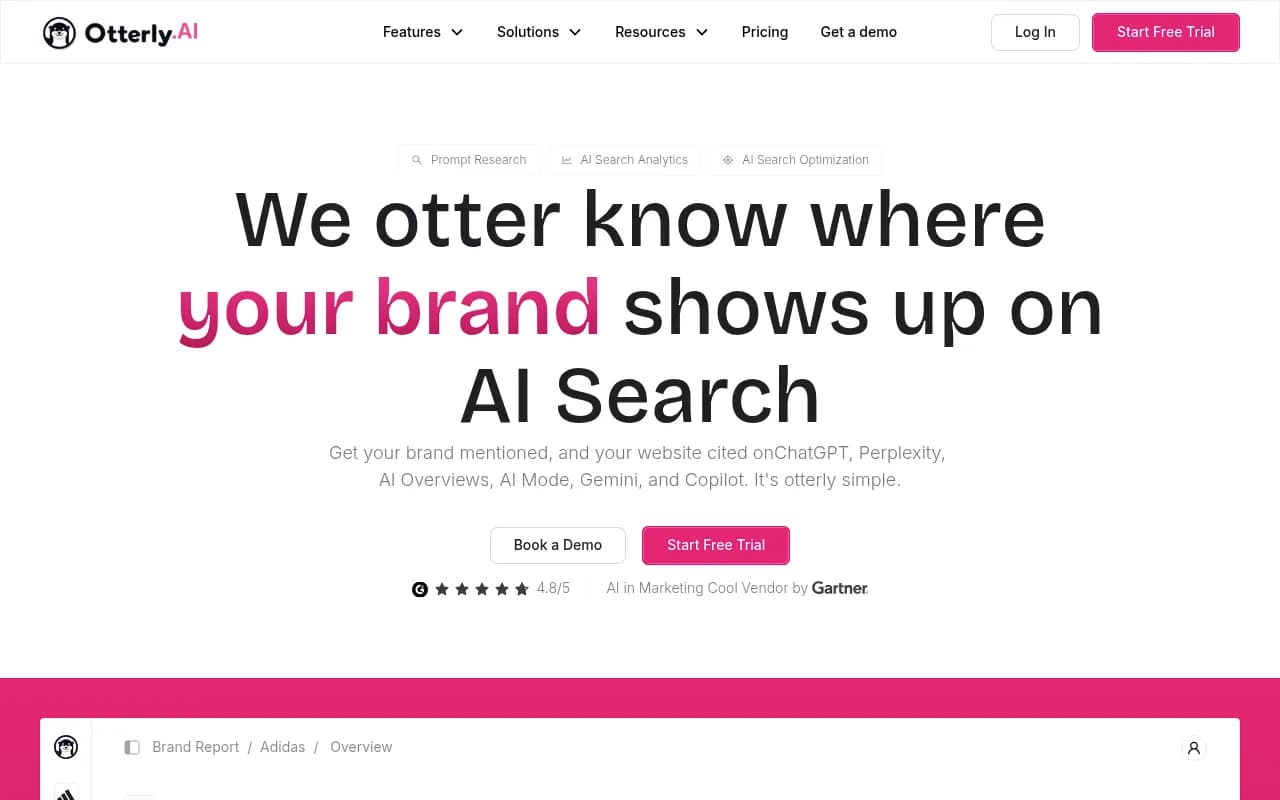
Otterly's Lite plan starts at $29/mo, but that only includes ChatGPT and a couple of core engines. Claude, Gemini, and Google AI Mode are paid add-ons on every tier, running from $9/mo up to $149/mo each depending on the plan. Stack all three add-ons onto the Premium tier and you're near $1,226/mo, above Otterly's own advertised "Enterprise starts at $1,000/mo" line. The unlimited team seats on every plan starting at $29 is a genuine advantage over competitors that gate seats, but check the full engine list before assuming the headline price is what you'll pay.
Ahrefs Brand Radar isn't a standalone purchase
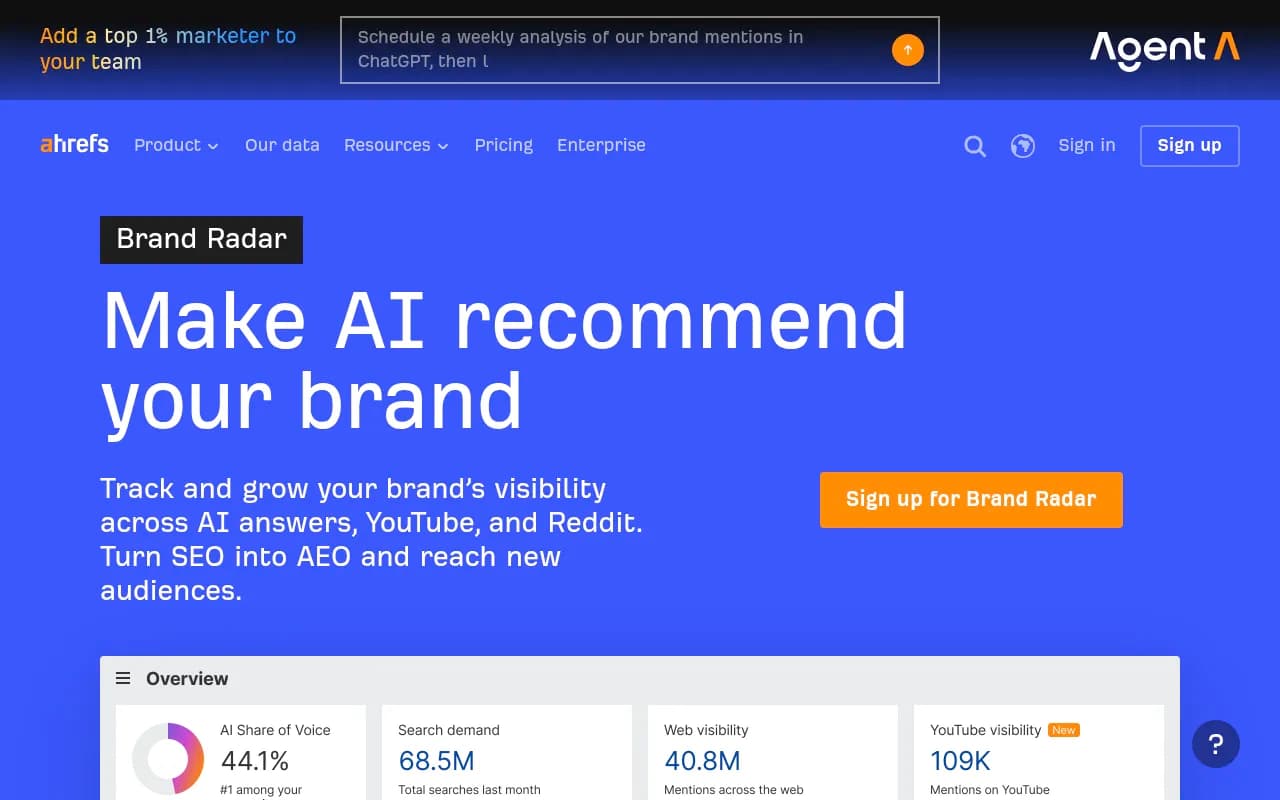
Brand Radar requires a base Ahrefs plan ($129-$449/mo) plus per-engine indexing at $199/mo, or $699/mo for all six engines bundled. Realistic all-in cost lands between $828 and $1,148/mo. It comes with access to Ahrefs' prompt database of 239M+ (some sources say over 455M) organic prompts, which is genuinely useful for third-party research, but there's no content generation or execution layer attached.
Where a monitoring-only approach falls short
Most of the tools above answer one question well: was my brand mentioned, and where do I stand versus competitors. That's valuable, but it's half the job. Someone still has to look at the dashboard, figure out why a competitor is outranking you in a specific prompt cluster, write or fix the page that would fix it, and publish it. On a lot of teams, that step just doesn't happen, and the tracking dashboard becomes a report nobody acts on.
Promptwatch approaches this differently. It runs daily prompt tracking across ChatGPT, Gemini, Claude, Perplexity, Grok, Copilot, AI Overviews, and AI Mode using real UI monitoring rather than API-only sampling, and pairs it with AI crawler logs that show exactly which pages ChatGPTBot, ClaudeBot, and 400+ other crawlers actually read on your site, and where they hit errors. That's the "why" layer most trackers skip entirely. Then it goes further: content gap analysis flags where your coverage falls short of what AI is actually citing, and its Content Agents can plan, write, and publish GEO-optimized pages directly to Webflow, Framer, or WordPress on a schedule, with a review inbox if you want a human checking the work first.
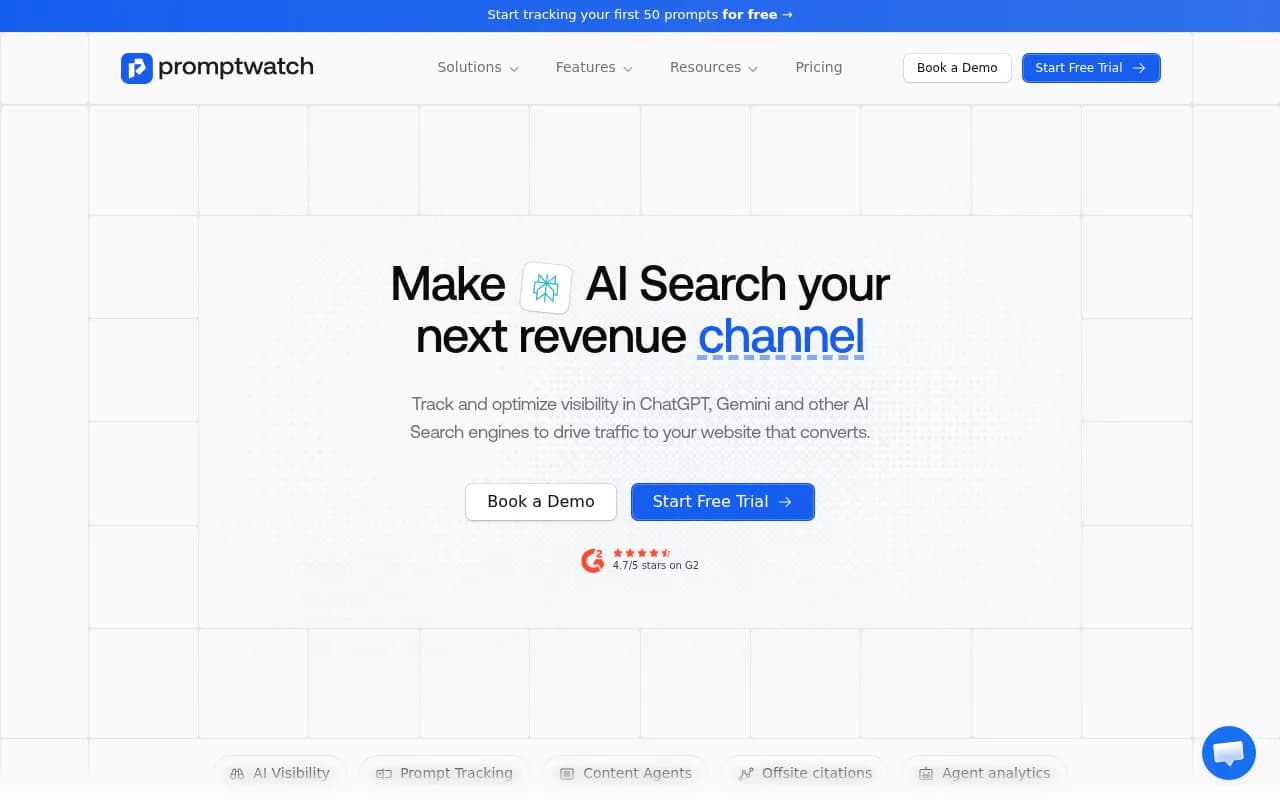
Crisp, one of Promptwatch's customers, reported 2x higher conversion rates from AI-driven traffic compared to traditional channels and scaled to publishing 5-10 articles per day once the tracking-to-content loop was automated. That's the kind of outcome that separates a tracking subscription from an optimization platform. Pricing starts at $95/mo for the Essential plan (1 site, 50 prompts, 6,000 responses) and moves to $245/mo Professional, which adds automated content generation and shopping insights, up to $579/mo Business for larger teams needing 350 prompts and 100M crawler logs.
Other tools worth a look, depending on your setup
If you're running an ecommerce catalog, Alhena AI is built specifically around product-level visibility tracking rather than generic brand prompts.
For teams already inside Ahrefs' ecosystem, Ahrefs Brand Radar is a reasonable add-on if you don't mind the extra per-engine cost stacking on top of a base subscription.
And if daily monitoring alone is what you need without the content execution layer, Otterly remains one of the cheapest entry points, provided you budget for the engine add-ons up front.
A practical way to decide
Don't start by asking which tool has the most model coverage. Start with your prompt list. Write down the 20-40 questions a real buyer would actually type into ChatGPT or Gemini about your category, separate them into "must be right every day" and "fine to check weekly," and price out a couple of vendors against that actual split rather than against their marketing page. Most teams find that daily tracking on a small, high-stakes prompt set beats daily tracking on everything, both on cost and on signal quality.
If you want a broader view of the category before committing, the GEO software directory at bestgeosoftware.com is a reasonable place to compare more platforms side by side, and agenticseotools.com is worth a look if you specifically want tools that act on the data rather than just report it.