Key takeaways
- AI Overviews cite very different sources than ChatGPT, so a local tracker needs per-engine and per-location tracking, not one blended score.
- Map-first tools (Local Falcon, BrightLocal, Nightwatch) are best at "where am I seen from this spot." Prompt-first tools are best at "who gets named and cited."
- Promptwatch's data shows Google AI Overviews gets 12.2% of its citations from social platforms versus 0.46% for ChatGPT, so Google Business Profile, YouTube, Facebook and Instagram belong in your tracking.
- For one location, a monthly manual check can beat a paid tool. For 20+ locations, you need location-level reporting and a named owner for fixes.
- Prices below were listed by vendors in autumn 2026 and change often. Confirm before buying.
Why local AI Overview tracking is different
A national brand can track 50 prompts, average the results, and get a usable number. A local business can't. "Best roofer near me" returns a different answer in each suburb, and a plumber in the map pack can still be absent when someone asks an AI assistant for a plumber in that city. A map rank is not an AI citation.
Three things make local tracking harder than generic AI visibility tracking:
- Location sensitivity. The answer depends on where the searcher stands. A tool that checks from one data center tells you little.
- Prompt shape. Cheers reported that in its panel of 13 home-services companies (28 days to September 2, 2026), generic "best" list prompts without a place name produced a 28.4% pooled appearance rate. Prompts with a named place or "near me" behave differently, and few companies track them. Ask any vendor which prompt shapes sit behind its score.
- Different engines, different sources. This is the one people underestimate.
What AI Overviews cite for local queries
Promptwatch Data's social media citations report (Sep 28 to Oct 4, 2026) found Google AI Overviews takes 12.2% of its citations from social platforms, about 26 times ChatGPT's share. YouTube was 4.28%, Facebook 2.38% (more than doubled), Reddit 2.15%, Instagram 1.61% and LinkedIn 1.55%. ChatGPT's seven tracked social platforms together made up only 0.46%, and Reddit fell from 5.19% to 0.09% of its citations.
The June 2026 AI Overview citation share data adds that google.com itself rose to 2.30% of citations (from 0.37% in January), which fits the idea that Google Business Profile and other Google-owned surfaces matter. That June figure was month-to-date, so it may overstate momentum.
The practical read: a local AI Overview tracker should capture citations of your GBP, YouTube, Facebook and Instagram, and it should report each engine separately. Reddit tactics that helped a year ago no longer move ChatGPT.
What to look for in a local tracker
- Location-level results. Separate rows per location, ideally with coordinates, city or ZIP, not just a country setting.
- Real answers, not only scores. You need to see who was named instead of you and which URLs were cited.
- History. AI answers vary run to run. One check proves little; weeks of data show a trend.
- Local competitors. Competitors per market, not one global list.
- A next step. A tool that reports you're missing and stops there leaves the hard part to you.
- Honest pricing at scale. Per-location pricing gets expensive quickly. Check how a 40-location rollout is billed.
Comparison table
| Tool | Built around | AI Overviews coverage | Local strength | Public starting price |
|---|---|---|---|---|
| Local Falcon | Geo-grid map scans | AI Overviews, AI Mode, ChatGPT, Gemini, Perplexity, Grok, Copilot | Grid scans around a business location | $24.99/mo for 7,500 credits |
| BrightLocal | Listings, reviews, local rank | ChatGPT and Google's AI | Listings, citations, GBP audit | $41/mo for one location |
| Semrush | SEO suite | ChatGPT, Google AI, Gemini, Perplexity | Multi-location tracking listed | $99/mo per domain for AI toolkit |
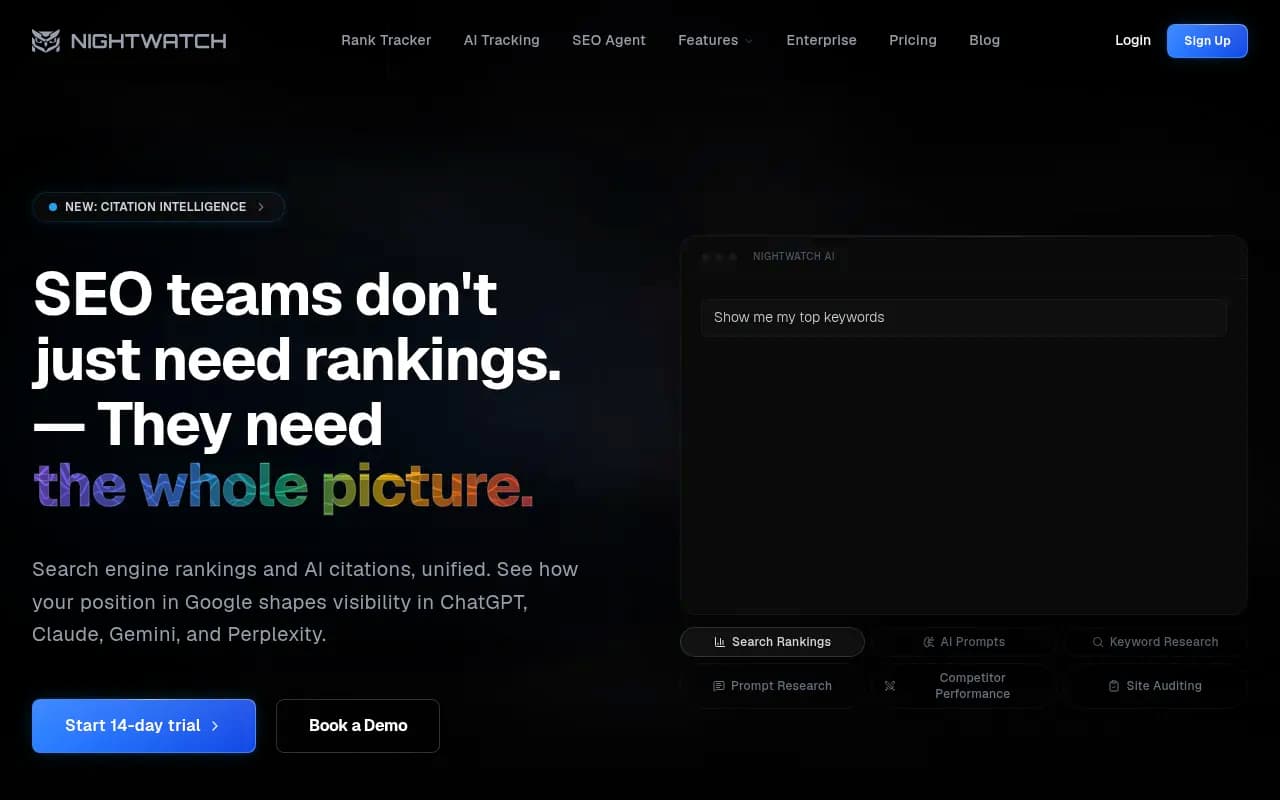
| Nightwatch | Rank tracking plus AI | AI Mode and AI tracking | Geo-level data | $39/mo plus AI add-on |
| Otterly.AI | Prompt and citation monitoring | ChatGPT, AI Overviews, Perplexity, Copilot in base | Limited local depth | Lower-cost tier |
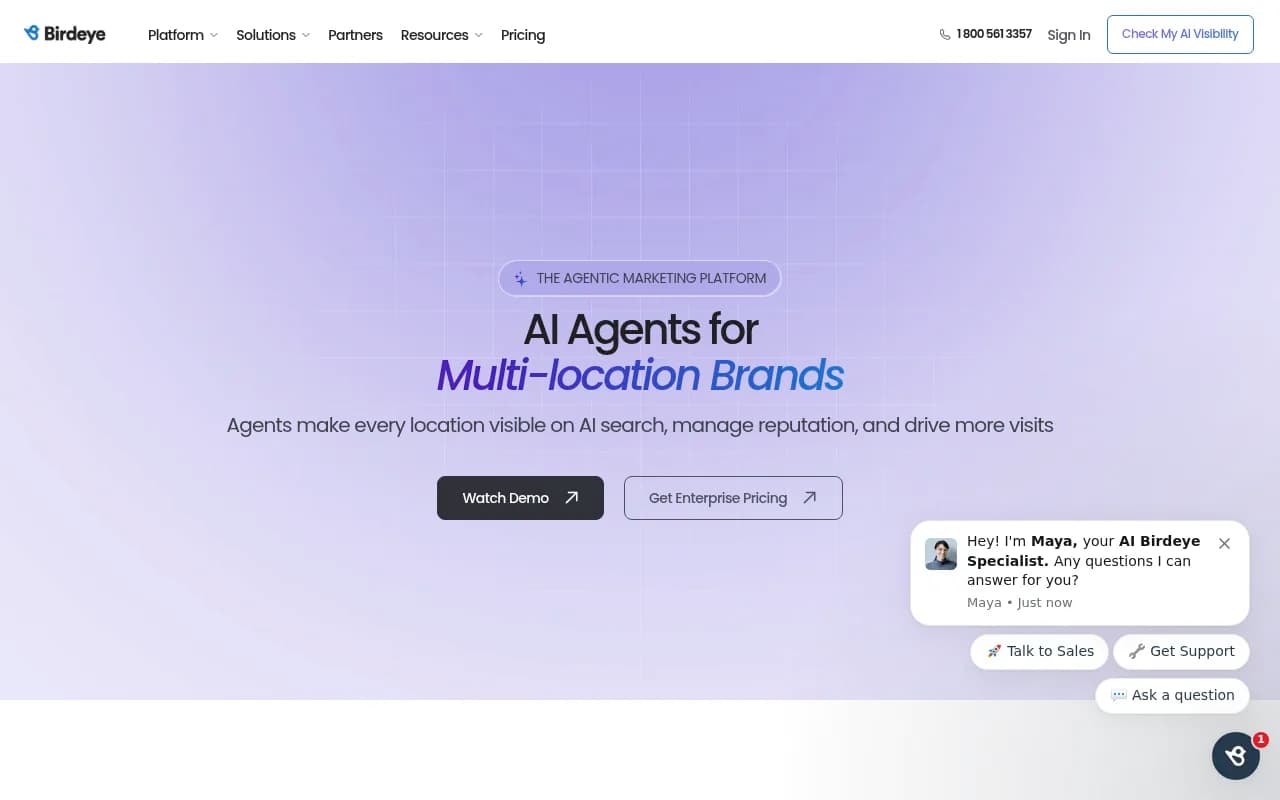
| Birdeye Search AI | Reviews and local AI visibility | Location-level tracking | Multi-location review ops | Quote-based |
| Promptwatch | AI visibility plus optimization | Real AI Overviews and AI Mode UIs | Exact-coordinate monitors | From $95/mo, Business $579/mo for local |
Prices come from vendor pages as reported in autumn 2026. Treat them as indicative.
The best options, by job
Promptwatch: best when you want to track and then fix
Promptwatch is the option I'd look at first if tracking is only half the job. Its Business plan (listed at $579/mo) includes local GEO/SEO targeting: you pin a monitor to exact coordinates, with an accuracy radius from 20 m to 5 km, so ChatGPT, Google AI Overviews and Google AI Mode answer as if asked from that spot. State and city tracking is also included from Business, and it is available in the API and MCP.
The part that matters for multi-location brands is what happens after you see a gap. Content gap analysis, the Action Board and the Content Agent turn a missing citation into a to-do or a published page, and crawler logs show whether AI bots can read your location pages at all. It tracks the real UIs rather than only API outputs, which matters because user-facing answers differ from API responses.

The trade-off: it is a GEO platform, not a listings manager or a geo-grid map rank tool. You'd still want something like BrightLocal or Synup for citation cleanup, and the full local feature set sits on the higher-priced plans. Confirm current pricing at promptwatch.com/pricing.
Local Falcon: best for seeing where you appear across a service area
Local Falcon runs the same search from a lattice of points around your business and shows rank at each one on Google and Apple Maps. Its AI tracking is the broadest of the map-focused tools: eight platforms including Google AI Overviews and AI Mode, refreshed daily. Plans are credit packs, with one credit per map point, so a 5x5 grid uses 25 credits. Credits on monthly packs expire at the end of each month, which matters if you scan irregularly.
Where it falls short: if the reason assistants skip you lives on your site (a firewall blocking AI crawlers, missing schema, an address that disagrees between pages), a grid will show the symptom but not the cause.
BrightLocal: best if listings and reviews need work
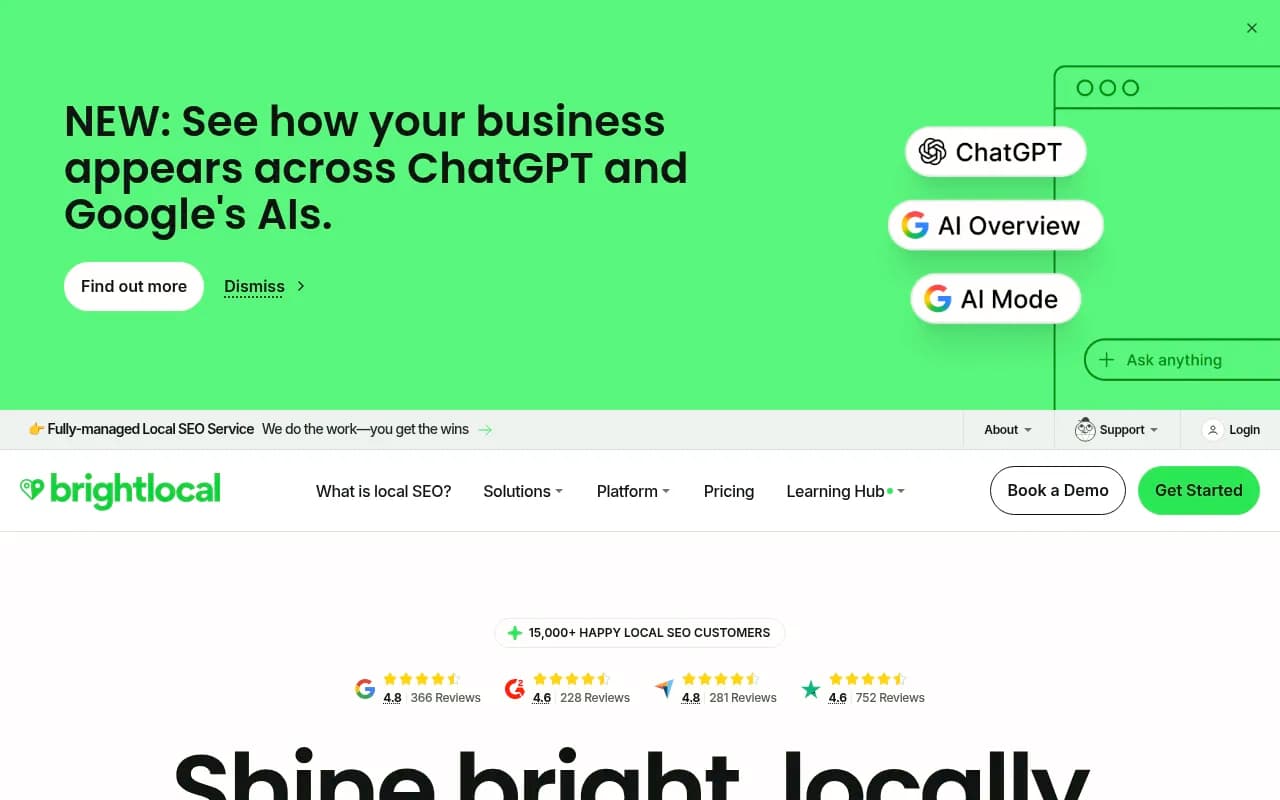
BrightLocal has been around for 15+ years. The entry Track plan covers local rank tracking for up to 100 keywords and four competitors, citation monitoring, a GBP audit and a geo-grid. Its Local AI Visibility Tracker shows how your business appears in ChatGPT and Google's AI. Higher tiers add listing sync and review management.
It is a sensible pick for agencies that already live in local SEO. Its AI engine coverage is narrower than Local Falcon's, so check whether it breaks out AI Overviews the way you need.
Semrush: best if you already pay for the suite
One roundup put it plainly: buy Semrush if you already use the suite and 50 to 200 prompts a day is enough. Pro-level plans list multi-location tracking, though the AI toolkit is priced separately at $99/mo per domain. It is shallow on location-specific AI answers compared with the map-first tools, but it keeps everything on one invoice.
Nightwatch: best for agencies that need geo-level rank plus AI
SE Ranking's AI Mode roundup recommends Nightwatch for local businesses targeting specific locations, thanks to geo-level data alongside AI rankings. It starts at $39/mo plus an AI add-on.
Birdeye Search AI and the reviews-heavy stack
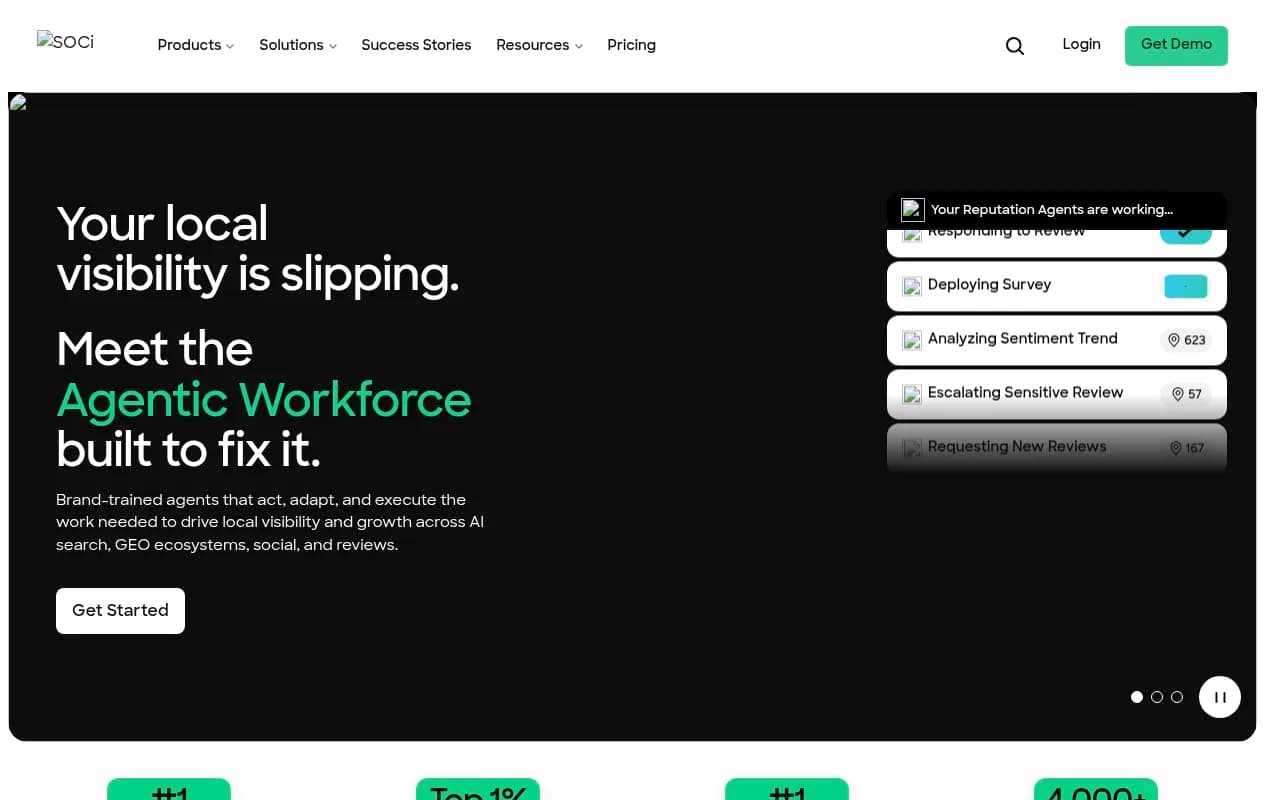
Birdeye pairs location-level AI visibility with review operations. Similar logic applies to Reputation.com, Chatmeter and SOCi, which are multi-location platforms where AI tracking sits beside listings and reviews. If your franchise system already runs one of these, test its AI module before adding another vendor.
Otterly.AI: best low-cost self-serve monitoring
Otterly's plan page lists tracking of ChatGPT, Google AI Overviews, Perplexity and Microsoft Copilot in the base tier, with Claude, AI Mode and Gemini as add-ons. It is cheap and quick to start. It is not built around location, so use it for brand-level prompts, not neighborhood-level checks.

Done-for-you options
Cheers sells done-for-you work for multi-location service brands, with tracking by location, prompt, engine and competitor, plus review operations. Speak Local ($49/mo) pairs a site audit and fix list with tracking of ChatGPT, Perplexity and Gemini, with AI Overviews drawn from your tracked Google searches. Both vendors publish comparisons of their own market, so read their claims about rivals with that in mind. For listings upkeep, Synup is worth a look.
Screenshot: how one vendor frames the local shortlist
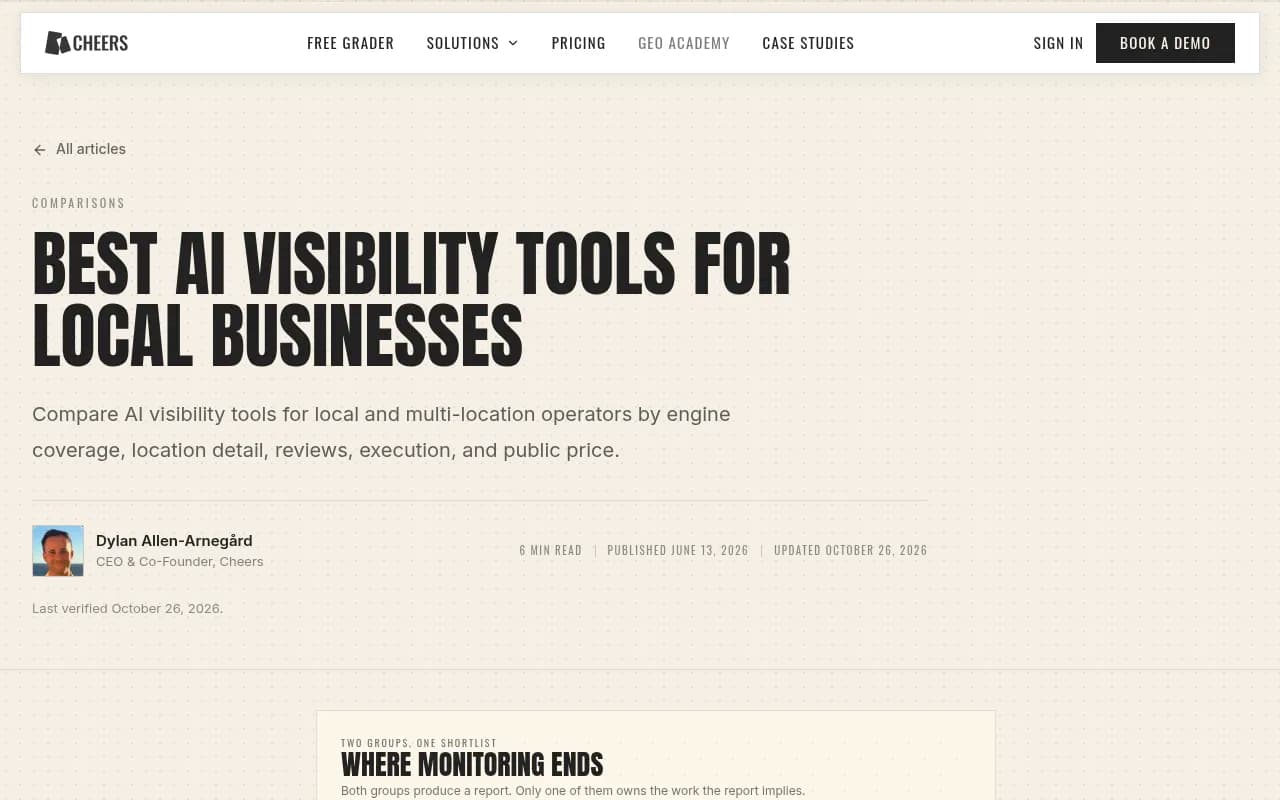
The useful idea on this page is the split between tools that report and services that fix. Cheers competes here, so treat its checklist as a test to run against every vendor.
Which setup fits which business
| Situation | Suggested approach |
|---|---|
| One location, tight budget | Manual monthly check of ChatGPT, Perplexity and Gemini with your three best customer questions, plus a free tier trial |
| Single location, map-driven (restaurants, clinics) | Local Falcon for grids, plus GBP upkeep |
| 5 to 30 locations, SEO team in-house | Semrush or Nightwatch if already used; otherwise Promptwatch for per-location monitors and content actions |
| 30+ locations or franchise | Location-level platform (Birdeye, Chatmeter, SOCi) plus a GEO platform for AI answers |
| Agency with many local clients | Tools with white-label reports and unlimited projects; check agency tiers |
A practical tracking setup
1. Build prompts in three shapes
Track "best [service] in [city]", "[service] near me" pinned to coordinates, and branded queries like "[brand] reviews [city]". Keep competitor comparison prompts separate.
2. Track engines separately
AI Overviews and ChatGPT diverge sharply. Report them as different rows. For Google-focused local brands, Promptwatch's research advice is to invest in YouTube first, then keep public Facebook pages and Instagram profiles complete and active.
3. Treat GBP as a core asset
The rise of google.com as an AI Overview source suggests GBP, Merchant Center and help content deserve the same attention as your website.
4. Check readiness before you blame content
Confirm AI crawlers aren't blocked in robots.txt or by a firewall, that LocalBusiness schema is on each location URL, and that name, address and phone match everywhere. Structured data is not a substitute for tracking, and tracking is not a substitute for markup.
5. Assign an owner
When a location drops out of an answer, someone has to open the ticket. A dashboard with no owner becomes decoration.
Pitfalls
- Single-number scores. A blended score hides that you may be strong in one city and absent in another.
- Short windows. Answers vary between runs, so judge trends over weeks.
- Vendor self-comparisons. Several comparison pages in this space come from vendors. Prices and features were read from vendor pages on the dates they list and shift quickly.
- Confusing map rank with AI presence. They correlate loosely at best.
Where to browse next
If none of these fits, the rankings at ai-rank-tools.com list more AI rank trackers, and the GEO software directory covers the broader category.
Bottom line
Pick by the job. Local Falcon for map-grid visibility, BrightLocal for listings and reviews, Semrush or Nightwatch if you already live in them, Otterly for cheap brand-level monitoring, and Promptwatch when you want location-pinned AI Overview tracking tied to content actions. Whatever you choose, test it on three real prompts in two of your actual locations before signing anything.