Key takeaways
- Outrank is the most hands-off option: one $99/month plan, 30 articles a month, published daily. It is also the most expensive per article at about $3.30.
- Junia AI is the cheapest way into autopilot publishing on paper. Scale Starter is $29/month (apparently on yearly billing) for 68 articles, but the page is vague on monthly prices.
- Autoblogging.ai is credit-based, takes up to 500 titles per batch, and works out to roughly $0.13 to $0.48 per article. That figure comes from Autoblogging.ai itself, so treat it with some salt.
- I found no independent tests of ranking results for any of the three. Everything below is based on vendor pricing pages and features, so test on a small batch before scaling.
- Whichever tool you choose, you still need to check whether the content gets cited and read by AI systems. Publishing volume is not the same as visibility.
What we compared (and what we didn't)
A caveat first. This is a comparison built from pricing pages and feature lists, not a ranking experiment. I could not find independent data showing which of these tools produces articles that rank better, and I did not verify Google's current stance on scaled AI content. Several of the sources I leaned on are competitors of the tools they describe: Autoblogging.ai wrote the bulk-writer comparison page, and The SEO Agent sells its own rival product. Their numbers are useful but biased, and I flag them where they appear.
The real question with these tools is not whether they can generate an article. They all can. It is how much control you have before something goes live, how much it costs per post, and what happens to the pile of content once it is published.
The three tools at a glance
| Outrank | Junia AI | Autoblogging.ai | |
|---|---|---|---|
| Pricing model | One plan, $99/month ($999/year) | Tiered: Growth $17/mo, Scale Starter $29/mo (yearly billing) | Credits: $19 to $999/month, plus a free plan |
| Articles included | 30/month, add-ons for 60 or 90 | 10 (Growth), 68 (Scale Starter) | 40 to 5,000 credits depending on plan |
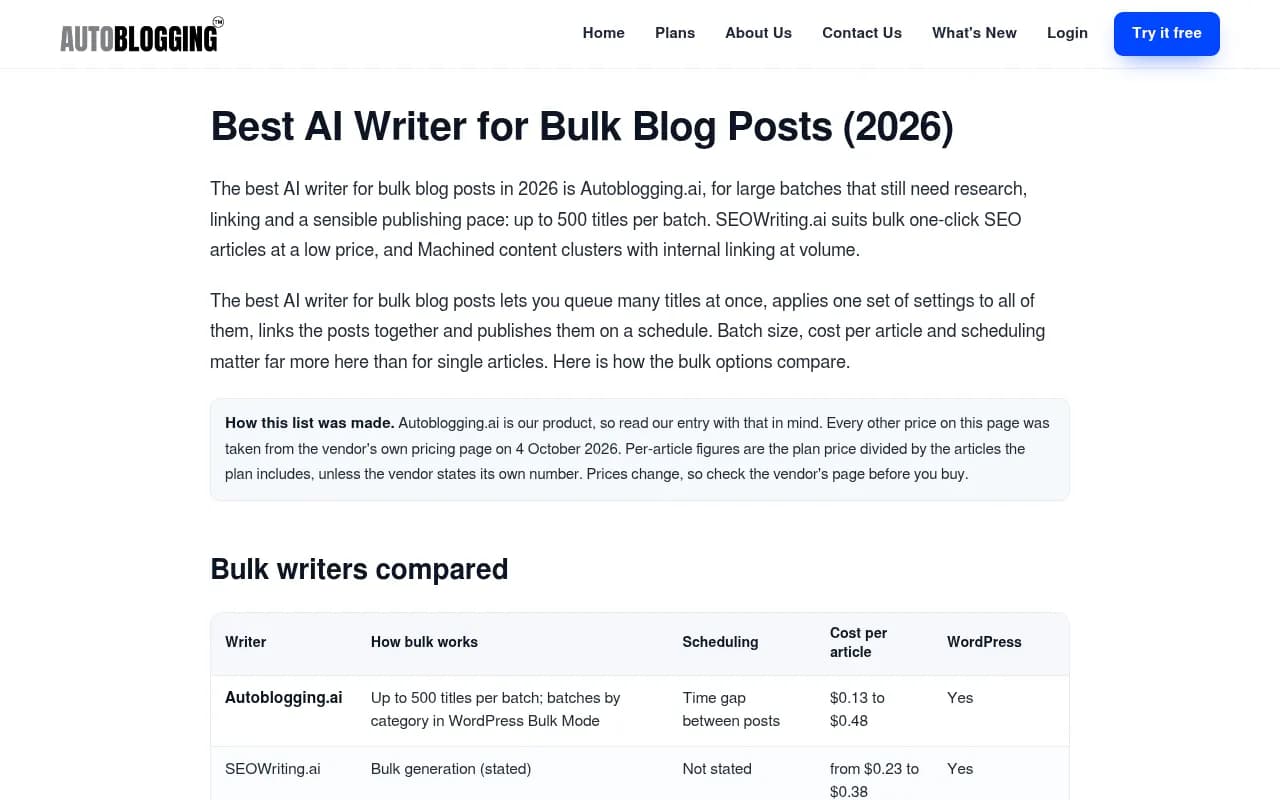
| Cost per article (per Autoblogging.ai) | $3.30 | $0.34 to $3.40 | $0.13 to $0.48 |
| Autopilot publishing | Yes, daily | Yes, AutoBlog scheduling on Scale | Time gap between posts in bulk mode |
| Bulk generation | No bulk queue, 30 a month on autopilot | Yes, on Scale | Up to 500 titles per batch |
| Backlinks | Built in (automated) | Not a headline feature | Not a headline feature |
| CMS options | WordPress, Webflow, Shopify, Wix, Framer, Notion, Ghost, webhook | Publishes to your site, all integrations on Growth | 10+ publishing integrations |
| Free tier | No (free hosted blog only) | Not confirmed | Yes, 10 credits/month |
| Best for | Founders who want zero involvement | Cheap volume and multi-site | Big batches with research and linking |
Outrank
Outrank is the closest to a true set-and-forget product. You connect a site, it researches keywords, writes and publishes about one article a day, and it also builds backlinks.

Pricing
There is one plan: the Organic Growth Plan at $99/month (shown struck through from $199), or $999/year, which saves $189. It includes 30 articles a month, automatic keyword research, automated backlink building, AI images, YouTube embeds, 150+ languages, unlimited users and unlimited AI rewrites.
Need more volume? Add 60 articles a month for +$85 (two a day) or 90 for +$160 (three a day). Multi-site discounts kick in automatically: 10% off for 2 to 4 sites, 15% for 5 to 19, and 20% for 20 to 25.
The add-on menu is where costs climb:
- Human Curated Service: $1,399/month, with human editors reviewing and fact-checking every article
- Backlink Premium $199, Scale $899, Enterprise $1,899 per month
- Free Tools Builder: $99/month
- Directory Submission: $500 one time, for 100+ directories
- Premium Images: $49/month
What I like and don't
I like the focus. One plan, one price, one job. Integrations are broad (WordPress, Webflow, Shopify, Wix, Framer, Notion, Ghost and a custom webhook), which matters if you are not on WordPress.
What I don't like: at roughly $3.30 an article it is the priciest of the three for raw writing, and the thing you are paying for is mostly the lack of effort. The SEO Agent's roundup describes Outrank as the closest to the full autopilot category and says the key question is how much control you get before publishing. That is the right question. Their product competes with Outrank, so the framing is not neutral, but the point stands.
Outrank also claims 750,000+ articles created, 25,000+ backlinks and 10,000+ "ChatGPT mentions secured". Those are vendor claims. I could not verify them.
Junia AI
Junia positions itself as an AI SEO agent that finds competitor gaps and publishes on autopilot. It has more of a toolbox feel than Outrank.

Pricing
- Growth: $17/month on yearly billing. 10 SEO articles a month, AI writer and editor, one-click optimization, auto keyword research, one-click internal and external linking, brand voice and knowledge bases, custom brand images, all integrations, 150+ languages.
- Scale Starter: $29/month, marked Most Popular, with a "Save 50%+" label. 68 articles a month generated and published on autopilot, AutoBlog scheduling, bulk generation, Content Planner, LLM Brand Visibility, unlimited websites, auto Google indexing, auto-translate, team collaboration, API access and priority support.
- Higher Scale tiers (Plus, Pro) exist, but I did not capture their prices.
- SEO, Done For You: from $2,000/month, with a promise of a 30% traffic increase within 90 days or you don't pay. Only 3 spots a month.
A warning: the pricing page does not make clear whether $17 and $29 are annual-billing prices. The yearly toggle strongly suggests they are. Check the monthly price on the live page before you budget around it.
What I like and don't
The price-to-feature ratio on Scale Starter is hard to ignore. Unlimited websites, auto indexing and translation at that price makes it interesting for agencies or anyone with a stable of small sites. The Content Planner and one-click internal linking address the weak spot of most autopilot tools, which is that posts end up as orphaned islands.
The wide cost-per-article range Autoblogging.ai quotes ($0.34 to $3.40) hints at the catch: the cheap end depends on using your full allowance on the higher plan. If you only use 10 articles on Growth, you pay far more per post.
Autoblogging.ai
Autoblogging.ai is built around batches. You paste titles, pick settings once, and it writes everything with the same configuration.

Pricing
Plans are credit-based:
| Plan | Price/month | Credits |
|---|---|---|
| Free | $0 | 10 |
| Starter | $19 | 40 |
| Regular | $49 | 120 |
| Standard | $99 | 300 |
| Gold | $179 | 600 |
| Premium | $249 | 1,000 |
| Enterprise | $999 | 5,000 |
Annual billing saves 35%, which brings Enterprise to $649/month. Cost per article lands at $0.13 to $0.48 by the vendor's own math (plan price divided by included articles).
Features worth knowing
- Up to 500 titles per batch, with WordPress Bulk Mode that splits titles by category
- A time gap between posts so a batch doesn't land all at once
- The estimated charge is shown before a run starts
- Godlike Mode (SERP and competitor analysis, entities) on Starter and up
- Topical Maps on Regular and up
- A 21-point semantic SEO analysis, GEO Optimization and News Mode on Starter and up
- Site Optimizer for batch-optimizing existing WordPress posts
- Fan Out Queries (free, 12 generated queries)
- 38 languages, 4 AI images per article, 10+ publishing integrations
- An AI visibility tracker for Google AI Overviews. The numbers on the demo page are example data, not real results.
One useful pitfall, straight from the vendor's page: turn internal linking on before a bulk run. Otherwise the batch publishes with nothing tying the posts together. That is the kind of mistake that is easy to make at 200 articles and painful to fix.
What I like and don't
The credit model is flexible and the free plan lets you test without a card, which I rate highly given that none of these vendors can show you independent ranking results. The downside is that fewer features come with the lowest tier, and a bulk-first workflow makes it very easy to publish a lot of mediocre content quickly. The comparison page I leaned on is Autoblogging.ai's own. It ranks itself first and calculates competitors' per-article costs itself, so verify against the vendors' pages.
Head-to-head: where they actually differ
Control before publishing
Outrank is the least hands-on. Junia gives you an editor and scheduling. Autoblogging.ai gives you the most levers before a batch runs (settings, internal linking, cost preview) but expects you to use them. If you want a review step, Outrank's Human Curated Service is $1,399 a month, which is steep. With Junia or Autoblogging.ai you review the drafts yourself, which is free but costs time.
Cost at 30 articles a month
Outrank is $99 for 30. Autoblogging.ai's Standard plan is also $99 but includes 300 credits, so for the same money you get roughly ten times the volume, if credits map to one article each. Junia's Scale Starter at $29 covers 68 articles. On raw volume per dollar, Junia and Autoblogging.ai win easily. Outrank's pitch is the bundle, notably backlinks and daily autopilot, not price.
Backlinks
Outrank is the only one of the three with automated backlink building baked into the base plan. Whether those links help or hurt is a risk call you should make yourself, since I found no independent evidence either way.
Publishing destinations
Outrank supports the widest list of named CMSs. Autoblogging.ai is strongest on WordPress (Bulk Mode by category). Junia says all integrations are included on Growth and that it publishes to your site.
Which should you pick?
- You run one site, want to hand it off and have budget: Outrank.
- You manage several sites or are watching every dollar: Junia AI's Scale tier, after confirming the monthly price.
- You have a list of 100+ target keywords and want a batch with internal links and scheduling: Autoblogging.ai.
- You want editorial control more than speed: consider an optimization tool such as Surfer SEO instead of an autopilot.

Other options in the same bracket are worth a look: Arvow, RightBlogger and SEO Writing AI all show up in competing roundups. RightBlogger, for example, bundles keyword research, an SEO editor and autoblogging.


A sensible test plan
Because nobody has published reliable ranking data for these tools, run your own:
- Pick one site and 10 to 20 keywords you would be happy to rank for.
- Publish a small batch from one tool. Edit by hand: check facts, add your own examples, remove filler.
- Turn on internal linking before you publish, not after.
- Wait 60 to 90 days. Check Search Console for impressions and indexation.
- Only then scale up, or switch tools and compare on the same keyword set.
Measuring whether the content gets cited by AI
All three vendors now talk about AI visibility. Outrank cites ChatGPT mentions, Junia has an LLM Brand Visibility feature, and Autoblogging.ai has GEO Optimization and an AI Overviews tracker. Those are vendor-side claims, and a built-in tracker is not the same as independent measurement.
If AI search matters to you, track it separately. A tool like Promptwatch shows which of your pages AI systems actually crawl and cite, and flags gaps, so you can see whether automated articles are doing anything beyond filling your sitemap. For context on what AI models tend to cite, Promptwatch's data on which content types ChatGPT cites most is a good start. Product pages led at 22.4% of citations from Sep 28 to Oct 4, 2026, followed by landing pages and listicles, which is a reminder that a generic blog post is not automatically the format AI reaches for. Promptwatch's content half-life report also found that news lost half its cited pages within 36 days, while landing pages and docs stayed cited longest.

If you are comparing monitoring options in more depth, the GEO software directory at bestgeosoftware.com lists more of them.
Bottom line
Outrank sells convenience, Junia sells a low entry price with plenty of features, and Autoblogging.ai sells batch scale with controls. None of them has independent proof that its articles rank. Start with Autoblogging.ai's free plan or Junia's lowest paid tier to test cheaply, publish a small batch with internal linking on, and let 60 to 90 days of Search Console data decide whether Outrank's higher price is worth it. Always confirm current numbers on the Outrank, Junia and Autoblogging.ai pricing pages before buying.