Key takeaways
- Measure before you hire. A tracker shows where you stand across AI engines and costs a fraction of a retainer.
- Much of AI Overview work (product pages, how-tos, schema, answer-first copy) can be done in-house once you can see which formats get cited for your prompts.
- An agency makes sense when AI visibility is a real priority, your budget is there, and you want to manage outcomes instead of tasks.
- Walk away from anyone who guarantees placement in ChatGPT or Google AI Overviews. No agency controls an AI engine's output.
- The order that rarely works: signing a long retainer before you have measured anything.
The real question behind the decision
Most people frame this as agency versus software. That's slightly off. The two do different jobs. A tracker tells you what is happening: which prompts mention you, which sources get cited, how you compare with competitors. An agency (or a freelancer, or an in-house hire) does the work that changes the answer.
So the useful question is: do you need help with execution, or do you first need to know where you stand? Plenty of teams skip the second step and pay for the first.
A disclosure up front. This site is published by 1001 SEO Media, an SEO and GEO agency, and the tracker I mention most is Promptwatch, which is a tracker vendor. Both of us have a stake in how you decide. Weigh what follows accordingly, and note that a lot of it points toward doing the cheap thing first.
Why AI Overviews changed the calculation
AI Overviews appear on a meaningful share of Google searches now, and the citations behind them don't map neatly onto classic rankings. Third-party figures vary: SE Ranking reported that roughly 42% of previously cited domains were replaced after Google moved AI Overviews to Gemini 3 on January 27, 2026, and Ahrefs and BrightEdge put the overlap between top-10 organic results and AI Overview citations somewhere between 17% and 38%, down from 76%. I haven't verified those numbers independently, so treat them as directional. The point holds either way: ranking well in classic search no longer guarantees a citation.
The click impact is also real. A study cited by Business.com found that when an AI Overview appeared, outbound organic clicks fell by 39.8% and zero-click searches rose by 34.5%. Whether that justifies a separate budget depends on how much of your demand runs through queries that trigger Overviews.
Google itself published a guide to optimizing for generative AI features in Search Central. Its message is blunt: there's no secret trick, and the fundamentals (helpful content, crawlability, structured data that matches visible content) still do the work. That matters for this decision, because fundamentals are largely in-house work.
What the work actually consists of
Break AI Overview optimization into pieces and the agency question gets easier.
- Measurement: a frozen prompt set (the 20 to 50 questions your buyers really ask), run on a schedule across engines, recording who is cited and from which sources.
- Technical readiness: crawlability, schema, clean page structure, fast pages.
- Content: answer-first pages, product specs, pricing, how-tos, comparisons, video.
- Entity and third-party signals: consistent brand details across the web, directory listings, mentions on trade sites, Reddit, YouTube, and review platforms.
- Reporting and iteration: tying changes to citation movement.
Measurement is tool territory. Technical readiness and content are usually in-house or freelancer territory if you have a competent SEO. Entity building and digital PR is where agencies earn their fee, because it's slow, relationship-heavy, and hard to staff.
Promptwatch's data on AI Overviews in July 2026 shows why this matters for what you write. Listicles averaged about 18% of cited content that month, product pages 16.3% to 16.4%, how-tos 15.1%, and news articles 13.5%. Product pages were the most cited format every day from July 28, the first time listicles lost the top spot. You can read the breakdown in Promptwatch's AI Overviews citation types report for July 2026. Product specs, availability, and how-tos live on your own site. You don't need an agency to write them, but you do need to know which formats are cited for your prompts, and that's what a tracker is for.
The four ways to get this done
| Option | Typical cost | Best for | Main risk |
|---|---|---|---|
| Tracker only | Tens to a few hundred dollars a month | Teams with an SEO who can act on data | Insight without execution |
| Freelancer or consultant | Project or part-time retainer | Specific fixes and audits | Capacity and continuity |
| In-house hire | $70,000 to $110,000 a year plus tools (vendor-sourced figure from geotoolbox) | AI visibility as a permanent channel | Slow hiring in a young field |
| Agency | Roughly $1,500 to $5,000 a month for SMB, $5,000 to $10,000 mid-market, $10,000 to $50,000+ enterprise (Frase's published ranges) | Priority channel, limited internal capacity | Paying agency rates for work one person could do |
Treat the pricing as ballparks. I didn't verify them, and both the in-house and agency figures come from vendors who sell adjacent things.
When an agency is the right call
Hire one when most of these are true:
- Your buyers demonstrably use AI assistants to shortlist vendors in your category.
- You lack SEO or content staff, or they're already full.
- You need entity and third-party work: digital PR, mentions on sources AI already trusts, review-platform presence.
- You're in a regulated industry where content needs compliance review and a process around it.
- You'd rather buy outcomes and reporting than manage tasks.
The big-name agencies tend to specialize. Lists in 2026 sort them by use case: enterprise technical GEO, B2B SaaS content, thought leadership, digital PR that earns citations, local contractors. Pick for the job, not the brand. If you want help from a team that treats this as its core work, 1001 SEO Media covers technical SEO, content, and AI search optimization, and I'd still tell you to run a baseline first.
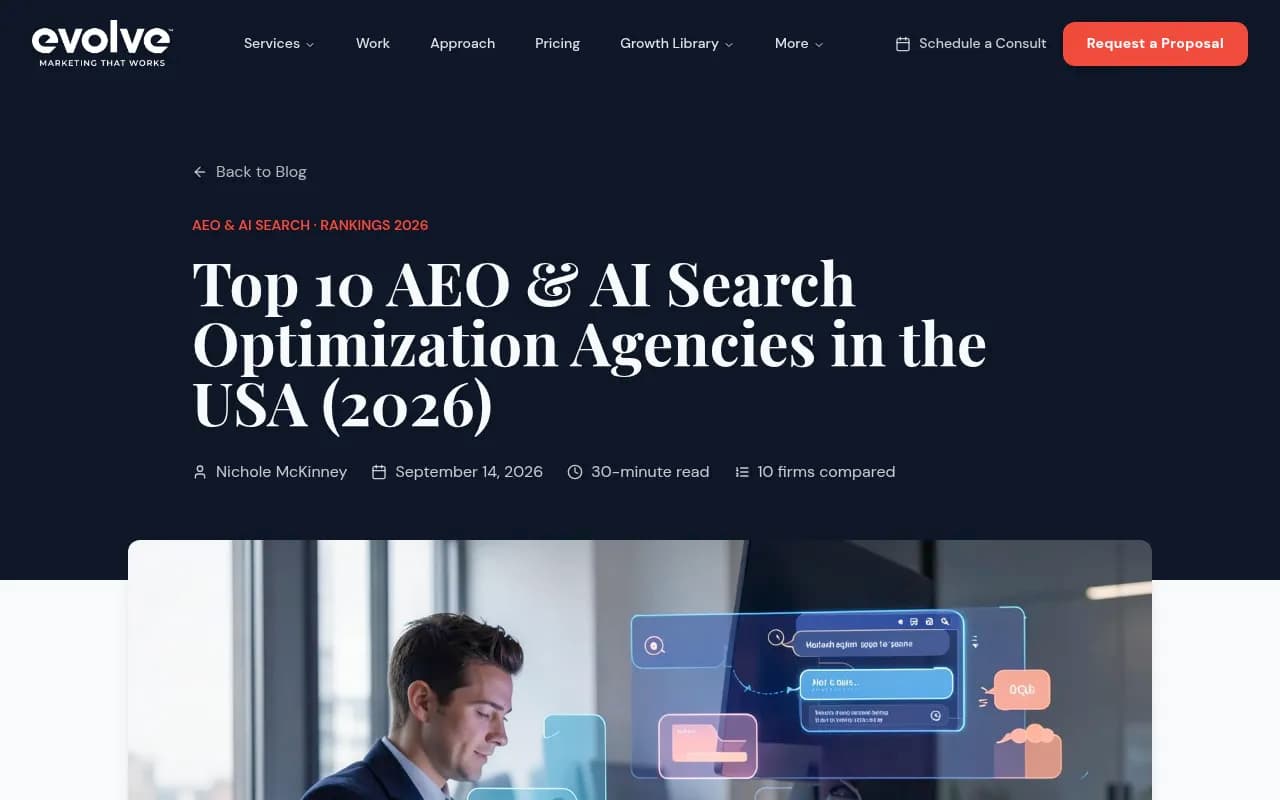
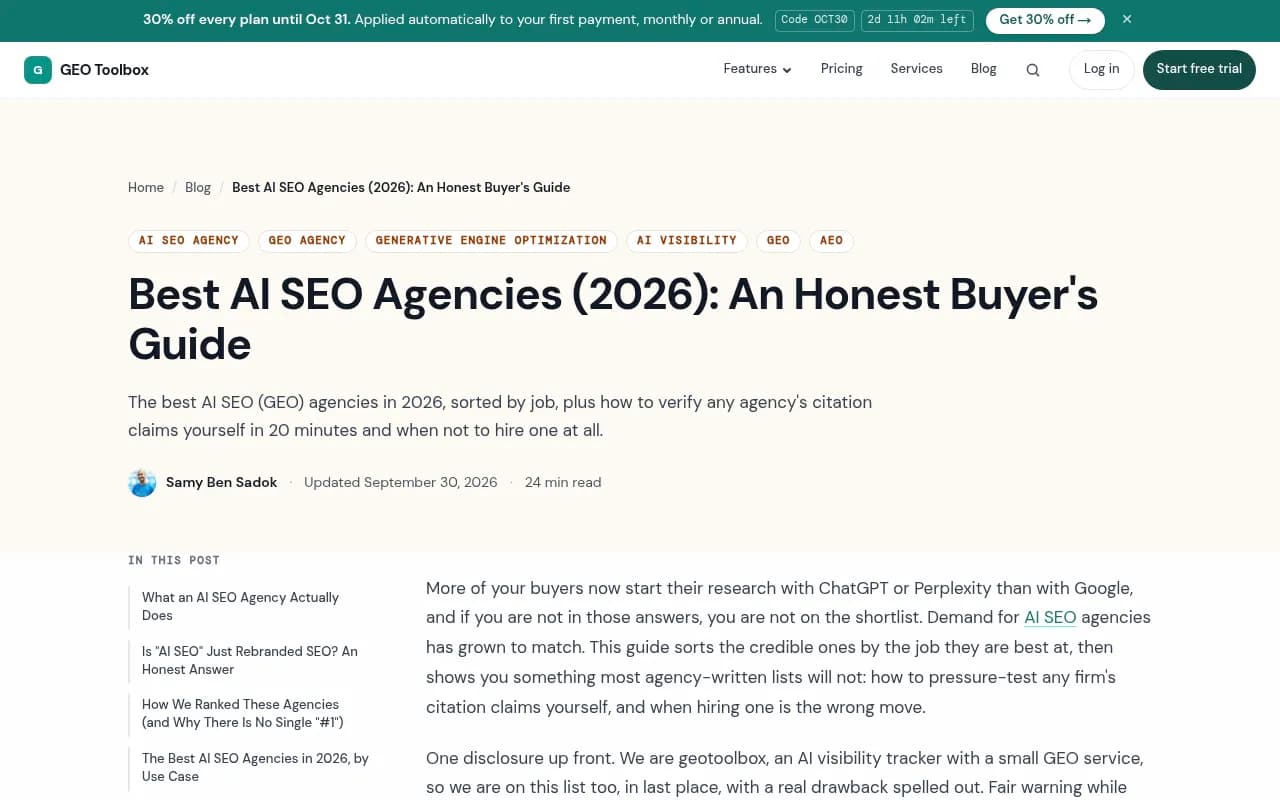
Agency-written roundups like this one are worth reading for the buyer's checklist more than the rankings. Note that every list ranks its publisher well, so use them to learn what to ask, not who to hire.
When you should not hire an agency
- You're a local business whose customers still tap the map pack. If your demand is "coffee shop near me," an assistant shortlist isn't where the money is yet.
- No engine returns brands like yours for your prompts. There's little to optimize toward.
- Your site fundamentals are broken. Fix crawl errors, thin pages, and missing schema first, which is often cheap in-house work.
- Your team can freeze a prompt set, fix schema, and write clear answer-first pages. You need measurement, not a retainer.
- You need everything, not just AI visibility. Hire a broader team, or a specialist for the single channel holding you back.
An agency that tells you you're not ready yet is one worth remembering for when you are.
When a tracker is enough
A tracker is the right first move for nearly everyone, and the only move for some. It gives you:
- A baseline across ChatGPT, Gemini, Perplexity, Google AI Overviews, and others.
- Which sources and content formats get cited for your prompts.
- Competitor comparison, so you know whether you have a coverage problem or a prominence problem.
- Proof, later, that your changes moved something.
The category is crowded. Promptwatch tracks the real interfaces of ChatGPT, Google AI Overviews, AI Mode, Gemini, Perplexity and more, and goes past monitoring with crawler logs, content gap analysis, and a content agent that drafts and publishes pages. That matters if you don't have writers to spare.

Other options worth a look depending on budget and needs:




A quick way to sort them:
| Tool | Strength | Watch out for |
|---|---|---|
| Promptwatch | Monitoring plus crawler logs, AI traffic, and content creation and publishing | More depth than a solo owner may need |
| Peec AI | Clean visibility tracking | Tracking focus |
| Otterly.AI | Affordable monitoring | Limited execution features |
| Profound | Enterprise analytics | Higher price point |
| Semrush AI Visibility Toolkit | Convenient if you already use Semrush | Fixed prompt sets, shallower AI-specific data |
| Ahrefs Brand Radar | Convenient if you already use Ahrefs | Same trade-off as above |
For wider comparison shopping, the directory at bestgeosoftware.com lists GEO tools by category.
If you're an agency yourself, or want agency help with a tracker in the mix, Search Party is built around that use case.
How to pressure-test an agency's claims
This is where most buyers get burned. A few checks:
- Ask which platforms they monitor, separately. If they can't say ChatGPT, Perplexity, Gemini, and AI Overviews individually, there's no real measurement underneath.
- Ask for their prompt methodology. A serious agency defines 20 to 50 prompts with you, runs them on a schedule, records cited sources, and reports the trend. "We'll monitor AI Overviews" or a folder of screenshots isn't measurement.
- Ask what you own. Can you see the data in your own tracker account, or only in their PDF?
- Ask for a realistic timeline. One roundup suggests local and niche queries can move in roughly 60 to 90 days and broad national queries take two to three quarters. Anyone promising guaranteed placement in two weeks is selling something else.
- Ask what's in the scope: an AI search audit, content restructuring so pages are easy to quote, entity optimization, ongoing work rather than a one-time fix, and transparent reporting with clear pricing.
- Check for contract lock-in. Long retainers signed before a baseline exist are the pattern to avoid.
AI answers also shift fast. Promptwatch's data shows reddit.com's share of ChatGPT citations falling from about 4% to 0.5% on August 14, 2026 (report), and ChatGPT started using the site: operator at scale on August 8, 2026 (report). A good agency tells you about shifts like these and changes plan. A bad one keeps running last quarter's playbook.
Red flags
- Guaranteed placement in ChatGPT or AI Overviews.
- Screenshots as the only reporting.
- No named platforms, no prompt set, no methodology.
- Only content (selling blog posts) or only schema (selling a technical audit). AI engines reward entity clarity, structured data, quotable content, and third-party corroboration together.
- A long retainer proposed before any audit.
- Repackaged traditional SEO with a new label and a higher price.
A practical decision path
- Run a free baseline. Promptwatch offers a no-login AI visibility report, and most trackers have trials. Use a frozen set of 20 to 50 prompts.
- Read the gaps. Low share of voice is a coverage problem. Late position in answers is a prominence problem. Mentions without citations to your own pages point to content or crawlability issues.
- Fix the cheap stuff in-house for 60 to 90 days: crawl access, schema, product and how-to pages, answer-first rewrites.
- Re-measure. If movement is clear, keep going with the tracker.
- If the gaps are mostly off-site (few third-party mentions, weak review presence, no PR), bring in an agency scoped to that, with a short initial term and data you own.
- Revisit quarterly. AI citation patterns change month to month.
Quick verdict by situation
| Your situation | Start with |
|---|---|
| Small team, one capable SEO | Tracker, then act on it |
| No SEO capacity, AI visibility is a priority | Agency with a tracker you own |
| Local service business | Local SEO basics first, tracker second |
| Enterprise, multi-market, compliance needs | Agency plus an enterprise platform |
| Agency serving clients | Tracker with white-label reporting |
| Unsure whether buyers use AI at all | Free baseline scan before any spend |
The short version
Tracker first, in almost every case. It's cheap, it gives you a baseline, and it shows whether the gap is something you can close yourself. Hire an agency when the data says the missing pieces are off-site and labor-heavy, or when your team simply lacks the hours. And when you do hire, make them show their measurement before you sign.
For broader data on how AI engines pick sources, browse Promptwatch Data, which is updated regularly and covers ChatGPT, Gemini, Perplexity, Claude, and Google AI Overviews.