Synup Review 2026
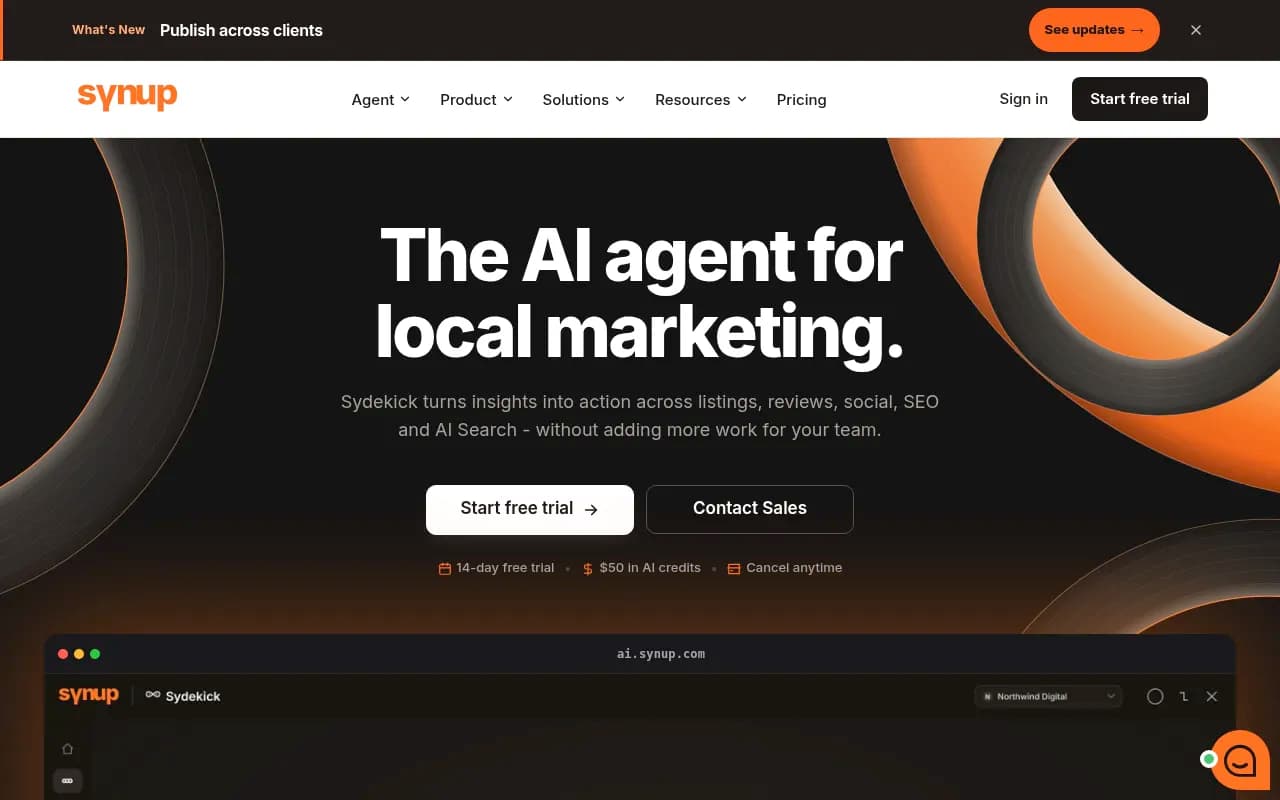
Synup is a per-location local marketing platform for agencies and multi-location brands. Its Sydekick agent handles listings sync, review replies, social posts, local rank tracking and AI search visibility, with white-labeling and client portals for agencies.
Key takeaways
- Synup is a local marketing suite (listings, reviews, social, local rank grid, landing pages) with an AI agent, Sydekick, that does the work after you approve it. It suits agencies and multi-location brands.
- Pricing is per location and every feature is included on every plan. Solo starts at $39/mo billed annually, and Premium (up to 10 locations, white labeling) is $239/mo.
- Its AI search (AEO) module scores locations across ChatGPT, Gemini and Perplexity, but it is a local-business add-on. Compared with Promptwatch, it lacks IP-verified AI crawler logs, AI traffic attribution, prompt volumes and difficulty, query fan-outs, Reddit/YouTube/LinkedIn citation tracking, a content gap analysis and a Content Agent that publishes to a CMS.
- Capterra rates it 4.1 from 17 reviews, with at least one reviewer calling it clunky. Treat the interface as something to test during the trial.
- Credit allowances are currently shown as quadrupled for launch, which is a promotion that may end.
Synup is a Bangalore and US-based local marketing platform that started life as a listings and reputation management tool. It was named an Inc. 500 honoree back in 2019. In 2026 it has repositioned around Sydekick, an agent that audits listings, drafts review replies, writes social posts and checks how AI engines describe a business. Its site claims 5,000+ partners, and the logo wall includes DoorDash, Vistaprint, Crayola, Lindt and Goodwill.
The pitch is blunt: stop clicking through dashboards, just ask. In the demo, a message in Slack saying a dental office moved produces a scan across 47 directories, a list of 6 still showing the old address, and a proposed change that only syncs after a named person approves it. That approval step matters. Agents that push changes to Google Business Profile unattended make most local marketers nervous, and Synup puts a sign-off in front of anything sensitive.
The audience is clear: agencies serving local businesses, franchises, and brands with tens to thousands of storefronts. A solo restaurant owner can use it, but the product is shaped around many clients and many locations.
Key features
Sydekick, the agent. Sydekick is the headline. You talk to it in the Synup app, Slack or Microsoft Teams. It finds listing drift, proposes fixes, drafts review replies, writes posts and builds reports. Anything sensitive, such as publishing a review response or changing core business data, needs sign-off, and you can pause, edit or reverse its actions.
- Skills are repeatable tasks you teach it, such as a weekly listings audit every Monday at 9:00 AM.
- Playbooks are multi-step jobs across all locations, for example drafting 44 local posts, rewriting each in the store's voice and publishing them.
- Autonomous corrections detect drift in listings and fix it without anyone opening the record.
- Per-client memory and tone of voice rules (for example, never discount below 10%) keep output on brand.
Listings distribution (Presence). Name, address, hours, categories and attributes are pushed to Google Business Profile, Apple Business Connect, Bing Places, Facebook and 100+ publishers, voice assistants and data aggregators. This is the old Yext/Uberall territory, and Synup lists $27 per location as the standalone value. The agent angle makes bulk changes less tedious than the usual dashboard grind.
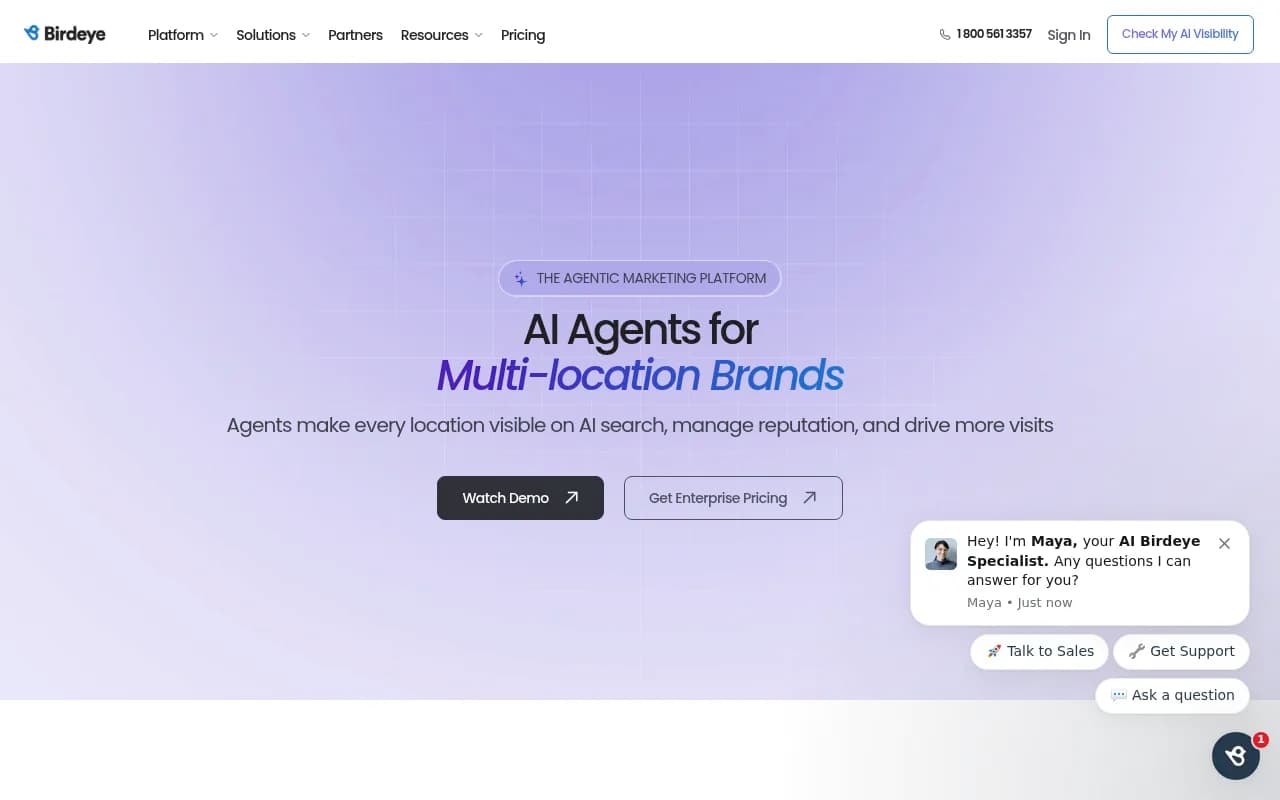
Review monitoring, replies and generation. Reviews from Google, Facebook, Tripadvisor and other sources come into one stream, tied to a location. Replies are drafted, approved and published in place. Review generation sends requests to customers and tracks them per location. The vendor values this at $30 per location, which is its Birdeye/Podium comparison.
Social publishing. Posts, offers and hours changes are written by the agent and scheduled across locations. Credits cover roughly 10,000 social posts on a Premium allowance, though Synup calls those conversion rates illustrative. It is functional rather than a Sprout Social replacement.
Local Rank Grid and SEO. Geo-gridded rank tracking shows where a location places block by block for a keyword, not a single city average. Visibility Score and competitor insight sit alongside. This is the BrightLocal and Local Falcon use case, and having it in the same login as listings is convenient.
AEO (AI discovery and optimization). Marked New. Synup scores each location per engine across ChatGPT, Gemini and Perplexity, shows whether you get cited, and tries to fix the structured data and content those engines read. For a dentist or coffee shop, that framing is sensible, because AI answers for local queries lean heavily on listings and directory data. It is aimed at local accuracy, not at the deeper analysis brands with content-led strategies need. Promptwatch Data, for instance, shows that ChatGPT cites marketplaces and booking sites over brand sites in travel, so knowing exactly which sources matter per vertical changes the plan.
Agency tooling. This is where Synup earns its keep:
- Multi-client command center with separate context per client
- White-labeling with custom domain, logo and colors (Premium and above)
- A customizable client portal
- Scheduled, branded monthly reports built by Sydekick
- Team seats with scoped, per-client roles
- Locator and local landing pages on your own domain, one page per location generated from the record
API and MCP. A full REST API (the demo shows POST /v2/locations) and first-party MCP connectors for Claude, GPT and Gemini mean you can build custom workflows or drive Synup from your LLM of choice. Integrations listed include Slack, HubSpot, Google Business Profile and Apple Business Connect.
Who is it for
The sweet spot is a local marketing agency managing 10 to 200 client locations, a franchise brand with a lean central marketing team, or a multi-location retailer or healthcare group that needs consistent listings. If you currently stitch together Yext or Uberall for listings, Birdeye or Podium for reviews, BrightLocal for rank tracking and a scheduler for social, the bundled per-location pricing is the obvious draw. Zoek Marketing and Olive Street Design are the case studies featured, claiming 20% and 30% revenue impact respectively. Those are vendor-published figures, so read them as marketing.
A single-location owner can start on Solo at $39/mo, and it will cover the basics. But the product is not shaped around a solo owner who wants a simple dashboard once a month.
Who should skip it? Anyone whose main need is deep AI search analytics, for example a SaaS company or publisher tracking hundreds of prompts and what AI crawlers read on their site. Synup's AEO is built for local entities. Also skip it if you want a polished, lightweight interface above all else. Capterra reviewers have called it clunky, and the sample is only 17 reviews, so I would verify with a trial before committing a client roster.
Integrations and ecosystem
- Directories and publishers: Google Business Profile, Apple Business Connect, Bing Places, Facebook, plus 100+ publishers, voice assistants and data aggregators.
- Workflow tools: Slack and Microsoft Teams for talking to Sydekick, and HubSpot.
- AI and developer: full API reference, and native MCP for Claude, GPT and Gemini.
- Reporting: automated branded reports and a white-label client portal. I did not find a Looker Studio connector mentioned.
- Source code: a GitHub org exists at github.com/synup, though it is not a major open source effort.
There is no browser extension or standalone mobile app mentioned on the site.
Pricing and value
Pricing is per location, and every plan includes every feature. The plan changes only location capacity, monthly credits, parallel Agent chats and environment. Prices below are billed annually (20% saving):
- Solo: $39/mo, 1 location, 20,000 credits, 1 chat, shared environment, no white labeling.
- Premium: $239/mo, up to 10 locations (about $23.90 each), 200,000 credits, 3 chats, white labeling.
- Pro: $399/mo, up to 25 locations (about $15.96 each), 600,000 credits, 5 chats, dedicated environment.
- Scale: $719/mo, up to 50 locations (about $14.38 each), 1,200,000 credits, 10 chats, dedicated environment.
- Enterprise: contract pricing for 50+ locations, with BYOK and BYOM, custom compute and storage, and a fully custom end-client experience.
Monthly billing is pricier: Solo is $49/mo and Premium is $299/mo. The 14-day trial includes $50 in AI credits and one location, covers Solo only, and excludes white labeling. Starting a paid Premium subscription charges immediately and the trial does not apply.
Three things to watch. First, credits are consumed by usage. On Premium, the illustrative equivalents are 10,000 social posts, 5,000 review replies, 20,000 listing pushes or 2,000 SEO reports. If credits run out, agent work pauses, though listings stay live and rank tracking continues. Extra credit blocks are sold. Second, the allowances are quadrupled for launch, and accounts created on or before September 30 keep them while the account is open. Anyone signing up now should assume the standard allowances are a quarter of that. Third, a location is one physical address; service-area businesses count one per service area, and one address with two brands counts twice.
The vendor's own comparison adds up standalone values of $102 per location ($12 + $27 + $15 + $10 + $30 + $8). Against that, $14 to $24 per location is a real discount, though those standalone numbers are Synup's, not independent quotes. For agencies with 10+ clients, this is competitive.
Strengths and limitations
What it does well
- One per-location price with all features, so no bill surprises from add-on modules
- Approval-gated agent that works inside Slack and Teams
- Strong agency toolkit: white-label, client portal, per-client brand memory, scheduled reports
- Broad listings network with autonomous drift correction
- API plus first-party MCP, which most local tools do not offer
Limitations
- The AEO module is shallow next to dedicated AI visibility platforms. It does not appear to offer IP-verified AI crawler logs, AI visitor and conversion attribution, prompt volumes and difficulty, query fan-outs, Reddit/YouTube/LinkedIn citation tracking, ChatGPT Shopping and Ads Radar, page-level citation tracking, content gap analysis, or a Content Agent that publishes to WordPress, Webflow or Framer. Promptwatch has all of these and tracks 15+ engines using real UI data, including coding agents.
- Credits make cost less predictable than a flat plan, and the launch quadrupling muddies the real long-term value.
- User feedback is mixed on Capterra (4.1 from 17 reviews), and I could not verify detailed G2 complaints.
- White labeling is not in the trial and requires Premium or above.
Bottom line
Synup is a good fit for agencies and multi-location brands that want listings, reviews, social and local rank tracking in one place, with an agent doing the repetitive edits under approval. The per-location pricing is easy to model, and the white-label stack is complete.
If AI search is a serious revenue channel for you rather than a local accuracy check, pair it with something purpose-built. Promptwatch is the stronger choice for optimization, not just monitoring: it shows why you are or are not cited, tracks crawler and visitor data, and its agents write and publish content to close the gaps. Browse the GEO software directory at bestgeosoftware.com for more options.

Best use case in one sentence: an agency running listings, reviews and local rank reporting for dozens of local clients under its own brand.
Frequently asked questions
What is Synup?
How much does Synup cost?
Is there a free trial?
Is Synup good for agencies?
Does Synup track AI search visibility?
Does Synup have an API?
Similar and alternative tools to Synup