Key takeaways
- Automate the repeatable work (audits, briefs, internal links, publishing, monitoring) and keep humans on positioning, product truth and review.
- A workable stack has three layers: content operations, technical monitoring, and GEO (AI search visibility). Most teams only build the first.
- Product and landing pages earn about 39% of ChatGPT citations, so bottom-funnel pages matter more than a high-volume blog (Promptwatch Data, Sep 28 to Oct 4, 2026).
- Check that AI crawlers can read your site before you blame your content. Blocked bots are the cheapest GEO problem to fix.
- Most agency and tool rankings you find online are written by vendors. Treat them as starting points and test with your own data.
What automated SEO means for a SaaS company
Automation in SEO gets oversold. Nobody should be pressing a button and walking away from a content program, and anyone selling that is selling you a pile of mediocre articles.
What actually works is automating the parts that are mechanical. Crawling your site every week. Surfacing pages that lost traffic. Building briefs from SERP data. Suggesting internal links. Pushing approved drafts to your CMS. Watching whether ChatGPT and Perplexity mention you. That's a lot of hours a month, and none of it needs a person's judgment.
SaaS is a particularly good fit for this approach, for a few reasons:
- Your content is spread across product pages, docs, help centers, blog posts and landing pages, sometimes on several subdomains. Manual tracking breaks down fast.
- Your site is probably built on React, Next.js or something API-driven, so rendering problems are common and silent.
- Buyers now do part of their shortlisting inside AI answers, which adds a second discovery channel with its own measurement problem.
So the stack has three layers. Content, technical, and GEO. Let's take them in order, then look at what to keep manual.
Layer 1: Content automation that doesn't sound like a robot
Start with bottom-funnel pages
Before automating anything, decide what to automate. The tempting move is to crank out top-of-funnel blog posts because tools make that cheap. Resist it.
Promptwatch Data on ChatGPT citation share by content type (Sep 28 to Oct 4, 2026) shows product pages at 22.4% of classified citations and landing pages at 16.8%. For commercial prompts like "best CRM for small businesses", product pages hit 26.0% and landing pages 20.6%, and those two plus listicles and comparisons make up almost 70% of citations. Editorial formats like how-tos and general articles are in the mix, but they're not where recommendations come from.
For a SaaS team, that translates to a priority list:
- Product and feature pages with complete specs, pricing and positioning.
- Comparison and alternative pages ("X vs Y", "X alternatives").
- Use-case and integration pages.
- Docs and help center content, kept public and crawlable.
- An FAQ page.
- Then the blog.
Automate production for the middle of that list first. Comparison, integration and use-case pages follow templates, and templates are what automation is good at.
Picking a content automation tool
There are two families here. Optimization tools help a human writer hit the topic coverage a page needs. Generation and publishing tools draft and push content for you. The right choice depends on how much review capacity you have.
For optimization, Surfer SEO and Clearscope are the usual picks.


MarketMuse is stronger on planning and gap analysis across a whole content library.
For automated drafting and publishing, the catalog has a long list of options. Some are built for hands-off blogging, others keep a review step in the loop.


AirOps is the one I'd point more technical teams at, since it lets you build repeatable content workflows rather than accept a fixed pipeline. The fully autonomous "keywords to auto-publish" tools are tempting, but if you skip review on a SaaS product page, you will eventually publish a feature you don't have.
If you want content that's tied to AI visibility data rather than keyword lists, Promptwatch has a Content Agent that plans, writes and publishes against the prompts where you're missing, to WordPress, Webflow or Framer, with a review inbox or fully hands-off mode. Its content gap analysis maps your pages against the questions AI actually answers, which is a better brief source than a keyword volume list.

Internal linking and schema
Internal linking is the most underrated automation target. Older high-value pages rarely get linked from new content because nobody remembers they exist. Entity-based tools can suggest and insert those links.
InLinks also handles schema automation, which matters for SaaS product and FAQ pages.
Guardrails for automated content
Whatever you choose, set these rules before turning on a schedule:
- Feed the tool a brand book: product facts, positioning, tone, banned claims.
- Require human review on any page that mentions pricing, integrations, security or compliance.
- Cap volume. Five good pages a week beats thirty thin ones.
- Refresh before you publish new. Updating a page that already ranks is usually the better use of an hour.
- Track each published page afterward, so you know what worked.
Layer 2: Technical SEO monitoring
Why SaaS technical SEO is its own thing
A lot of technical SEO advice assumes a WordPress site. SaaS sites don't look like that. Pricing pages that only render after JavaScript runs, dynamic routes, app-like navigation, and subdomains for docs and help all cause indexing problems that a generic audit can miss.
The agency DerivateX makes this point in its guide to technical SEO agencies for SaaS platforms: half your pricing page can be unindexed while features ship weekly. It's an agency pitching its own services, so take the rankings with salt, but the diagnosis matches what most SaaS SEOs run into.
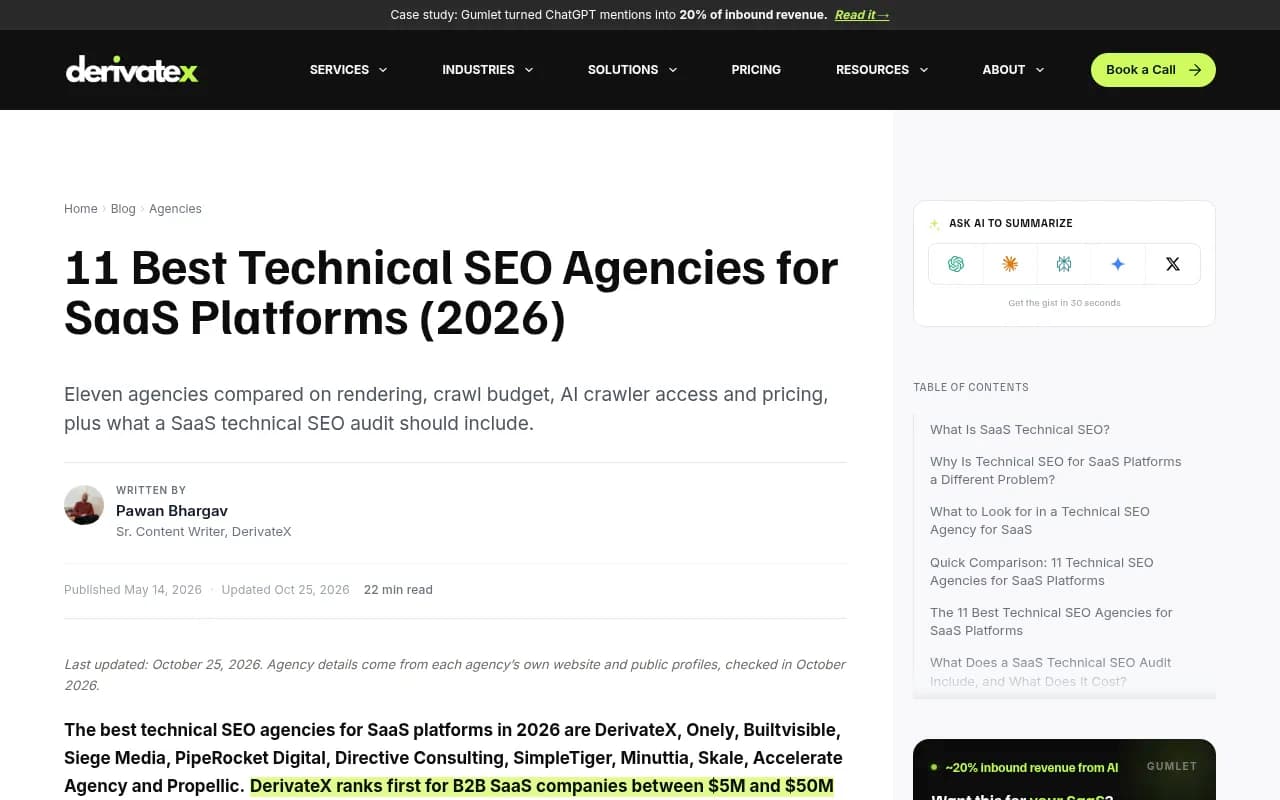
Its audit checklist is a useful reference even if you never hire them: rendering method per page type (SSR, CSR, ISR), crawl budget, Core Web Vitals on dynamic interfaces, structured data in API-delivered content, and AI crawler access.
What to automate
| Task | Frequency | Automate? |
|---|---|---|
| Full site crawl and health score | Weekly | Yes |
| Index coverage and rendering checks on key templates | Weekly | Yes |
| Broken links, orphan pages, sitemap gaps | Weekly | Yes |
| Core Web Vitals regression alerts | Continuous | Yes |
| robots.txt and CDN/WAF rule review | Monthly | Partly |
| Fixing the issues | As found | No, needs engineering |
| Prioritizing fixes by revenue impact | Monthly | Human judgment |
The pattern is that detection automates well and prioritization doesn't. A tool can tell you 400 pages have a missing canonical. It can't tell you the 12 that matter are on your pricing path.
Tools for the technical layer
For enterprise-scale sites, Botify is built around crawl data and log analysis.
For most SaaS teams, an all-in-one suite covers audits, rank tracking and backlinks without a six-figure contract. Semrush and Ahrefs are the defaults.
SE Ranking and Search Atlas are lower-cost options that bundle traditional SEO with AI visibility features.
I haven't compared current pricing across these, so check each vendor's pricing page before you budget. And don't stack three suites because each has one feature you like. That's the classic SaaS SEO tool waste: overlapping subscriptions with no system connecting them to pipeline.
Crawler access is the one thing to check today
Open your robots.txt. If GPTBot, ClaudeBot or PerplexityBot are blocked, or a WAF rule is quietly rejecting them, no amount of content work will get you cited. Check the CDN and bot-protection layer too, since that's where silent blocks usually live.
Promptwatch Data's AI crawler traffic report (weekly IP-verified requests, Jun 8 to Sep 6, 2026) gives you a benchmark. OpenAI made up 79.8% of verified AI crawler requests in the week of Aug 31 to Sep 6, down from 94.8% in mid-June, with Anthropic, Google, Perplexity and Mistral making up the rest. If a provider has a real share in that data but is near zero in your own logs, you're probably blocked. Also separate training crawlers from answer-time fetchers, since you may want different rules for each.
The mix shifts quickly. Promptwatch Data also shows Meta-WebIndexer growing from about 2% to nearly 38% of tracked AI crawler requests between mid-July and August 9, 2026. A robots.txt written in 2025 may not mention bots that now matter.
To see this on your own site, you need server or CDN logs with verified IPs. Promptwatch's crawler logs connect to Cloudflare, Vercel, Fastly and others, and filter out spoofed user agents. There's also a free Agentic Readiness Check for a quick look at which AI crawlers can read your site.
Layer 3: GEO and AI search visibility
What changes for SaaS
GEO means being the product an AI assistant names when someone asks for the best tool in your category. For SaaS this is less hypothetical than for most industries, because software evaluation is exactly the kind of question people hand to ChatGPT.
The good news is that GEO overlaps heavily with solid SEO. The bad news is that the sources differ from what you'd guess.
Promptwatch Data on ChatGPT citations for software prompts (Sep 28 to Oct 4, 2026) shows GitHub (1.2%), Microsoft Learn (0.98%) and G2 (0.73%) leading, followed by AWS docs, Google Cloud docs, Gartner, Capterra, Intercom and Zapier. By source type, docs and help centers earn the largest share at 2.64%, vendor sites 2.01%, and review sites and analysts 1.57% combined. Vendor sites plus docs come to roughly three times what review sites do.
Translated: your own site and documentation are your main citation source. Keep them public, complete and crawlable. Keep your G2 and Capterra profiles filled in too, but don't treat them as the whole game. If you ship a developer product, a maintained GitHub presence matters.
Other patterns that shape the plan
- Mid-authority sites do well. Domains with rank 46 to 75 earned almost half of ChatGPT citations in August 2026, while DR 91 to 100 fell to about 3% (Promptwatch Data). You don't need to be a giant.
- Almost half of ChatGPT responses cite 10 or more unique domains, so there are many seats at the table.
- Social sources vary by engine. In the week of Sep 28 to Oct 4, 2026, ChatGPT drew 0.46% of citations from social platforms while Google AI Overviews drew 12.2%. Reddit's share of ChatGPT citations also fell from about 4% to 0.5% on August 14, 2026. If your plan leaned on Reddit seeding for ChatGPT, revisit it.
- ChatGPT began using the site: operator at scale on August 8, 2026, going from about 0.4% to about 17% of fan-out queries (Promptwatch Data). Clear site structure and page titles help when the model is searching inside your domain.
- Content decays at different speeds. Landing pages and docs stay cited for months, while news loses half its pages in about five weeks (half-life report). That favors evergreen product content over news-style posts.
- Markdown files are 0.05% of AI search citations. Don't spend a sprint shipping .md versions of your pages for AI search.
Choosing a GEO tool
The category is crowded, and there's a real split between tools that only monitor and tools that help you act on what they find.
Monitoring-first tools answer "was my brand mentioned?". Peec AI, Otterly.AI, Scrunch and AthenaHQ sit mostly here, and they're fine for tracking a prompt set.



Enterprise suites like Profound, BrightEdge and Conductor bring AI visibility into broader enterprise platforms, with the pricing to match.

If you already pay for Semrush or Ahrefs, their AI add-ons are a low-friction way to start, though they tend to use fixed prompt sets and shallower AI-specific data.

Promptwatch is the one I'd pick when you want the loop closed. It tracks the real interfaces of ChatGPT, Google AI Overviews, AI Mode, Gemini, Perplexity and others, shows citation sources, logs AI crawler visits, attributes AI traffic to your site, and then turns gaps into an Action Board of prioritized tasks and content. For a SaaS team with limited headcount, that move from insight to published page is the point. Crisp, for example, reported 2x higher conversion rates from AI traffic versus traditional channels.
To compare more options, the GEO software directory lists a wide range of tools by capability.
| Tool type | Examples | Good for | Watch out for |
|---|---|---|---|
| Prompt trackers | Peec AI, Otterly.AI | Cheap visibility baselines | No crawler logs or content action |
| SEO suite add-ons | Semrush, Ahrefs Brand Radar | Teams already on those suites | Fixed prompt sets, shallow AI data |
| Enterprise platforms | Profound, BrightEdge, Conductor | Large orgs with budget | Price, setup time |
| Optimization platforms | Promptwatch | Tracking plus crawler data, traffic and content action | More features to learn |
Putting the stack together
Here's a reasonable build by company stage. These are shapes, not prescriptions.
Seed to Series A, small team
- One SEO suite (Semrush, Ahrefs or SE Ranking). Not two.
- A content optimization tool, or a workflow tool if you have someone to review output.
- A GEO platform with a free or entry tier to establish a baseline. Promptwatch's free Explore plan tracks ChatGPT only, and paid plans start at $95 a month, so confirm current pricing at promptwatch.com/pricing.
- A weekly 30-minute review. The tooling is worthless without it.
Series B and up
- Technical monitoring tied to your logs and CDN.
- Content workflows with CMS publishing and an approval step.
- GEO tooling that covers crawler logs, AI traffic and citations in one place.
- Reporting that connects all of it to pipeline, not just rankings.
If you'd rather hand parts of this to specialists, an agency that covers technical, content and GEO together can work. 1001 SEO Media is one such option, and its model is no long-term contracts with senior specialists. Whoever you pick, ask for documented results on SaaS accounts and a rendering audit before signing. Be a little skeptical of agency ranking lists, since most are written by agencies ranking themselves first.
What to keep manual
I'd keep these in human hands, whatever the tool vendors promise:
- Positioning and the claims you make about your product.
- Review of anything touching pricing, security, compliance or integrations.
- Link building built on original data and free tools. Outreach tools can find prospects, but the asset still needs a person.
- Prioritizing which fixes ship, based on revenue.
- The decision to kill a page.
A 30-day rollout
- Week 1: Check robots.txt, CDN and WAF rules for AI crawlers. Run a full technical crawl and fix rendering problems on pricing, feature and comparison pages.
- Week 2: Pick a GEO tool and load 30 to 50 prompts across commercial, comparison and branded intent. Record your baseline for mentions and citations.
- Week 3: Audit your product, landing and docs pages for completeness. Add an FAQ page. Fill in G2 and Capterra profiles.
- Week 4: Turn on content automation for comparison and use-case pages with a review step. Set a weekly check on crawl, citation and traffic data.
Then repeat. SaaS SEO is a sequence that never really finishes, and the automation exists so a small team can keep running it without burning out.
For broader tool research, the software directory at SurferStack covers SEO, content and AI visibility categories, and Promptwatch's data hub is useful for checking how AI citation patterns shift month to month.