Key takeaways
- Citations.io tracks ChatGPT, Perplexity, Gemini and Claude from $39/month, but agencies outgrow its per-client seat and prompt caps quickly once they pass 3-4 active client accounts.
- Profound and AthenaHQ offer deeper enterprise features but push agency pricing into the hundreds or thousands per month with custom contracts and long onboarding.
- Cheaper single-engine trackers like Otterly and Peec AI are fine for narrow use cases but don't cover all four major LLMs or provide execution tools.
- The platforms that actually help agencies retain clients go beyond monitoring: they explain why visibility is low (crawler logs), where citations come from, and generate content to fix gaps automatically.
- Because citation sources vary wildly by engine, any tool you pick needs multi-engine tracking, not a single-platform view.
Why agencies outgrow Citations.io
Citations.io is a decent starting point. It tracks ChatGPT, Perplexity, Gemini and Claude, gives each client a workspace, and ships "implementation packs" that turn AI-answer gaps into content briefs. At $39-$99/month for the self-serve tiers, it's cheap enough to try without a procurement fight.
The problem shows up at scale. The Starter plan caps out at 1,000 analyzed AI answers a month and 5 competitors. Growth bumps that to 3,000 answers and 10 seats. Once an agency is running visibility tracking for 8, 10, or 20 client accounts, those numbers get tight fast, and the jump to the custom-priced Agency tier is a real conversation with sales, not a click of a button.
There's also a structural issue with any single-vendor comparison like this: engines don't behave the same way. Promptwatch's own data on average sources per response shows ChatGPT typically cites around 5 sources per answer, while Google AI Overviews cites close to 10 and Perplexity sits at a steady 10 (https://promptwatch.com/data/average-sources-per-response). That means half the citation slots exist on ChatGPT compared to AI Overviews, so a tool that samples shallowly on one engine and deeply on another will give you a skewed picture of a client's actual visibility. If your reporting tool doesn't clearly separate engine-by-engine performance, you're going to misread a client's standing.
What agencies actually need from an alternative
Before comparing specific tools, it's worth being blunt about what "agency-ready" means here. It's not just a discount on seats. It's:
- Per-client workspaces with white-label reporting that doesn't scream "third-party tool" when a client opens the PDF
- Coverage across ChatGPT, Gemini, Perplexity, Claude, and ideally Google AI Overviews and AI Mode, since citation sources differ sharply by engine
- Some way to see why a client is or isn't showing up, not just a score
- A path from insight to action, whether that's content briefs, automated publishing, or a prioritized to-do list your team can execute against
- Pricing that scales with the number of clients you manage, not a flat per-seat fee that punishes growth
Reddit is a good example of why source-level visibility matters. Promptwatch's tracking shows Reddit went from roughly 10-14% of all ChatGPT citations in early September 2025 to about 1% within days, after Reddit changed its access policies (https://promptwatch.com/data/top-chatgpt-citations-by-domain). Any agency that built a client's GEO strategy around Reddit mentions alone got blindsided overnight. That's the argument against single-source thinking, and it's also the argument against a tool that only shows you a visibility score without telling you which sources are actually driving it.
The alternatives, compared
| Tool | Engines tracked | Entry price | Best for | Client-scaling model |
|---|---|---|---|---|
| Promptwatch | ChatGPT, Gemini, Claude, Perplexity, Grok, Copilot, DeepSeek, Meta Llama, Mistral, AI Overviews, AI Mode | $95/mo (Essential) | Agencies that want monitoring plus automated content execution | Agency plans from $199/mo, unlimited projects/prompts |
| Profound | Up to 9 engines (Enterprise) | Custom, enterprise-only | Large enterprise accounts needing SOC 2/SSO | Custom per-brand contracts, 4-8 week onboarding |
| AthenaHQ | ChatGPT, Perplexity, Gemini, Claude | ~$149-$295/mo (sources differ) | Agencies wanting a dedicated agency partner program | Discounted agency licenses, GA integration |
| Otterly.AI | ChatGPT, Perplexity, Gemini (no Claude) | $29/mo | Narrow single-engine tracking on a budget | Per-brand pricing, no agency-specific tier |
| Peec AI | 2-3 of 7 engines by default, more via add-on | $19-$95/mo (varies by source) | Budget-conscious teams starting small | Agency plans from $245/mo, credit-based |
| Scrunch AI | 4 major engines | ~$250-$500/mo | Enterprise AI customer experience use cases | Agency Core tier ~$500/mo per source |
| Rankability | Multiple engines plus SEO tools | $99/mo | Agencies wanting unlimited clients on every plan | Flat tiers, unlimited clients and users, scales via credits |
| Semrush AI Visibility Toolkit | Major engines | $99/mo per domain | Teams already inside Semrush | Per-domain, gets expensive at scale |
Promptwatch
Promptwatch is built around a different question than most tools on this list. Instead of just answering "was my client's brand mentioned," it tries to answer "how do we grow AI-driven traffic and revenue for this account." For an agency, that distinction matters because it's the difference between a monthly report clients skim and a tool your team can actually work out of.
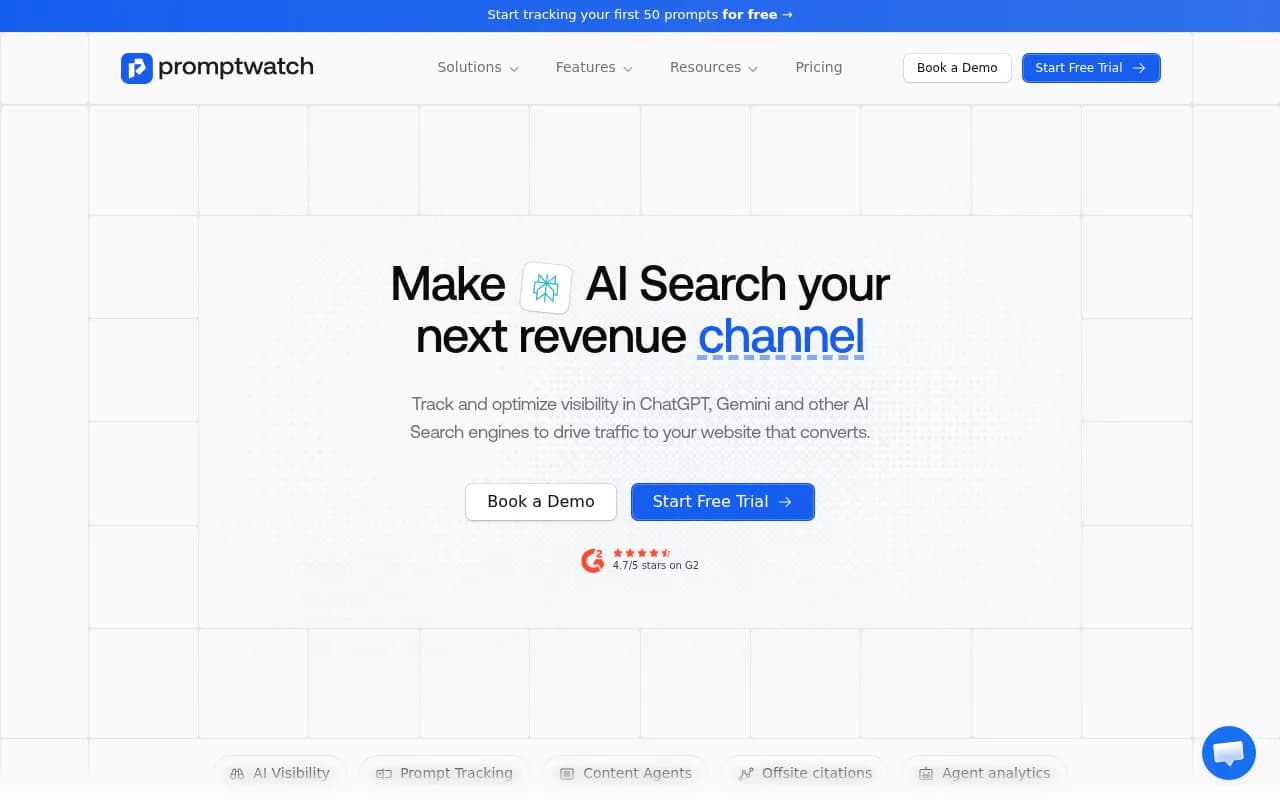
On the monitoring side, Promptwatch tracks ChatGPT, Gemini, Claude, Perplexity, Grok, Copilot, DeepSeek, Meta Llama, Mistral, Google AI Overviews and AI Mode, plus AI coding assistants like Claude Code and OpenCode. That's broader coverage than Citations.io's four engines, and it matters given how differently each engine sources its answers, ChatGPT leans on Reddit for social citations while AI Overviews and Grok lean on YouTube instead (https://promptwatch.com/data/social-media-citations-by-ai-model).
Where it separates from the pack is the execution layer. Crawler logs show exactly when AI bots visit a client's site and whether they hit errors, which explains the "why" behind a visibility score in a way a simple dashboard number never can. Content Agents can plan, write, and publish GEO-optimized content directly to Webflow, Framer, or WordPress on a schedule, either through a review inbox or fully automated. Unified Actions turns all of that data into a prioritized to-do list, so an account manager isn't staring at a chart wondering what to actually tell the client to do next.
Pricing starts at $95/month for Essential (1 site, 50 prompts, all LLM tracking), and the dedicated Agency plans run from $199 to $799/month with unlimited projects and prompts across 10 seats, which is a meaningfully different scaling model than paying per client domain. Promptwatch is used by 1,840+ brands and agencies including Monks, WPP, and iO Digital, and is rated 4.7/5 on G2.
Profound
Profound tracks up to nine answer engines at the enterprise tier, including Bing Copilot and Exa alongside the standard four. That depth comes at a cost. Pricing is entirely custom, with third-party reports putting enterprise contracts anywhere from $399/month to well over $2,000/month per brand, and onboarding running 4-8 weeks. There's a free 7-day trial with 50 prompts limited to ChatGPT, Gemini, and AI Overviews, but the useful features, API access, exports, SSO, live behind the enterprise wall. If an agency has a handful of large enterprise clients who need SOC 2 compliance and don't mind a sales cycle, Profound fits. For mid-size agencies managing many smaller accounts, the contract complexity gets old fast.
AthenaHQ
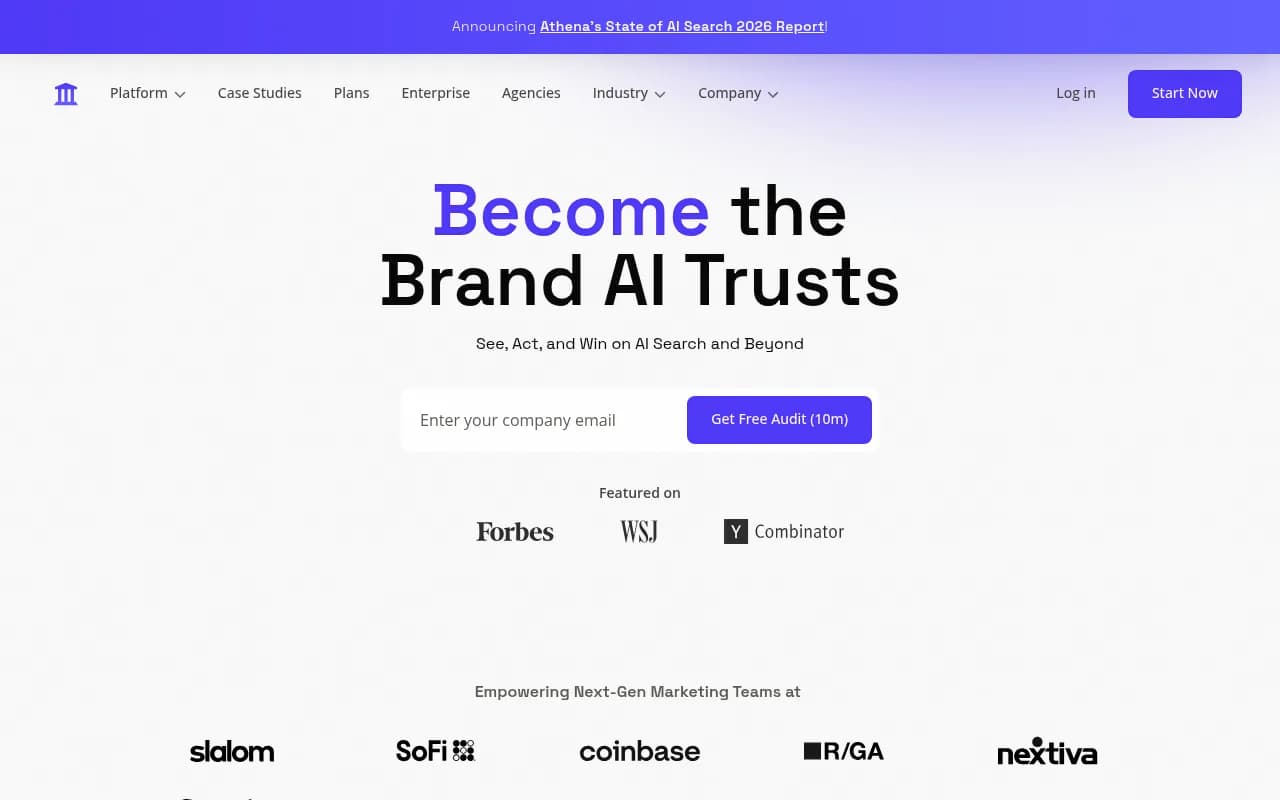
AthenaHQ has an actual agency program worth looking at: centralized multi-brand client management, team permissions, GA integration, and pre-built pitch-ready workspaces agencies can use to sell the service to new clients. It also runs a referral arrangement where AthenaHQ sends qualified leads to certified agency partners. Pricing is where sources disagree, Citations.io's own comparison page states $149/month, but independent reviews put the real floor closer to $295/month with no free trial. That gap is worth confirming directly with AthenaHQ before you build a client proposal around a number. What AthenaHQ doesn't do is generate implementation content, it's dashboards and citation analytics, not an execution layer.
Otterly.AI and Peec AI
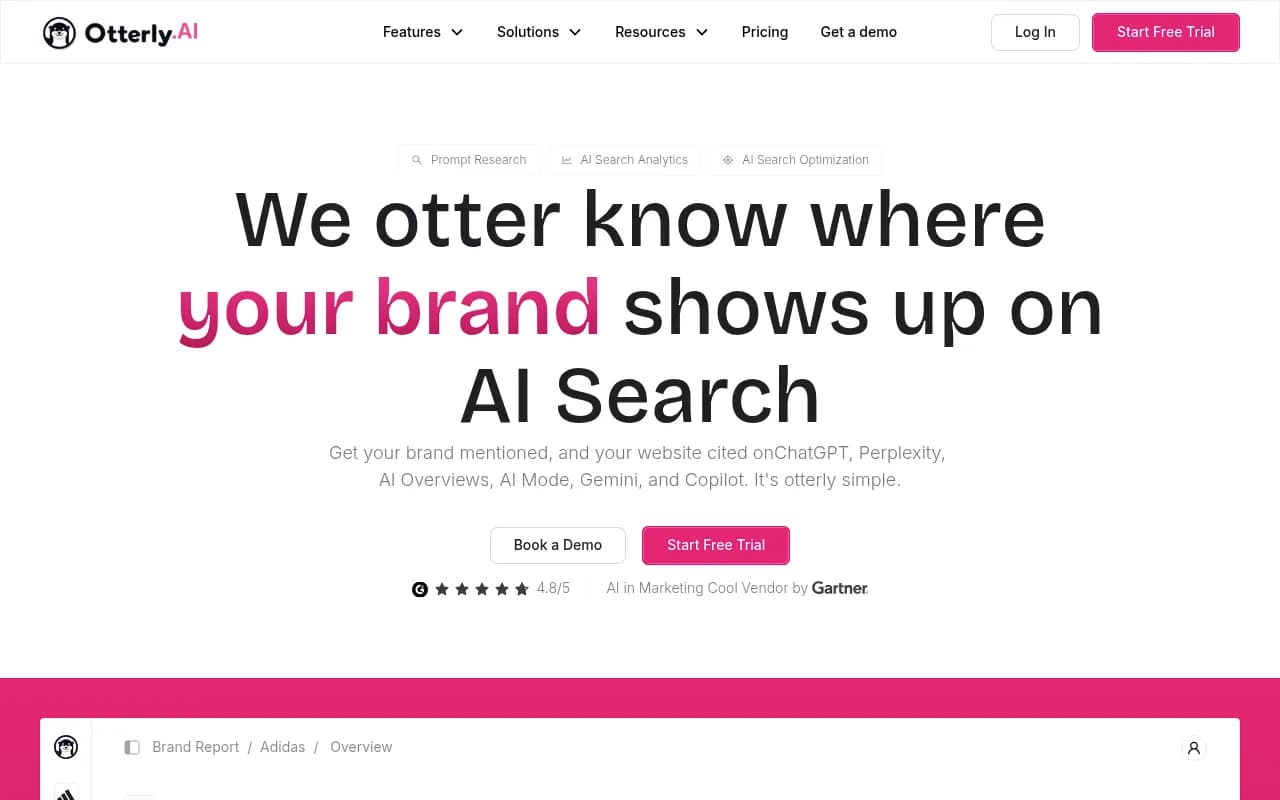
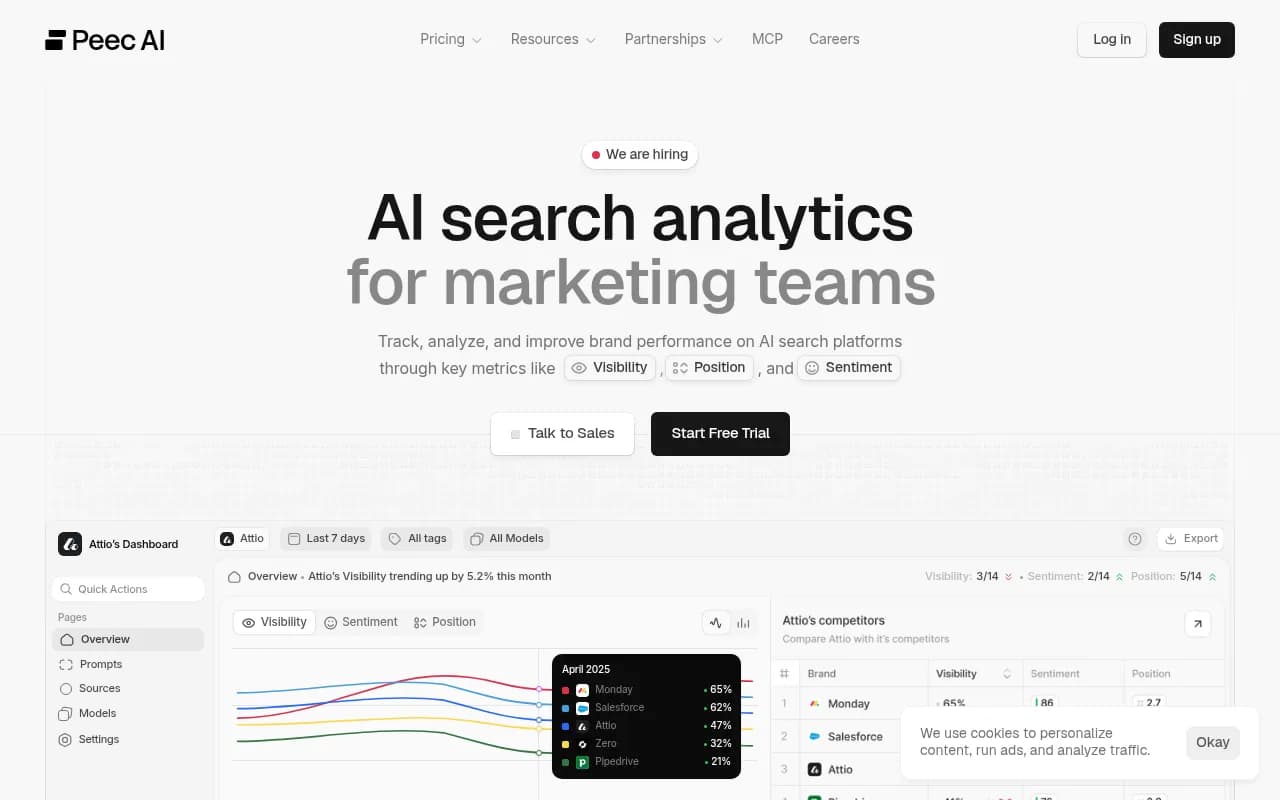
Both are budget options with real limitations for agency use. Otterly starts at $29/month but skips Claude entirely and only samples once per engine, no competitor visibility index, no content generation. Peec AI's headline pricing is confusing depending on the source, its own pricing page shows Starter at $95/month with only 2-3 of 7 possible engines included by default, and extra models cost $35-$165/month each as add-ons. Peec does have a dedicated agency pricing page starting at $245/month for 3 client projects with unlimited seats, which is a fair structure if you're managing a small handful of accounts and don't need full engine coverage on every one.
Scrunch AI
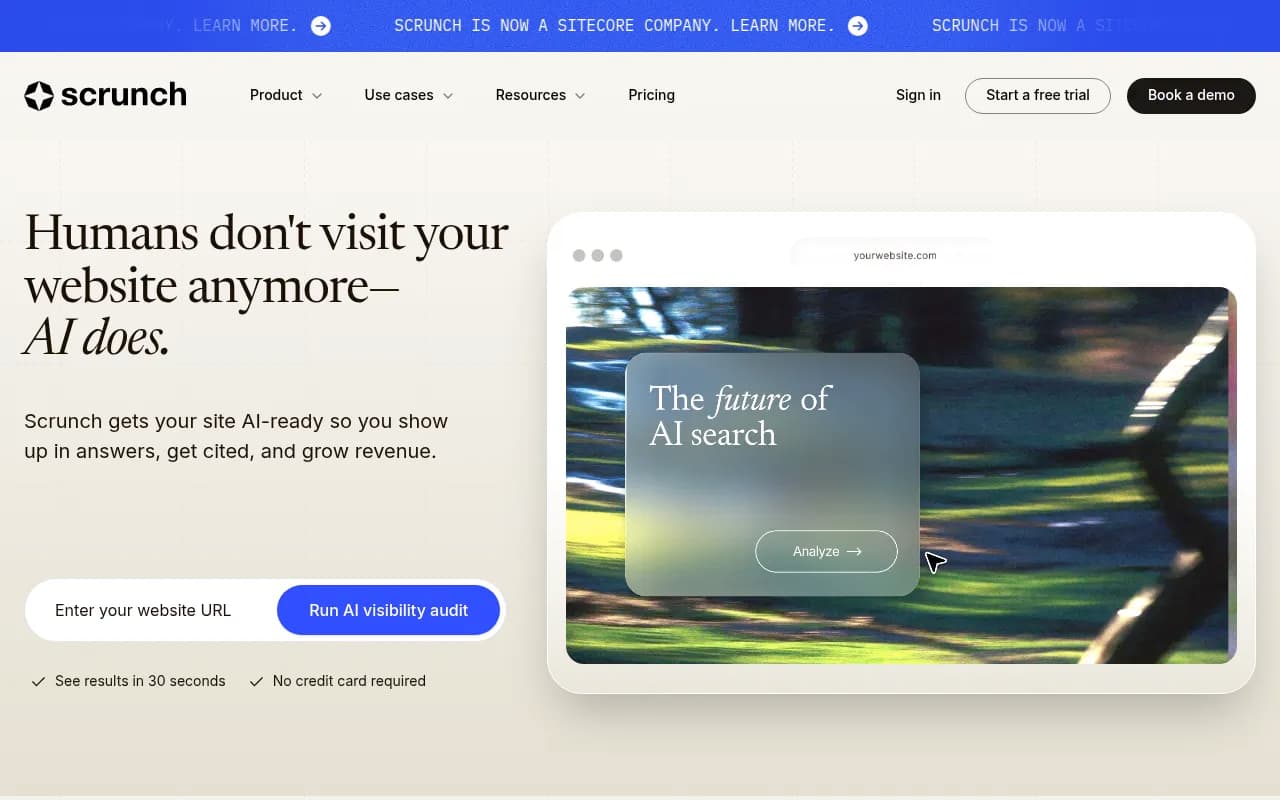
Scrunch positions itself less as a pure tracker and more as an "AI customer experience platform" that also optimizes website content for AI agents to read. Pricing runs from roughly $250/month at the entry tier to $500/month for the Agency Core plan, with full enterprise pricing custom beyond that. It's a reasonable pick if a client's biggest problem is that their site itself is hard for AI crawlers to parse, less so if you just need clean multi-client reporting.
Rankability
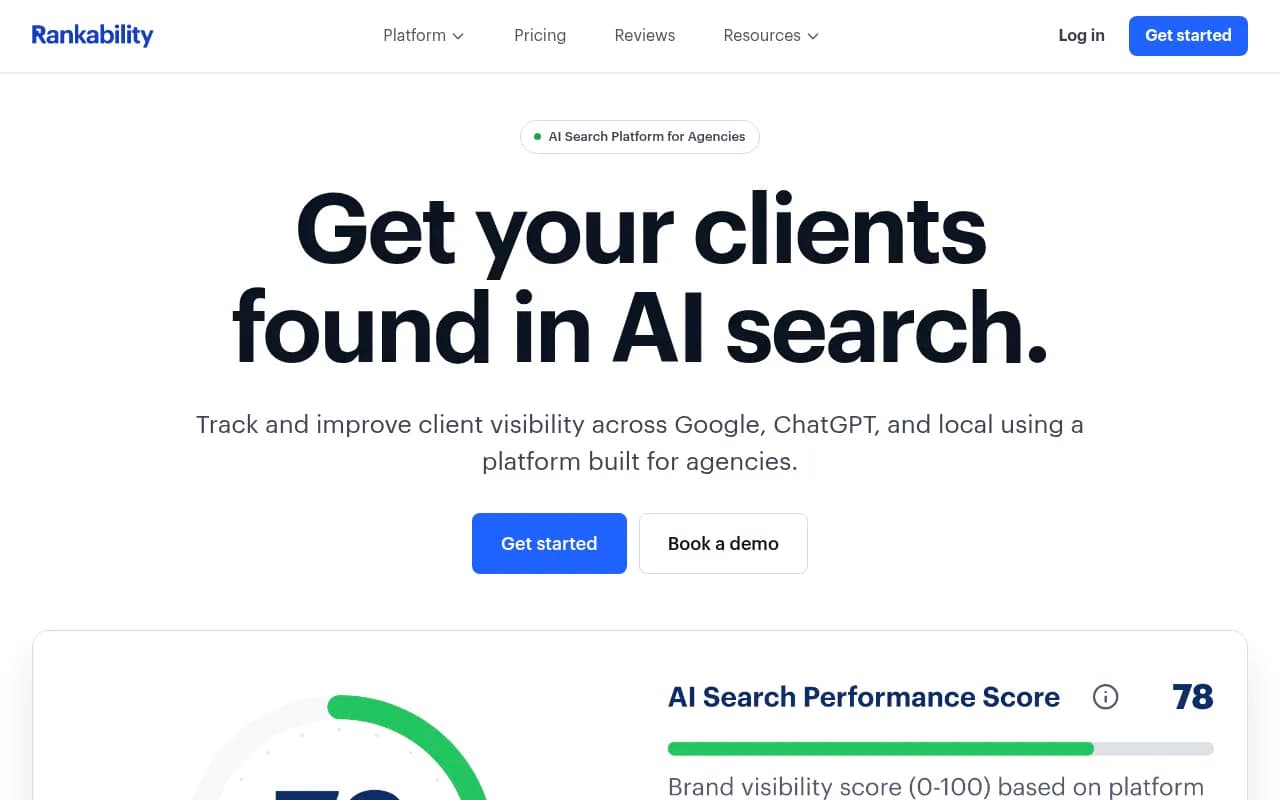
Rankability's pitch to agencies is straightforward: every plan, starting at $99/month, includes unlimited clients and unlimited users, scaling through credits instead of per-seat or per-client fees. That's a genuinely different pricing philosophy than most of this list, and it bundles in an integrated track/research/create/audit/promote workflow plus white-label reporting and API access on every tier. Worth a serious look if your agency runs a high volume of smaller accounts where per-client pricing from other vendors adds up fast.
Semrush AI Visibility Toolkit
If your agency already lives inside Semrush for traditional SEO, the AI Visibility Toolkit is a reasonable bolt-on at $99/month per domain. The catch is in that last phrase, per domain. Ten client accounts means $990/month just for AI visibility tracking, on top of whatever else you're already paying Semrush for. Profound's own review of the toolkit calls it affordable but not scalable for agencies managing many accounts, which lines up with what agencies report in practice.
Mistakes agencies make switching tools
A few patterns show up repeatedly when agencies move off a single-brand tool like Citations.io and try to scale GEO reporting across many clients.
First, tracking only one engine and reporting it as "AI visibility." A client can rank strongly in Perplexity and be nearly invisible in Gemini at the same time, because the engines disagree on which sources to trust more often than they agree.
Second, reporting raw mention counts with no baseline or competitor comparison. "We got 14 mentions this month" doesn't tell a client anything about whether that's growth, decline, or noise. Every serious tool on this list, and Citations.io itself, includes some form of competitor benchmarking for exactly this reason.
Third, confusing a mention with a visit, and a visit with a lead. GEO measurement needs layers: visibility, then actual AI-referred traffic, then conversion. A tool that stops at visibility scores is only giving you a third of the picture.
Which one should you pick
If your agency wants monitoring that also does the work, drafting content, publishing it, prioritizing the next action, Promptwatch is the most complete option on this list and the one built specifically to close the loop between insight and execution rather than stopping at a dashboard.
If you're managing a large roster of smaller accounts and pricing predictability matters more than engine breadth, Rankability's unlimited-client model is worth testing. If you have a small number of large enterprise clients who need SOC 2 and don't mind a sales process, Profound is the deepest option. Everyone else on this list fills a narrower niche, useful, but usually missing either full engine coverage or an execution layer, sometimes both.
For a broader look at GEO and AI visibility software beyond this list, the directory at bestgeosoftware.com is a reasonable place to keep comparing as new tools launch. Given how fast this category moves, expect the pricing and feature gaps between these tools to keep shifting through 2026.