Key takeaways
- Podcasters need GEO tools that track how AI engines describe their show and which pages or videos they cite. Production tools like Descript or Riverside do not cover this.
- Citation data shows YouTube matters for Google AI Overviews, while ChatGPT has nearly stopped citing social platforms (0.46% of citations, Sep 28 to Oct 4, 2026).
- Small creators are not shut out. Videos under 100K views earned nearly 80% of YouTube citations in Promptwatch's February 2026 data.
- Start with a free visibility check, pick one tracker, and fix your show pages and transcripts before buying anything else.
Why podcasters should care about GEO
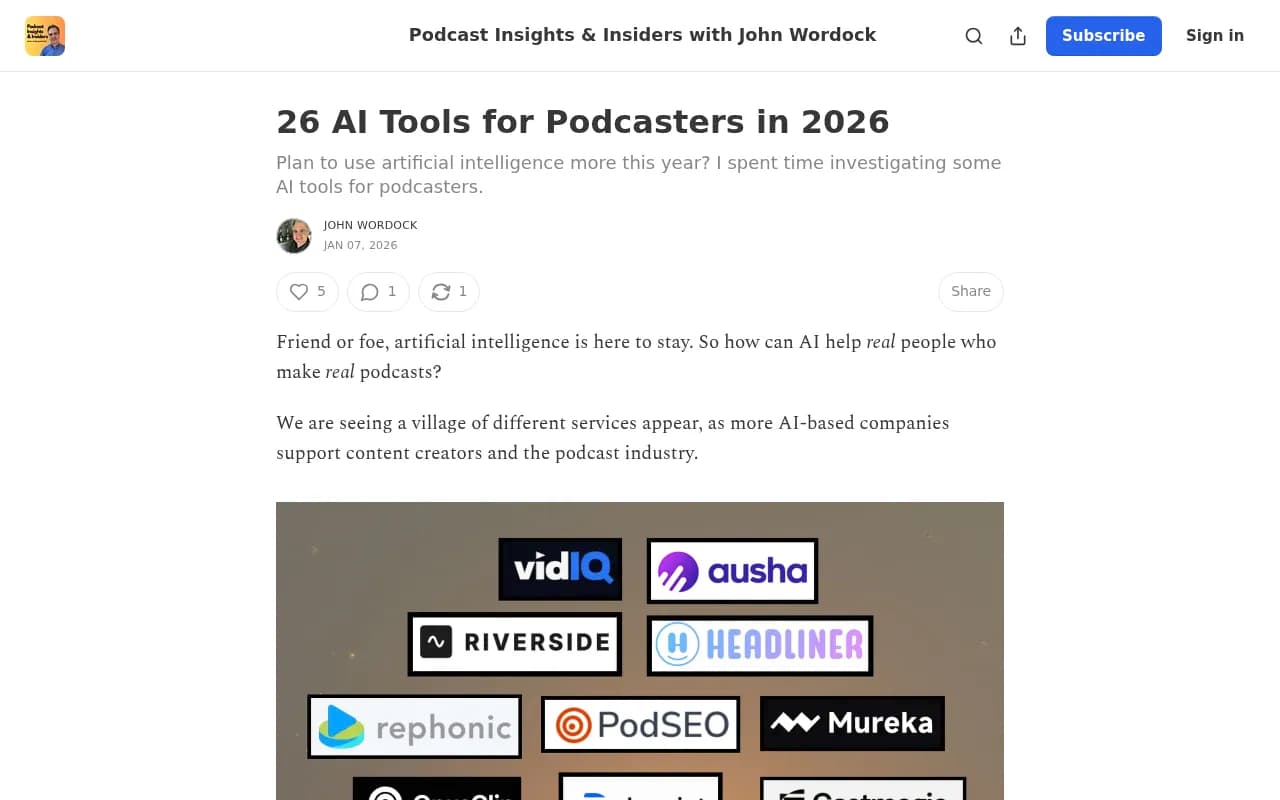
Podcasting has a post-production problem and a discovery problem. The first one has a pile of good AI tools. A Presenc AI guide from May 2026 says between 86% and 92% of creators now use generative AI somewhere in production, and names Descript, Riverside and Castmagic as the usual picks. John Wordock's January 2026 list adds PodSEO and Ausha for titles, keywords and metadata.
The second problem is newer. Listeners, and more importantly sponsors and guests, now ask ChatGPT or Perplexity things like "best podcasts about indie hardware" or "who hosts the show on X". If your show is missing from those answers, or the answer is wrong, no editing tool fixes it.
That is what GEO (generative engine optimization) is for. A GEO tool tracks what AI says about you, shows which sources it cites, and tells you what to change.
What the citation data says about where creators should publish
Before picking a tool, it helps to know what AI engines actually cite. Promptwatch publishes first-party research on this, and a few findings matter for creators.
YouTube is the social platform that still works
In Promptwatch Data's social citation report (Sep 28 to Oct 4, 2026), ChatGPT got only 0.46% of its citations from social platforms, down from 5.8% in the earlier report. Reddit fell from 5.19% to 0.09%. Google AI Overviews, by contrast, got 12.2% of its citations from social platforms, about 26 times ChatGPT's share, and YouTube led at 4.28%.
Perplexity sat in between at 2.7%, with LinkedIn and Reddit tied at 0.86%. X peaked at about 0.1%.
So the practical read: put effort into YouTube if you want Google-driven discovery, publish on LinkedIn for Perplexity, don't count on Reddit threads to get you into ChatGPT, and skip X. For context on the Reddit drop, see Promptwatch's report on Reddit citations falling in ChatGPT.
You do not need a huge channel
The YouTube in AI search report (Jan 31 to Feb 27, 2026) found that videos with under 100K views earned nearly 80% of citations. Only about 7% of cited videos had over 1M views, and 78% had fewer than 1,000 likes. Channels under 100K subscribers earned about 80% of citations.
Note the dates. YouTube's Perplexity share was 2.74% in February and 0.79% in October, so treat any single figure as a snapshot. But the pattern, that engines match titles, descriptions and transcripts to the question instead of filtering by popularity, is good news for niche shows.
Tactics that follow from it:
- Put the exact question in the video title
- Summarize the answer in the first lines of the description
- Add chapters
- Keep captions and transcripts accurate
- Refresh titles and descriptions on back-catalog episodes
Which page types get cited
Promptwatch's content type report (Sep 28 to Oct 4, 2026) shows what ChatGPT cites:
| Content type | Share of ChatGPT citations |
|---|---|
| Product pages | 22.4% |
| Landing pages | 16.8% |
| Listicles | 13.6% |
| How-to guides | 8.7% |
| Documentation | 7.5% |
| Comparisons | 5.9% |
| News | 5.7% |
| FAQ pages | 3.3% |
| Reviews | 1.7% |
For a podcaster, "product page" translates roughly to your show page and your sponsor or membership landing page. Make them factual: who hosts, what topics, how often, where to listen. Then publish how-to and comparison content built from episodes, add an FAQ, and collect reviews, which rise to 5.6% of citations on branded prompts.
One caution on timing: news content loses half its cited pages in about 36 days, while landing pages and docs last far longer. Episode-news posts are short-lived. Evergreen show pages are not.
What to look for in a GEO tool as a creator
Most GEO tools were built for SaaS marketing teams. Creators have different needs, so judge them on:
- Whether it tracks the real AI interfaces or only API outputs, since user-facing answers can differ
- Whether it shows which of your pages, videos and third-party mentions get cited
- Whether it tells you what to fix, not just a score
- Price per tracked prompt, because a solo podcaster does not need 350 prompts
- Whether it can show if AI crawlers can even read your site
The best GEO tools for podcasters and media creators
Promptwatch
Promptwatch is the one I would start with if you want more than a dashboard. It tracks how ChatGPT, Gemini, Claude, Perplexity, Google AI Overviews, AI Mode and others mention and cite you, then traces where answers come from, including YouTube videos, Reddit threads and LinkedIn posts, which matters given the data above. Its crawler logs show whether AI bots actually read your show pages, and the Content Agent can write and publish pages to WordPress, Webflow or Framer to fill gaps.
Pricing starts at $95/month for Essential (50 prompts, daily tracking) and $245/month for Professional; confirm current numbers at promptwatch.com/pricing. There is a 7-day free trial on monthly billing, and a free AI visibility report if you only want a first look. Publisher-heavy networks and agencies can look at the agency plans.

Peec AI
Peec AI is a clean, prompt-focused tracker with smart suggestions. It suits a creator who wants to monitor a handful of prompts about their show and competitors without extra machinery. It monitors rather than fixes, so you handle the content work yourself.

Otterly.AI
Otterly.AI is positioned as affordable brand monitoring. A reasonable pick for an independent podcaster who only needs to know whether the show appears.

Profound
Profound is an enterprise platform. It is likely overkill for one show, but a media company running a network of podcasts and sites may find the depth useful. Compare directly on Promptwatch vs Profound.

Semrush AI Visibility Toolkit and Ahrefs Brand Radar
If you already pay for Semrush or Ahrefs to run your podcast website's SEO, their AI add-ons are convenient. The tradeoff is shallower AI-specific data than dedicated platforms.

Scrunch AI
Scrunch pairs monitoring with agent-ready pages for your site, which is relevant if you want your show pages served cleanly to AI crawlers.

WordLift and InLinks for schema
Neither is a tracker. WordLift handles schema and content tagging for publishers, and InLinks automates entity-based internal linking and schema. For a podcast site with hundreds of episode pages, structured data is worth doing, and these save manual work.

Quick comparison
| Tool | Best for | Fixes problems or only monitors? | Fit for solo creators |
|---|---|---|---|
| Promptwatch | Tracking, crawler logs, content creation | Both | Good from Essential up |
| Peec AI | Simple prompt tracking | Monitors | Good |
| Otterly.AI | Budget monitoring | Monitors | Good |
| Profound | Large media networks | Mostly monitors | Overkill |
| Semrush / Ahrefs | Existing SEO users | Monitors | Depends on current plan |
| Scrunch AI | Agent-ready pages | Both | Moderate |
| WordLift / InLinks | Schema and entities | Fixes structure | Good for big archives |
I have not verified current pricing for the non-Promptwatch tools here, so check each vendor's page. For wider lists, the GEO software directory at bestgeosoftware.com is a useful pointer.
Production tools still matter
GEO tools do not replace the production stack. Descript for transcript-based editing, Riverside for remote recording, Castmagic for turning an episode into show notes and posts, and Adobe Podcast for speech cleanup are all named in the Presenc AI guide. Their GEO value is indirect but real: accurate transcripts, chapters and show notes are exactly the text AI engines match to questions.
A practical workflow for one show
- Run a free visibility check and ask ChatGPT, Perplexity and Gemini about your show by hand. Note what is wrong or missing.
- Check your site's robots.txt and crawler access. Promptwatch's AI crawler traffic data shows who is actually crawling, and the Robots.txt generator for AI helps with rules.
- Rebuild your show page with host names, topics, schedule and an FAQ.
- Publish full transcripts and structured show notes for each episode, then add how-to or comparison posts drawn from the best ones.
- On YouTube, rewrite titles as questions, front-load answers in descriptions and add chapters.
- Track a small set of prompts weekly. Adjust what does not move.
Mistakes I see
- Chasing Reddit threads for ChatGPT visibility. The data says that door has mostly closed.
- Buying an enterprise platform for a single show.
- Treating a visibility score as the goal. A mention without a citation to your own site is a content or crawlability problem.
- Publishing time-sensitive episode news and expecting it to stay cited.
Where to go next
Pick one tracker, fix your show page and transcripts, and give it a month before judging. If you run a larger network and want help instead of tooling, 1001 SEO Media handles GEO and AI search work for brands and publishers. For general software comparisons, surferstack.com covers the wider category.