Key takeaways
- Visibility and accuracy are different problems. Being mentioned by ChatGPT does not mean ChatGPT is describing you correctly.
- Generic fact-checkers (Snopes, ClaimBuster, Fact Check Explorer) check public claims. They do not tell you what AI engines say about your brand, so you need brand-specific tools.
- The brand-specific options that check claims against your own source of truth are Promptwatch (Brand Narrative and Fact Check) and Profound (FactCheck). Most other trackers only report mentions, sentiment and citations.
- Accuracy work only pays off if you trace the wrong claim to a source page and fix it. A report you never act on changes nothing.
- Prices for these tools conflict across third-party sources, so verify on each vendor page before you buy.
Why fact-checking AI answers about your brand is a separate job
Most brand teams start by asking whether ChatGPT mentions them. That is a visibility question. The next question is nastier: when it does mention you, is it right?
Profound's own research across 50,000 LLM responses found that 47% of response content is unsolicited. The AI is not just answering the question asked, it is adding its own commentary about your brand. In all that extra text you get outdated pricing, features you shipped two launches ago, and claims nobody at your company ever made. Most teams find out when a customer complains or a screenshot goes around Slack.
That is reactive, and it does not scale. A proper process has four steps: collect what AI says, compare it with what is true, trace the wrong claim to its source, and fix the source.
Why AI gets brands wrong
It helps to know where the errors come from, because that tells you where to look.
AI engines with web search pull from a short list of sources. Promptwatch's data on unique domains per ChatGPT response (Sep 28 to Oct 4, 2026) shows that for brand-specific prompts like "is Asana good for small teams", the most common count is 5 domains, at 14.9% of responses, and 40.7% cite 5 domains or fewer. Only 21.3% cite 10 or more. So when someone asks about you by name, a handful of pages shape the answer. Review sites, forums, old blog posts and your own outdated pages all compete to define you.
Source counts also differ by engine. Promptwatch's average sources per response report found ChatGPT cites about 5 sources per web-search answer, while Google AI Overviews and Perplexity cite about 10. Each engine can land on a different version of the facts about you.
And then there is training data. Models answering without live search repeat what they absorbed months ago. A price change from last spring can live on for a long time.
The two kinds of fact-checking tools
The tools worth knowing fall into two groups, and mixing them up wastes time.
General claim and media verifiers check whether a public statement is true. They are useful for your own content, but they know nothing about your brand's ground truth.
AI brand accuracy tools run prompts across AI engines, extract the claims made about you, and compare them with your facts. That is the group this guide cares about.
| Tool type | What it answers | Examples |
|---|---|---|
| Claim verifiers | Has this public claim already been checked? | Google Fact Check Explorer, Snopes, ClaimBuster |
| Media verifiers | Is this image real or recycled? | TinEye, FotoForensics, Sensity AI, AI or Not |
| AI answer monitors | Does AI mention us, and how? | Otterly.AI, Peec AI, AthenaHQ |
| AI accuracy tools | Is what AI says about us true, and where does it come from? | Promptwatch, Profound |
Brand-specific tools for checking AI accuracy
Promptwatch
Promptwatch is an end-to-end AI visibility platform, and two of its features matter most for accuracy. Brand Narrative pulls the individual claims AI makes about you and your competitors out of every tracked response (things like "affordable for small teams" or "its mobile app lacks features"), groups repeated claims, shows how often and which models say each one, and scores themes such as Pricing, Features, Support and Reputation from 0 to 100. It is on every plan.
Fact Check is the next step. You mark a claim Accurate or Inaccurate, and it reads the pages crawled from your site to find the ones that state the claim or its opposite, with quotes and a recommended next step. That tells you which page AI is learning the wrong thing from. It is available on Business, Agency Scale and Enterprise, and uses Agent Credits.
The data comes from the real interfaces of ChatGPT, Google AI Overviews, Google AI Mode, Gemini, Perplexity, Copilot and others, in the countries and languages you choose. That matters because user-facing answers can differ from API outputs. After you find the bad source, you can fix it with Content Refresh or the Content Agent, then see through crawler logs and Page Tracker whether AI bots read the new version and whether it gets cited.

Pricing at the time of writing: Essential $95/mo, Professional $245/mo, Business $579/mo. Fact Check starts at Business; confirm current plans at promptwatch.com/pricing. There is a 7-day free trial on monthly billing, and a free AI visibility report if you want a first look at how ChatGPT, Gemini and Perplexity describe you.
Profound
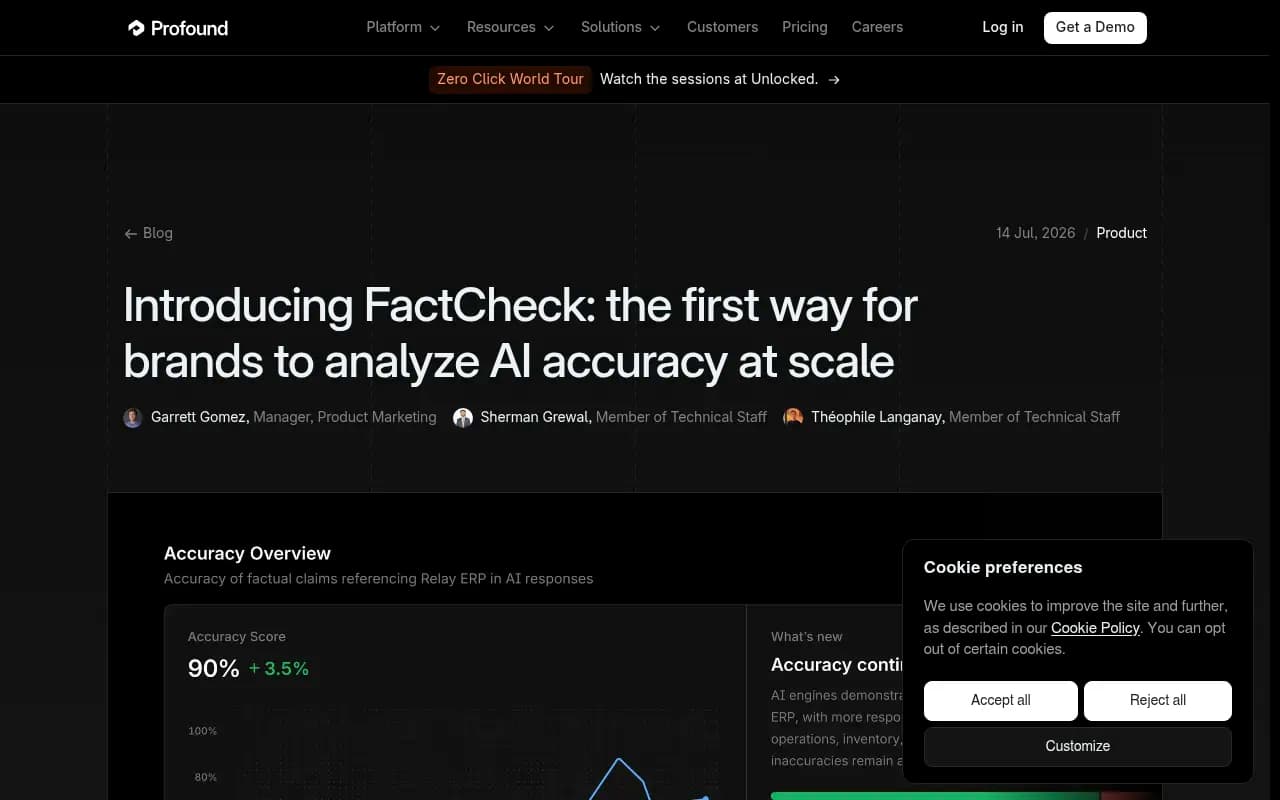
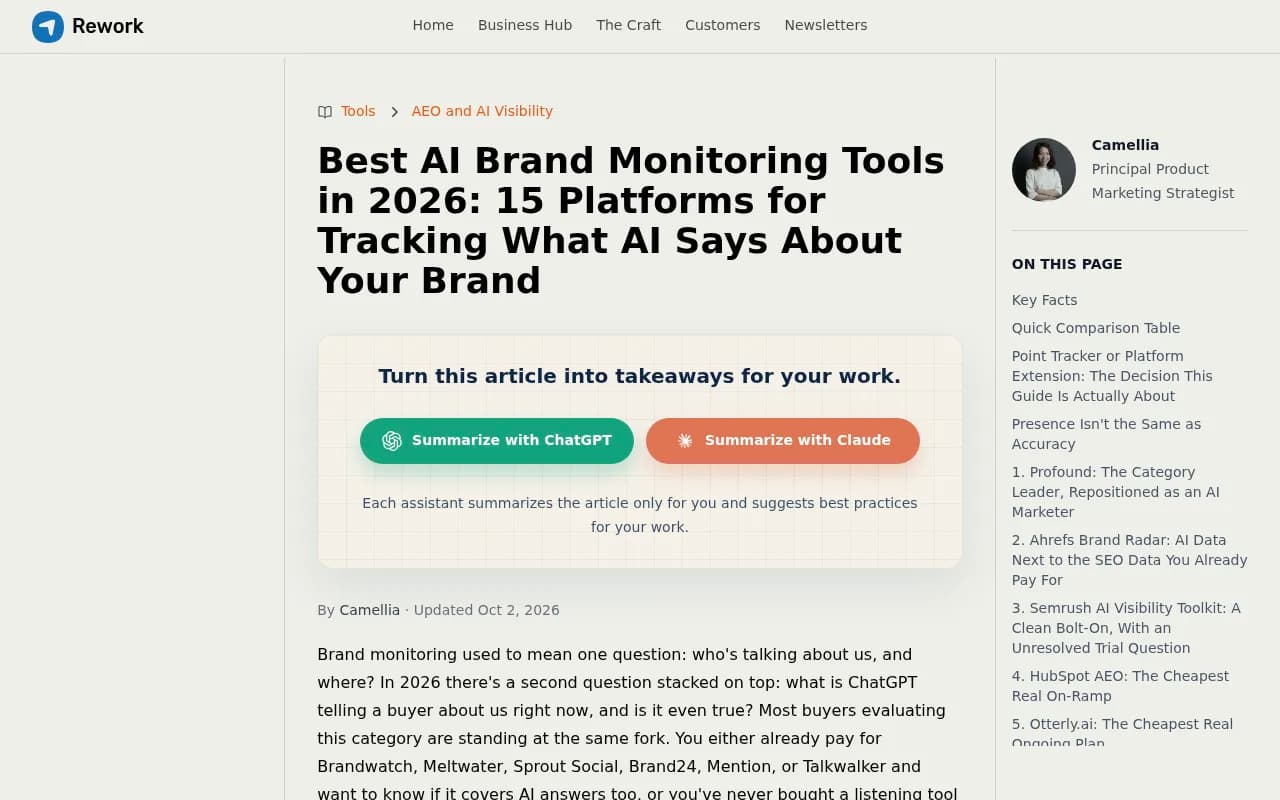
Profound launched FactCheck in July 2026. Its pitch is that it systematically compares what AI engines say about your brand against your own source of truth, then tells you what is accurate. Rework's 2026 roundup describes the FactCheck Agent as tracing an inaccurate claim back to the publisher repeating it, drafting a personalized correction, and tracking which corrections actually get updated. That outreach angle is a genuinely different job from a dashboard.

The catch is access. Rework notes there is no self-serve paid tier, so every real deployment starts with a sales call. Third-party pricing is inconsistent: one roundup lists Starter at $99/mo and Growth at $399/mo, while Profound's own June 2026 content quoted Growth at around $499/mo, and enterprise is custom. Verify on the vendor page. If you want a head-to-head, see Promptwatch vs Profound.
Other tools that touch accuracy
Rework lists Goodie (Brand Command), Meltwater and Talkwalker as also flagging misinformation or fact accuracy. Meltwater's GenAI Lens and Talkwalker's LLM Insights are extensions of listening platforms you may already pay for.

I would treat these as worth a demo rather than a default pick. I could not find documentation or case studies showing how well any of them correct wrong claims in practice, so test them on your own known errors.
Monitoring tools: useful, but only half the job
Most of the AI visibility category tells you whether you show up and how you compare. That is a necessary first step, and some of these let you read responses manually for errors. Without claim-level comparison against your facts, though, you are doing the checking by eye.
If budget is tight, these are the common starting points:

Otterly.AI is often cited as the lowest credible entry point, from around $29/mo according to one third-party roundup.

Peec AI is popular with marketing teams. Pricing is reported in euros, and one competitor page lists Starter at $95/mo, so confirm directly.
AthenaHQ covers many models, but its pricing has changed across sources, so check the vendor.
For wider options, the GEO software directory at bestgeosoftware.com lists dozens more. Quora commenters make a fair point about all of them: none of it matters if you run one report and never look again.
Generic fact-checkers still have a role
Your own content is also a source of errors, especially AI-drafted content. Before you publish, run claims through the standard tools covered in RightBlogger's 2026 guide:
- Google Fact Check Explorer to see if a claim has already been reviewed by credentialed fact-checkers
- ClaimBuster to find the sentences in a long draft worth checking first
- Snopes for viral rumors and recycled claims
- TinEye and FotoForensics for reverse image search and edit detection
- Sensity AI (enterprise-only) or the free AI or Not for deepfake and AI-image checks
The RightBlogger guide makes a point I agree with: no single tool covers everything, and humans make the final call. These tools are filters, not verdicts.

A workflow you can run this month
1. Write your source of truth
List the facts AI most often gets wrong: pricing, plans, features, integrations, locations, founding details, competitor comparisons. A Brand Book or spreadsheet is fine. Without this, you cannot judge accuracy.
2. Run the prompts buyers actually use
Include brand-specific prompts ("is [brand] good for small teams"), competitor comparisons and generic category questions. Run them across ChatGPT, Gemini, Perplexity, AI Overviews and Copilot. Do it in more than one country if you sell in more than one.
3. Extract and label claims
Split answers into individual claims and mark each one accurate, outdated or wrong. This is where Brand Narrative or FactCheck-style tooling saves hours. Repeated claims matter more than one-off glitches.
4. Trace each wrong claim to a source
Check the cited pages. Often the culprit is your own stale pricing page, a third-party review, a forum thread or a comparison listicle. Promptwatch's citation type data shows product pages are the most cited content in ChatGPT (22.4% of citations, Sep 28 to Oct 4, 2026), so your own product and pricing pages are a likely suspect.
5. Fix, then verify
Update your own pages first. For third-party pages, contact the publisher or add accurate material they can cite. Then check whether AI crawlers actually re-read the page. Content also ages out: Promptwatch's content half-life data found news lost half its cited pages within 36 days, while landing pages and docs stayed cited longest. Corrections on evergreen pages stick better.
6. Repeat monthly
Models change and wrong claims return. Put the prompt set on a schedule.
Which setup fits which team
| Situation | Suggested approach |
|---|---|
| Small team, tight budget | Free AI visibility report, a cheap tracker, manual claim review |
| Mid-size brand, wants fixes not just reports | Promptwatch Business, for Fact Check plus content updates |
| Large enterprise with sales-led buying | Profound or Promptwatch Enterprise, compare in demos |
| Already on Meltwater or Talkwalker | Ask about GenAI Lens or LLM Insights before adding a tool |
| Publishing lots of AI-drafted content | Claim verifiers plus a human editor before publish |
Mistakes to avoid
- Treating a high visibility score as proof you are described well
- Checking one engine only. ChatGPT, AI Overviews and Perplexity cite different sources
- Fixing the AI answer instead of the source page
- Relying on sentiment alone. A positive answer can still contain a wrong price
- Skipping the human review. Tools flag, people decide
Bottom line
For accuracy specifically, the shortlist is short: Promptwatch if you want claim checking tied to fixing the pages and measuring the result, Profound if you are an enterprise happy to go through sales. Everything else is monitoring that you will have to eyeball. Whatever you pick, write down your facts first, trace wrong claims to their sources, and fix those sources. Verify current pricing on each vendor page, since the numbers in third-party roundups disagree.
For more on the wider category, see the Promptwatch Data hub and the AI rank tracking tools directory.