Key takeaways
- A user agent string proves nothing. Anyone can send "GPTBot" or "Googlebot" in a request header, so verification has to rely on the source IP.
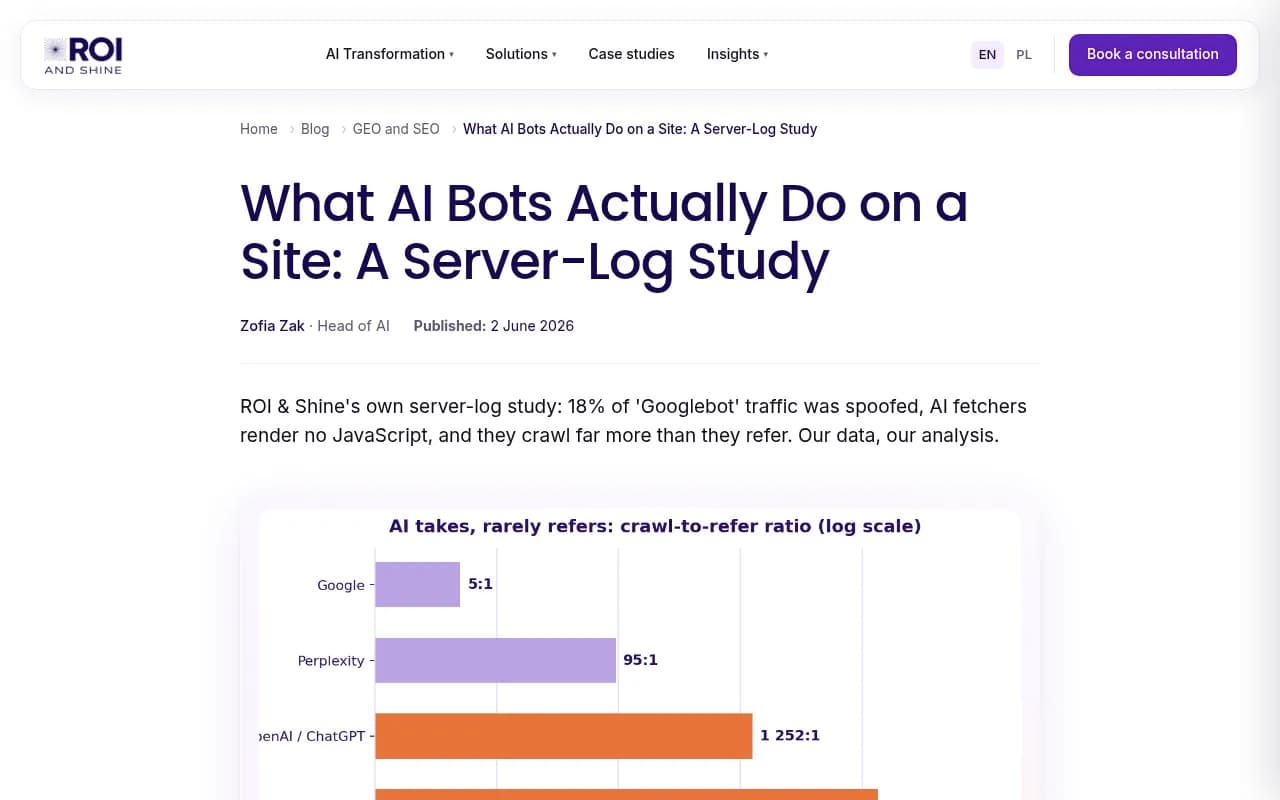
- In a small 2026 server-log study by ROI & Shine, 4.3% of declared bot traffic failed verification and 18% of "Googlebot" requests were spoofed. Bing, Apple and Perplexity verified at 100%.
- Real AI fetchers behave differently from fakes. The same study saw AI fetchers request 0% assets (no JS, CSS or images), while classic search bots requested 42 to 79%.
- Tools that verify for you include searchVIU, Screaming Frog Log File Analyser, Promptwatch crawler logs and Botify. A DIY script against official IP ranges works too.
- Check your own infrastructure before you celebrate a spike. One "Claude surge" of 821 requests turned out to be the author's own WordPress MCP server.
Why spoofed AI bots matter
Spoofing is boring but expensive. Fake bots inflate your crawl numbers, add server load, and make you think GPTBot loves your site when it has never visited. They also hide real problems. If you count 2,000 "GPTBot" hits and half are a scraper wearing a costume, your conclusions about AI visibility are wrong.
There is also a decision problem. Many teams now write robots.txt rules, WAF rules and CDN allowlists for AI crawlers. If you allowlist by user agent alone, you have effectively allowed anyone who types the right string.
The pattern from the data is consistent: fakers crowd around the name everyone trusts. In the ROI & Shine server-log study, 18% of requests claiming to be Googlebot were spoofed, across 43,345 requests over 26 days on one fresh test domain. The author is upfront that the sample is small and single-site, so treat the percentages as an illustration, not a benchmark. But the direction is believable, and anyone who has looked at their own logs has seen it.
How verification actually works
There are two methods, and every tool below uses one or both.
Published IP ranges
OpenAI, Anthropic and Perplexity publish the IP ranges their crawlers use. You match the source IP of each request against the range for the bot it claims to be. If GPTBot shows up from an address outside OpenAI's list, it is not GPTBot. This is the method the ROI & Shine study used for OpenAI, Anthropic and Perplexity.
Forward-confirmed reverse DNS
Google, Bing and Apple support FCrDNS. You reverse-resolve the IP to a hostname, check the hostname belongs to the operator's domain, then forward-resolve that hostname and confirm it returns the same IP. Both directions must match. A spoofer can set a reverse record on an IP they control, but they cannot make the forward lookup on Google's domain point back at it.
I would not trust any tool that does only a user-agent match and calls it "bot detection". Ask the vendor which of the two methods it uses.
Behavioral tells that a bot is fake
IP verification is the real test, but behavior gives you quick triage when you are staring at raw logs.
- Asset requests from an AI fetcher. In the ROI & Shine data, AI fetchers requested 0% assets. A "ChatGPT-User" that pulls CSS, JS and images is suspicious. This is my inference from that data, not a claim the study makes, so confirm with the IP check.
- Speed and volume. ChatGPT-User is a user-initiated fetch. In the same study it made 352 verified requests across 45 unique URLs in a month. A "ChatGPT-User" hammering thousands of URLs per hour does not fit that profile.
- Training crawlers on a tiny site. The study saw zero GPTBot, ClaudeBot, CCBot, Bytespider or Google-Extended requests all month, even with an allow-all robots.txt. If a brand-new site suddenly shows heavy "GPTBot" traffic, be skeptical.
- Sweeping crawl patterns. Real crawlers tend to follow sitemaps and links. Fakes often walk predictable URL patterns, or probe login and admin paths.
- Your own tooling. The study's 821-request "Claude surge" was the author's WordPress MCP server. Check monitoring, MCP servers, uptime checkers and staging scripts before you count a spike.
Best tools for spotting spoofed AI bots
| Tool | Verification method | Log sources | Best for | Pricing signal |
|---|---|---|---|---|
| searchVIU AI log file analysis | Checks each fetch IP against the claimed bot | Cloudflare, upload, FTP, Amazon S3 | SEO teams wanting managed bot-by-bot reports | Add-on from EUR 199/mo |
| Screaming Frog Log File Analyser | Verifies search engine and AI bots | Imported log files | Technical SEOs who prefer desktop software | Check vendor site |
| Promptwatch crawler logs | IP-verified against operator ranges | Cloudflare, Vercel, Fastly, raw logs, WordPress plugin | Connecting crawls to citations and traffic | Business from $579/mo |
| Botify | Enterprise log analysis | Enterprise integrations | Large technical SEO teams | Custom |
| DIY script | IP ranges and FCrDNS | Any access log | Developers on a budget | Free |
searchVIU
searchVIU sells AI log file analysis as an add-on to its SEO Monitoring product. It separates genuine bots from fake ones by checking the IP of each fetch against the claimed bot, and it splits AI bots by purpose: training, search, and fetches on user request such as ChatGPT-User.
Its demo page shows the shape of the problem well: 182,400 verified Googlebot fetches against 12,900 fetches that claim to be Googlebot but do not come from Google, plus 2,150 fake GPTBot fetches. That is demo data, not a study, so do not quote it as a benchmark. It also counts fetches of llms.txt, /.well-known/ files and MCP endpoints per bot.
Logs can come from Cloudflare (delivered daily), upload, FTP or Amazon S3. With Cloudflare logs you also see firewall events, which helps when bot protection blocks Googlebot or an AI bot you have allowed in robots.txt. Only log lines with bot user agents are sent to searchVIU, data is stored in the EU, and the vendor says it is ISO/IEC 27001:2022 certified. Pricing starts at EUR 199 per month as an add-on to SEO Monitoring, which itself starts at EUR 399 per month with 50,000 URLs. That stacks up, so it suits teams already using searchVIU. The vendor also publishes a public list of AI bots at searchviu.com/en/ai-bots.
Screaming Frog Log File Analyser
If you want something you run on your own machine, the Screaming Frog Log File Analyser imports your logs, verifies search engine and AI bots, and lets you analyse their behavior. It ships user-agent presets for the main AI bots: GPTBot, OAI-SearchBot and ChatGPT-User from OpenAI, ClaudeBot and Claude-User from Anthropic, and PerplexityBot and Perplexity-User from Perplexity.
I could not confirm the exact verification details or current pricing from the tutorial, so check the vendor page before buying. The practical upside is that your logs never leave your machine, which matters if legal is nervous about shipping access logs to a third party.
Promptwatch crawler logs
Promptwatch takes a different angle. Its AI crawler logs are IP-verified against each operator's published ranges, so spoofed user agents are filtered out before they hit your numbers. It covers GPTBot, OAI-SearchBot, ChatGPT-User, ClaudeBot, Claude-User, PerplexityBot, Perplexity-User and others, and it works with Cloudflare, Vercel, Fastly, other CDNs, a custom endpoint, or the official WordPress plugin.

The reason to choose it over a pure log analyser is what happens after verification. It shows which pages bots read, the errors they hit with plain-language explanations, and a crawl-to-citation path with a citation rate per page, so you can tell an access problem from a content problem. Crawler logs are not in the Essential plan. They start on Professional ($245/mo, 25M crawler logs) and are included on Business ($579/mo) and the agency plans. Confirm current pricing at promptwatch.com/pricing. If you only want a one-off check of which AI crawlers can reach you, the free Agentic Readiness Check is a quick start.
As a benchmark for your own logs, Promptwatch Data's AI crawler traffic report counts only requests whose source IP matches the operator's published ranges. In the week of Aug 31 to Sep 6, 2026, OpenAI made up 79.8% of verified AI crawler requests, down from 94.8% in the week of Jun 8 to 14. The report covers OpenAI, Anthropic, Google, Perplexity and Mistral. Its suggested check is simple: if a provider is a big share in the report but near zero in your logs, you are probably blocked or unreachable for that provider, so look at robots.txt, CDN and WAF rules. The data on Meta-WebIndexer is worth a look too, since that crawler grew from about 2% to nearly 38% of tracked AI crawler requests between mid-July and August 9, 2026, and any new crawler name is a spoofing target.
Botify
Botify is the enterprise option, built for technical SEO teams that already analyze logs at scale and want AI crawler behavior in the same place as classic crawl data.
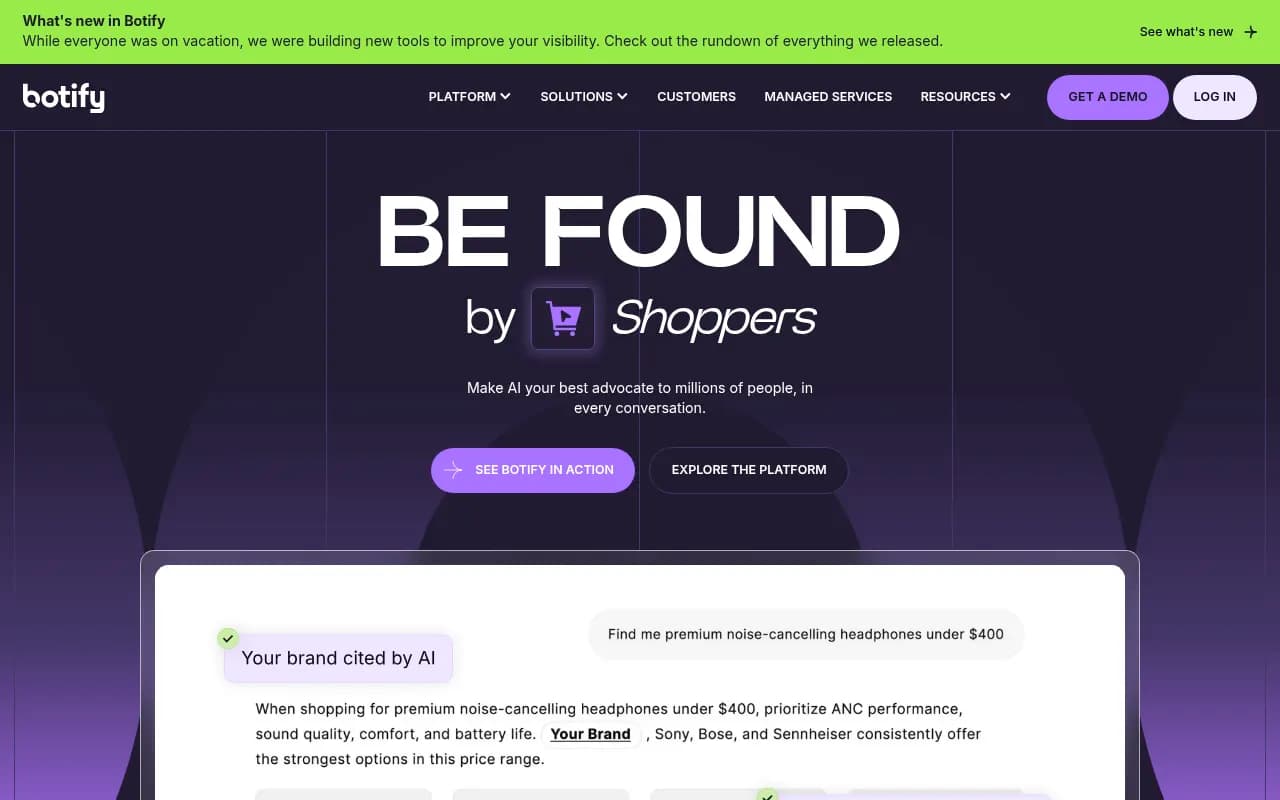
I have not verified its specific spoofing checks or pricing, so ask the sales team how it validates bot identity before assuming it matches IP ranges. It makes sense for very large sites where log volume is the main headache.
Similarweb's SIGNAL workflow
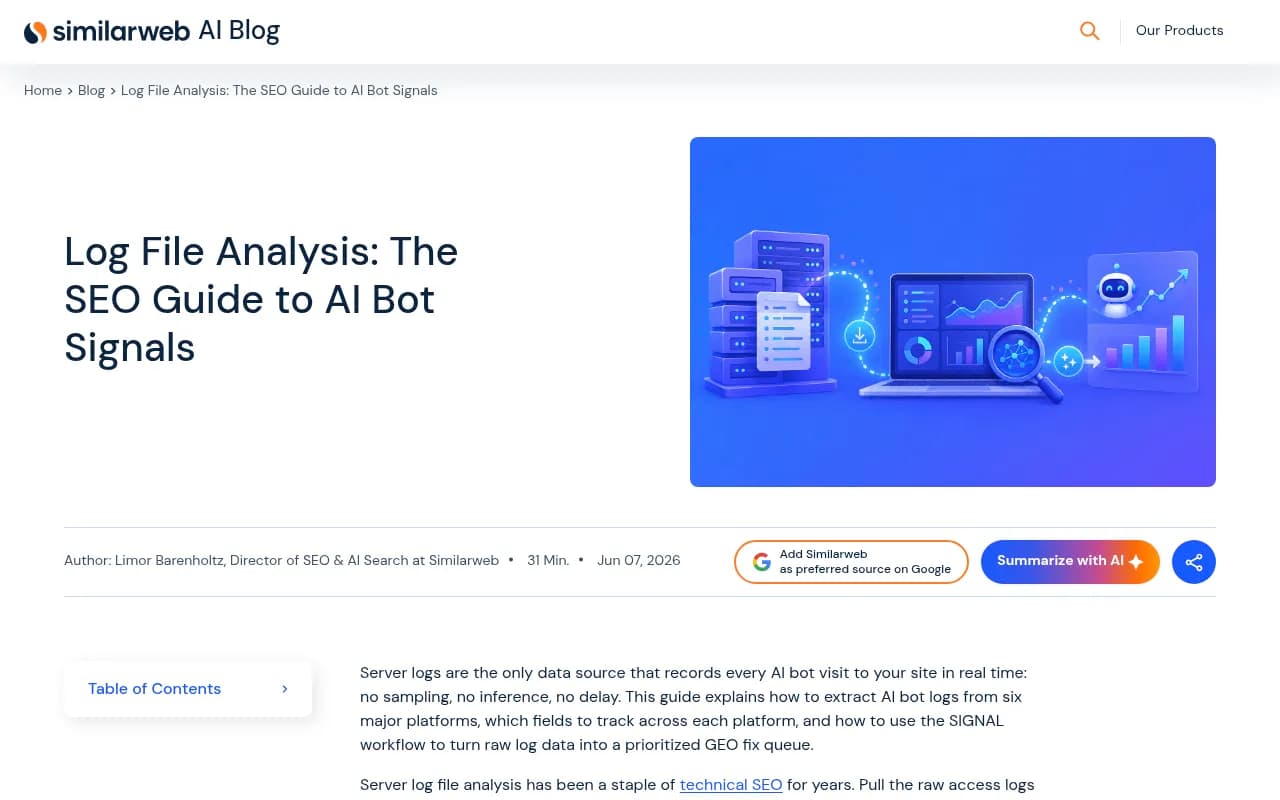
Similarweb published a long guide on log file analysis for AI bots, with a SIGNAL workflow that turns raw log data into a prioritized fix queue, and covers extracting AI bot logs from six major platforms. It is more method than tool, but useful as a process template.
The company also sells Similarweb AI Brand Visibility, though that product tracks brand mentions in AI answers, not server logs.
Similarweb AI Brand Visibility
A DIY check you can run today
If you do not want another subscription, a script gets you most of the way. The outline:
- Export your access logs (Nginx, Apache, or CDN logs) for the last 30 days.
- Filter lines whose user agent contains the bot names you care about: GPTBot, OAI-SearchBot, ChatGPT-User, ClaudeBot, Claude-User, PerplexityBot, Perplexity-User.
- Download the operator's current published IP ranges and match each source IP against the range for its claimed bot.
- For Googlebot, Bingbot and Applebot, run FCrDNS: reverse lookup, confirm the hostname domain, forward lookup, confirm the IP matches.
- Count verified and unverified requests per bot, and list the top unverified IPs and ASNs.
# Quick triage: top IPs claiming to be GPTBot
grep -i "GPTBot" access.log | awk '{print $1}' | sort | uniq -c | sort -rn | head -20
That command only tells you who is claiming the name. You still need the range comparison to know who is lying. Keep in mind ranges change, so re-download them each time rather than hardcoding a list.
What to do once you find fakes
Do not just block by user agent, since that stops honest bots and misses dishonest ones. A sensible order of operations:
- Segment first. Report verified and unverified traffic separately so your crawl stats stay clean.
- Allowlist by IP. Where your CDN or WAF supports it, allow the verified AI crawlers by IP range and challenge or rate-limit the rest.
- Watch firewall events. Bot protection that blocks Googlebot or an AI bot you allowed in robots.txt is a common, silent cause of missing visibility. searchVIU surfaces this with Cloudflare logs.
- Keep server-side HTML. The ROI & Shine data shows AI fetchers request no JavaScript or assets, so content that depends on client-side rendering is invisible to them.
- Do not count internal traffic. Exclude your own monitoring, MCP servers and staging jobs.
Which tool should you pick?
- You want a managed report and already use searchVIU: add its log analysis.
- You want logs on your own machine: Screaming Frog Log File Analyser.
- You want verification tied to citations, traffic and content fixes: Promptwatch.
- You run a very large site with a dedicated technical SEO team: look at Botify.
- You have a developer and no budget: the DIY script above.
For more options in the category, the GEO software directory at bestgeosoftware.com lists tools that go beyond logs into AI visibility tracking.
FAQ
Can I trust the user agent string?
No. It is a self-declared header. Treat it as a claim and verify the source IP.
How much spoofed traffic is normal?
It varies a lot. One small test site saw 4.3% of declared bot traffic fail verification, with 18% of Googlebot requests spoofed. Your numbers will differ, so measure your own.
Is a missing GPTBot a problem?
Not necessarily. A fresh small site in that study got zero training-crawler requests in a month. Compare against a benchmark such as Promptwatch's crawler data before assuming you are blocked.
Does ChatGPT-User count as a crawler?
It is a user-initiated fetch, triggered when someone asks ChatGPT something that needs your page. It is a strong sign of real demand, and it is also a name worth verifying.
Do I need to block spoofed bots?
At minimum, separate them from your reporting. Blocking depends on load and risk, but IP allowlisting for verified bots plus rate limits for the rest is the usual pattern.