Key takeaways
- Visby is a mention tracker: prompt-level mentions, cited sources, competitor comparison, and change over time. If you need to know what to fix and whether the fix worked, you will probably outgrow it.
- The real dividing line in 2026 is monitoring versus optimization. Most tools stop at a dashboard. A few help you create content, check crawler access, and tie AI traffic to revenue.
- Citation behavior differs a lot by engine, so any tool you pick should measure each engine separately and, ideally, expose ChatGPT's fan-out queries.
- Promptwatch is the strongest all-round pick if you want tracking plus action. Peec AI, Otterly.AI, and Ahrefs Brand Radar suit narrower budgets and workflows.
- I did not verify current pricing for most tools below, so check each vendor's pricing page before you commit.
What Visby does, and where it stops
Visby AI is an AI visibility tracker. You set up prompts, it runs them across engines like ChatGPT, Perplexity, Gemini, AI Overviews, and Copilot, and it reports where your brand shows up, which sources get cited, and how you compare to competitors over time.
That is a legitimate product. But it is also the baseline for the category. There are 40+ tools doing roughly the same core loop: schedule prompts, store responses, draw charts. One honest caveat: the most prominent "best tools" listicle that ranks Visby first is published by Visby itself, so treat it as vendor-written. It lists Profound, Peec AI, Otterly.AI, Scrunch AI, and Semrush behind it, and I would not take that ordering as neutral.
I could not find public pricing or hard numbers for Visby while researching this guide, which is itself something to ask about on a sales call.
So why look elsewhere? Usually one of these reasons:
- You can see you are invisible but have no idea why.
- You want to know whether AI crawlers can even read your site.
- Leadership asks about revenue from AI, and a mention count does not answer that.
- You need content produced against the gaps, not just a report about them.
- Your prompts are guesses, and you want volume or difficulty data behind them.
How to evaluate an alternative
Visby's own criteria are reasonable: model coverage, prompt tracking depth, citation and source analysis, competitor benchmarking, historical tracking, and actionability. I would add four more, based on how AI engines actually behave.
Measure each engine on its own
Citation slots differ by engine. According to Promptwatch's Average Sources Per Response data, ChatGPT cites about 5 sources per web-search answer, Google AI Overviews around 10, and Perplexity almost exactly 10 every day. Microsoft Copilot is the odd one: its average swung from under 2 to nearly 17 within a few weeks. A tool that rolls everything into one score hides that. Judge Copilot on monthly trends, and use Perplexity as a stable test bench, since movement there is more likely to reflect your content than engine noise.
Check for fan-out visibility
ChatGPT splits one prompt into several web searches. Promptwatch's ChatGPT query fanout data shows average fanouts per response fell from 2.15 in early December 2025 to about 1.84 by early March 2026, and average query length dropped from roughly 117 characters to the high 80s. A tool that tracks only the literal user prompt misses the searches that actually trigger retrieval. Also, ChatGPT began using the site: operator at scale on August 8, 2026, jumping from about 0.4% to roughly 17% of fan-out queries, per Promptwatch's site: operator report. Retrieval behavior changes fast, and your tracker should show it.
Ask where the prompts come from
Most tools invent their prompts. Ahrefs argues this is the real differentiator, and its Brand Radar claims 243M+ prompts drawn from People Also Ask questions with measurable search volume. That is Ahrefs' own claim, but the lens is useful: are you tracking questions people actually ask?
Look for the action layer
Does the tool tell you what to publish, publish it, and then check whether it got crawled and cited? Or does it hand you a chart?
Comparison at a glance
| Tool | Best for | Goes beyond mention tracking? |
|---|---|---|
| Promptwatch | Teams that want tracking plus fixing | Yes: crawler logs, traffic attribution, content agent |
| Profound | Enterprise reporting | Partly: prompt volume data, Amazon Rufus module |
| Peec AI | GEO-first teams wanting suggestions | Light: smart suggestions |
| Otterly.AI | Small teams and agencies on a budget | No: simple monitoring |
| Ahrefs Brand Radar | Existing Ahrefs users | Data-led: search-based prompts |
| Semrush AI Visibility Toolkit | Teams already in Semrush | Partly: sits inside an SEO suite |
| Scrunch AI | Brands and agencies | Partly: agent-ready pages |
| AthenaHQ | Mid-market monitoring | Light |
| Trakkr | Tying AI visitors to revenue | Yes, on attribution |
| ZipTie | Deep analysis and reporting | Analysis-focused |
The best Visby alternatives
Promptwatch
Promptwatch is the one I would put first for anyone whose problem is "we track mentions and nothing changes." The difference is that it does not stop at a dashboard. It monitors the real interfaces of ChatGPT, Google AI Overviews, AI Mode, Gemini, Perplexity, Copilot, Meta AI, Alexa, and others, then connects that to IP-verified AI crawler logs, visitor analytics for AI-referred traffic, and weekly site audits.

That answers the questions a mention tracker cannot. Which AI crawlers hit your pages, and did they hit errors? Which pages get cited, and where do they land in the source list? Which pages rank in Google and Bing but never get cited by AI? Then the action layer kicks in: content gap analysis maps your pages against the prompts AI answers, the Action Board gives you a prioritized to-do list, and the Content Agent can plan, write, and publish to WordPress, Webflow, or Framer, then track the result.
Some specifics worth knowing:
- Prompt intelligence with monthly volumes, difficulty scores, and ChatGPT query fan-outs, so you are not guessing at prompts.
- Reddit, YouTube, and LinkedIn citation reports, which most trackers skip.
- Local targeting at exact coordinates for multi-location brands (Business tier and up).
- ISO/IEC 27001 certification and GDPR compliance, useful for procurement.
- It is rated 4.7/5 on G2 and used by 1,840+ brands and agencies.
Pricing runs from a free Explore plan (ChatGPT only, 10 prompts) through Essential at $95/month, Professional at $245/month, and Business at $579/month, with agency plans from $199/month. The Content Agent is on Business and Enterprise. Confirm current numbers at promptwatch.com/pricing.
One real-world data point: Crisp reported 2x higher conversion rates from AI traffic than from traditional channels. The trade-off is that there is more to learn here than in a simple tracker. If all you want is a weekly mention count, it is more tool than you need.
If you want to browse more options after this list, the GEO software directory at bestgeosoftware.com is a good place to compare.
Profound
Profound is the name most people reach for first. It has some features few competitors match: real-user prompt volume data, front-end response capture, and an Amazon Rufus shopping module.

The catch is price and packaging. Per the Tim Soulo comparison, the Starter plan is $99/month and covers ChatGPT only. Growth is $399/month and adds Perplexity and AI Overviews, but caps you at 100 prompts and 3 seats. Wider model coverage is Enterprise pricing, which is unpublished. Visby's own write-up says Profound can be more than smaller teams need, and for once I agree with it.
Peec AI
Peec AI is GEO-first with no traditional SEO features, and it is known for smart suggestions. Zapier's roundup picks it for exactly that. It is a clean choice if your team is already well stocked on classic SEO tooling and wants a dedicated AI layer.

The limitation is the usual one for trackers in this class: it tells you where you stand more than it executes the fix.
Otterly.AI
Otterly.AI is the simple, affordable entry point, which is how both Zapier and Visby's list describe it. Good for small teams and agencies that need monitoring without ceremony.

If you later need crawler logs, traffic attribution, or content generation, you will be shopping again.
Ahrefs Brand Radar
Ahrefs Brand Radar is the pick if you already live in Ahrefs and care about data provenance. It monitors six AI indexes (ChatGPT, Perplexity, Gemini, Copilot, AI Overviews, AI Mode). Published pricing from the comparison I used: $50/month for 2,500 checks, $100 for 7,000, $250 for 25,000, $199/month per AI index, or $699/month for all six indexes plus 2,500 custom prompt checks, with a free demo tier.

The check-based pricing is worth modeling before you commit. Checks go quickly if you track many prompts daily.
Semrush AI Visibility Toolkit
If your team already pays for Semrush, the AI Visibility Toolkit keeps everything in one login. The downside is that suite add-ons tend to have shallower AI-specific data than dedicated platforms, and no crawler-level view.
Scrunch AI and AthenaHQ
Scrunch AI is built for brands and agencies and adds agent-ready pages on top of monitoring. AthenaHQ is a monitoring-focused platform for mid-market teams. Both are credible, neither gives you the crawler and traffic evidence that explains why you are or are not cited.


Trakkr and Passionfruit for revenue attribution
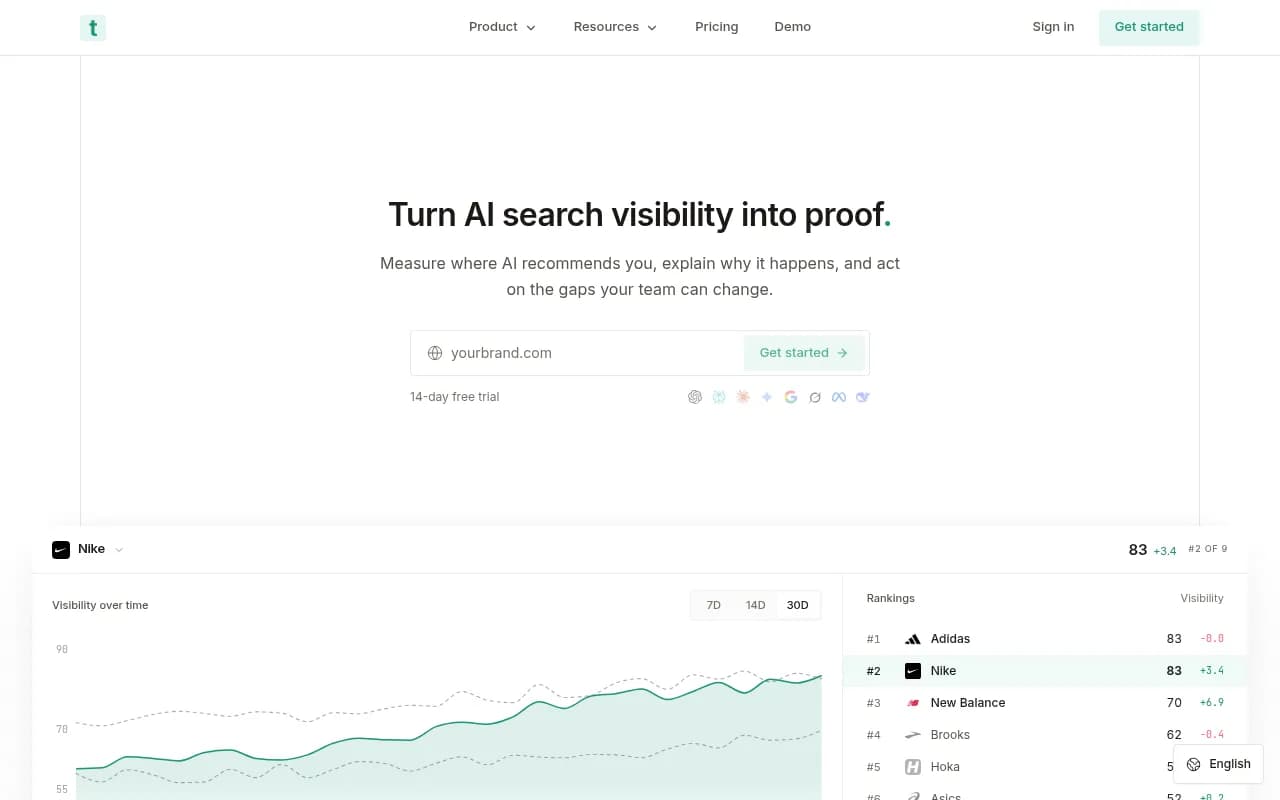
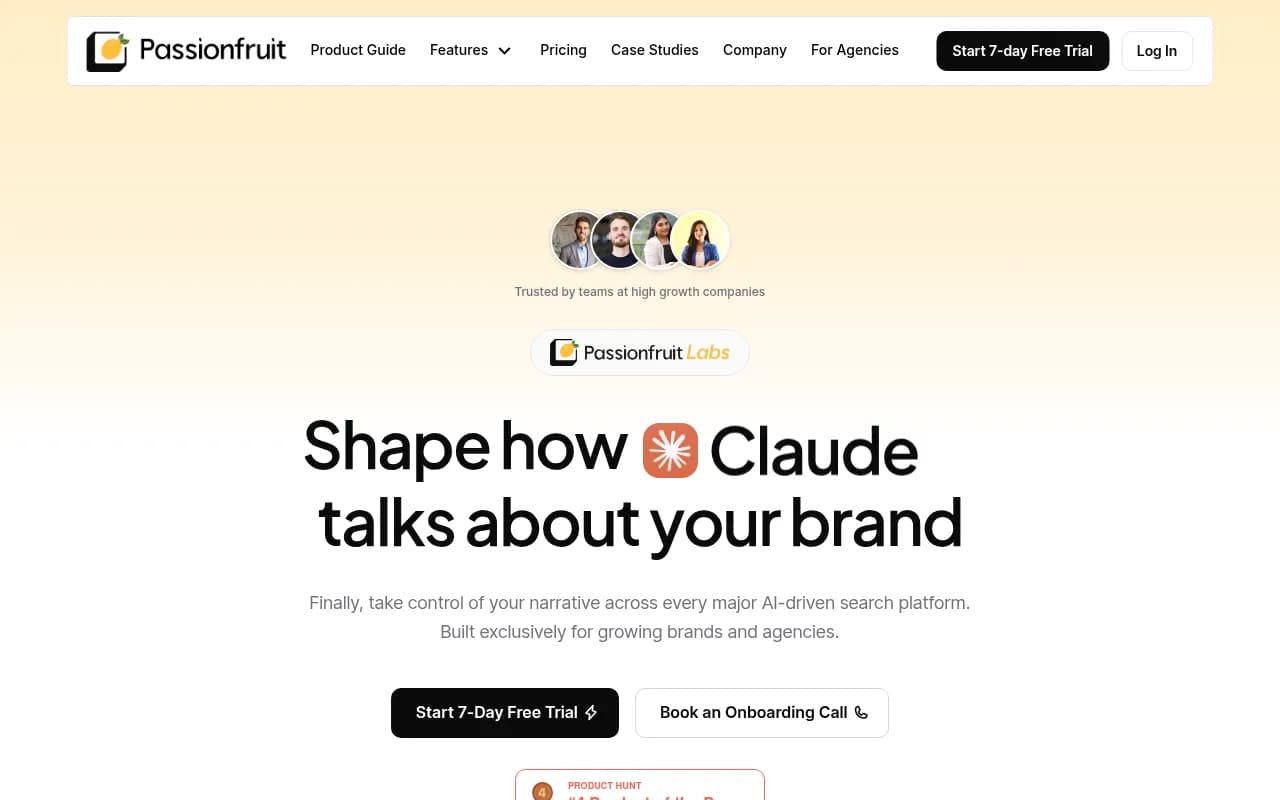
If your leadership question is "what is this worth," look at Trakkr, which traces AI visitors to revenue, and Passionfruit, which connects citation tracking to revenue attribution.
ZipTie
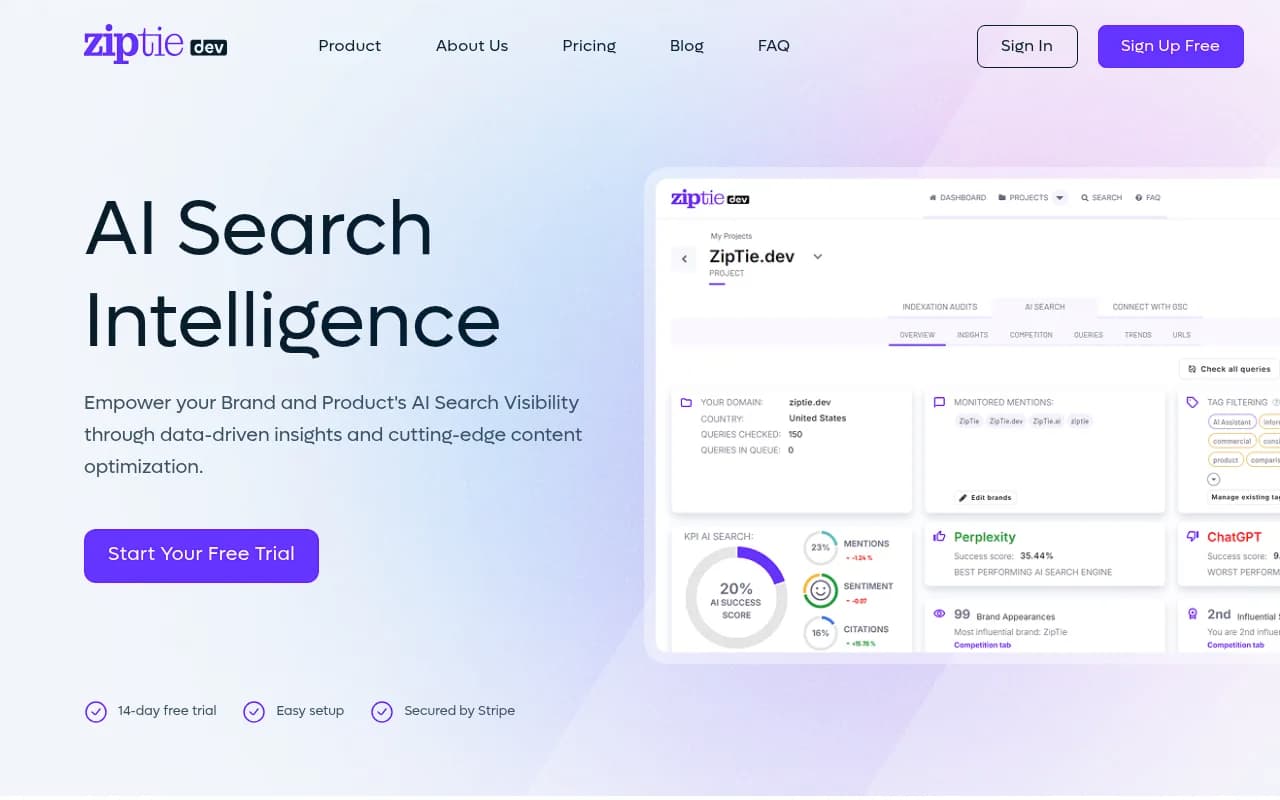
ZipTie gets recommended for deep analysis and reporting. It is a focused tracker, so expect depth in analysis rather than a content workflow.
Which one should you choose?
A short decision guide:
- You want to track and fix: Promptwatch.
- You are an enterprise team that wants deep reporting and real-user prompt volumes, and the budget is there: Profound.
- You want the cheapest respectable monitoring: Otterly.AI.
- You already pay for Ahrefs or Semrush and want to stay in one login: Brand Radar or the Semrush toolkit.
- You need to prove revenue: Trakkr or Passionfruit, or Promptwatch's visitor analytics.
- You run an agency with many clients: look at Promptwatch's agency plans, Scrunch AI, or Peec AI.
Questions to ask on any demo
- Are prompts run in the real user interface of each engine, or via API only? Answers and citations can differ between the two.
- Can I see ChatGPT's fan-out queries?
- Does it show whether AI crawlers can access my pages?
- Can it attribute traffic and conversions from AI engines?
- What does it recommend I do, and can it help produce that content?
- How is pricing metered: prompts, responses, checks, or seats?
Most of the gap between a mention tracker and an optimization platform shows up in questions 2 to 5. For help interpreting all of this and building a program around it, an agency like 1001 SEO Media, which does AI search and GEO work alongside technical SEO, is worth a conversation, and the team uses Promptwatch for its own AI visibility work.
Bottom line
Visby is fine if you only need to watch mentions. But a mention count is a symptom, not a diagnosis. Pick the tool that shows you the cause (crawler access, content gaps, weak citations), helps you ship the fix, and measures what AI actually sends to your site. For most teams that means starting with a free Promptwatch scan or the 7-day trial on a paid plan, and comparing it against one budget tracker and one suite add-on before deciding.