Key takeaways
- ChatGPT answers are wide, not narrow. Promptwatch Data shows 47.6% of responses cite 10 or more domains (Sep 28 to Oct 4, 2026), so one prompt per client tells you almost nothing.
- "White-label" means different things at different vendors. Check whether it covers PDF exports, scheduled emails, a client portal, or a custom domain before you sell it.
- Platform cost per client ranges from roughly $1 to $50 a month on brand-based plans, to $100+ on project-based plans. Typical retainers sit at $500 to $1,500 per client per month, so software is rarely the margin problem.
- A four-layer reporting cadence (alerts, weekly digest, monthly PDF, quarterly review) serves everyone from analysts to CMOs from one tracking stack.
- Annotate reports with ChatGPT behavior changes. Citations move in steps, and clients blame you if you do not explain the step.
Why agencies are suddenly asked about ChatGPT citations
Clients used to ask where they rank on Google. Now they ask why ChatGPT recommends a competitor. That question is board-visible and urgent, and most agencies still answer it with screenshots pasted into slides.
That does not scale past three clients. Tracking citations properly means running a fixed prompt set daily, recording which domains get cited, where your client appears in the answer, and how the model describes them. Then you need to wrap it in a report that carries your logo, not the vendor's.
This guide covers three things: what to measure and report, what white-label actually includes at different vendors, and what the per-client math looks like.
What to track for each client
Citations are noisy, so sample widely
Promptwatch Data on unique domains per ChatGPT response (Sep 28 to Oct 4, 2026) found that 47.6% of responses cite 10 or more domains and 66.1% cite at least 8. Only 6% cite three or fewer. For organic prompts where no brand is named, 52.5% cite 10 or more.
Brand-specific prompts behave differently: 5 domains is the most common count (14.9%), and 40.7% cite five or fewer.
For agencies, this has a direct implication. If a client appears in one citation out of ten domains, a single prompt run is a coin flip. Track dozens of prompts per client, split them into organic, brand-specific and competitor-comparison groups, and report trends rather than single results.
Metrics worth putting in a client report
- Mention rate and share of voice against two or three named competitors
- Position in the answer (first named versus buried at the end)
- Whether the client's own domain is cited, versus third parties mentioning them
- Sentiment, meaning how ChatGPT describes the brand
- Which third-party domains get cited for the client's prompts (these become your outreach and content targets)
- AI-referred sessions and conversions, if the client lets you install analytics
Mentions without self-citations usually point to a content or crawlability problem. Low share of voice is a coverage problem. Separating those saves you from selling the wrong fix.
Annotate for ChatGPT behavior changes
ChatGPT does not drift smoothly. It changes in steps. Promptwatch Data recorded a citation drop around the GPT-5.3 rollout on March 4, 2026, and a shift to using the site: operator at scale on August 8, 2026, when site: queries went from about 0.4% to about 17% of fanout queries. Its Reddit data shows reddit.com's share of ChatGPT citations falling from roughly 4% to 0.5% on August 14, 2026.
If a client's numbers fall on one of those dates, the cause is the model, not your work. Put a changelog line in the monthly report. It takes two minutes and prevents an uncomfortable call.
The query fanout data is a useful companion. Fanouts averaged 2.15 per response in early December 2025 and about 1.84 by early March 2026, with average query length dropping from about 117 characters to the high 80s. Shorter, query-like headings with the entity and category up front tend to match how ChatGPT searches.
Content type matters for recommendations
When you recommend fixes, the content type data helps. Product pages were the most cited type at 22.4% of citations (Sep 28 to Oct 4, 2026). The half-life report shows landing pages and docs staying cited longest, while news lost half its cited pages within 36 days. That tells you which clients need evergreen pages and which are wasting budget on news.
What white-label actually means
Vendors use the term loosely. Before you promise a client "your dashboard," ask which of these layers you actually get.
| Layer | What it means | Common catch |
|---|---|---|
| Branded exports | PDF or Word reports with your logo and colors | Usually the baseline |
| Scheduled delivery | Reports emailed to clients automatically | Emails may still carry vendor attribution |
| Client portal | Clients log into a branded dashboard | Often a higher tier |
| Custom domain | Dashboard served from your own URL | Rare, often enterprise only |
| Prospect scans | Run a branded audit before a pitch | Scan caps per month |
Ayzeo is a clear example of why you need to read the fine print. Its Pro plan at $149 a month includes white-label PDF and Word reports, and since an October 2026 update also dashboard branding and a Prospect Scanner for agency organizations. But scheduled report emails keep Ayzeo attribution, even on Enterprise.
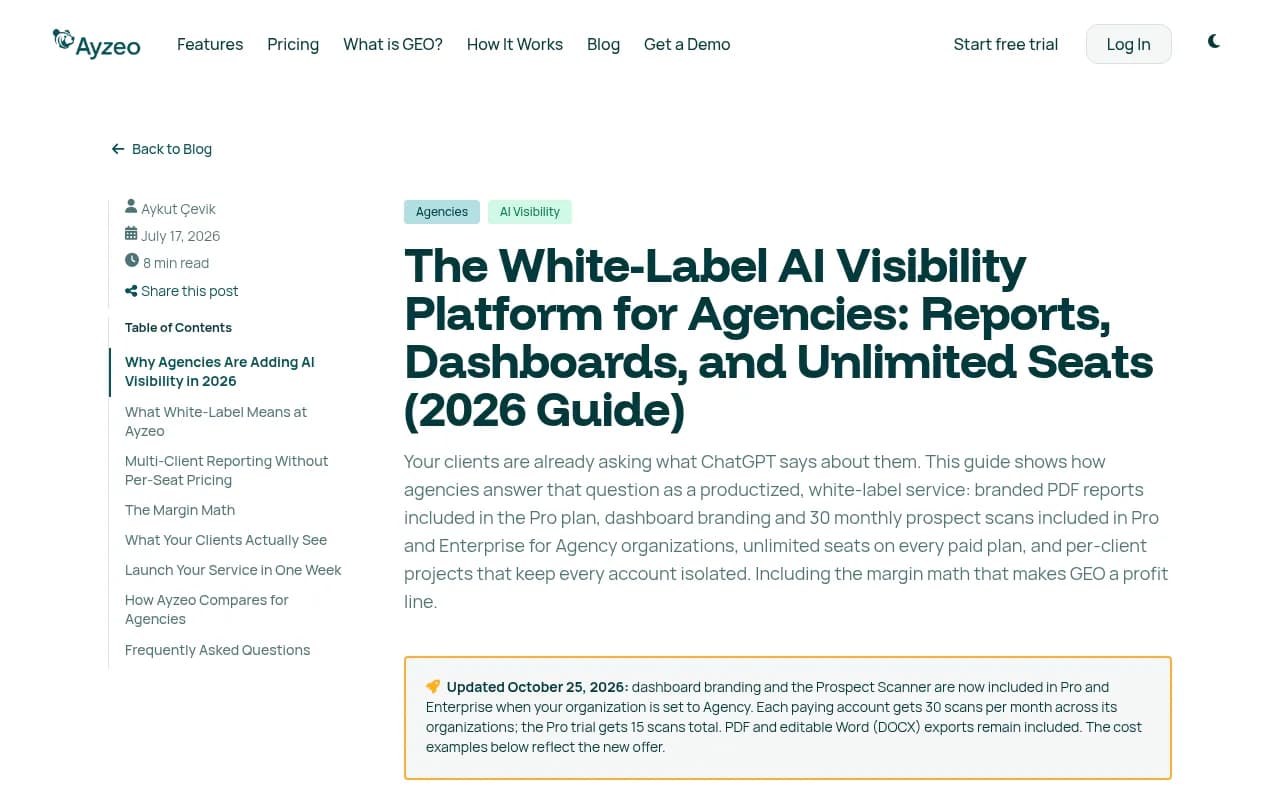
Neither answer is wrong. Just know which one you are selling. A client who sees a vendor name in the email footer may ask what else you outsource.
Tools agencies are using for ChatGPT citation tracking
Pricing below comes from vendor pages and third-party roundups. Treat it as a starting point and confirm on each vendor's pricing page, since several of these figures were not re-verified.
Promptwatch
Promptwatch is the platform I would start with if the work extends past reporting into fixing things. It tracks the real interfaces of ChatGPT, Google AI Overviews, AI Mode, Gemini, Perplexity, Copilot and others, and the Agencies plans give you unlimited projects and prompts, 10 seats, white-label workspaces, branded read-only client access and white-label PDF exports with scheduled delivery.
Where it differs from most trackers is what sits behind the reporting: IP-verified AI crawler logs, visitor analytics for AI-referred traffic, Reddit, YouTube and LinkedIn citation reports, and Agent Chat for building dashboards and PDFs on request. That matters in a client meeting, because "you were cited 12% less" lands better with "and here is the crawl error causing it."
Agency pricing runs Kick-off $199, Growth $399 and Scale $799 per month, billed on response volume (10,000, 25,000 and 65,000) rather than per brand. Check promptwatch.com/pricing, as these plans do not include the Content Agent or AEO articles.

Rank Prompt
Rank Prompt is built around agency economics. Its Agency plan is listed at $149 a month with white-label reports emailed after each scheduled run, a client portal and 500 brands. Agency Plus at $299 adds client logins, prospecting and 1,000 brands.
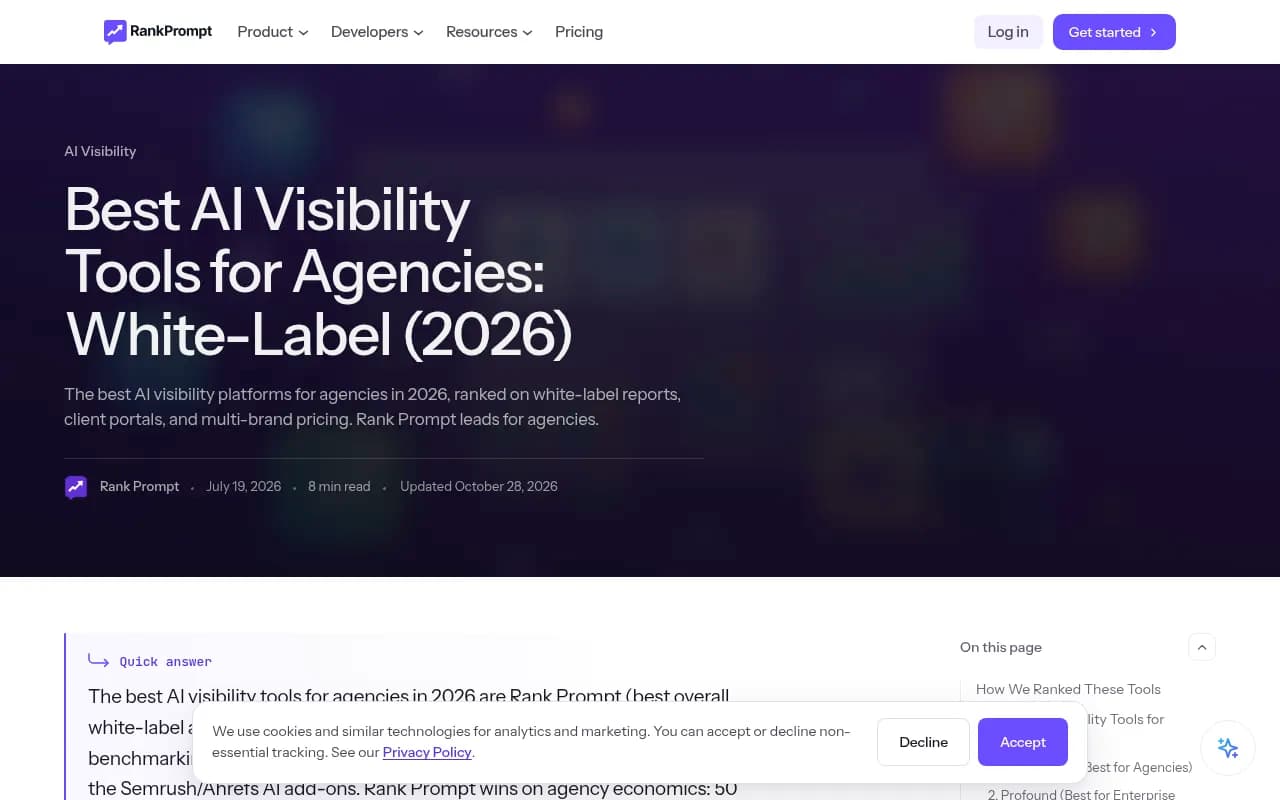
The brand counts are generous. Check how many prompts and models each brand gets before you assume 500 clients is realistic.
Rank Prompt
Peec AI, Otterly.AI and LLM Pulse
These are the usual budget comparisons. Per Ayzeo's comparison table, Peec AI starts around 70 euros annually with branded Looker dashboards on agency plans, Otterly.AI starts at $29 with an own-brand Looker Studio option at $189, and LLM Pulse starts around $60 with white-label reports and a client portal. They are fine for monitoring. Expect to bolt on separate tools for crawler data, traffic attribution and content.



Others worth a look
Scrunch AI, Profound and Search Party are commonly shortlisted. Search Party positions itself specifically for agencies. Scrunch and Profound suit larger accounts, generally at higher price points.


If you want a wider scan of options, the directory at ai-rank-tools.com lists AI rank trackers by category.
Quick comparison
| Tool | Entry agency price | White-label | Client access | Billing basis |
|---|---|---|---|---|
| Promptwatch | $199/mo (Kick-off) | PDF exports, white-label workspaces | Branded read-only client access | Responses |
| Rank Prompt | $149/mo | Reports, scheduled email | Portal; logins at $299 | Brands |
| Ayzeo | $149/mo (Pro) | PDF, DOCX, dashboard branding | Viewer invites | Projects |
| Peec AI | about 70 euros/mo | Not published; Looker dashboards | Via Looker | Credits by client count |
| Otterly.AI | $29/mo | Own-brand Looker Studio at $189 | No portal | Plan tiers |
| LLM Pulse | about $60/mo | Yes | Yes | Plan tiers |
Per-client cost math
Platform cost is only part of it. Here is how the main billing models behave as you grow.
Per-project billing
Ayzeo's Pro plan includes 3 projects, then $49 per extra project per month. Extra models (Claude, Perplexity, Gemini, Grok) are $29 per model per project. Ayzeo's own example puts a 10-client agency at $492 a month, but that figure assumes one market per client and no add-on models. Add Perplexity tracking for five clients and you add $145. Also, 7 extra projects at $49 is $343, so the total is $492 including the $149 base.
Per-brand billing
Rank Prompt's headline numbers (500 brands for $149) make per-client software cost almost negligible. The limiting factor is then prompts and runs per brand, not the brand count.
Response-based billing
Promptwatch's agency plans are priced on response volume. That favors agencies with many clients and modest prompt sets each, because you are not penalized for adding a project. It punishes sloppy prompt lists that run daily across every model for no reason, so budget your monitors.
Margin sanity check
Ayzeo reports that agencies reselling AI visibility charge $500 to $1,500 per client per month for monitoring, reporting and remediation. DoodleWeb publishes an agency white-label offer at $599 a month for three domains. Treat those as vendor-reported ranges, not market averages.
| Agency size | Platform cost (illustrative) | Retainer revenue at $500/client | Software as share of revenue |
|---|---|---|---|
| 3 clients | $149 to $199 | $1,500 | 10 to 13% |
| 10 clients | $249 to $500 | $5,000 | 5 to 10% |
| 25 clients | $399 to $800 | $12,500 | 3 to 6% |
The takeaway: software is rarely your margin problem. Analyst hours spent assembling reports are. Pick the tool that cuts report-building time, not the one with the lowest sticker price.
A reporting cadence that works
One approach from Demand Local's agency guide is a four-tier cadence, and it matches what I would do:
- Daily anomaly alerts for sudden mention drops, mostly for your analysts
- Weekly digest for the account lead, covering movement, new competitors and new cited sources
- Monthly white-label PDF for the client, tying citations and share of voice to leads, branded search lift or sales
- Quarterly review for the CMO with strategy and a changelog of ChatGPT behavior changes
Tie the monthly PDF to a business number whenever you can. A mention chart alone invites "so what?" AI-referred sessions, conversions, or branded search lift answer it. Crawler logs and visitor analytics, which a few platforms include, are what let you do that without guessing.
Setup checklist for a new client
- Build 30 to 100 prompts split across organic, brand-specific and competitor-comparison types
- Add two to four competitors and brand aliases, so mentions are counted correctly
- Set the country and language the client sells in
- Run a baseline for a week before you show any numbers
- Connect Search Console and analytics where the client allows it
- Schedule the monthly PDF with your branding and test the email before the first send
- Add a changelog section to your template for model changes
For pitching, look for a prospect-scan feature. Running a branded visibility check live on a sales call converts better than a deck.
Mistakes I see agencies make
- Selling "white-label dashboard" when the tool only does branded PDFs
- Reporting a single prompt's result as if it were a trend
- Ignoring that API outputs and user-facing ChatGPT answers can differ
- Running every prompt on every model daily and burning through response limits
- Skipping the baseline week, then having no honest before and after
- Sending clients mention counts with no link to traffic or revenue
If you want a human team to take the whole workstream, agencies like 1001 SEO Media run GEO programs for clients, but for most agencies the better route is to own the tracking in-house and resell the insight.
For broader shopping, bestgeosoftware.com keeps a directory of GEO platforms.
Bottom line
Start by deciding what you will promise clients: a PDF, a branded login, or a fully branded domain. Then pick the billing model that fits your client count. Brand-based pricing works for many small clients, response-based pricing works for fewer, deeper accounts, and project-based pricing sits in between. Test one tool on two real clients for a month, check the white-label output as a client would see it, and only then roll it across the book.