Key takeaways
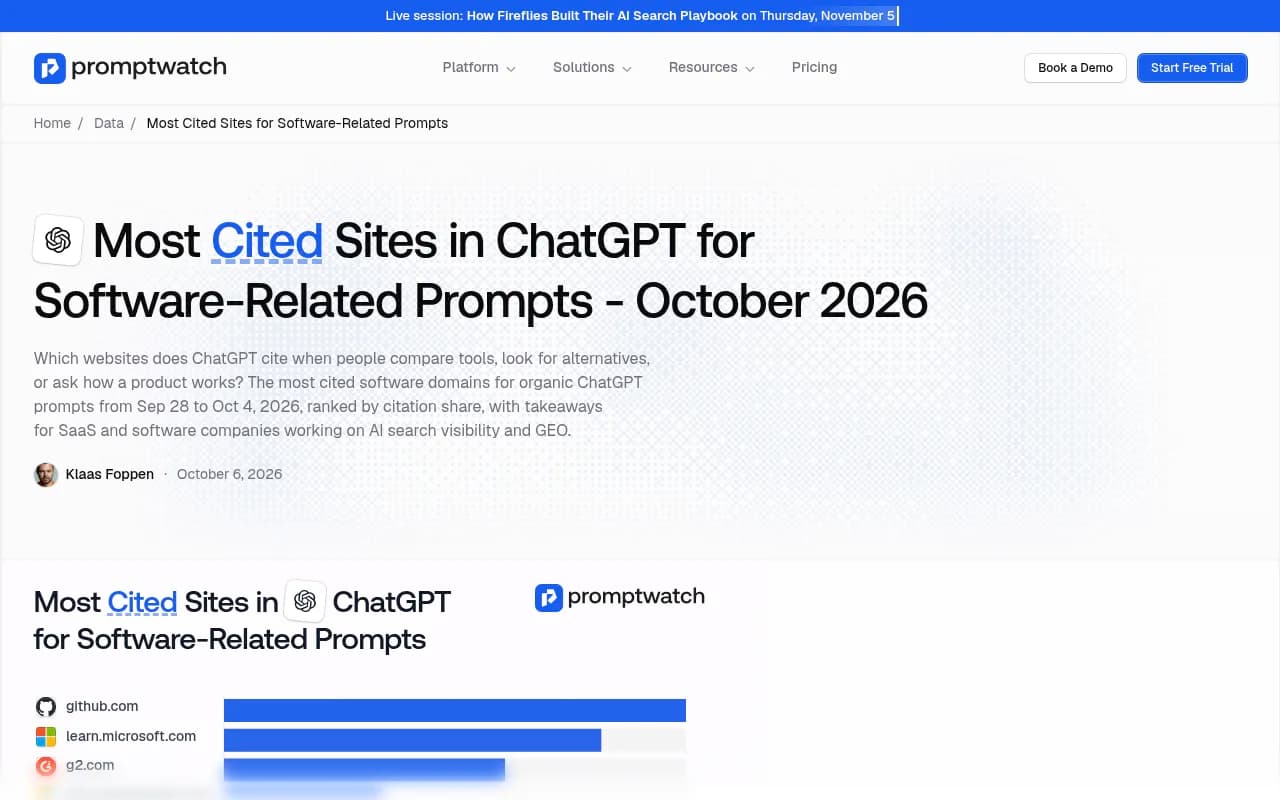
- In Promptwatch Data for organic software prompts (Sep 28 to Oct 4, 2026), github.com is the most cited software domain at 1.2%, followed by learn.microsoft.com at 0.98% and g2.com at 0.73%.
- Docs and help centers earn the largest share of software citations (2.64%), ahead of vendor sites (2.01%), review sites and analysts (1.57%) and GitHub (1.2%).
- Most cited pages are not blog posts. Product pages (22.4%) and landing pages (16.8%) lead all ChatGPT citations, and documentation is 7.5%.
- Docs and landing pages stay cited the longest. News pages lose half their citations in 36 days.
- Tracking citations by source type, not just brand mentions, tells a SaaS team where to spend its next hour.
Why SaaS teams should track citations, not just mentions
A brand mention in ChatGPT is nice. A citation is where the money is. When someone asks "best CRM for a 20-person team" or "how do I connect X to Y", ChatGPT builds an answer from a handful of pages, and those pages get the click, the trust and often the shortlist spot.
For software, the pages that get picked are not the ones most SaaS marketing teams obsess over. Promptwatch's data on which sites ChatGPT cites for software prompts (Sep 28 to Oct 4, 2026) shows that documentation, GitHub repos and third-party review profiles carry a lot of the weight. Your blog is competing with all of that.
One caveat before the numbers. Citation shares here look small (the top domain is 1.2%) because ChatGPT cites a very long tail of domains. The 23 domains in the chart together earn only 7.89% of software citations. Small percentages on a huge base are still large in absolute terms.
What the October 2026 software data says
| Domain | Share of software citations | Source type |
|---|---|---|
| github.com | 1.20% | Code host |
| learn.microsoft.com | 0.98% | Docs |
| g2.com | 0.73% | Review site |
| docs.aws.amazon.com | 0.41% | Docs |
| docs.cloud.google.com | 0.35% | Docs |
| gartner.com | 0.34% | Analyst |
| capterra.com | 0.32% | Review site |
| intercom.com | 0.28% | Vendor |
| zapier.com | 0.24% | Vendor |
Source: Promptwatch Data, organic software prompts, Sep 28 to Oct 4, 2026.
A few things stand out to me.
First, the top of the list is mostly big-tech docs. Microsoft earns 1.35% across three domains, Google 0.98% across four, AWS 0.69% across two. If you sell a mid-size SaaS product, you will not beat Microsoft Learn. But you do not need to. You need to show up in the long tail of specific, product-level questions where those docs have nothing to say.
Second, review sites punch above their weight as a group. G2, Gartner, Capterra and Software Advice combined earn 1.57%, more than any single vendor, Microsoft included. Vendor sites plus docs earn 4.65%, about three times the share of review sites. So your own site still matters most, but the review layer is a real second front.
Third, GitHub is its own category at 1.2%. For developer tools, APIs and SDKs, a public repo with a good README is a citation asset.
G2's own CEO posted a different framing on LinkedIn: that the three G2 marketplaces together reach 1.23% of citations, slightly ahead of GitHub. That is G2 self-reporting and may use a different dataset, so treat it as directional. The Promptwatch figures are what I would plan against.
Docs: the quiet citation engine
Docs and help centers are the largest source type in the software data at 2.64%. Across all prompts, Promptwatch's content type data puts documentation at 7.5% of classified citations, rising to 8.5% for informational prompts.
They also last. In Promptwatch's content half-life study, 76% of docs pages cited on July 6, 2026 were still cited after 30 days, and 67% after 60. News pages, by comparison, lost half their pages within 36 days. Docs are about the most durable thing you can publish for ChatGPT.
What to check on your docs
- Crawlability. Is your docs subdomain blocked by robots.txt, behind a login, or rendered entirely client-side? If AI crawlers cannot read it, nothing else matters.
- Page structure. One task or concept per page, a clear H1 that matches how people phrase the question, and code samples in plain text rather than screenshots.
- Comparison and integration pages. "X vs Y" and "X integration with Y" are the questions buyers ask ChatGPT. Docs that answer them directly get picked.
- Freshness. Old versions of docs that outrank current ones confuse models as much as people.
Check your AI crawler logs if you can. Seeing GPTBot, OAI-SearchBot and ChatGPT-User hit (or fail to hit) your docs tells you whether the problem is access or content. Promptwatch's AI crawler traffic data shows what normal crawler volume looks like for context.
G2 and Capterra: managing a citation source you do not own
G2 is the most cited review site at 0.73% of software citations, and Capterra adds 0.32%. Gartner (0.34%) and Software Advice also appear in the top 23.
The pattern is more pronounced for branded prompts. Promptwatch's content type data shows reviews at 5.6% of citations for branded prompts, more than three times their overall 1.7% share. When someone asks "is [your product] any good?", review pages are disproportionately what ChatGPT reaches for.
A third-party press-release study of 40 software categories claims ChatGPT cites a recommended vendor's own site only 11.6% of the time. I have not verified that, and press-release studies deserve skepticism. But the direction matches the Promptwatch numbers: much of what ChatGPT says about you is sourced from pages you do not control.
A practical G2 and Capterra checklist
- Claim and complete every profile. Description, pricing, screenshots, integrations, category placement.
- Keep review volume and recency healthy. Stale profiles with two-year-old reviews are a weak citation source and a weak sales asset.
- Make sure the product description on the profile matches your site's positioning. Conflicting descriptions lead to conflicting AI answers.
- Check which competitor profiles are cited alongside yours for "alternatives" prompts. That is where you are losing shortlist spots.
GitHub: not just for developer tools
GitHub's 1.2% makes it the single most cited software domain. If you sell to developers, this is obvious. If you sell a business SaaS product, it is still worth a look: public SDKs, API client libraries, sample apps, integration templates and open-source connectors all give ChatGPT something concrete to cite when someone asks "how do I integrate X with Y".
What tends to help:
- A README that states what the project does in the first two lines, with install and usage examples.
- Consistent naming between the repo, the docs and the product.
- Links from the repo to the canonical docs, and back.
- Active maintenance. An abandoned repo with open issues is a poor thing to be cited.
If your product is something coding agents recommend, it is also worth tracking how tools like Codex and Claude Code describe it. That is a separate surface from ChatGPT search but increasingly part of how developers choose tools.
Which pages do you actually want cited?
The content-type data should reset some assumptions. Across all ChatGPT prompts from Sep 28 to Oct 4, 2026:
| Content type | Share of citations |
|---|---|
| Product pages | 22.4% |
| Landing pages | 16.8% |
| Listicles | 13.6% |
| How-tos | 8.7% |
| Documentation | 7.5% |
| Articles | 6.1% |
| Comparisons | 5.9% |
| News | 5.7% |
| FAQ | 3.3% |
| Reviews | 1.7% |
For commercial prompts like "best CRM", product pages (26.0%), landing pages (20.6%), listicles (15.0%) and comparisons (7.9%) add up to almost 70%. Your pricing page, feature pages and comparison pages are not secondary content. They are the main event.
Half-life matters too. Product pages, reviews and how-tos keep about 55% of their citations after 60 days, with half-lives of 74 to 77 days. Landing pages and docs last longer. A news-style launch post will fade quickly, so do not build your AI visibility on press-cycle content alone.
How to set up ChatGPT citation tracking for a SaaS product
Here is a workable process. It does not need a big team.
1. Build a prompt set that mirrors buying and usage
Cover four groups:
- Category prompts: "best project management software for agencies"
- Comparison prompts: "[you] vs [competitor]"
- Alternatives prompts: "alternatives to [competitor]"
- Usage prompts: "how to connect [you] to Salesforce", "does [you] support SSO"
Start with 30 to 50 prompts. Tag each by type so you can read results by group later.
2. Track the source, not only the answer
For each prompt, record whether you are mentioned, where you appear, and which URLs ChatGPT cites. Then classify each cited URL: your docs, your marketing site, G2, Capterra, GitHub, Reddit, a competitor, a blog listicle. This source-type view is what makes the data actionable.
3. Diagnose by pattern
- Mentioned but your own domain is never cited: a content or crawlability problem. Fix access and write pages that answer the specific prompt.
- Not mentioned, but competitors are, and G2 is the cited source: a review-profile problem.
- Integration prompts cite a competitor's docs: you are missing integration pages.
- Everything cited is a two-year-old listicle: reach out to the author or publish a better comparison yourself.
4. Fix, then re-measure
Pick one gap per week. Publish or update the page, then watch whether it gets crawled, cited and clicked over the following weeks. Without that last step you are guessing.
Tools for tracking ChatGPT citations
You can do a version of this by hand, pasting prompts into ChatGPT and logging the sources in a spreadsheet. It works for ten prompts and falls apart at fifty, partly because answers vary run to run and by country.
Tools like Promptwatch cover the full loop for SaaS teams: real-UI tracking of ChatGPT, citation analytics by page and source type, IP-verified AI crawler logs to see whether your docs are being read, and a content agent that drafts and publishes pages against the gaps it finds.

Monitoring-focused alternatives are worth knowing about if you only need tracking:




SEO suites have also added AI tracking, usually with fixed prompt sets and lighter citation detail:

| Approach | Citation source detail | Crawler logs | Content fixes | Good for |
|---|---|---|---|---|
| Manual spreadsheet | Whatever you log | No | No | Under 10 prompts |
| Prompt trackers (Peec AI, Otterly.AI) | Basic | Usually no | No | Lightweight monitoring |
| Enterprise monitors (Profound) | Strong | Limited | Limited | Large budgets |
| SEO suites (Semrush, Ahrefs) | Shallow | No | No | Teams already on those suites |
| Promptwatch | Page-level, 22 content types and 20 source types | Yes, IP-verified | Yes, with CMS publishing | Tracking plus fixing |
To compare more options, the GEO software directory lists many of them side by side.
Common mistakes
- Treating the blog as the whole strategy. In the software data, docs, vendor sites, review sites and GitHub all earn more than blog content.
- Ignoring crawl access on the docs subdomain. It is the single most common silent failure.
- Updating G2 once a year. Profiles are a living asset.
- Tracking only brand prompts. Category and comparison prompts are where new buyers show up.
- Reading one week of data as a trend. Citation patterns shift. Promptwatch Data recorded ChatGPT's reddit.com share dropping from about 4% to 0.5% on August 14, 2026 (see the Reddit citation report), so any source you depend on can move fast.
A simple 30-day plan
- Week 1: build your prompt set and baseline your citations by source type.
- Week 2: audit docs crawlability and fix blocks. Update G2 and Capterra profiles.
- Week 3: publish or refresh two comparison or integration pages, and tidy your main GitHub repo's README.
- Week 4: re-run the prompt set, compare against the baseline, and pick next month's gaps.
The point is the loop. Docs, G2 and GitHub are the three places the data says SaaS companies should look first, and tracking which of them ChatGPT actually uses for your prompts tells you where the gap is. For more first-party numbers, the Promptwatch Data hub is updated regularly.