Key takeaways
- ChatGPT only cites pages when it searches the web, and one answer can't tell you why a rival won. You need repeated runs across a set of prompts to see patterns.
- Start by collecting the cited URLs behind each competitor mention, then classify them by content type: product page, landing page, listicle, comparison, review, docs.
- Promptwatch Data (Sep 28 to Oct 4, 2026) shows product pages at 22.4% of ChatGPT citations, landing pages at 16.8% and listicles at 13.6%, so those are the first places to look.
- Rule out access problems on your own site before you assume content is the issue. OAI-SearchBot has to be able to reach your pages.
- Tools like Promptwatch can automate the prompt runs, citation lists and page-level tracking once the manual test shows you what to look for.
Why this question is harder than it sounds
You ask ChatGPT for the best option in your category. It names three competitors and not you. Annoying. The obvious next step is to look at what it cited, and that is the right instinct, but it is easy to draw the wrong conclusion from it.
OpenAI documents how to be eligible for ChatGPT search. It does not document why one business is named over another. Its help center says ChatGPT may search the web automatically, may rewrite your question into targeted queries, and ranks results using multiple factors without guaranteeing placement. So there is no setting to copy from a competitor. What you can do is observe, repeatedly, and infer.
A useful framing comes from the Xtrusio write-up on this topic: one answer shows that ChatGPT named a rival and which pages it cited. It cannot tell you why it chose the rival. A page that names the rival is a lead, not a verdict.
Step 1: check that ChatGPT searches at all for your prompts
Before you analyze anything, know that ChatGPT does not search the web for every question. Semrush's February 2026 clickstream sample found web search enabled for only 34.5% of observed queries. If a prompt is answered from training data, there are no citations to study, and nothing on a competitor's site is being "cited".
So when you build your test set, favor prompts where search is likely to trigger: comparisons, "best X for Y", pricing questions, recent facts. Mark each run as searched or not searched. Discard the ones that were not.
Step 2: build a prompt set that mirrors real buyers
Ten well-chosen prompts beat a hundred random ones. Pull them from the questions your sales team hears, your Search Console queries and People Also Ask boxes. Split them into three groups:
- Category prompts: "best CRM for small businesses", no brand named.
- Comparison prompts: "[Competitor] vs [You]" and "[Competitor] alternatives".
- Brand prompts: "Is [Competitor] any good?", "[Competitor] pricing".
The split matters because the content types that win differ by prompt type. In Promptwatch Data's content-type breakdown (Sep 28 to Oct 4, 2026), commercial prompts leaned on product pages (26.0%), landing pages (20.6%), listicles (15.0%) and comparisons (7.9%), which together are almost 70% of commercial citations. Branded prompts looked different: landing pages reached 22.8% and reviews hit 5.6%, more than three times their overall share.
Step 3: collect the cited URLs, not just the brand mentions
Run each prompt in ChatGPT with search on, and open the sources panel. For every response, log:
- the prompt and the date
- whether your brand and each competitor was named
- every cited URL, in order
- whether the cited page is the competitor's own site or a third party
A spreadsheet is fine. Columns for prompt, brand mentioned, URL, domain, page type and source owner (first-party, listicle site, review site, forum). Run each prompt at least three times. ChatGPT answers vary, and a single run can mislead you.
If you want a quicker view of what the model is searching for, a Chrome extension like the free GEO Inspector for ChatGPT from Promptwatch shows the fan-out queries and the fetched versus cited sources locally in the browser.
Don't skip third-party pages
Often the page that matters is not the competitor's. It is a best-of list, a review, or a directory entry that names them. Almost half of ChatGPT responses cite 10 or more unique domains, per Promptwatch Data on unique domains per response (Sep 28 to Oct 4, 2026), so a single answer is usually built from a mix of sources. Your list should show who else is feeding the answer.
Step 4: classify every cited page by type
This is the step that turns a pile of URLs into something useful. Tag each one: product page, landing page, listicle, comparison, how-to, documentation, review, news, FAQ, social post.
Then compare against the baseline. Promptwatch Data's overall shares for Sep 28 to Oct 4, 2026:
| Content type | Share of ChatGPT citations |
|---|---|
| Product pages | 22.4% |
| Landing pages | 16.8% |
| Listicles | 13.6% |
| How-to guides | 8.7% |
| Documentation | 7.5% |
| General articles | 6.1% |
| Comparisons | 5.9% |
| News | 5.7% |
| FAQ pages | 3.3% |
| Reviews | 1.7% |
If a competitor is cited for a type that is rare in the baseline, such as an FAQ page or a docs page, that is a sign of an unusually specific page answering an unusually specific sub-question. If they are cited for a product page and you have none that is crawlable, the gap is obvious.
Pay attention to durability too. Promptwatch's content half-life data tracked pages cited on July 6, 2026 for 90 days. Landing pages (78% still cited after 30 days) and docs (76%) held on longest, comparisons held at 72%, and news lost half its pages within 36 days. A competitor's cited news or press pages are short-lived. Their landing pages, docs and comparison pages are the assets worth studying.
Step 5: work out why those pages win
Now the hard part. Treat everything here as a hypothesis, not a ranking factor.
Title and URL match the sub-question
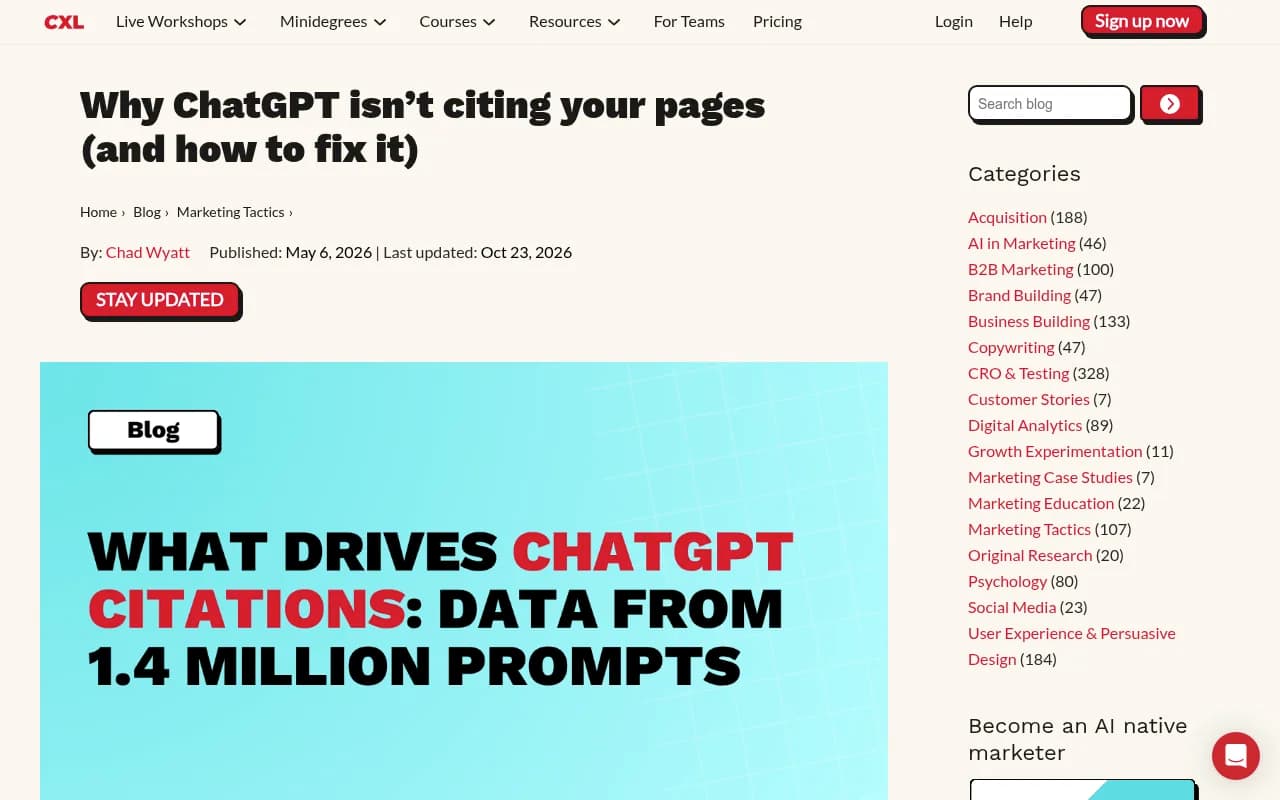
Ahrefs' study of 1.4 million prompts, summarized by CXL, found ChatGPT retrieves roughly 33 pages per query and cites about half. Selection seems to happen on title, URL and snippet. Cited pages scored 0.602 on semantic similarity between title and prompt versus 0.484 for non-cited pages, and 0.656 when measured against fan-out queries. Pages with readable slugs were cited 89.78% of the time versus 81.11% without. These are third-party figures and correlations, so use them as a checklist rather than a law.
Read the competitor's title tag and URL for each cited page. Does it match the sub-question, like "pricing", "alternatives", "for small teams"? Compare it to your nearest page.
Fan-out coverage
A prompt can trigger several background searches. Promptwatch's query fan-out data puts it at 3 to 8+ searches for a single prompt in its intro, though the average per response fell from 2.15 in December 2025 to about 1.84 by March 2026, and was about 1.0 in April. The depth varies, so don't build a strategy on one number. The practical read is the same: competitors that have a focused page per sub-question (pricing, alternatives, how-to) get retrieved more.
If you want to see the sub-queries for your own prompts, a fan-out generator or the browser extension above will show them. Then check whether each competitor has a page matching each one.
One more thing worth knowing: on August 8, 2026, ChatGPT started using the site: operator at scale, jumping from about 0.4% to about 17% of fanout queries, per Promptwatch Data. That means ChatGPT is sometimes searching inside a specific domain, which makes clear, well-labeled pages on your own site matter more.
Third-party corroboration
When the cited page is a listicle or review site rather than the competitor's own domain, the win is off-site. Check whether the rival is listed there, how they are described, and whether you are missing or described badly. Fixing that is outreach and PR, not on-page work.
Source type
Do not expect social to rescue you. Promptwatch's social citation data shows ChatGPT drew just 0.46% of its citations from social platforms from Sep 28 to Oct 4, 2026, while Google AI Overviews drew 12.2%. And reddit.com's share of ChatGPT citations fell from about 4% to 0.5% on August 14, 2026. If a competitor's Reddit presence is their "secret", it is a weaker lever in ChatGPT than it was, though it may still matter in AI Overviews.
Step 6: rule out problems on your side
Before you decide a competitor simply has better content, check yours can be seen.
- Is OAI-SearchBot allowed in robots.txt? OpenAI says sites that opt out will not be shown in ChatGPT search answers, though they may appear as navigational links. Robots.txt changes can take about 24 hours to apply. GPTBot is a separate setting.
- Does your host or CDN block OpenAI's published searchbot IP ranges?
- Is the page indexed in the standard web index? CXL, citing Ahrefs, reports 88.46% of ChatGPT citations come from standard indexed content.
- Does the page answer the question near the top, in plain language? A page that buries the answer under 800 words of preamble is hard to quote.
- Is what your page says consistent with what third-party sources say about you? Conflicting founding dates or outdated service lists make you harder to trust and repeat.
If your server logs show OpenAI's bots hitting your pages, access is probably fine. Crawler log analysis is available in some tracking platforms, and the free Agentic Readiness Check from Promptwatch tests which AI crawlers can read your site.
Step 7: do it at scale with a tool
The manual method teaches you what "cited" means. It is also slow, and inconsistent across runs. Once you know what you are looking for, a tracker saves hours. Here is a rough guide to the categories.
| Tool | Best for | Notable angle |
|---|---|---|
| Promptwatch | End-to-end: tracking, citations, crawler logs and content fixes | Real-UI prompt tracking, page-level citation data, Content Agent and Action Board |
| Profound | Enterprise monitoring | Deep analytics, higher price point |
| Ahrefs Brand Radar | Teams already in Ahrefs | AI mention data alongside SEO data |
| Semrush AI Visibility Toolkit | Teams already in Semrush | Fits existing SEO workflow |
| Peec AI | Smaller teams | Prompt tracking with suggestions |
| Otterly.AI | Budget monitoring | Lightweight brand tracking |
| Findable | Gap analysis | Citation-gap analysis across LLMs |
Promptwatch is the one I would reach for here, because it answers the "why" and not just the "who". You can watch any URL, yours or a competitor's, and see which prompts cite it, filter citations by content type, and see how long each cited page keeps getting cited. It also joins that to crawler logs and traffic, so you can check whether your fix got crawled and cited.

The others are reasonable depending on your stack. Profound is a strong monitor for enterprises.

If you already live in Ahrefs, Brand Radar is the lowest-friction way to start.

Semrush has a similar pitch for its users.
For lighter budgets, Peec AI and Otterly.AI cover the monitoring basics.


Findable adds citation-gap analysis.
Most of these stop at showing you the gap. If you want to compare more options, the GEO software directory at bestgeosoftware.com and the AI rank tracking directory at ai-rank-tools.com list many more.
Step 8: turn the findings into a fix list
What you do next depends on which gap you found. Be specific.
| What you found | Likely gap | Fix |
|---|---|---|
| Rival cited via a product or landing page, you have none | Missing page | Build a crawlable page targeting that sub-question |
| Rival cited via comparison or alternatives page | Missing format | Publish an honest comparison on your site, including competitors |
| Rival named on a third-party listicle, you are absent | Off-site coverage | Outreach to get listed or corrected |
| Your page exists but is never retrieved | Weak title, URL or buried answer | Rewrite title, slug and opening paragraph |
| Bots can't reach your pages | Access | Fix robots.txt, CDN or firewall rules |
| Cited page about you is wrong or old | Inconsistent facts | Update your page and the source, if possible |
A caution about comparison pages. Publishing your own best-of list with yourself on it can work, as it can be cited like any other page, but it is not a guarantee. Describe competitors accurately and disclose commercial relationships.
Also keep in mind that recently updated pages take time to be crawled and absorbed. Recheck the same prompts on a schedule, say weekly, and compare which pages get cited. Answers that come from training data only change with new model versions.
Common mistakes
Treating one answer as proof is the big one. Another is copying a competitor's page structure wholesale without checking that it is the page ChatGPT actually used. A third is chasing mentions without checking whether your page was cited. As the Xtrusio piece points out, your page can be a source without your company being recommended, and the reverse.
Also resist the urge to measure only referral clicks. CXL notes that a ChatGPT mention often triggers a later branded search, so direct ChatGPT referrals undercount the effect.
A simple weekly routine
- Run your 10 to 20 core prompts, three times each, with search on.
- Log cited URLs and tag them by type and owner.
- Note new competitor pages and pages that dropped out.
- Pick one gap, ship one fix.
- Recheck next week and see if the cited set changed.
That loop is boring, and it works. For the wider picture of how citation patterns shift month to month, the free reports at Promptwatch Data are a good baseline.
Start with one buyer question where a rival is named, open every page ChatGPT cited, and write down what each one has that yours doesn't.