Key takeaways
- Claude Code has strong defaults in databases (PostgreSQL, 58.4%), payments (Stripe, 91.4%) and email (Resend, 62.7%), but auth is split and often hand-rolled.
- "What the agent picks unprompted" and "what the agent integrates successfully" are different questions. Stripe wins the first for payments, PayPal topped the second in one test.
- Stack matters more than category. Next.js projects get NextAuth.js, Python projects get homemade JWT, and Vite SPAs lean on Supabase.
- Agent-friendly docs, an llms.txt file, a CLI and an MCP server separate the APIs that work from the ones agents never find.
- The sample sizes are small (70 to 125 responses per category) and the models tested are not the newest, so treat percentages as direction, not law.
Two ways to measure a Claude Code recommendation
People say "Claude Code recommends X" and mean two different things. Sometimes they mean: when I give Claude Code an empty repo and say add a database, what does it choose? Other times they mean: when I hand it a specific API and a production key, can it actually get the job done?
This guide pulls from two public benchmarks that measure those separately.
The first is Amplifying's benchmark, which ran Claude Sonnet 4.5, Opus 4.5 and Opus 4.6 against four repos (a Next.js 14 app, a FastAPI service, a Vite and React SPA, and one more) and recorded which tool the agent picked on its own. Category pages show roughly 70 to 125 extractable responses each.
The second is Lightsage's test, which gave Claude Code and Codex 70+ live production API keys across 12 categories and measured usability, discoverability, tool calls and errors. They reported spending over $5,000 on Claude Code and getting rate-limited along the way.
One caveat before the numbers. The Amplifying runs used Sonnet 4.5, Opus 4.5 and Opus 4.6, which may be older than whatever your Claude Code is running today. Check the dates before you quote any of this as current.
Side-by-side summary
| Category | Default pick (Amplifying) | Share | Best integration results (Lightsage, Claude Code) |
|---|---|---|---|
| Databases | PostgreSQL | 58.4% (n=125) | LanceDB, Chroma (vector databases) |
| Auth | Custom/DIY | 47.7% (n=109) | Auth0, Scalekit, Descope |
| Payments | Stripe | 91.4% (n=70) | PayPal, Stripe |
| Resend | 62.7% (sample size not published in what I reviewed) | Not covered as a leaderboard |
The table shows the pattern right away. Where the agent has a clear favorite (payments, email), the default is an obvious developer-first API. Where it doesn't (auth), it writes code itself.
Databases: PostgreSQL by default, Supabase when the app has no backend
Amplifying labels databases a "Strong Default". Out of 125 responses, PostgreSQL was the primary pick 73 times (58.4%), Supabase 30 times (24%) and SQLite 20 times (16%).
The interesting part is how much it flips by repo.
- In the Next.js app, PostgreSQL was picked 78.6% of the time by Sonnet 4.5, 93.3% by Opus 4.5 and 100% by Opus 4.6.
- In the FastAPI project, PostgreSQL averaged 77%, but SQLite took about 34.5% on average, and Opus 4.5 and 4.6 picked it 33 to 36% of the time.
- In the Vite React SPA, Supabase won, because the agent treated it as one product for database, auth and storage. Its share climbed from 53.3% (Sonnet 4.5) to 76.9% (Opus 4.5) to 84.6% (Opus 4.6).
So when a project has no server, Claude Code reaches for a backend-as-a-service. When it has a server, it reaches for Postgres. That is sensible behavior, honestly.
The long tail
The alternatives column is worth reading. As suggested second choices (alt picks / mentions), the numbers were SQLite 35 / 34, Supabase 27 / 9, Firebase 21 / 7, MongoDB 17 / 30, PlanetScale 16 / 11, Neon 9 / 16 and Vercel Postgres 7 / 4.
MongoDB is the odd one. It got zero primary picks but 30 mentions. Claude knows it well, talks about it, and still doesn't choose it. If you run a document database company, that gap is the thing to worry about.
I also tried to find the Reddit thread where someone asked Claude which database to use 612 times and compared chat answers with what Claude Code actually did. I couldn't pull figures from it, so I'm not going to quote any. The question it asks (does chat advice match agent behavior?) is a good one though.
Vector databases
In Lightsage's integration test, LanceDB and Chroma led the vector database category for Claude Code. That's an integration result, not a default-choice result, so don't read it as "Claude picks LanceDB when you say add vector search".
Auth: the category where Claude would rather write it itself
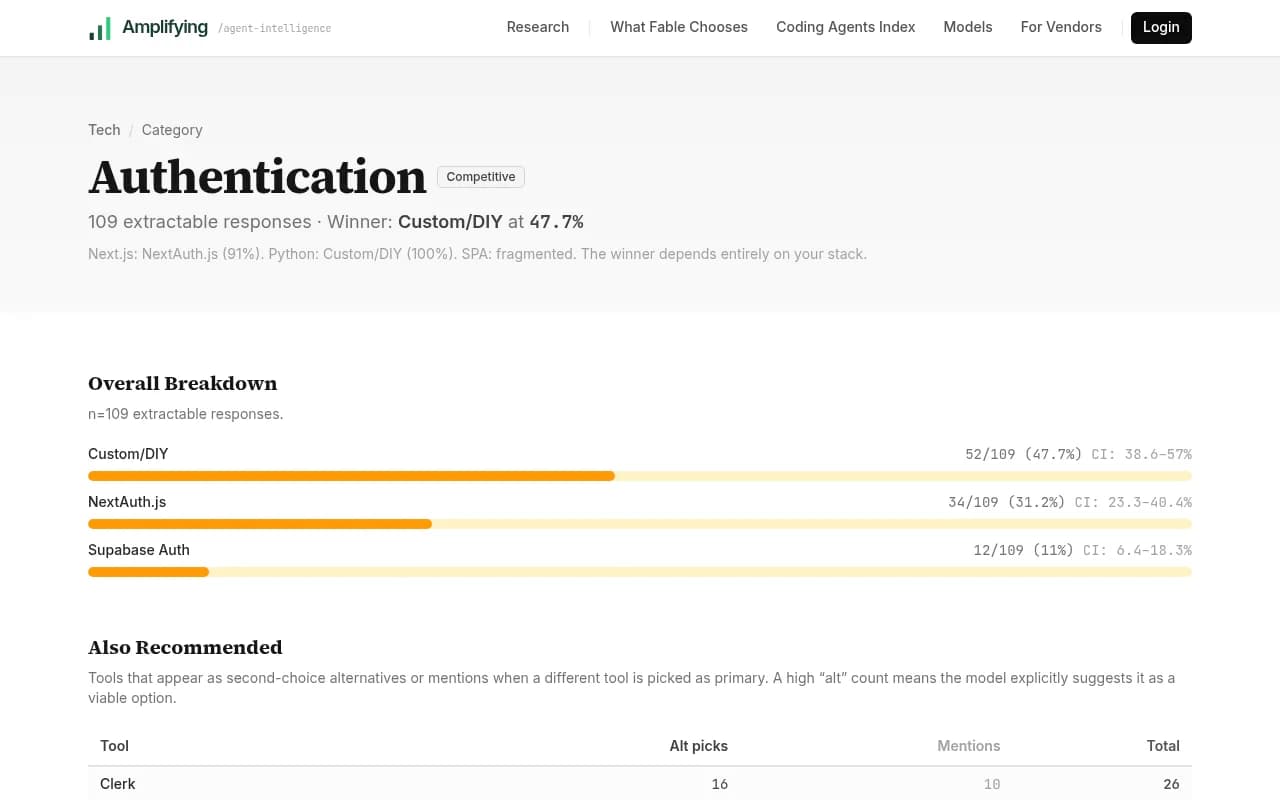
Auth is the least settled category. Amplifying calls it "Competitive", and the top result isn't a product at all. Custom/DIY led with 52 of 109 responses (47.7%), followed by NextAuth.js at 34 (31.2%) and Supabase Auth at 12 (11%).
| Tool | Alt picks | Mentions | Total |
|---|---|---|---|
| Clerk | 16 | 10 | 26 |
| Auth0 | 9 | 11 | 20 |
| Supabase Auth | 8 | 11 | 19 |
| Firebase Auth | 7 | 6 | 13 |
| Lucia | 2 | 7 | 9 |
| NextAuth.js | 3 | 2 | 5 |
| better-auth | 3 | 2 | 5 |
The stack split is the real story:
- Next.js: NextAuth.js at about 91% on average, and Opus 4.6 picked it 100% of the time.
- Python/FastAPI: Custom/DIY at 100% across all three models. Claude Code hand-builds JWT handling every time.
- Vite SPA: fragmented across Custom/DIY, Clerk, Firebase Auth and Supabase Auth.
Better Auth showed up as a primary pick in 7.1% of Opus 4.5 Next.js runs. Small, but it's the only newer entrant that registered.
Why Lightsage's leaders look so different
Lightsage named Auth0, Scalekit and Descope as Claude Code's auth leaders. That doesn't contradict Amplifying, it measures something else. Those three are what Claude Code integrated well once pointed at them. NextAuth and DIY are what it picks when nobody points.
If you build an auth product, you need both: be easy to integrate (docs, CLI, MCP) and be the thing the model volunteers. Lightsage also found WorkOS and Auth0 had CLI support and Descope and Clerk had MCP servers, which is a more fragmented picture than the payments one.

Skills help with outdated SDKs
Auth is where stale training data hurts most, because SDKs change and the old calls still look plausible. Clerk publishes the most complete official skill set I've seen, with one skill per framework (Next.js, React, Expo, Astro and more), installed with npx skills add clerk/skills. Better Auth ships its own skills too, including a create-auth scaffolder. If you stick with a managed provider, installing its official skills is the cheapest fix for "Claude used the v4 API".
Payments: Stripe is the default, PayPal is the surprise
Payments is the closest thing to a monopoly in this guide. Stripe was the primary pick in 64 of 70 responses (91.4%, confidence interval 82.5 to 96%). The other six were Custom/DIY, and those were mock payment UIs in a serverless React SPA, not real processors. In the Next.js repo, all three models picked Stripe every time.
No other processor was ever a primary pick. They only appeared as suggested alternatives (alt picks / mentions): LemonSqueezy 14 / 5, Paddle 12 / 6, PayPal 10 / 6, Square 3 / 6 and Braintree 1 / 7.
Then Lightsage flipped the order. In their live-key test, Claude Code's payment leaders were PayPal and Stripe, and PayPal was also one of Claude Code's top three APIs overall (alongside Vercel and Jina AI). For Codex it was Stripe, Mollie and PayPal. On MCP, Stripe and PayPal led.
Here's the line from that report I keep thinking about: Stripe is the only payment API with CLI support, and only 1 of 10 payment APIs had a CLI at all. Nine of ten are invisible to agents that live in a terminal.
Merchant of record options
If you're selling SaaS subscriptions globally, LemonSqueezy and Paddle show up as Claude's favorite alternatives. Dodo Payments and Polar also publish official agent skills. Dodo's cover checkout, subscriptions, webhook verification, usage-based and credit-based billing, which is the pattern most AI apps need. Run the provider's testing skill before swapping to live keys. That advice is boring and it saves real money.
Email: Resend is the default, and its docs are written for agents
Email is the category I have the least detail on. Amplifying lists it as a "Strong Default" with Resend at 62.7%, but I only saw that on a category link and didn't verify the sample size or breakdown. Treat it as a pointer.
What I can say: Resend publishes an official skill covering transactional sends (single and batch), inbound email through webhooks, templates, delivery events and domains. And the Lightsage write-up uses a Resend-style llms.txt as its model example, with sections for when to use it and when not to.
| Email tool | Where it fits | Source note |
|---|---|---|
| Resend | Transactional email, Next.js and React teams | Top pick in Amplifying's email category |
| SendGrid | Complex templates | Named as the alternative in that example llms.txt |
| Mailchimp, ConvertKit | Marketing campaigns | Same example file recommends them for campaigns |
| Hunter.io | Email finding with confidence scores, free tier of 25 searches a month | Different job: prospecting, not sending |
| Findymail | Verified email finding, pay only for valid results | Different job: prospecting, not sending |
The last two rows matter if you're confused by search results. "Email API" can mean sending mail or finding addresses. Claude Code handles both fine, but they're separate categories.
What the winners had in common
Lightsage's patterns line up with the Amplifying data. The APIs that agents found and used well tended to have:
- A llms.txt file with a short description, a "when to use" list and a "when NOT to use" list, plus a quick start with a literal request example
- A CLI (rare in payments, more common in auth)
- An MCP server
- Official agent skills
- Clean REST endpoints, even without a dedicated SDK
The "when NOT to use" section is the clever bit. It gives the model permission to recommend a competitor for the right job, which makes the file read as trustworthy.
If you maintain an API, a free llms.txt generator like the one at promptwatch.com/free-tools/llms-txt-generator gets you a starting point in a few minutes, and the Agentic Readiness Check shows which agent standards your site supports.
Picking a stack for your own project
A practical way to use this data when you start a project with Claude Code:
- Decide the stack first. If you tell Claude it's a Next.js app, you'll get PostgreSQL, NextAuth.js and Stripe. If you don't, it infers one.
- State your auth choice explicitly. This is the category where unprompted behavior is least reliable, and hand-rolled JWT is a security review waiting to happen.
- Install the provider's skills before you start (Clerk, Better Auth, Supabase, Resend and Dodo all publish them).
- For payments, keep Stripe as the default unless you need a merchant of record, then name LemonSqueezy or Paddle directly.
- Add the testing or go-live skill to your checklist before production keys go in.
If you sell a developer tool, track this like a channel
Vendors in these categories now have a new discovery surface. If Claude Code picks Resend 62.7% of the time and Stripe 91.4%, the long tail is competing for scraps and the difference between page-one and invisible is a documentation decision.
Tracking it takes more than spot checks. Promptwatch monitors how coding agents like Claude Code, Codex and OpenCode recommend tools, SDKs and docs, alongside how ChatGPT, Gemini and Perplexity talk about you, and its IP-verified AI crawler logs show whether bots can actually read your docs.

For a wider view of options in the category, the GEO software directory at bestgeosoftware.com lists the alternatives.
Limits of this data
Be honest about what these numbers can and can't say.
- Amplifying's category samples are 70 to 125 responses across four repos. A 91.4% share with a tight interval is solid. A 47.7% share with an interval of 38.6 to 57% is a lot softer.
- Three models, not all current ones.
- Lightsage tested live keys on specific tasks. A different task could reorder the leaderboard.
- I couldn't find current pricing, feature comparisons or setup details for most of these tools in the research, so check each vendor's own pricing page before deciding.
The safe conclusion: Postgres, Stripe and Resend are what Claude Code reaches for. Auth is where you should make the call yourself.