Key takeaways
- Most GEO RFPs are SEO RFPs with an AI paragraph bolted on. They miss the questions that decide whether a tool survives an enterprise rollout: data source, sampling, crawler verification and exit terms.
- Ask where the data comes from first. Real interface monitoring and API calls can return different answers and different citations, so the answer changes how much you trust every dashboard.
- Require evidence with every answer. A "yes" without a screenshot, a test on your own prompts or a contract clause should score zero.
- Separate monitoring from execution. A tool that reports a score is a different purchase from a platform that helps you fix gaps and proves the fix worked.
- Run a 30-day paid pilot on your own brand and competitors before signing anything multi-year.
Why GEO needs its own RFP template
Buying a generative engine optimization (GEO) platform in 2026 is awkward. The category is barely two years old, vendors range from $95 a month trackers to enterprise suites inside Adobe Experience Cloud, and every demo shows a dashboard that looks impressive on the vendor's chosen brand.
Generic AI procurement templates help a little. The Kognitos agentic AI RFP template groups 30 questions into eight categories, including audit trails, model governance and commercial terms. QueryNow's enterprise search RFP template adds stable requirement IDs and acceptance tests. Both are worth stealing from. Neither knows anything about citations, query fan-outs or AI crawlers, which are the things that make GEO tools hard to compare.
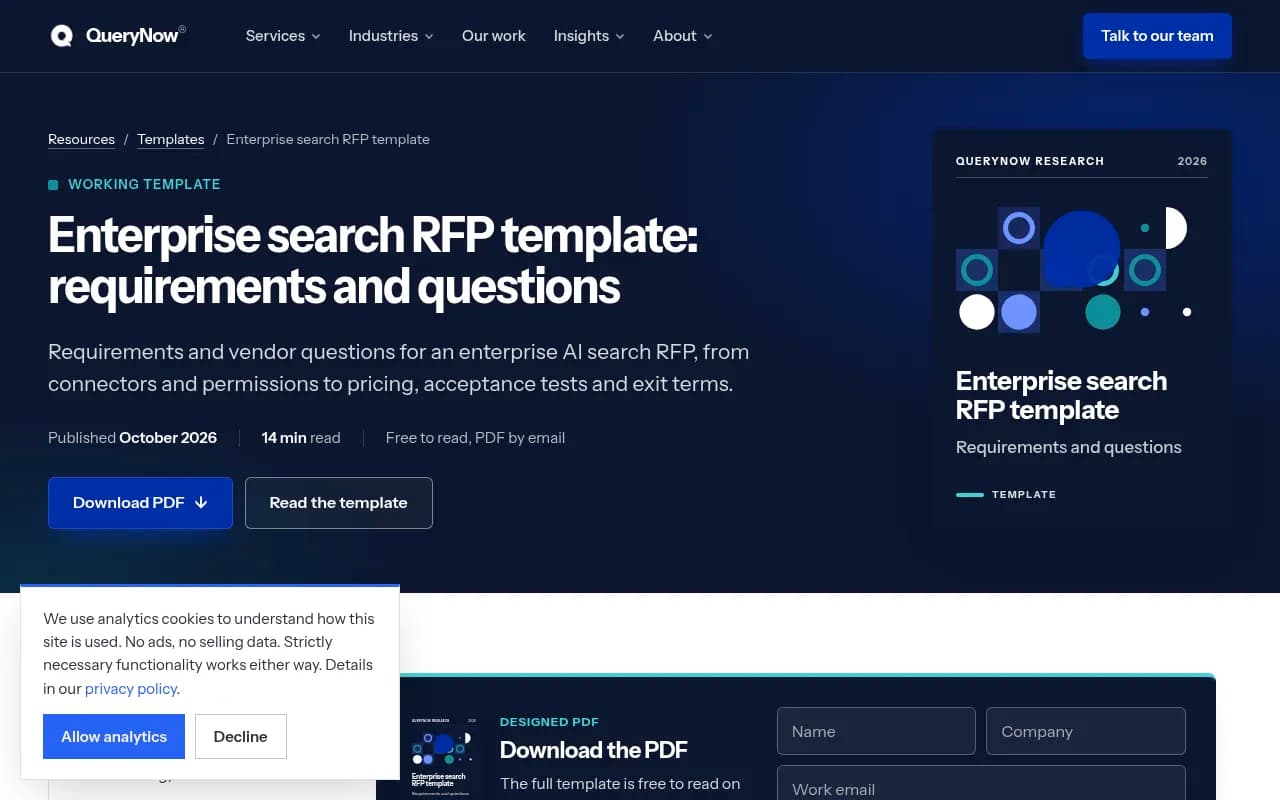
The QueryNow page is a good model for format. Every requirement gets an ID so answers compare side by side, and the template insists on evidence. Its line that a yes without evidence should score zero is the single best rule to carry over.
Seer Interactive's GEO RFP guide covers the agency side, with questions about measurement and whether a vendor can explain when visibility did not drive business impact. This guide focuses on the software side: the platform you will run for years.
How to use this template
- Fill in your scope before sending anything: number of brands, markets and languages, competitors, the AI engines that matter to your buyers, and who needs access (SEO, content, PR, executives, agencies).
- Give each question an ID (Q1 to Q25) and keep the IDs stable once the RFP is out.
- Ask for evidence with every answer.
- Score on a weighted sheet, with a few pass/fail knockouts (see the scoring section below).
- Confirm the winner with a paid pilot.
A note on the market: our tools catalog lists well over a hundred AI visibility products. If you want a quick shortlist before writing the RFP, the directories at bestgeosoftware.com and ai-rank-tools.com are useful starting points.
Section 1: Data collection and methodology (Q1 to Q6)
This is where vendors differ most and where demos tell you least. Start here.
Q1. Does your data come from the real user interfaces of AI engines, or from API calls?
User-facing answers, citations and shopping results can differ from API output. A good answer names which engines are collected from the real interface (ChatGPT, Google AI Overviews, AI Mode, Gemini, Perplexity, Copilot) and which come from APIs, and says why. A red flag is "we use the latest models" with no detail. For reference, Promptwatch collects from real interfaces and tracks API models alongside to show what models believe from training data. Superlines, among others, also markets real-interface collection.

Q2. How large is your sample, and how do you handle run-to-run variance?
AI answers are not deterministic. Ask how many runs per prompt, how often prompts execute, and whether the visibility number is an average or a single draw. Daily runs are common. Faster cadences (every 12, 6 or 1 hours) matter if you are tracking a launch.
Q3. How do you handle per-engine differences in citation counts?
Promptwatch Data's average sources per response report shows how different the engines are. ChatGPT cites about 5 sources per web-search answer, Google AI Overviews and Perplexity about 10, and Microsoft Copilot's average swung from under 2 to nearly 17 within a few weeks (data from September 2025). A tool that treats all engines as interchangeable will mislead you. Ask how the vendor normalizes, and how it separates your changes from engine noise.
Q4. Do you capture query fan-outs?
Fan-outs are the web searches an engine runs behind one prompt. Promptwatch's ChatGPT query fanout data shows the average moved from 2.15 queries per response in December 2025 to about 1.84 by March 2026, then reset to 1.0 in April. Then in August 2026 ChatGPT began using the site: operator at scale, jumping from about 0.4% to about 17% of fan-out queries (report). Ask whether the vendor captures fan-outs and how quickly it re-baselines when engine behavior changes.
Q5. How do you annotate model and retrieval changes?
Engines change under you. Promptwatch Data recorded a drop in average citations per response around the GPT-5.3 rollout on March 4, 2026, and reddit.com's share of ChatGPT citations fell from roughly 4% to 0.5% on August 14, 2026. If a vendor's chart just shows your score falling with no annotation, your team will spend a week blaming the wrong thing. Good answer: timeline annotations and a changelog of engine events.
Q6. Can we choose country, language, state, city and persona, and are they fixed per monitor?
Enterprise brands sell in many markets. Look for country and language per monitor so markets never mix, state and city tracking where relevant, and persona-based prompting. For multi-location brands, ask whether local answers can be pinned to exact coordinates.
Section 2: Metrics and measurement (Q7 to Q12)
Q7. How is your visibility score calculated?
Ask for the formula in writing. Does it account for placement, depth and share of attention, and do responses with no mention count as zero? A black-box score you cannot reproduce is hard to defend to a CFO.
Q8. Do you separate mentions from citations?
Being named and being cited are different outcomes with different fixes. Mentions without citations usually mean a content or crawlability problem. Ask to see both, plus self-citation rate (how many citations point at your own domain).
Q9. Can you break down citations by content type and source type?
This tells you what to build. Promptwatch Data found product pages were the most cited content type in ChatGPT at 22.4% of citations (Sep 28 to Oct 4, 2026, report), and that news loses half its cited pages within 36 days while landing pages and docs last longest. A vendor that can only list cited domains cannot help with content strategy.
Q10. Do you track social and community sources?
The picture is uneven across engines. In Promptwatch's October 2026 social citation data, ChatGPT got 0.46% of its citations from social platforms while Google AI Overviews got 12.2%. Ask whether the tool reports Reddit, YouTube, LinkedIn and Instagram citations separately, and whether it can filter to your own channels.
Q11. Do you track AI shopping results and ads?
Relevant for retail and marketplaces. Ask whether product carousels and sponsored placements in AI answers are captured, and which competitors the engine recommends instead. Promptwatch Data tracks ChatGPT ads over time and shopping feature usage, so the behavior is measurable. Not every vendor covers it.
Q12. How do you connect visibility to business impact?
Taken from the Seer guide: when did visibility improve and not drive results, and how did you explain it? Seer also cites Profound's finding that users visit a brand's site at 1.5 to 2.5x baseline in the 7 days after an AI mention (not independently verified here). Whether or not you accept that number, you want a vendor who talks about assisted impact and not only clicks. Ask for visitor analytics that attribute AI-referred sessions and conversions. One detail to test: ChatGPT stopped sending a referrer on October 8, 2026, so ask how the tool counts those visits (for example via utm_source tagging).
Section 3: Crawlers, site health and technical access (Q13 to Q16)
Q13. Do you provide AI crawler logs, and are they IP-verified?
User agents are trivially spoofed. Only requests whose source IP matches the operator's published ranges should count. Promptwatch Data's AI crawler traffic report (June 8 to Sept 6, 2026) counts verified requests only, and shows OpenAI falling from 94.8% of verified crawler requests in the week of June 8 to 79.8% in the week of August 31. The Meta-WebIndexer data shows how fast a new crawler can appear, from about 2% to nearly 38% of tracked requests between mid-July and August 9, 2026. A vendor that cannot show verified logs cannot tell you whether a missing citation is an access problem.
Q14. Do you separate training crawlers from answer-time fetchers?
Blocking the wrong bot can remove you from answers or leave you open to training use. Good answer: per-provider, per-purpose breakdown, with robots.txt, CDN and WAF guidance.
Q15. How is log ingestion set up?
Ask for the integration list: Cloudflare, CloudFront, Fastly, Vercel, Netlify, Akamai, a plugin or a custom endpoint. Ask how long setup takes and who on your side has to do it. Security teams will want to know exactly what data leaves your CDN.
Q16. Do you run site audits aimed at AI readability?
Look for scheduled audits, a health score, change tracking and linking checks (orphans, broken links, sitemap gaps). Ask whether it checks agent standards like llms.txt, not as a ranking promise but as a readiness signal.
Section 4: Action and execution (Q17 to Q20)
This is the section that separates tools. A dashboard tells you that you are invisible. A platform helps you change that.
Q17. What does the tool do after it finds a gap?
Compare answers: a score and an export, a prioritized to-do list, or an agent that drafts the content. Ask for a live walk-through from "gap found" to "page published."
Q18. Can it write and publish content, and with what controls?
If yes, ask about review inboxes, brand and fact grounding (a knowledge base or brand book), CMS support (WordPress, Webflow, Framer), draft versus live publishing and language handling. Promptwatch's Content Agent, available from its Business plan, plans, writes and publishes against visibility gaps with an approval inbox or a hands-off mode. Alternatives with execution features include Profound, AirOps and Writesonic GEO, each with different depth.

Q19. Does it close the loop?
After a page ships, does the tool track whether bots crawled it, whether engines cited it, and whether it drove visits? Pages that underperform should come back as new actions. If the answer is "export to your analytics tool," that is a monitoring product.
Q20. How do you benchmark us against similar clients or competitors?
Another Seer question, and a good one: how long would it take to answer "how does our GEO performance compare?" Ask whether competitors are auto-discovered, whether you can compare by topic and model, and whether anonymized peer benchmarks exist.
Section 5: Security, governance and integration (Q21 to Q23)
Q21. What certifications and data handling commitments do you have?
Ask for ISO/IEC 27001 or SOC 2 evidence, GDPR posture, data residency, and a signed statement on whether your data is used for model training. The Dan Cumberland Labs template lists data governance first, and for good reason: your prompts and brand strategy should not train someone else's product.
Q22. What access controls and audit trails exist?
Look for roles, project-level permissions, SSO, scoped API keys and an audit log that shows whether a change came from the dashboard, the API or an agent. If AI agents can change settings, you want to see exactly who or what did it.
Q23. What are the API, MCP and export options?
Enterprise teams push this data into BI tools. Ask about REST API coverage, rate limits per hour, date-range limits per request, Looker Studio connectors, CSV exports and whether an MCP server exists for agent workflows. Rate limits are an easy place for a cheap plan to quietly fail at scale.
Section 6: Commercial terms and exit (Q24 to Q25)
Q24. How is pricing structured, and what triggers overage?
Prices in this category are quoted per prompt, per response, per seat or per credit, and they are not directly comparable. Ask for cost per tracked response, what counts as a response, what happens when you exceed limits, whether tracking continues during a billing dispute, and what is charged for extra markets or brands. Always confirm current numbers on the vendor's own pricing page.
Q25. What are the exit terms?
Borrowed from the QueryNow template: can you export all raw responses, citations and history in a usable format, and for how long after termination? Ask about contract length, price caps on renewal and notice periods. Historical data is your most valuable asset in a category that changes monthly.
Scoring sheet
A simple weighted sheet is enough. Adjust the weights to your situation.
| Category | Questions | Suggested weight | Knockout? |
|---|---|---|---|
| Data collection and methodology | Q1 to Q6 | 25% | Q1 answered with evidence |
| Metrics and measurement | Q7 to Q12 | 20% | No |
| Crawlers and technical access | Q13 to Q16 | 15% | No |
| Action and execution | Q17 to Q20 | 20% | No |
| Security and governance | Q21 to Q23 | 15% | Q21 certification or equivalent |
| Commercial and exit | Q24 to Q25 | 5% | Q25 data export |
Score each answer 0 to 3: 0 for no or no evidence, 1 for partial, 2 for yes with evidence, 3 for yes and demonstrated on your own data.
What the market looks like against these questions
This is a rough orientation, not a verdict. Vendor capabilities move monthly, so verify each cell during your RFP.
| Vendor type | Examples | Typically strong on | Ask harder about |
|---|---|---|---|
| End-to-end GEO platforms | Promptwatch, Profound | Monitoring plus action, citations, crawlers | Pricing structure, content controls |
| Monitoring-focused trackers | Peec AI, Otterly.AI, AthenaHQ | Quick setup, affordability | Crawler logs, attribution, content execution |
| SEO suites with AI add-ons | Semrush, Ahrefs Brand Radar, Conductor, BrightEdge | Existing workflows, familiar reporting | Prompt depth, fixed prompt sets, crawler data |
| Content generation tools | AirOps, Jasper, Copy.ai | Production speed | Grounding in citation data |
| Enterprise suites | Adobe LLM Optimizer, Yext Scout, Bluefish | Integration with existing stacks | Cost, flexibility, evidence of results |

If you want a head-to-head view, Promptwatch publishes a side-by-side comparison of GEO platforms. Treat any vendor-authored comparison as a hypothesis to test, including that one, and check it against your own pilot.
Running the pilot
The QueryNow rule applies here. A vendor's demo content is chosen to look good, so test on your own material.
- Pick 50 to 100 prompts that your buyers actually use, split across branded, competitor comparison and category prompts.
- Include at least two competitors and one market outside your home country.
- Run the pilot for 30 days, long enough to see an engine change.
- Ask each vendor to explain one surprising result in detail, such as a competitor outranking you or a sudden dip.
- For execution tools, have the vendor publish a small number of pages and check whether crawlers fetch them and whether they are cited.
- Have security review the answers to Q21 to Q23 in parallel, not after you have picked a favorite.
If you also need strategy and implementation help, consider whether you want an agency or the software alone. Agencies such as 1001 SEO Media, which covers technical SEO, content and GEO and uses Promptwatch as its AI visibility platform, can run the pilot and the program, but the same RFP questions apply to any agency partner too.
Red flags that show up in answers
- "Proprietary methodology" with no explanation of sampling or scoring.
- Dashboards that show a single blended score across all AI engines.
- No crawler data, or crawler data without IP verification.
- No export of raw responses.
- Pricing that hides what counts as a response or prompt.
- Case studies with no baseline and no time frame.
- A reluctance to run the pilot on your brand rather than theirs.
Copyable RFP intro paragraph
Here is a short paragraph you can paste at the top of your document.
[Company] is evaluating AI search visibility (GEO) platforms for [number] brands across [markets/languages]. Please answer all 25 questions below using the question IDs. Provide evidence with each answer (screenshot, documentation, test result or contract clause). Answers without evidence will be scored zero. Shortlisted vendors will take part in a paid 30-day pilot on our own prompts and competitors. Please include full pricing, overage terms, data export terms and security documentation with your response.
Final thoughts
The biggest shift in how I would run this process is simple: weight data methodology and execution over dashboard polish. Every vendor can draw a chart. Fewer can tell you which interface the data came from, prove that a crawler actually fetched your page, and then help you ship the page that fixes the gap. If you start your evaluation with Q1, Q13 and Q19, you will cut most shortlists in half within a week.
To see how your own brand currently shows up before writing the RFP, Promptwatch offers a free AI visibility report and a 7-day trial on monthly plans. Check pricing for current numbers, and use the baseline as input for your scope section.