Key takeaways
- Social listening tools monitor public conversations on social networks, forums, news and review sites. GEO tools monitor the answers AI engines like ChatGPT, Gemini and Perplexity generate about your brand.
- They answer different questions. Social listening asks "what are people saying?" GEO asks "what is the AI telling people, and which sources does it cite?"
- Social is a small, shifting slice of AI citations. In Promptwatch Data for Sep 28 to Oct 4, 2026, social platforms made up 0.46% of ChatGPT citations but 12.2% of Google AI Overviews citations.
- Most teams need both. Buy social listening for reputation and campaigns, and a GEO platform for AI answers, crawler access and AI-driven traffic.
- Pricing differs sharply: enterprise social listening often runs five figures a year, while GEO tools range from about $95/month to enterprise contracts.
The short version
People lump these two categories together because both involve "monitoring your brand." That is about where the similarity ends.
A social listening tool collects public posts, comments, reviews and articles that mention your brand, competitors or topics, then scores sentiment and flags spikes. A GEO (generative engine optimization) tool runs prompts through AI engines, records the answers, and shows whether your brand is mentioned, where, with what sentiment, and which pages get cited.
One measures human conversation. The other measures a machine's summary of the web. Sometimes the machine's summary draws on those human conversations, which is why the question comes up at all. But the link is weaker and weirder than most vendors suggest.
What social listening tools actually cover
The typical pipeline is collect, filter, analyze. Tools pull data from social APIs and licensed partners, plus news, blogs, forums and review sites. You filter with keywords and Boolean queries. Then sentiment analysis, topic clustering and spike detection do the sorting, increasingly with an AI assistant on top.
Coverage claims in 2026 vary a lot:
- Onclusive Social says it covers 850M+ sources daily, with up to 24 months of history.
- Brandwatch processes 500M+ posts daily and has a historical archive going back to 2010.
- Lumen by Talkwalker (Talkwalker rebranded inside Hootsuite's Social OS) covers 30+ social networks and 150M+ websites.
- Meltwater pairs social with traditional media: 400,000+ traditional sources, podcasts and broadcast monitoring.
- Brand24 is the budget-friendly option, covering 25M+ sources.
What you get from them is useful and specific: crisis detection, campaign and hashtag tracking, competitor share of conversation, influencer discovery, customer feedback mining, and PR coverage reporting.
Pricing reality
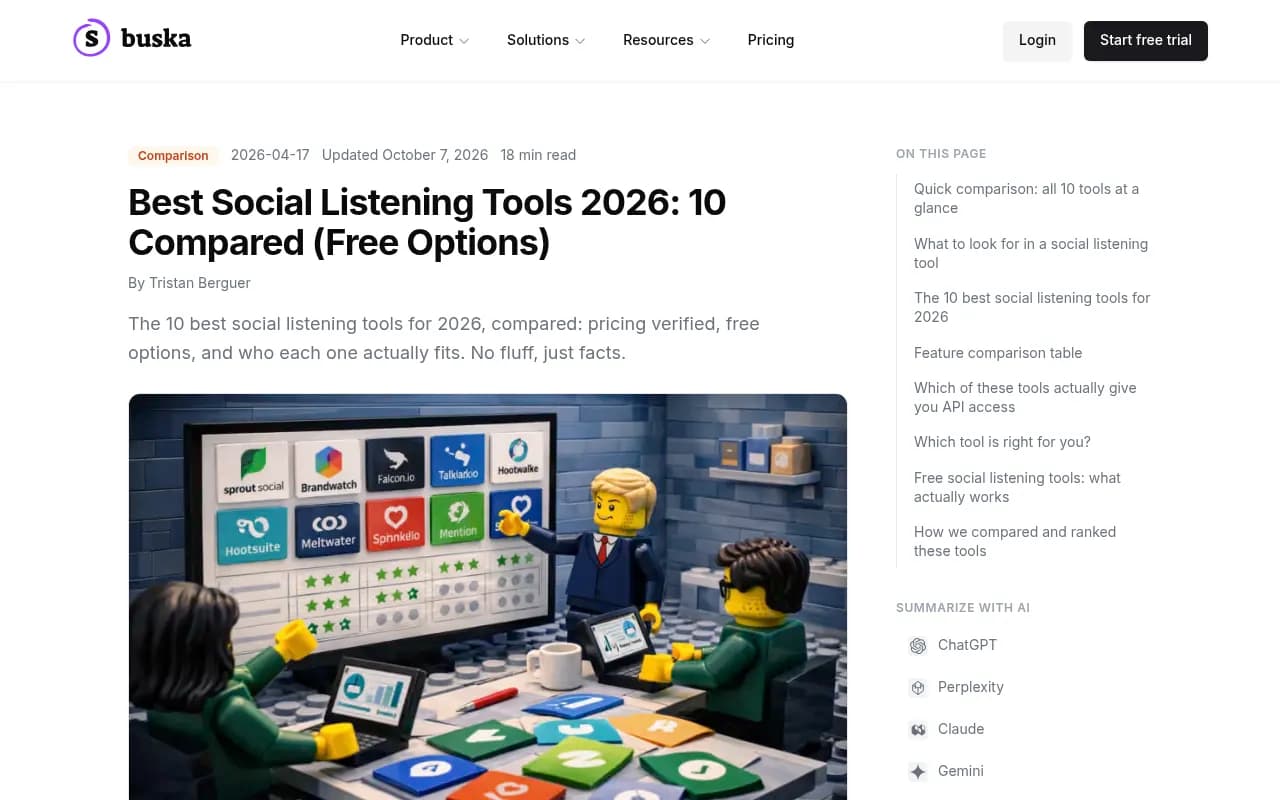
Social listening is not cheap at the top end. According to the Buska comparison (prices checked September 2026), Brand24 now starts at $249/month, Mention moved to a single quote-only plan around $599/month, and Talkwalker deployments run roughly $13,000 to over $100,000 a year per third-party contract data. Brandwatch averages around $50,000 a year on real contracts. Sprout Social and Hootsuite start near $99 to $249 per seat, but their full listening features sit in premium tiers or add-ons.
That price spread matters for the budget conversation later. If you already spend five figures on listening, you do not want a GEO purchase to feel like the same thing twice. It is not.
What GEO tools actually cover
GEO tools start from a different object: the AI answer. They send a panel of prompts to ChatGPT, Google AI Overviews, Google AI Mode, Gemini, Perplexity, Copilot and others, then record what comes back.
The core outputs are:
- Mentions and share of voice: does the brand appear, and against which competitors?
- Position and sentiment inside the answer.
- Citations: which URLs and domains the AI used as sources.
- Prompt research: which questions are worth tracking, and what web searches (query fan-outs) the AI runs.
- Content gaps: prompts where competitors appear and you do not.
The better platforms go past monitoring. AI crawler logs show whether GPTBot, ClaudeBot or PerplexityBot can read your pages. Visitor analytics attribute real traffic from AI platforms. Some also draft and publish content against the gaps they find.
Promptwatch is the one I would point most marketing teams to here, because it covers the full chain: real-interface prompt tracking, IP-verified crawler logs, AI traffic attribution, and a Content Agent that publishes to Webflow, Framer or WordPress. Plenty of alternatives stop at "was my brand mentioned?"

Other tools in the category include Profound for enterprise monitoring, Peec AI and Otterly.AI for lighter tracking, and SEO-suite add-ons from Semrush and Ahrefs.




For a broader list, the GEO software directory at bestgeosoftware.com catalogs the field.
Side-by-side: what each one answers
| Question | Social listening | GEO tool |
|---|---|---|
| What are people posting about us on TikTok or X? | Yes | No |
| Is a PR crisis forming right now? | Yes | No |
| Does ChatGPT recommend us for "best CRM for startups"? | No | Yes |
| Which of our pages does Perplexity cite? | No | Yes |
| Can AI crawlers read our site? | No | Yes (with crawler logs) |
| How much traffic do we get from AI platforms? | No | Yes (with visitor analytics) |
| Which influencers mention us? | Yes | Partly (via citations) |
| What is our sentiment in social conversation? | Yes | No |
| What is our sentiment in AI answers? | No | Yes |
| Which Reddit or YouTube content do AI engines cite? | Partly | Yes |
| Historical conversation data going back years | Yes (Brandwatch from 2010) | Limited |
The one that surprises people is "sentiment." You can have glowing sentiment on social and still get described as outdated by ChatGPT, because the AI is summarizing review sites, comparison articles and your own documentation, not your Instagram comments.
Where they overlap, and where the overlap breaks
The tempting argument goes: AI engines cite Reddit, YouTube and LinkedIn, so social listening must tell me what AI will say. In 2026 that argument is shakier than it was.
Promptwatch's data on social media citations by AI model (Sep 28 to Oct 4, 2026) shows how different the engines are:
| Engine | Share of citations from social platforms | Biggest social source |
|---|---|---|
| ChatGPT | 0.46% | LinkedIn (0.3%) |
| Google AI Overviews | 12.2% | YouTube (4.28%) |
| Perplexity | 2.7% | LinkedIn and Reddit (0.86% each) |
AI Overviews cites social about 26 times as often as ChatGPT. And Reddit, the platform social listeners love, went from 5.19% to 0.09% of ChatGPT citations between the earlier report and this one.
There is a more dramatic example. Promptwatch's report on Reddit citations dropping in ChatGPT shows reddit.com holding about 3.83% of ChatGPT citations from Jul 18 to Aug 7, 2026, then falling under 1% on Aug 14. The Aug 14 to 17 average was 0.52%. Promptwatch flags that the exact size of the drop is provisional, but the direction was clear. Over the same period, Reddit's share in AI Overviews eased only from about 2.37% to 2.10%.
The lesson: a platform your social listening tool covers extremely well can stop mattering for one AI engine overnight. A social listening dashboard will not tell you that. A GEO tool tracking each engine separately will.
The practical overlap is narrower than the pitch decks claim:
- Reddit, YouTube and LinkedIn conversations about you can still influence what Google AI Overviews and Perplexity say.
- Social listening can surface the narrative problem (people think your product is slow). GEO tools show whether that narrative reached AI answers.
- Neither replaces the other's data.
What the AI actually cites instead
If social is a minor source for ChatGPT, what is it citing? Promptwatch's data on ChatGPT citation share by content type (Sep 28 to Oct 4, 2026) puts product pages first at 22.4% of citations, followed by landing pages and listicles. For software prompts, the software citation report shows GitHub, Microsoft's docs and G2 leading, with documentation and help centers earning the largest share.
That is a different playbook from social. It is your product pages, docs, comparison coverage and review profiles. Social listening was never designed to monitor any of that.
Content also ages differently. In Promptwatch's content half-life study, landing pages and docs stayed cited longest, while news lost half its pages within 36 days. A PR-heavy, news-first approach, which social listening and media monitoring support well, produces citations that decay fast in ChatGPT.
Who needs which
Teams that should lead with social listening
- Consumer brands with active communities and frequent product conversation.
- PR and comms teams managing reputation risk, where Meltwater or Brandwatch earn their cost.
- Campaign and event marketers who need hashtag-level tracking (Keyhole is built for that).
- Social teams who want listening beside publishing and engagement, like Sprout Social or Agorapulse.
Teams that should lead with a GEO tool
- B2B and SaaS companies where buyers ask AI "which tool should I use?" before visiting any site.
- Ecommerce brands competing for product recommendations in ChatGPT shopping results.
- Content and SEO teams who need to know which pages AI engines cite and where the gaps are.
- Agencies that need to report AI visibility to clients.
Teams that need both
Most mid-size and enterprise marketing teams. The split is simple: social listening protects and informs what the market says about you, GEO makes sure the AI answer layer reflects it accurately and sends you traffic.
Picking tools for each job
Social listening shortlist
| Tool | Best for | Pricing signal |
|---|---|---|
| Brandwatch | Deep research, 15+ years of history | Quote only, around $50K/year average |
| Meltwater | PR plus social in one place | Quote only, 12-month minimum |
| Lumen by Talkwalker | Global multilingual listening | $13K to $100K+/year |
| Sprout Social | Publishing-first teams | From about $79 to $249 per user/month |
| Brand24 | Small teams on a budget | From $249/month ($199 annual) |
| YouScan | Visual and image recognition | Demo only |
| Google Alerts / F5Bot | Free basics (web, Reddit and Hacker News) | Free |
A caution from the research: Hootsuite moved full listening to its Enterprise tier in its 2026 plan overhaul, and Mention dropped its self-serve plans. Check current pricing before you build a budget around any of these.
GEO shortlist
| Tool | Best for | Notes |
|---|---|---|
| Promptwatch | End-to-end: tracking, crawler logs, AI traffic, content publishing | Free Explore plan; paid from $95/month |
| Profound | Enterprise monitoring | Higher price point |
| Peec AI | Straightforward prompt tracking | Lighter feature set |
| Otterly.AI | Affordable monitoring | Tracking-focused |
| Semrush AI Visibility Toolkit | Teams already in Semrush | Add-on to an SEO suite |
| Ahrefs Brand Radar | Teams already in Ahrefs | Add-on to an SEO suite |
For Promptwatch, confirm current plans at promptwatch.com/pricing. Essential is $95/month, Professional $245/month, Business $579/month, with agency plans from $199/month.
If you track AI rankings specifically, the directory at ai-rank-tools.com is a handy shortlist source.
How to run both without doubling the workload
A workable setup for a marketing team looks like this:
- Use social listening for alerts. Keep it focused on brand, competitors and a handful of campaign terms. Route alerts to Slack.
- Build a GEO prompt panel. Start with 50 to 150 prompts covering category queries, competitor comparisons and brand-specific questions. Track them daily across engines.
- Check each engine on its own. ChatGPT, AI Overviews and Perplexity behave differently. Use rolling trends, not single-day snapshots.
- Read citations, not just mentions. If you are mentioned but never cited, you have a content or crawlability problem. Crawler logs tell you whether AI bots can even reach your pages.
- Connect the findings. When social listening shows a recurring complaint, check whether AI answers repeat it. When a GEO tool shows a competitor winning a prompt, see what third-party sources they appear in.
- Report separately. Social metrics (volume, sentiment, reach) and GEO metrics (visibility score, share of voice, citations, AI-referred conversions) should not be merged into one number.
Platform advice from the data
Promptwatch's own read of its October 2026 data is useful for deciding where to spend effort. For Google, prioritize YouTube, then Facebook and Instagram. Do not count on Reddit threads to get into ChatGPT. For Perplexity, publish on LinkedIn as well as Reddit. Keep X out of AI search plans, since it peaks around 0.1% of citations on any engine.
Social listening can then tell you whether those channels are even producing conversation worth amplifying.
Common mistakes
- Assuming positive social sentiment means positive AI sentiment. They draw on different sources.
- Buying a social listening tool to answer GEO questions. It cannot show citations, crawler access or AI traffic.
- Buying a monitoring-only GEO tool and expecting growth. Knowing you are invisible is step one. Somebody still has to fix the content.
- Tracking a single AI engine. The gap between ChatGPT (0.46% social citations) and AI Overviews (12.2%) shows why.
- Treating one data spike as a trend. Even Promptwatch labels the size of the Reddit drop provisional.
When an agency makes sense
If neither your team nor your tool stack has the capacity to act on the data, an agency can close the gap. 1001 SEO Media runs GEO and AI search programs alongside technical SEO and content, and uses Promptwatch for AI visibility work. For general software research, the broader directory at surferstack.com is a good place to compare options.
Bottom line
Social listening and GEO tools do not compete. One reads the crowd, the other reads the machine that summarizes the crowd and everything else on the web. If you can only fund one this quarter, fund the one that covers the channel where you are currently blind. For most teams in 2026 that is the AI answer layer, because they already have some form of social monitoring and almost nothing watching ChatGPT.