Key takeaways
- Across 112 sales tools, the median annual discount is 20.0%, and an annual plan only beats monthly billing after about month 9.6, per RevenueFlow's September 2026 study. A 10% discount takes until month 10.8.
- GEO tool pricing is changing fast. Tiers get pulled, renamed and repriced within months, so a 12-month prepay carries more risk here than with a mature category like email software.
- Pay monthly (or use a free trial) for your first 2-3 months with any GEO tool. Switch to annual once the prompt set, model coverage and reporting workflow have proven themselves.
- Check three things before prepaying: engine coverage on your tier, whether you can add but not drop capacity mid-term, and what happens if the vendor restructures its plans.
Why this decision is harder for GEO tools
Annual billing is easy to reason about for a tool you already know you will use for years. A CRM, an accounting package, an email platform. You flip the toggle, take the discount and forget about it.
GEO and AI visibility tools are different. The category is under two years old for most vendors, the AI platforms being tracked change behavior without warning, and most teams are still figuring out which metrics matter. Locking in twelve months of budget before you know any of that is a bet, not a saving.
Promptwatch's own data shows how fast the ground moves. According to Promptwatch Data on the ChatGPT citation drop, average sources cited per search-enabled ChatGPT response fell from about 6.4 to roughly 4.7-4.9 within weeks of the GPT-5.3 rollout on March 4, 2026. That is around 27% fewer citation slots, it hit GPT-5.3, GPT-5.4 and GPT-5-Mini alike, and there was no recovery a month later. If the platform you are measuring can shift that much overnight, your measurement tool and your contract should be able to shift too.
The break-even math
The discount is only real if you stay long enough to collect it. The formula is simple: divide the annual price by the monthly price. That gives you the number of months of monthly billing you would have to pay to match the annual bill.
Take a tool at $95 per month. A 20% annual discount means you pay roughly $912 up front instead of $1,140. That is 9.6 months of monthly billing. Cancel after month 9 and monthly billing was cheaper. Stay all twelve and you save $228.
RevenueFlow's study of 112 sales tools found exactly this pattern. At the median 20.0% discount, annual only wins after month 9.6, and at 10% it takes until month 10.8. Sales tools are not GEO tools, but the arithmetic is the same for any subscription.
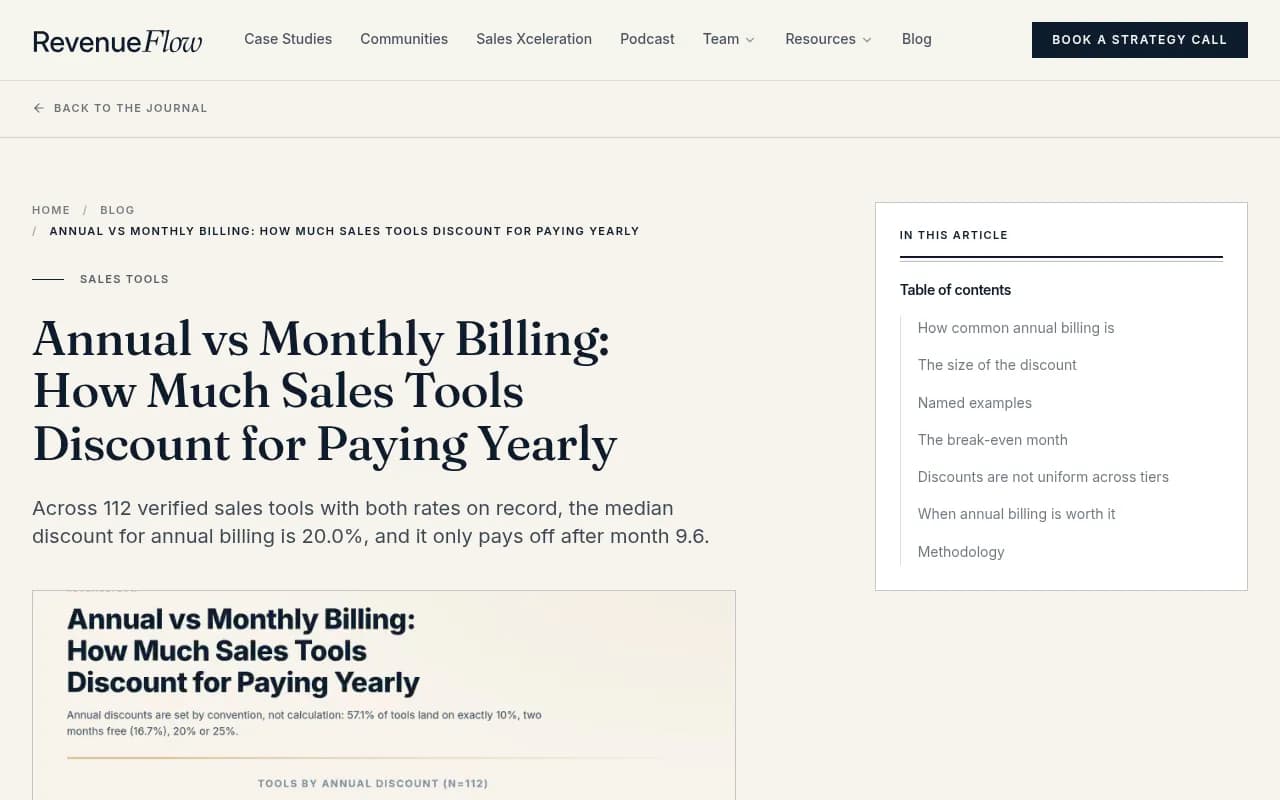
Two more details from that study are worth remembering. First, 57.1% of tools land on exactly 10%, two months free (16.7%), 20% or 25%. Discounts are set by convention, not calculation, so there is no deep logic behind a vendor's number. Second, 53 of 386 tools publish no monthly price at all, which means the per-month figure you see requires a twelve-month commitment.
A quick way to use it
Ask one question: how confident am I that I will still be using this exact tool, at this exact tier, in month 10? If the honest answer is 90% or better, take the discount. If it is closer to a coin flip, the expected saving is negative once you factor in the chance you pay for months you do not use.
Recurly's pricing analysis makes a related point from the vendor side. A discount below 10% gives buyers little reason to commit, and one above 30% starts to make monthly plans look overpriced. Most GEO vendors sit in the middle of that range.
What GEO vendors actually charge
Public data on annual discounts in this category is thin. Here is what could be verified as of October 2026, with the gaps stated plainly.
| Tool | Entry price (monthly) | Annual discount | Notes |
|---|---|---|---|
| Promptwatch | $95/mo (Essential) | Toggle on pricing page; confirm the current figure | 7-day free trial on Essential and Professional; Business is sold by demo |
| Otterly.AI | $29/mo (Lite) | 15% per third-party reporting of its pricing page | 14-day trial, markets "no annual lock-in" |
| Profound | Reported $99/mo Starter, since removed | Starter quoted as billed annually | Now free trial plus custom Enterprise per an October 2026 report |
| Peec AI | About $95/mo for brand plans (one review) | Not found | Reviews conflict on older euro pricing |
| AthenaHQ | Around $295/mo | Not found | Reported by Otterly's blog |
Treat third-party price roundups as a starting point. The Profound row is the clearest example: one review lists a $99 Starter tier billed annually, while another dated 12 October 2026 says it has been removed from the public pricing page. Always confirm on the vendor's own page before you budget.
Promptwatch lists Essential at $95/mo, Professional at $245/mo and Business at $579/mo, with annual billing giving twelve months for the price of ten (about 17% off). Verify the current numbers at promptwatch.com/pricing before you commit.





Five risks specific to prepaying for a GEO tool
1. Plan structures change
Profound's Starter tier appears and disappears across reviews. Peec's older entry pricing is described as outdated in 2026 write-ups. When tiers are renamed or withdrawn, an annual contract usually honors what you bought, but it also means you may not be able to renew on the same terms. Ask what happens at renewal, not just at signup.
2. Engine coverage is gated by tier
Some cheaper tiers track fewer AI engines. The reported Profound Starter covered ChatGPT only. Otterly's Lite plan covers four engines. If you prepay for a low tier and later need Google AI Overviews, AI Mode, Gemini or Copilot coverage, you may have to upgrade mid-term. Tools that include every model on every paid plan, which is how Promptwatch handles it, remove this particular trap.
3. You can add but rarely drop
The Google Workspace pattern applies broadly: add seats or capacity any time, but reductions only happen at renewal, and cancelling early usually means paying the remaining commitment. Check whether prompt volume and response limits can be scaled down, not just up.
4. Your methodology might change
Most teams start with a guessed prompt set, then rewrite it after a few weeks of data. If you chose a tool for 50 prompts and discover you need 300, or that you actually need crawler logs and traffic attribution rather than mention tracking, you have prepaid for the wrong product.
5. Cash flow
For a $95 tool the lump sum is small. For a $579 Business plan or a $799 agency plan, a year up front is a real budget line. Sastrify's guidance is that healthy cash flow makes the lump sum worthwhile, but it is a poor approach if you are still exploring new tools.
When annual billing is the right call
Annual makes sense in a handful of clear situations:
- You have run the tool for at least 60-90 days and your team opens it weekly.
- Your reports go to clients or leadership on a schedule, so the tool is embedded in a workflow.
- Your prompt set, markets and competitors are stable, and your current tier covers every engine you need.
- The discount is 17% or more, which brings break-even to roughly month 10 or earlier.
- You have procurement or finance reasons to prefer a single annual invoice. Some enterprise teams also need the paperwork and security review done once, not twelve times.
Agencies are a good fit when they bill clients monthly for AI visibility reporting. The tool cost becomes a fixed line item against recurring revenue, and the 17% saving goes straight to margin.
When monthly is smarter
- It is your first GEO tool and you are still deciding whether to track 30 or 300 prompts.
- You are running a pilot, a quarterly experiment or a single client audit.
- You are comparing two or three vendors side by side. Pay monthly for both, keep the winner, cancel the other.
- The vendor has recently changed its pricing, removed tiers or been acquired.
- Your budget is approved quarterly, not annually.
The cost of monthly billing on a $95 tool is about $228 per year compared to annual at 20% off. That is the price of optionality. For most teams in their first three months, it is cheap insurance.
A staged approach that works
Here is the sequence I would follow with any GEO platform:
- Start with a free trial or free tier. Promptwatch has a free Explore plan (ChatGPT only, 10 prompts) and a 7-day trial on monthly Essential and Professional. Otterly offers 14 days without a card.
- Move to monthly billing for 60-90 days. Build your real prompt set and check that responses, citations and reports are useful.
- Run a decision review at day 75. Is the tool changing what you publish or fix? Are you using more than the monitoring dashboard?
- If yes, switch to annual at the same tier. Most vendors let you convert mid-term, though you should ask whether the first months are credited.
- Calendar the renewal 30 days ahead. Reprice, compare and downgrade if needed.
Questions to ask before you pay annually
These rarely appear on a pricing page, and the research for this guide could not find published refund or cancellation terms for any major GEO vendor. Ask the sales team directly:
- Is there a refund window after the first annual payment, and for how long?
- Can I upgrade mid-term and keep the credit from the unused portion?
- Can I move down a tier at renewal without losing historical data?
- Do you offer annual contracts paid monthly or quarterly? Some SaaS vendors do, which gives you the discount without the lump sum.
- If you retire or restructure my plan, what happens to my price?
- Are new AI models added to my plan at no extra charge?
That last question matters more than it sounds. New models launch constantly, and a plan that includes them automatically is worth more than one that charges for each engine.
Choosing a tool before choosing a billing cycle
Billing is the second decision. The first is whether the tool does what you need. Monitoring-only trackers answer whether your brand was mentioned. Platforms that add crawler logs, traffic attribution and content workflows answer a different question: what to do about it. If you expect to use the latter, you will probably stay longer, which makes annual billing more attractive.
For a wider shortlist, the GEO software directory at bestgeosoftware.com compares dozens of options, and ai-rank-tools.com focuses on trackers.
Other tools worth pricing alongside the ones above:


SEO suites like Semrush and Ahrefs often bundle AI visibility into existing subscriptions, so the annual decision there is really about the whole suite, not the GEO add-on.
Decision checklist
| Question | If yes | If no |
|---|---|---|
| Used the tool weekly for 60+ days? | Lean annual | Stay monthly |
| Discount is 17% or more? | Break-even near month 10 | Monthly may be cheaper in expectation |
| Tier covers every engine you need? | Safe to prepay | Upgrade first or stay monthly |
| Prompt set stable? | Safe to prepay | Stay monthly |
| Vendor repriced in the last 6 months? | Ask for written terms | Lower risk |
| Cash flow comfortable? | Prepay | Ask about quarterly billing |
Bottom line
Take the annual discount when you are certain about the tool, the tier and the team using it. Until then, the 15-20% saving is smaller than the cost of paying for something you drop in month five. GEO is a young category where the platforms being measured, and the vendors doing the measuring, both change quickly. Start monthly, prove the workflow, then lock in the year.
If you want help deciding which AI visibility setup fits your site before you buy, 1001 SEO Media runs audits and GEO programs for brands, and uses Promptwatch as its own visibility platform.